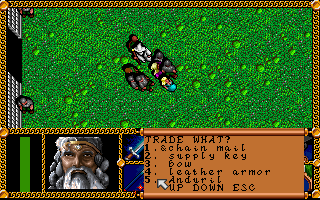
In case you couldn’t already tell, I’ve been on a huge video game kick lately, which is amping up with Civilization Beyond Earth. Civ has been one of my favorite series ever since the beginning; in fact, it’s by far the longest-running franchise that I follow. It’s been a series of ups and downs with me; I loved I, II, and IV; enjoyed Colonization; liked the concept of Alpha Centauri while not finding it very fun; and haven’t particularly enjoyed III or V. That’s still a pretty excellent overall record, though, and in the absence of any particularly frightening information I tend to look forward to a new Civ game with a lot of anticipation.
Beyond Earth has been acquiring much more attention than usual. Alpha Centauri wasn’t a particularly successful game, but it had some of the most incredibly devoted, die-hard fans anywhere, and there’s been intense lobbying for well over a decade to make a sequel. The path for this was always going to be difficult; Alpha Centauri was made during the MicroProse years, and unlike the Civilization rights, Sid Meier didn’t get to reclaim Alpha Centauri when he left to found Firaxis. Still, the general idea of “civ in space!” is a very compelling one, and it isn’t at all surprising that they would return to this in one form or another.
Beyond Earth ends up being a really unique game. It isn’t a retread of Alpha Centauri, nor is it a reskin of Civ V. While it’s obviously built on the Civ V engine, it massively overhauls all of its systems, creating a game that is approachable but ends up feeling quite different.
One thing it shares in common with AC is a surprisingly strong narrative for a turn-based strategy game. Neither game obviously starts off telling a story, but as the game continues you’ll encounter more and more events that provide narrative hooks, linking in your strategic struggles to a deeper, more thematic plot. Of course, the biggest story is the one you create for yourself, the story of your triumphs and struggles and the rivals you face and vanquish in your drive towards victory.
The game starts on a really strong note, with a surprisingly effective opening movie that establishes the background fiction for the game. Due to the Big Mistakes on Earth, humanity is desperate to escape the ruined planet and start anew elsewhere. This could be communicated via apocalyptic mushroom clouds or mass riots or other standard signifiers; instead, the movie goes small, zeroing in on a father and his daughter. There’s no dialogue, but their expressions of dismay and hope convey everything we need to know.
I really liked this, for a couple of reasons. First of all, it really grounds the action in a great way, reminding us that this is ultimately a story about people: we are responsible for the survival of humanity, not in an abstract sense but in the specific sense of needing to keep this individual people alive. Ultimately, though, that opening sequence will resonate extremely differently depending on which affinity you pursue throughout the game. In my game, I’ve been pursuing Harmony, where we shed off our corrupt, weak Earth selves and unite with the benevolent alien life we have encountered. In this context, the opening shows the folly of our old way of life, and how lucky we are to have chosen a more peaceful path.
In contrast, a player who pursues Purity will read that opening scene as the moment when humanity was knocked down, and the rest of the game as humanity getting back off, dusting itself off, and diving back into the ring. Here, you are telling a tale of triumph, where we hold on to our essence even when orbiting a distant star, and can admire our strength and resilience even in the most desperate of circumstances.
Finally, a Supremacy player would probably be startled to realize that, by the end of the game, they’re no longer the same people as they were at the beginning. That father and that daughter are no longer part of the same species. A supremacy player on the cusp of victory might re-watch that clip and feel much the same way we would when watching tadpoles: interesting in an academic sense, but not something we can truly relate to.
There’s a ton of reviews out there that summarize the new features in CBE, so instead I’ll just babble for a bit about my first game.
In contrast with earlier Civ games, which just had you select a civilization and, possibly, a leader, you have a whole bunch of options to pick from at the start of CBE. In fact, this will prove to be a major theme throughout the entire game: surprisingly frequent and significant choices. These are rarely narratively satisfying, but can have huge impacts on the mechanics of your play, as you can adapt common elements available to every player to have vastly different effects.
Anyways: your opening choices have to do with things like the expedition sponsor, the colonists you select, the materials you take, etc. All of these are independent of one another, giving you a lot of freedom in fine-tuning your desired stats and gameplay. As with earlier Civs, human players will have the best success if they plot a strategy early in the game and doggedly pursue it. So, here, you can usually set yourself up pretty well at the start of the game; after making planetfall, you can explore your immediate surroundings, locate your neighbors, and make some final decisions about what kind of game you want to play. In my case, I opted for the Pan-Asian Cooperative, whose bonuses to wonder construction and worker speed are really helpful for builder civs; I took along aristocrats, who provide bonus energy and health; a fusion reactor, for a starting bonus of 100 energy (= money); and machinery, which gave me a free worker at planetfall. I’m very happy with how all of these turned out; I’m sure other combinations are fine, but I didn’t have any problems at all with this one.
Ever since Civ III, I’ve been drawn to builder civs, so I had decided from the beginning to try and pursue as pacifist a path as possible. This would also have the effect of allowing me to simplify my game somewhat and focus on mastering a subset of the mechanics in this game; I ended up paying minimal attention to combat, and almost entirely ignoring the orbital layer, while investing heavily in infrastructure, virtues, trade, and espionage.
Similarly, I decided early on to try and pursue Harmony, reasoning that this would allow me to remain on friendly terms with the aliens and minimize my warmongering. That turned out to be not entirely true. Your choice of affinity is pretty orthoganal to your position on the hostile/pacifist scale. Furthermore, most of the later techs that grant Harmony points are pure-military techs for creating new bug units, which put me in the weird position of choosing between violent harmonic tech and peaceful unharmonious tech.
One interesting change in CBE is the staggered start. Usually, every civ starts in the year 4000 BC and starts expanding immediately. In CBE, your craft is the first to land, and you’ll have some time to start exploring and establishing yourself. Every decade or so, another pod will come down, and its leader will immediately introduce themselves. Even if you haven’t explored much of the world yet, you’ll see where their capitals lie, and so can start getting a feel for which rivals you’ll need to pay attention to, where you might want to establish chokepoints, and where expansion will be easiest. (I’m pretty sure that the late arrivals arrive with a few more resources than the early birds, since everyone ended up at pretty comparable power levels early on.)
I lucked out, starting off on the eastern shore of a long and fairly narrow continent. I eventually ended up with Polystralia a decent distance to my west, in the center of the continent, while the Kavithan Protectorate were wedged in the far west. All of the other civs shared a large and pretty chaotic continent on the other side of a wide ocean. My capital wasn’t very resource-rich, but I was able to claim some really good strategic resources and upgraded tiles for my later planned cities. Most of them were coastal, although I did place one inland to maximize available sources of titanium.
Trade is really fantastic in this game. It’s kind of a hybrid between the active and the passive trade systems that have been alternately deployed in earlier versions of Civ. You build specific trade units, and must choose their destination; you aren’t responsible for actively moving them around, but you’ll see them on the map, and you’ll need to protect the units if you want to keep your trade routes productive. It ends up feeling a bit like a public/private sector divide, which is a cool concept. As the public sector, you’re responsible for the details of deploying your army and directing the overall trade policy; the private sector kind of runs its own show, you can’t micromanage them, but will need to look after their needs if you want to reap the benefits of their productivity.
You can establish a trade route to any other city or station (city-state) that you can reach; they don’t need to be connected by roads, but need to be free of hostile forces and miasma. Trade is VERY lucrative, and as with everything else in CBE, you have two choices in how to handle it. Trade routes established between your own cities will produce more food and resources for both of them, letting your cities grow more quickly and build infrastructure. Trade routes with foreign cities will generate science and culture, which will boost your civilization’s overall advancement. Trade with stations will provide a wide variety of benefits. Furthermore, foreign civs are usually happy when you establish a trade route with them, since they gain some benefit from it too. Presumably, this should help strengthen diplomatic ties with them. (It is reflected in the relationship advisor screen, but doesn’t seem to be very effective in preventing a betrayal.)
Managing aliens, though, can be tricky, particularly in the context of trade. Aliens are somewhat analogous to barbarians in Civ or mindworms in AC, but also sort of act like their own independent faction, with slightly different rules; now that I think about it, a better analogy might be the native tribes of Colonization. Aliens are initially curious about your presence. They might just move around passively, or might try to attack you. If you are attacked, and you strike back, they seem to learn their lesson and will keep their distance. Now, if you continue to harass them, and particularly if you threaten their nests, they will turn hostile and will begin to swarm you like barbarians. But if you leave them alone, they will generally leave you alone as well, making it safe for your workers to head out and do their work.
The exception, though, is trade convoys. For whatever reason, aliens seem to believe that these convoys are absolutely delicious, and will munch on them any chance they get. I tried escorting them for a while, but even so they would end up getting destroyed. The trick to solve this is nonintuitive: you need to build an ultrasonic fence. According to the description, this will prevent any aliens from approaching within 2 tiles of your cities. However, as with all of the other buildings in CBE, some time after constructing your first ultrasonic fence, you will get a one-time quest event prompting you to choose an upgrade. One expands the range of the fence; the much more useful one is to make all of your trade units immune to alien attacks. After picking this upgrade, I quickly maxed out all of the available trade slots in all of my cities, and reaped massive economic and cultural benefits.
Sadly, my attempt at a completely passive game proved overly optimistic, as those dastardly Polystralians betrayed me and launched an invasion, despite previously being quite Friendly to me. I had virtually no military to speak of, so I desperately rushed some Soldiers in the city nearest the border, started rushing my two other Soldiers from their spots near the Capital to the frontier, and began purchasing some missile rovers and a tactical jet. Fortunately, even at this early stage in the game I had a very healthy bank account; if I remember correctly, the war struck during a lull when I had built all of the buildings available to my tech level in most of my cities, so I’d just been letting cash accumulate.
Having barely played Civ V, and only limited wars in there, I was a bit nervous about how I would do in this conflict. From what I can tell, the rules of war are very similar across both games. Units have hitpoints, and it usually takes multiple rounds of combat for any unit to be eliminated. Your city also has hitpoints, and also strength; it can bombard nearby units, and must be attacked over multiple rounds to be defeated. Hostile units establish zones-of-control around them, and you can’t move more than one tile around a hostile unit after entering its proximity.
The war was a desperate match, but I had a few advantages. Despite Hutama and me I both pursuing Harmony, only I had already acquired the tech that rendered all my units immune to miasma; so his units regularly dropped in health for every turn they stayed near my city. I also had that enormous bank account; while my units were one tier behind his, and were scrambling to reach the location of the fighting, I had much more capacity to reinforce myself than he did.
My workers fled from the fighting, crossing paths with my incoming soldiers. Fortunately, a few of his units decided to pursue the workers rather than focus on the city. This allowed me to direct all of my limited firepower on attacking the units threatening my city.
Combat in Civ V (and Beyond Earth) is rather famously rock-paper-scissors in its design. Artillery is highly effective against infantry, since they can launch ranged attacks that do a lot of damage at no immediate risk to themselves. Artillery is vulnerable to combat rovers, which can quickly chase down the distant units and force them into crippling melee battles. And rovers are threatened by infantry, who have straight-up better stats.
So, even though I’m not exactly a combat expert, I was able to figure out an effective way to use my limited forces against Hutama’s assault. My city bombardment focused on the nearest units. Missile rovers drove into range, then launched ranged assaults on melee units. By this point, after their strength had already been weakened, I would unleash my tactical jet or a soldier to finish them off. When they set up their own missile rovers to start barraging my city, I treated it as a secondary threat - ranged attacks can’t capture a city alone; after the immediate vicinity was clear of other forces, I could send a combat rover after it and rush it. In the meantime, my workers led Hutama’s straying units deep into my territory; after we had secured our city, though, my newly-promoted force was able to easily crush them.
And so, after some frenzied fighting, I had wiped all of those dastardly yellow units from sight. I now had a choice to make. Would I seek to end the war, and return my attention to my builder strategy? Or should I try and make Hutama pay for his treachery, and go after one of his own cities?
It was a tempting thought, but I ultimately elected to opt for peace. While I was happy with how the battle had gone, I knew it would be much more challenging once I started going after his core, especially since I’d not only neglected my military units, but also my military techs. Based on previous experience in Civ, I expected that I would be able to get favorable treaty terms after the solid thrashing I had delivered (crushing all six of his invading units while losing none of my own).
I opened up negotiations with a humiliating demand: all of his energy, plus additional reparations each turn. No dice. I began dialing it back, gradually lowering my demands to find the highest he could bear. He stood strong. Annoyed, I offered a straight-up peace. He refused. Out of curiosity, I asked what he wanted for peace. He demanded the city we had been fighting over, plus tons of resources and energy! Pfah!
Stunned, I sent him away. Why on earth would he be making such outlandish demands? It was almost as if he was utterly confident in his ability to defeat me militarily. But that was absurd; if he had greater strength, he surely would have led with it, rather than send a weak expeditionary force.
Still, even if we technically remained at war, the immediate threat was past. My recently-marshaled army was ready to beat back any future incursions, and in any case he had only a narrow passable corridor from his territory to my own; now that I could keep an eye on things, he wouldn’t be able to sneak up on me again. Instead, I turned my attention to a more active threat: rampaging aliens!
Like I’d said, after some early misunderstandings I’d worked things out with the bugs. However, this detante did not extend to siege worms. Two of them, highly agitated, had appeared in my territory right as my war with Polystralia began. I’m still not sure if this was coincidental or not; given Hutama’s love of affinity, I suspected he might have influenced this threat to my rear. I’d ignored the worms during the main war, but in the meantime they had pillaged my vital road connection, damaging the connection between my capital and cities and harming my economy.
Unfortunately, taking down the worms was no simple task. Siege worms have a ridiculous 60 Strength, against my marines’ pitiful 14. A single worm, let alone two, would have no trouble crushing my entire army.
So, what’s the secret to defeating a Dune-sized sandworm? Two simple things: ranged units and flagrant abuse of hypersonic fences! A hypersonic fence keeps any alien, no matter how strong, from approaching within 2 tiles of your city. As I learned, this also means that it can’t attack into that 2-tile range. Therefore, all I needed to do was line up my missile rovers at that 2-tile border, and fire away! It took many turns, and I would occasionally need to chase it and then fall back in retreat, but eventually the mighty worm fell. This felt nicely epic, on par with defeating Acheron the Red Dragon in Fall From Heaven 2, and comes with a comparable bundle of rewards: an immediate boost of energy and science, completion of a long-standing quest, a sigh of relief as my workers were able to move back in and repair the damage, and an intense feeling of pride in what we weak, fleshy humans were able to accomplish. (Though, as a Harmony player, it would have been more appropriate for me to feel envious of the mighty worm’s immense power, and provided a further strengthening of my resolve to become one with these awesome beings.)
Around this time, Hutama came back to me, asking for peace. I repeated my punishing terms, and this time around he accepted. I was a bit surprised, since we’d had exactly zero interactions since our previous negotiations, and as far as I could tell nothing significant had changed. It does make me wonder if the AI only re-calculates its relative power at certain intervals, or if perhaps it keeps a rolling window of power metrics that only gradually updates. Regardless, I was pleased to bury the hatchet. Despite his shocking betrayal, Hutama and I shared many good reasons to cooperate (including our mutual affinity and numerous trade routes), so I felt optimistic that he had learned his lesson and would leave me in peace, much as the aliens had learned their own lesson early on.
That optimism proved, well, overly optimistic. He betrayed me again almost a century later, again with little warning and no provocation. I resolved to wipe him off the face of the Earth… well, off the face of whatever this planet’s name was. Once again, I tapped my ridiculously large energy stockpiles: “Buy me an army!”, I bellowed. And so they came, and I fought, and it was good.
There’s so much that I love about the affinity system, and one major positive aspect is how well integrated it is with the mechanics of the game. When it comes to combat, your affinity choices will have subtle but profound impacts on the style and look of war. For example, as a Harmony player, many of my units had a unique ability where they gain 40% additional strength when not adjacent to a friendly unit. This encourages a very different style of combat: Harmony players are strongest when scattered, whether because a lone unit is fighting on after its comrades have died, or because they are swarming you from all directions. This has a very different visual look from the sleek, unified front lines you would see when facing a Purity or Supremacy player.
That does cause some potential problems: in the most typical combat configuration, you would want your shock-troop soldiers in the front line, and ranged missile rovers or rangers in the rear line backing them up; but you’re effectively cutting your potential strength (both offense and defense) by 40% in this configuration, so you need to choose between a disciplined formation that negates the upgrade, or a more powerful loose configuration that puts your ranged units at greater risk.
Fortunately, by the time of the Second Polystralian War, I had upgraded to the top-level Harmony artillery units, Minotaurs, which have an incredible range of 3 tiles. So, my Marauders could still form a good front line, and get support from the rear, and each fight at maximum effectiveness. Furthermore, many top-level units like the Minotaurs have thrusters that cause them to hover over the ground; as a result, they could move through hilly terrain very quickly, and even float over canyons, which until now had been completely inaccessible.
Hutama’s forces fell quickly in the beginning; once again, he didn’t seem to have the boots on the ground to back up his violent aims. As before, I initially focused on beating back his assault, and then on eliminating his units; now, though, I followed up by moving into his territory. This war was mostly fought along the eastern border of his realm, in contrast to the First Polystralian War, when he had sent troops north and attacked the middle-west of my country.
Many of Hutama’s cities had been abandoned militarily, and put up little resistance. I decided to burn all of his cities: I was reluctant to take the Health hit for absorbing them into my nation, and didn’t see much benefit in installing a puppet government. Unlike previous Civ games, burning a city isn’t instant: instead it lowers the population by one person per turn until the city is destroyed. If this had been our first war, I would have held on to them and then given them back in a peace deal; however, since he had already proven himself untrustworthy, I had no plans to ever offer peace.
The war got a bit tougher once he was down to his last few cities; I think that he got a few extra Harmony points after the war started, which allowed him to upgrade some already-veteran units to match my top-level builds. He was actually really clever in using his fast units to chase down my vulnerable Minotaurs, and the war ended up being surprisingly close, with him tenaciously holding on to his final city while I had to split my forces between defending not-yet-wholly-burned cities and pressing the assault on his very powerful final stronghold.
Along the way, though, I had yet another AI annoyance. In an earlier war, Hutama had captured the capital and several other cities from Kavitha Thakur of the Kavithan Protectorate. Rather than burn these, I opted to return them to the Kavithans; they were so weak that they didn’t pose a threat, and I figured some goodwill would be appreciated. She thanked me profusely, and I got a nice diplomatic benefit. On my VERY NEXT TURN, she appeared before me, irate, demanding that I remove my troops from her territory. Um… you mean, those units that just freed your city? The ones who are the reason you’re here at all? I chose the second option, truthfully saying “We’re just passing through” - which was true, they were all on the way to Hutama’s final city, which happened to be another of Kavitha’s captured cities, and another one I was planning to liberate.
The next turn, she showed back up, irate, canceling our open borders agreement, censuring me before the world, and turning hostile towards me. I was speechless! There’s a lot of buggy diplomatic AI in this game, but this was by far the most egregious: someone who should have been my friend, irrationally lashing out at me, destroying our relationship AND her own self-interest.
Because her border was closed, I now needed to go the long way around a mountain range to finally reach Hutama’s last city. I almost burned it out of spite, but at the last minute decided to give it back to Kavitha after all. She seemed to appreciate it, but not enough to be friends again. Grumble, grumble.
The AI in general got pretty frustrating around this point. A lot of people were denouncing me for being a warmonger. Which is, you know, just patently untrue. I’d never initiated any wars. I’d never provoked any wars. Granted, I was burning all of Hutama’s cities to the ground; but if that’s what they were upset about, then they should have complained about that, not lying about me being the aggressor in the conflict.
While I enjoyed Beyond Earth, the farther I got into the game the less polished it seemed. Beyond the janky diplomatic AI, I had a shockingly hard time figuring out how to get the Transcendence victory. From the Civilopedia, I knew that I would need to build a Mind Flower; but the Civilopedia didn’t list what techs I needed to research in order to build it. I spend an inordinately long time trawling through the Tech Web, and searching the Civilopedia directly, and just could not find out what I needed. I ended up needing to Google it and hunt through several forum posts before finally finding the answer. Frankly, it felt ridiculous. I don’t think over Affinity victories are this messed up, but it felt like a really gaping oversight.
For the Transcendence victory, after you build research the requisite techs, you build the Mind Flower, a big Project that consumes a tile in your territory. You then need to defend it, as all alien life on the planet turns hostile towards you. I thought that was a really interesting wrinkle: thematically, most Harmony players are probably likely to try to live in, well, harmony with the native life, and so may not have invested in the anti-alien technologies that other players will have. Still, it was really easy. Even though they turn hostile, the hypersonic fence is still effective at repelling them, so they never came close to threatening my borders. I did appreciate that my human opponents didn’t gang up on me: in previous Civs, it’s very common for the entire world to declare war on you if, say, you start launching your spaceship to Alpha Centauri. The other players were more hostile to me at the end, but I couldn’t really tell if this was due to me approaching victory, or more bold in my covert ops against them, or their miscomprehension of me as a bloodthirsty warmonger. Regardless, I was happy that the game didn’t force me to fight a big war at the end of what had been a fairly pacifistic path to victory.
As with Civ V, winning a game is incredibly anti-climactic: you see a still image, and a few sentences of text, and that’s it. I shouldn’t have been surprised, but after that excellent intro video, I’d foolishly allowed myself to hope that they would show something of similar quality (if shorter length) as a reward for the long time it takes to win the game. I continue to feel befuddled at just why they have relapsed so far from the triumphant, uplifting victory sequences of Civilizations I, II, Alpha Centauri, III and IV. They’ve even gotten rid of the most basic classic aspects of victory, like replaying the game in strategic view; there’s still a graph view at the end, but it’s deeply buried within the main menu. I dunno. I wonder if it’s a purely financial decision, or a stylistic one, or what, but out of all the things I miss from Civ IV (a very long list!) this is near the top.
Here’s a rundown of my opinions after my first full game!
THE AWESOME
Affinities! The whole affinity thing is really colorful and flavorful, and nicely unites purpose, mechanics, and visual design in a really attractive (but compact and comprehensible) whole.
Choices, choices everywhere! It’s actually kind of ridiculous: every time you build a new building, or reach a new affinity level, or do one of the dozens of quests, you’ll get a popup asking you to make a decision on something. This will have lasting effects on your game, typically changing the outputs of a building or a tile upgrade or certain unit types in your military. Because every choice is independent with every other one, there’s a ridiculous combination of different outcomes, many of which will be perfectly viable depending on your situation.
THE GOOD
Lore! It’s easy to just click past this, but any time I pause and actually read the quotes and descriptions on the Civilopedia, I’m really impressed. I feel a bit like how I imagine a Renaissance genius would feel listening to a podcast from the 21st century: it’s comprehensible, while still being fantastical enough that my mind has trouble absorbing it.
Music! It’s maybe slightly less iconic than the awesome tunes in Civ IV, but still one of the best soundtracks of any Civ.
The tech web! It’s radically different from earlier Civ games, and yet works really well. Tech choices now feel even more significant than before: in previous Civs, you were really only worried about the order in which you would discover things; now, you’ll definitely finish the game without ever getting a whole bunch of techs. But, because the web is shallower, it’s simultaneously easier to pivot if you realize mid-game that you need to pick up an unexpected tech.
Searchable civilopedia and tech web! Especially in my first game, when I didn’t always know what type of thing I was looking for, it was really handy to be able to just type stuff in.
Leader personalities! It’s fun to see the Affinities eventually mark their followers. I also liked the way that, for example, a leader would occasionally mention that they were happy that we were in a mutual group of friends.
Espionage! For a non-combat person like me, it’s a great way to exercise soft power and feel engaged with the world without building enormous armies. I was stunned and delighted to see that it was possible to incite an insurgency in a foreign capital and take possession of it! The victim didn’t even declare war on me! (I gave it back because I felt bad, but, man, that’s really cool; it means a conquest victory wouldn’t rely on arms alone.)
Unit evolution! This is another drastic change from Civ: instead of specific techs unlocking specific new units, and you needing to upgrade old units to new, earning enough affinity points will give a free upgrade of your choice to all existing instances of a given unit. So, there’s never the problem of updating your field military. It makes more sense than ever before to invest in early military units, since later ones will grow more expensive.
Aliens! I liked their general “we’ll leave you alone as long as you don’t spook us” attitude. It’ll be interesting to play as a more aggressive player later and see how that changes things; I imagine it’ll lead to more of an arms race, as your own units will become veterans more quickly but you’ll face increasingly hostile waves of bugs.
Based on my limited battle experience, the enemy combat AI seems pretty smart. Perhaps bad at the strategic level of making decisions about when to go to war, but effective at managing its assets in a fight.
Trade routes! They’re very lucrative, arguably too much so; I wouldn’t be surprised if they get nerfed in a future update. I like how they also lead to diplomatic bonuses, which often incentivizes me to pass over a more-rewarding route for one that offers me a more strategic relationship. There are good choices to make between internal and external routes, and in general I like the level of activity involved in setting up routes (which reminds me a little of the soft-touch hands-on involvement with spreading religion in Civ IV): you make some initial decisions around setting up your trade routes, but don’t really need to micromanage them.
THE NEUTRAL
Wonders seem less powerful than in previous Civ games; they’re still fairly expensive, but there are a lot of end-game Wonders that cost over a thousand Production and only grant, say, +4 Culture and no other benefits.
Cash is king. I’m used to running at a minimum bank balance, or hoarding my reserves for emergencies, but in the Energy economy it’s trivial to stockpile an enormous reserve, which you can and should expend. I generally tried to maintain reserves of around 10k Energy (which has good synergy with a Prosperity Virtue), and spend the surplus on buildings. But it’s also very useful for rushing an army if you’re attacked, or acquiring tiles if you suspect a rival of making a land-grab.
In general, I really like the idea of “favors”. It always bothered me in previous Civs when a rival would demand me to give them something for free, and then get upset when I told them “no”. Psychologically, I’m much more willing to acquiesce if I’m getting anything back, even something as insubstantial as “favors”. That said, favors are very insubstantial indeed. I had initially thought that these would be general diplomatic modifiers, and that by collecting enough favors I would be able to maintain friendships for longer. Instead, though, they’re just another resource to trade, and apparently not a very valuable one anyways. I’ll probably be much less likely to accept favors in any future games.
THE SUB-OPTIMAL
The Civilopedia (or whatever they’re calling it) is frustratingly incomplete. I ended up winning my game many decades later than I could have, just because the Mind Flower page didn’t list the prerequisite techs. There are very few internal links between pages, and very few deep links into the Civilopedia. Man, I really miss the glory days of Civ IV when you could right-click on pretty much anything in the game and be taken to the relevant page. I do like the search function, but in all honesty, probably 90% of the time I was typing, it was because I’d seen some text that wasn’t clickable that I needed to check out.
Along similar lines, while I love unit evolution, it’s seemingly impossible to find the actual stats on any given unit. Even for my own units, I would occasionally get confused (especially after several evolutions) about their powers and abilities.
Limited info. This is the downside of that “choice” thing I’m so excited about: without already being familiar with the game, or looking to an online reference (none of which are complete yet), it’s impossible to know what the actual effect of any given building will be after you build it. Many that initially seemed kind of pointless, like the Command Post, ended up seeming critical after I got the upgrade, making me regret not building them centuries earlier. (This is probably a complaint that will go away after I play a few more games, though, and honestly I’m not sure if I’d even want this info to join the Civilopedia; it would ruin the pleasure of surprise, even if it would improve overall strategy.)
THE BAD
As noted above, the ending feels incredibly hollow and disappointing. Especially when the gameplay has been so polished and the setting so flavorful, the bare-bones victory screen feels borderline insulting.
The diplomatic AI seems pretty buggy, unwilling to accept peace in one turn only to reverse itself for seemingly no reason shortly after, making bizarre demands, etc.
The late game tech web is a mess. There are advances that cost the maximum amount of science to research, that only enable a single world wonder, which only gives (e.g.) +4 Culture and no other bonuses.
There are a bunch of interface things that seem like weird oversights (and which I’m pretty confident will get patched soon). There’s currently no way to tell what building or unit a city has just finished building. There’s no sorting of trade routes, which gets particularly frustrating for coastal cities late in the game which can easily have 30+ available routes. There’s a “Previous route” choice, but it isn’t highlighted in any way and isn’t sorted anywhere in the list, so it takes just as much effort to hunt for this as it does to find the top-yielding route.
AND, THAT’S THAT!
I took a few screenshots while playing this game, which I have captioned and uploaded into the now-requisite album. There are a lot fewer for a strategy game like this than there are for my RPG albums! Still, if you want to check them out, that's where they are!
So, yeah… while the ending was a bummer, on the whole I really enjoyed Beyond Earth. It’s very evocative of Alpha Centauri while still confident enough to do its own thing. Some aspects of the game, like affinities, are really inspired. Things like the complete re-think of military unit progressions seemed like major changes to conventions that have been around in Civ for more than two decades, but ended up being wonderful innovations that solve problems I hadn’t realized the old games had.
As my brother aptly pointed out, it isn’t going to dethrone Civ IV / Fall from Heaven II in our favorite-Civ-like-experience category anytime soon; but for me, it’s at least a significant improvement over Civ V, and something I’m sure I’ll try again in the future. If only they would add that little extra sense of reward at the end of the game, I’d be champing at the bit to dive right back in. As it stands, I’ll probably return to some deferred games for a bit and wait for them to patch this before I take another crack at it.
Wednesday, November 05, 2014
Monday, November 03, 2014
Missy
Here’s something that’s, uh, a little different from my last writeup: Wittgenstein’s Mistress, a fascinating novel by David Markson. Naomi recommended this to me ages ago; as with most recommendations, even if something grabs my interest it takes a long time to make its way through my to-read queue, and by the time I start reading it I’ve forgotten what about it piqued my curiosity.
I’m really fascinated by voice in novels, and WM has one that’s utterly unique to my experience. The novel contains no chapter or section breaks, just an endless series of paragraphs, each only one or two sentences long. It’s told in the first person, and you gradually come to realize that it’s being written on a typewriter by a single woman, possibly in her fifties. She didn’t set out to write her memoirs or unburden her psyche: she appears to be somewhat bored and somewhat antsy, and is using this project as a sort of journal, capturing her flitting thoughts in real-time over minutes, days, weeks.
There’s a lot that I love about this book, but the single best part may be the way the narrator is constantly editing herself, correcting earlier statements that she worries may have given the wrong impression. Many, many, many paragraphs start with “Actually,” “Well,” “Then again”, or other qualifiers. She’ll often recall an event from her past, then several pages later realize that she got some detail wrong, then speculate that she might be conflating two separate events, and eventually call into doubt whether any of it matters anyways. But, again, it isn’t as if she’s desperate to correct the record or anything. Rather, the book is perfectly capturing the sort of inner monologue that we (or, at least, I) have in our heads when we’re idling, letting our minds wander and chew on themselves as we reflect on the past, a kind of mental chattering that keeps us busy without actually doing much but evoke a sense of nostalgia.
MINI SPOILERS
Here's a fairly representative passage from the novel:
As it is also a fact that in the painting by Rogier van der Weyden they are taking Jesus down from the cross at Calvary, but they are also taking him down on the top floor of the Prado, in Madrid.
Right next to the windows I washed.
I see no way of refuting either of those statements. Even if, as I indicated, there appeared to be something wrong with the first of them when I typed it before.
This is not something I intend to worry about, although I can fully understand how one might worry.
Well, perhaps I have already said that I actually do worry.
Although I have just now eaten a salad.
While I was eating the salad I thought about Van Gogh being mad again.
Lord above.
Van Gogh was not mad for a second time. It was I who was thinking about him once more.
And in any case it was Van Gogh trying to eat his pigments that I was more exactly once more thinking about.
There really isn’t much of a filter on Kate’s thoughts, and she treats every subject with equal importance, whether it’s the unusual sight of a driverless car rolling past her, or a recurring memory dropping hundreds of tennis balls down the Spanish Steps, or her dead son, or mowing the lawn. In fact, she’ll often seem to dwell on the more trivial things, endlessly refining her statements on which composers’ biographies she may or may not have read, while only obliquely referring to what seem to be far more interesting questions.
The biggest of these is what, exactly, is going on with Planet Earth. Among the cacophony of apparent red herrings Kate drops a bombshell: she is the last human being left on Earth. And, that’s all we know. This information arrives early, and I spent the rest of the book expecting her to return to this subject, but we never really get any more details: whether there was a war, or a plague, or the Rapture, or a mass colonization. The physical infrastructure of the world seems to be intact, since Kate has spent years traveling between and living in the world’s greatest cities. And other organic life seems to still be around, as Kate reports seeing a cat. What should be the central idea of the story becomes a discarded thought, neglected on the vine.
Of course, there are other possibilities. Kate is very straightforward about the fact that she’s crazy, which has the potential for explaining some things while opening up many more questions. The timing and nature of her madness are never explained, so multiple scenarios are equally plausible. She could just be making this whole thing up, rambling to herself from an isolated home, projecting her alienation after her sons’ death onto the whole world. Or maybe she really has been all alone on Earth for years, in which case we would absolutely expect her mental health to suffer. Which is cause, and which is effect: the madness or the isolation?
Since the sanity question is raised so early, it’s natural to read the book with extreme skepticism. Different people will probably raise their eyebrows at different points; personally, I was most put off by the tales of Kate’s travels. In a world with no other people, how could one middle-aged woman possibly have circumnavigated the planet? She describes driving through Siberia, failing to see Moscow, living in Rome and London, finding a boat that she sailed across the Atlantic, and so on. Not that any of this is impossible, of course, but it certainly strains credulity. And it isn’t necessarily an all-or-nothing proposition, either. Maybe she really is the last woman on Earth, and has gone crazy as a result, and because of this her memories have become jumbled, conflating trips she took at an earlier time with her recent haunting experiences.
END SPOILERS
Wittgenstein's Mistress feels experimental and unique - my copy included an afterword written by David Foster Wallace, which should tell you a lot about the intellectual company it keeps - but it seems very approachable. I've hesitated using the term "stream of consciousness" in describing the book: even though that's probably the most accurate description of the style, it doesn't match the knottiness that most people associate with that phrase. Honestly, the voice I hear in "Wittgenstein's Mistress" sounds a lot like my own voice when I'm writing a blog post: lots of random thoughts occurring to me, I write them down, following up on promising ones, amending ones that seem incorrect or incomplete. If I faithfully typed every thought as it occurred to me, and never deleted any of them, it would come out a lot like the text in this book. That's pretty interesting!
I’m really fascinated by voice in novels, and WM has one that’s utterly unique to my experience. The novel contains no chapter or section breaks, just an endless series of paragraphs, each only one or two sentences long. It’s told in the first person, and you gradually come to realize that it’s being written on a typewriter by a single woman, possibly in her fifties. She didn’t set out to write her memoirs or unburden her psyche: she appears to be somewhat bored and somewhat antsy, and is using this project as a sort of journal, capturing her flitting thoughts in real-time over minutes, days, weeks.
There’s a lot that I love about this book, but the single best part may be the way the narrator is constantly editing herself, correcting earlier statements that she worries may have given the wrong impression. Many, many, many paragraphs start with “Actually,” “Well,” “Then again”, or other qualifiers. She’ll often recall an event from her past, then several pages later realize that she got some detail wrong, then speculate that she might be conflating two separate events, and eventually call into doubt whether any of it matters anyways. But, again, it isn’t as if she’s desperate to correct the record or anything. Rather, the book is perfectly capturing the sort of inner monologue that we (or, at least, I) have in our heads when we’re idling, letting our minds wander and chew on themselves as we reflect on the past, a kind of mental chattering that keeps us busy without actually doing much but evoke a sense of nostalgia.
MINI SPOILERS
Here's a fairly representative passage from the novel:
As it is also a fact that in the painting by Rogier van der Weyden they are taking Jesus down from the cross at Calvary, but they are also taking him down on the top floor of the Prado, in Madrid.
Right next to the windows I washed.
I see no way of refuting either of those statements. Even if, as I indicated, there appeared to be something wrong with the first of them when I typed it before.
This is not something I intend to worry about, although I can fully understand how one might worry.
Well, perhaps I have already said that I actually do worry.
Although I have just now eaten a salad.
While I was eating the salad I thought about Van Gogh being mad again.
Lord above.
Van Gogh was not mad for a second time. It was I who was thinking about him once more.
And in any case it was Van Gogh trying to eat his pigments that I was more exactly once more thinking about.
There really isn’t much of a filter on Kate’s thoughts, and she treats every subject with equal importance, whether it’s the unusual sight of a driverless car rolling past her, or a recurring memory dropping hundreds of tennis balls down the Spanish Steps, or her dead son, or mowing the lawn. In fact, she’ll often seem to dwell on the more trivial things, endlessly refining her statements on which composers’ biographies she may or may not have read, while only obliquely referring to what seem to be far more interesting questions.
The biggest of these is what, exactly, is going on with Planet Earth. Among the cacophony of apparent red herrings Kate drops a bombshell: she is the last human being left on Earth. And, that’s all we know. This information arrives early, and I spent the rest of the book expecting her to return to this subject, but we never really get any more details: whether there was a war, or a plague, or the Rapture, or a mass colonization. The physical infrastructure of the world seems to be intact, since Kate has spent years traveling between and living in the world’s greatest cities. And other organic life seems to still be around, as Kate reports seeing a cat. What should be the central idea of the story becomes a discarded thought, neglected on the vine.
Of course, there are other possibilities. Kate is very straightforward about the fact that she’s crazy, which has the potential for explaining some things while opening up many more questions. The timing and nature of her madness are never explained, so multiple scenarios are equally plausible. She could just be making this whole thing up, rambling to herself from an isolated home, projecting her alienation after her sons’ death onto the whole world. Or maybe she really has been all alone on Earth for years, in which case we would absolutely expect her mental health to suffer. Which is cause, and which is effect: the madness or the isolation?
Since the sanity question is raised so early, it’s natural to read the book with extreme skepticism. Different people will probably raise their eyebrows at different points; personally, I was most put off by the tales of Kate’s travels. In a world with no other people, how could one middle-aged woman possibly have circumnavigated the planet? She describes driving through Siberia, failing to see Moscow, living in Rome and London, finding a boat that she sailed across the Atlantic, and so on. Not that any of this is impossible, of course, but it certainly strains credulity. And it isn’t necessarily an all-or-nothing proposition, either. Maybe she really is the last woman on Earth, and has gone crazy as a result, and because of this her memories have become jumbled, conflating trips she took at an earlier time with her recent haunting experiences.
END SPOILERS
Wittgenstein's Mistress feels experimental and unique - my copy included an afterword written by David Foster Wallace, which should tell you a lot about the intellectual company it keeps - but it seems very approachable. I've hesitated using the term "stream of consciousness" in describing the book: even though that's probably the most accurate description of the style, it doesn't match the knottiness that most people associate with that phrase. Honestly, the voice I hear in "Wittgenstein's Mistress" sounds a lot like my own voice when I'm writing a blog post: lots of random thoughts occurring to me, I write them down, following up on promising ones, amending ones that seem incorrect or incomplete. If I faithfully typed every thought as it occurred to me, and never deleted any of them, it would come out a lot like the text in this book. That's pretty interesting!
Labels:
books,
david markson,
literature,
reviews
Friday, October 31, 2014
COM Port
Once again, I had the pleasure of meeting one of my literary icons in the flesh. The latest name to strike off my steadily dwindling list of “awesome authors I would like to meet one day” was William Gibson, who came to San Francisco to promote his brand-new book, The Peripheral.
I’ve had a weirdly mediated relationship with Gibson. He is often credited with inventing cyberpunk, and he was a direct influence on some of my most formative creative forces, including Neal Stephenson’s “Snow Crash” and the Shadowrun mythos. I’ve been aware of him for a long time, but it was really only within the last decade that I began reading him directly. I was pleased to see that it still holds up: while reading Neuromancer today seems less like a prophetic glimpse of the future than it did in the 1980s, it’s still a darn fine read, and prone to causing whiplash when you start to realize all the seemingly ordinary things it described that simply did not exist at the time it was written.
His more recent books have drifted closer to our present time, and perhaps a direct result he has gained more acclaim from both the mainstream press and literary critics. The Peripheral seems like a return to form, with him uniting his recent style with his older fascination with the future.
This event was held at The Booksmith, the same independent bookshop that hosted the wonderful David Mitchell last month. Unlike that previous event, which was held in a movie theater, this was in The Booksmith’s own cozy bookstore. I’d been lucky enough to catch an early notice of his appearance, and so had managed to snag a coveted reserved seat by pre-ordering the book. This proved to be even more helpful than I had hoped, as business obligations forced me to race north from Santa Clara in order to arrive at the reading in time, and without the reservation I would have been stuck standing very far back indeed.
Gibson opened with a few brief remarks, then jumped into a reading. He had noticed that this book was “unusually vulnerable to spoilers,” to the extent that he’s been reluctant to retweet positive reviews because of how much they give away. So, he restricted himself to the start of the book, only reading chapters two and four (roughly five pages combined). It’s always really engaging to hear an author read their own words; Gibson doesn’t have a radio voice, but he’s able to place the beats and the intonations so subtly and effectively that they strongly elevate the text. I found myself re-reading these chapters soon after, and got more out of them the second time around.
He also accepted quite a few questions, and his interesting answers are the main reason why I’m writing this up now. In no particular order:
Any time an author (or, I suppose, another creative type) takes audience questions, it’s inevitable that they end up fielding multiple variations on the query “Where do you get your ideas from?” (fortunately at least phrased differently). Gibson is pretty intentionally non-self-reflective about “his process”, and leaves thematic analyses of his works to the critics. He did say, though, that he often feels like, as he goes through life, he accumulates various stray thoughts in the “hopper” of his mind. They stay in there, decomposing over the years, until he’s ready to take them out and try to use them in a novel. By this point, they’ve often changed enough that they may bear little resemblance to what he originally encountered.
Back when he first started writing, he wanted to get a stream of new, strange ideas, and so he would spend hundreds of dollars on magazines. In those pre-Internet days, that was the best way: magazines were (and are) aggregators of different, random thoughts. He’d just absorb them all: gothic Lolita, tons of magazines from Japan, whatever he could get his hands on. Now, of course, rather than spending hundreds of dollars to get a certain amount of strangeness, everyone can get an unlimited amount of strangeness through their web browser. It’s gone from him trying to open a faucet to him having a fire hose.
One person noted the different time spans of his books (Neuromancer set in the future but really about the 1980s, Pattern Recognition and friends are of and about the 2000s, etc.) and inquired about the significance. Gibson mentioned that, while he was very careful to never put information about the year in the book, in his own mind he had thought that Neuromancer took place around the year 2035. But, he said, all science fiction and speculative fiction books are really about the time in which they were written. When you read 19th-century science fiction today, you aren’t learning anything about any sort of possible future: you’re learning about the 19th century. This process happens to all books, including his own.
As for the reason for shifting time periods, he’d felt like his “yardstick of contemporary weirdness” had grown limited. Back when he was first starting to write, he had a strong sense of the strange things happening in society, and could use that to drive his novels. In later years, he felt like he was losing that sense. In some ways, his more recent present-day novels were a chance for him to re-calibrate that sense of contemporary weirdness; and now, armed with a fresh sense of the odd things at the fringes of culture, he’s more confident in writing about the future again.
One person mentioned that he had always thought that Gibson was cautiously optimistic about technology, and asked what he thought about other writers, like Dave Eggers, who seem more deeply pessimistic. Gibson demurred, and clarified that he has always been agnostic about technology. He believes that technology is amoral when it is created; it is only when human beings get their hands on it that it becomes good or evil. I thought that was interesting; it put me in mind of Kurt Vonnegut’s famous commencement speech, in which he implored budding engineers to only pursue positive and not wicked technology.
Another person asked whether Vancouver has had an impact on Gibson’s writing. It hasn’t too directly, only appearing twice across his entire career, once in a short story and again in the climax of Spook Country. He did share a fun anecdote about how, when he was writing the Vancouver scenes, he would clearly visualize visual aspects of Vancouver, then drive out to double-check them, and would flabbergasted at just how severely wrong his ideas had been.
After finishing his questions, he started signing. I appear to have some kind of superpower to always end up near the very tail end of any signing line; fortunately, I always have a brand new book in my arm, so it’s always a pleasant wait. Several other people had brought along some beloved older books for him to sign, but of course I was too dense to bring any of mine. I was really impressed by his stamina: even after signing books for nearly an hour, he was still engaged and pleasant with each person coming through the line, thus reinforcing yet again my belief that authors are some of the nicest people on the planet.
I’m still not much further than chapter four in the book, and honestly I’m backed up enough with other stuff that it will probably be a while before I can focus on it. Still, it’s wonderful to have another great tale to look forward to, and having a brief moment of contact with the man himself makes me all the more excited to dig into it.
I’ve had a weirdly mediated relationship with Gibson. He is often credited with inventing cyberpunk, and he was a direct influence on some of my most formative creative forces, including Neal Stephenson’s “Snow Crash” and the Shadowrun mythos. I’ve been aware of him for a long time, but it was really only within the last decade that I began reading him directly. I was pleased to see that it still holds up: while reading Neuromancer today seems less like a prophetic glimpse of the future than it did in the 1980s, it’s still a darn fine read, and prone to causing whiplash when you start to realize all the seemingly ordinary things it described that simply did not exist at the time it was written.
His more recent books have drifted closer to our present time, and perhaps a direct result he has gained more acclaim from both the mainstream press and literary critics. The Peripheral seems like a return to form, with him uniting his recent style with his older fascination with the future.
This event was held at The Booksmith, the same independent bookshop that hosted the wonderful David Mitchell last month. Unlike that previous event, which was held in a movie theater, this was in The Booksmith’s own cozy bookstore. I’d been lucky enough to catch an early notice of his appearance, and so had managed to snag a coveted reserved seat by pre-ordering the book. This proved to be even more helpful than I had hoped, as business obligations forced me to race north from Santa Clara in order to arrive at the reading in time, and without the reservation I would have been stuck standing very far back indeed.
Gibson opened with a few brief remarks, then jumped into a reading. He had noticed that this book was “unusually vulnerable to spoilers,” to the extent that he’s been reluctant to retweet positive reviews because of how much they give away. So, he restricted himself to the start of the book, only reading chapters two and four (roughly five pages combined). It’s always really engaging to hear an author read their own words; Gibson doesn’t have a radio voice, but he’s able to place the beats and the intonations so subtly and effectively that they strongly elevate the text. I found myself re-reading these chapters soon after, and got more out of them the second time around.
He also accepted quite a few questions, and his interesting answers are the main reason why I’m writing this up now. In no particular order:
Any time an author (or, I suppose, another creative type) takes audience questions, it’s inevitable that they end up fielding multiple variations on the query “Where do you get your ideas from?” (fortunately at least phrased differently). Gibson is pretty intentionally non-self-reflective about “his process”, and leaves thematic analyses of his works to the critics. He did say, though, that he often feels like, as he goes through life, he accumulates various stray thoughts in the “hopper” of his mind. They stay in there, decomposing over the years, until he’s ready to take them out and try to use them in a novel. By this point, they’ve often changed enough that they may bear little resemblance to what he originally encountered.
Back when he first started writing, he wanted to get a stream of new, strange ideas, and so he would spend hundreds of dollars on magazines. In those pre-Internet days, that was the best way: magazines were (and are) aggregators of different, random thoughts. He’d just absorb them all: gothic Lolita, tons of magazines from Japan, whatever he could get his hands on. Now, of course, rather than spending hundreds of dollars to get a certain amount of strangeness, everyone can get an unlimited amount of strangeness through their web browser. It’s gone from him trying to open a faucet to him having a fire hose.
One person noted the different time spans of his books (Neuromancer set in the future but really about the 1980s, Pattern Recognition and friends are of and about the 2000s, etc.) and inquired about the significance. Gibson mentioned that, while he was very careful to never put information about the year in the book, in his own mind he had thought that Neuromancer took place around the year 2035. But, he said, all science fiction and speculative fiction books are really about the time in which they were written. When you read 19th-century science fiction today, you aren’t learning anything about any sort of possible future: you’re learning about the 19th century. This process happens to all books, including his own.
As for the reason for shifting time periods, he’d felt like his “yardstick of contemporary weirdness” had grown limited. Back when he was first starting to write, he had a strong sense of the strange things happening in society, and could use that to drive his novels. In later years, he felt like he was losing that sense. In some ways, his more recent present-day novels were a chance for him to re-calibrate that sense of contemporary weirdness; and now, armed with a fresh sense of the odd things at the fringes of culture, he’s more confident in writing about the future again.
One person mentioned that he had always thought that Gibson was cautiously optimistic about technology, and asked what he thought about other writers, like Dave Eggers, who seem more deeply pessimistic. Gibson demurred, and clarified that he has always been agnostic about technology. He believes that technology is amoral when it is created; it is only when human beings get their hands on it that it becomes good or evil. I thought that was interesting; it put me in mind of Kurt Vonnegut’s famous commencement speech, in which he implored budding engineers to only pursue positive and not wicked technology.
Another person asked whether Vancouver has had an impact on Gibson’s writing. It hasn’t too directly, only appearing twice across his entire career, once in a short story and again in the climax of Spook Country. He did share a fun anecdote about how, when he was writing the Vancouver scenes, he would clearly visualize visual aspects of Vancouver, then drive out to double-check them, and would flabbergasted at just how severely wrong his ideas had been.
After finishing his questions, he started signing. I appear to have some kind of superpower to always end up near the very tail end of any signing line; fortunately, I always have a brand new book in my arm, so it’s always a pleasant wait. Several other people had brought along some beloved older books for him to sign, but of course I was too dense to bring any of mine. I was really impressed by his stamina: even after signing books for nearly an hour, he was still engaged and pleasant with each person coming through the line, thus reinforcing yet again my belief that authors are some of the nicest people on the planet.
I’m still not much further than chapter four in the book, and honestly I’m backed up enough with other stuff that it will probably be a while before I can focus on it. Still, it’s wonderful to have another great tale to look forward to, and having a brief moment of contact with the man himself makes me all the more excited to dig into it.
Wednesday, October 29, 2014
Keep On Keepin' On
Now that the Dragon Age Keep is in open beta, I can do something I've wanted to do for months: talk about Dragon Age Keep! I was lucky enough to be a beta tester for the Keep, and it's been a real treat to see it evolve over the months. If there are still any bugs with it, it's all my fault!
I'm kidding, of course. I was just happy to be a tiny cog in the big machine responsible for making the Keep. It was really interesting to get a behind-the-scenes look at things as they came together. It also strongly reinforced my impression of BioWare as a company that's particularly good at listening to its fans and making decisions based on feedback. Some aspects of the Keep changed, dramatically or subtly, in reaction to the experiences we had.
Er... before I get any further along, I should probably offer a précis about what the Keep is. I've previously written about the challenges in continuing an RPG franchise across multiple games, and the different approaches various companies have taken to solve this. So far, there have only been limited continuations in the Dragon Age games: from Origins to the Origins DLC to Dragon Age 2. These have worked by fairly conventional means: you import a saved game, which copies over your character and/or plot flags, and then the next game is updated to reflect what happened in the previous game. This is an idea that players love in theory, as it validates the importance of playing the game and makes them even more excited to see how their upcoming decisions play out in future titles. However, in practice bugs inevitably arise. Perhaps the first game's programmers didn't anticipate a particular action as being significant; as a result, the sequel's developers won't have plot flags available to read. Sometimes information is just stored the wrong way, making it impossible to determine which of several scenarios occurred.
BioWare ended up coming up with a really neat solution to all this: just bypassing the saved game system altogether, and letting players declare for themselves what had happened. I was initially surprised by this approach, but it makes a ton of sense. One major advantage for obsessive players like me is that if, say, you want to try importing a game where all the major NPCs have been killed, you won't need to spend 120 hours replaying through all the games and suffering the emotional trauma of betraying your friends. Instead, you can just declare what happened. Likewise, if you really liked one particular game but wish you had done one thing differently, you don't need to reload an ancient savegame and replay everything from that point: just fudge the record in the Keep, nobody will mind.
Furthermore, the Keep is also far more forgiving to people who wish to game between different platforms (there isn't really any way to transfer a save from an XBox 360 to a PS4), and also to those who may not have gone all the way through. Dragon Age: Origins was extremely popular, DA2 less so, and it's quite conceivable that many players picking up Inquisition will have played the former but not the latter. Thanks to the Keep, they'll be able to accurately portray all of their decisions from the first game, and can just accept a default world state from the second one (which the Keep will automatically make compatible with their actions in the first game). Or, if they want, they can do some extra reading, decide what they would have done if they had played DA2, and then take the time to configure that correctly.
When I first heard of The Keep, I was imagining something that looked like an Excel spreadsheet or Gibbed Save Generator: a set of fields and drop-down boxes, where you would declare things like "Did you kill Zevran?". When I was admitted into the Keep beta, I was blown away by what I saw: something they call the Tapestry, fitting the pseudo-medieval art motif that's become a hallmark of DA's art style, filled with gorgeous representational art of the major events over the course of the first two games.
I didn't have time to feel surprised by the graphics, though, because I was already amazed at just how much information was in there. I'd had a vague idea that the game might track, say, a dozen or so choices from each game; instead, there were easily a dozen choices in Orzammar alone. And these weren't just the big, earth-shattering decisions, either: also seemingly obscure choices, like whether you completed a minor sidequest to find ironbark for a Dalish craftsman, or fed a hungry prisoner.
Reading through the accompanying documentation, I realized that this didn't mean Inquisition was going to track all of these hundred or so plot points. That was a bit reassuring, since it will help maintain the surprise from not knowing which decisions will and will not prove to be significant in Inquisition. BioWare had elected to include as many relevant choices as possible in the Tapestry, hoping that they would not only set people up for the third game, but would also be the basis for continuity over the entire future of the franchise. So, even if Bevan's family doesn't reappear in Inquisition, that choice is recorded in the Keep such that he can reappear in game four or five and pass down the legend of the Warden's actions.
We Dragon Age fans are a passionate lot, and much of our early feedback centered around choices that we had felt were important but weren't included in the Keep. Like I said before, BioWare has been great at paying attention to what people are saying (using actual statistical data rather than hearsay! I love it!) and prioritizing their actions based on that. I felt elated to see a bunch of my suggestions find their way into the tapestry (MINI SPOILERS follow in the bullets):
Beyond adding plots (which is no small effort, seeing as bespoke art is necessary for each individual choice), the Keep team also made some much more significant overhauls over the months of beta development. One major change was a massive and gorgeous infusion of color, reversing the generally monochromatic (but still beautiful) style of the early Keep. This was a common request, and one they made happen. There was also a fantastic marketing reveal around the ISS, a really cool interactive story mode (narrated by the dulcet-toned Brian Bloom!) that talks through the major story points of the series, letting you click to select which decisions you wish to make. This has the effect of setting up the "big choices" from your play-through, after which you can use the Tapestry to fine-tune the minutiae to whatever extent you want.
I'll be really curious to see how the Keep is welcomed by the world at large, and Inquisition players in particular. I know that I've paid really close attention to the details, partly because I want to be a good beta tester and partly because that's the sort of player I am. I imagine a lot of other players will be the same way; others will just care that their Warden and Hawke are basically correct and not worry about the rest; and others won't bother with the Keep at all and will dive right in to the game. None of these are bad, and I'm curious how popular each faction will be.
Anyways! The Dragon Age Keep is now in open beta! It isn't completely done yet; they're still fixing a couple of (now mostly minor) bugs, and may add some more stuff before the game goes live, but absolutely anyone with an Origin account can now sign up and start tinkering around with it. I'm sure most fans will be delighted to have something to occupy themselves these last few weeks before Inquisition launches!
I'm kidding, of course. I was just happy to be a tiny cog in the big machine responsible for making the Keep. It was really interesting to get a behind-the-scenes look at things as they came together. It also strongly reinforced my impression of BioWare as a company that's particularly good at listening to its fans and making decisions based on feedback. Some aspects of the Keep changed, dramatically or subtly, in reaction to the experiences we had.
Er... before I get any further along, I should probably offer a précis about what the Keep is. I've previously written about the challenges in continuing an RPG franchise across multiple games, and the different approaches various companies have taken to solve this. So far, there have only been limited continuations in the Dragon Age games: from Origins to the Origins DLC to Dragon Age 2. These have worked by fairly conventional means: you import a saved game, which copies over your character and/or plot flags, and then the next game is updated to reflect what happened in the previous game. This is an idea that players love in theory, as it validates the importance of playing the game and makes them even more excited to see how their upcoming decisions play out in future titles. However, in practice bugs inevitably arise. Perhaps the first game's programmers didn't anticipate a particular action as being significant; as a result, the sequel's developers won't have plot flags available to read. Sometimes information is just stored the wrong way, making it impossible to determine which of several scenarios occurred.
BioWare ended up coming up with a really neat solution to all this: just bypassing the saved game system altogether, and letting players declare for themselves what had happened. I was initially surprised by this approach, but it makes a ton of sense. One major advantage for obsessive players like me is that if, say, you want to try importing a game where all the major NPCs have been killed, you won't need to spend 120 hours replaying through all the games and suffering the emotional trauma of betraying your friends. Instead, you can just declare what happened. Likewise, if you really liked one particular game but wish you had done one thing differently, you don't need to reload an ancient savegame and replay everything from that point: just fudge the record in the Keep, nobody will mind.
Furthermore, the Keep is also far more forgiving to people who wish to game between different platforms (there isn't really any way to transfer a save from an XBox 360 to a PS4), and also to those who may not have gone all the way through. Dragon Age: Origins was extremely popular, DA2 less so, and it's quite conceivable that many players picking up Inquisition will have played the former but not the latter. Thanks to the Keep, they'll be able to accurately portray all of their decisions from the first game, and can just accept a default world state from the second one (which the Keep will automatically make compatible with their actions in the first game). Or, if they want, they can do some extra reading, decide what they would have done if they had played DA2, and then take the time to configure that correctly.
When I first heard of The Keep, I was imagining something that looked like an Excel spreadsheet or Gibbed Save Generator: a set of fields and drop-down boxes, where you would declare things like "Did you kill Zevran?". When I was admitted into the Keep beta, I was blown away by what I saw: something they call the Tapestry, fitting the pseudo-medieval art motif that's become a hallmark of DA's art style, filled with gorgeous representational art of the major events over the course of the first two games.
I didn't have time to feel surprised by the graphics, though, because I was already amazed at just how much information was in there. I'd had a vague idea that the game might track, say, a dozen or so choices from each game; instead, there were easily a dozen choices in Orzammar alone. And these weren't just the big, earth-shattering decisions, either: also seemingly obscure choices, like whether you completed a minor sidequest to find ironbark for a Dalish craftsman, or fed a hungry prisoner.
Reading through the accompanying documentation, I realized that this didn't mean Inquisition was going to track all of these hundred or so plot points. That was a bit reassuring, since it will help maintain the surprise from not knowing which decisions will and will not prove to be significant in Inquisition. BioWare had elected to include as many relevant choices as possible in the Tapestry, hoping that they would not only set people up for the third game, but would also be the basis for continuity over the entire future of the franchise. So, even if Bevan's family doesn't reappear in Inquisition, that choice is recorded in the Keep such that he can reappear in game four or five and pass down the legend of the Warden's actions.
We Dragon Age fans are a passionate lot, and much of our early feedback centered around choices that we had felt were important but weren't included in the Keep. Like I said before, BioWare has been great at paying attention to what people are saying (using actual statistical data rather than hearsay! I love it!) and prioritizing their actions based on that. I felt elated to see a bunch of my suggestions find their way into the tapestry (MINI SPOILERS follow in the bullets):
- How you dealt with Kitty and Amalia in Honnleath. For me, this was the moment when I fell helplessly in love with the game, with the vast and nuanced range of potential reactions to a chilling situation, and it's one of the best ways to calibrate the moral character of a Warden.
- Whether the Warden ever accepted the Power of Blood. This provided an immediate gameplay benefit in the game, but the lore around the Power was quite distressing, and I loved the idea that, decades after that choice, profoundly negative impacts might arise.
- The Warden's dealings with Avernus and Sophia. Much like the Kitty situation, this is another fantastic way to express the particulars of your Warden's moral code.
- Whether the Warden acquired Flemeth's grimoire, and whether they lied to Morrigan about it.
- Whether Leliana confronted Marjolaine, and if so, what was the result of their encounter.
- The fate of Bella in Redcliffe.
- Whether the Warden assisted the Architect.
- The fates of Vigil's Keep and Amaranthine.
- The state of Merrill's clan.
Beyond adding plots (which is no small effort, seeing as bespoke art is necessary for each individual choice), the Keep team also made some much more significant overhauls over the months of beta development. One major change was a massive and gorgeous infusion of color, reversing the generally monochromatic (but still beautiful) style of the early Keep. This was a common request, and one they made happen. There was also a fantastic marketing reveal around the ISS, a really cool interactive story mode (narrated by the dulcet-toned Brian Bloom!) that talks through the major story points of the series, letting you click to select which decisions you wish to make. This has the effect of setting up the "big choices" from your play-through, after which you can use the Tapestry to fine-tune the minutiae to whatever extent you want.
I'll be really curious to see how the Keep is welcomed by the world at large, and Inquisition players in particular. I know that I've paid really close attention to the details, partly because I want to be a good beta tester and partly because that's the sort of player I am. I imagine a lot of other players will be the same way; others will just care that their Warden and Hawke are basically correct and not worry about the rest; and others won't bother with the Keep at all and will dive right in to the game. None of these are bad, and I'm curious how popular each faction will be.
Anyways! The Dragon Age Keep is now in open beta! It isn't completely done yet; they're still fixing a couple of (now mostly minor) bugs, and may add some more stuff before the game goes live, but absolutely anyone with an Origin account can now sign up and start tinkering around with it. I'm sure most fans will be delighted to have something to occupy themselves these last few weeks before Inquisition launches!
Labels:
bioware,
dragon age
Tuesday, October 28, 2014
Sub-creation
My recent, lengthy, kinda-ranty post got me thinking about Middle-earth and her video games. I have to confess that I totally am one of the people who is tempted to buy any product with “Tolkien,” “Middle-earth,” “Lord of the Rings” or “Hobbit” in the title, and so over the years I’ve encountered quite a few products. None of them have been exactly amazing, but each has its own charm.
The earliest one I encountered was “War in Middle-earth”, which I played on my ancient IBM 8088 PC with a CGA monitor (colors!). The game basically follows the events of Lord of the Rings, and does so fairly faithfully. You start off in the Shire with Frodo, Sam, and Pippin; you then walk down to Brandywine and pick up Merry, then it’s off to Bree to join Aragorn and so on. Along the way you occasionally bump into friendly people for a chat, who will sometimes share rumors with you; other times you’ll run into a group of hostile enemies, who you must fight or flee to proceed.
It was a surprisingly idyllic game, and my strongest memories of it are just watching those cute, chubby little hobbits gradually walking through screen after screen of background scenery. There didn’t seem to be much in the way of choice, and things would sometimes go horribly if, for instance, I ran into one or more Ringwraiths.
It wasn’t until much later that I realized there was an entirely different mode to the game: you could switch from the side view to a top-down strategic map, which displayed all of Middle-earth including the major fortresses and armies. At this point, it started to feel much more like a game to me. By default, the game will have your characters follow the path laid out by Tolkien in the books: however, you can issue your own orders, which can drastically change how events play out. For example, rather than traveling south to meet Merry, you can have your hobbits start out directly east to beeline towards Bree; this is risky, since there are ringwraiths on the road, but you can spot them and move off the path when necessary.
As I played the game over and over again, I gradually came to discover more of its mechanics. As the game continues, more and more units will activate: either due to you reaching a certain location, or performing a certain act, or after a certain time is reached, or after other events have transpired. Again, by default, events will play out fairly similarly to those of the books. The armies of Rohan will begin to stir after Saruman reveals his hostility. Gondor will react after Sauron’s host begins to march. Sending Merry and/or Pippin into Fangorn may awaken the Ents and Huorns; they aren’t under your control, but will fight on your side, crushing Saruman’s forces at Isengard.
I gradually came to discover, though, that the game was filled with things that weren’t part of the original series. Many of those cryptic statements you heard from people like Radagast and Galadriel were hints about where to find certain items of power. Some obvious ones are useful weapons or armor for your characters, like coats of mithril mail or elven blades. More interesting, though, were artifacts like the Sceptre of Arnor, abandoned in Annuminas, or one of the Dwarven Rings of Power, hidden south of Dol Guldur. If you find one of these items, and return them to their associated faction, then they will activate and join your side, regardless of what’s happening in the timeline. In this way, it’s possible to actually take the initiative: instead of waiting for the forces of darkness to strike, and then scrambling a defense of the free lands, you can organize a more comprehensive strategy.
The goal of “War in Middle-earth” is to destroy the One Ring, which you must do by taking it to Mount Doom; however, you can’t ignore the higher-level strategic picture either, as the game will immediately end if you lose ownership of two of the five major strategic points (which I want to say are Helm’s Deep, Edoras, Minas Tirith, Rivendell, and… maybe Erebor?). So, in the conventional strategy, you will send a small but well-prepared group of individuals into Mordor, while marshaling as many forces as possible and deploying them effectively to hold off destruction until your ring-bearers complete their quest.
Once you get the mechanics down, this isn’t terribly difficult. So, I decided to set a more ambitious task for myself. Would it be possible to actually defeat Sauron militarily? On the surface, this seemed like an absurd goal, as the forces of the enemy vastly outnumber your own. But still, it was something I had to try.
In addition to the hobbits, you also start out the game in control of Faramir and Eomer. There’s a gap of several months after the Council of Elrond during which you can’t issue new orders, but any existing orders will continue to be carried out during this time. So, after a lot of planning and scheming, I worked out an optimal process for recruiting all the Free Folks as soon as possible. I forget all the details, but I think it started by splitting my party and sending Pippin off to Annuminas; Eomer’s swift cavalry raced to Mirkwood, while Faramir went searching for some other artifact (perhaps a palantir?). I made sure they all had the items in their hands and were on their way to their final destinations by the time Frodo arrived in Rivendell. And so, I could immediately start raising the Elves and Dwarves in the North, as well as the Men in the South.
The enemy always follows the same sequence of moves, regardless of what you do, and so I could confidently dispatch my forces. Rivendell is a safe city, and needed only a token guard to stand against the few orc skirmishers sent against it. Erebor needed a slightly stronger defense against the group of Easterlings sent against it, but it could spare a large portion of its levies. And so, I was delighted to create a true Last Alliance, not just of Elves and Men but also of Dwarves, which hasn’t been seen on a large scale since the War of Power.
The Ents and Huorns will single-mindedly crush Saruman’s defenses at Isengard, but even after this he will still send out his new armies of Uruk-hai. So, I assembled a ridiculously huge force and had it camp in Helm’s Deep. You get a significant combat bonus when defending a fortress like this, and so wave after wave of uruk-hai dashed themselves against our wall while inflicting virtually no casualties. We stood against successive waves until Saruman was spent, then sent them racing along the Great West Road to Minas Tirith.
This is, by far, the biggest flash-point in the game. The armies of Mordor are HUGE, and that isn’t even counting all the corsairs, easterlings, and Haradim joining in the fight. That fight was more challenging, even with Minas Tirith’s defenses, but after a seemingly endless series of assaults we emerged, blinking, into the daylight. That was it. We were diminished, but had defeated all of Sauron’s armies!
I was delighted, and stunned. What to do next? The game was still going, but for the first time I wasn’t reacting to anything. The enemy is entirely scripted, and Sauron wasn’t breeding any more orcs for me to fight. I came up with the idea of wiping all the forces of evil off the map: while the mobile armies had been defeated, there were still groups of goblins in Goblin Town, orcs in Moria, and a few other strongholds. So, I took my super-ultra-mega-force on a tour, walking around the entire map and wiping out all the foes. Now I had to fave enemies on their own turf, and so they managed to inflict a good amount of damage, but my own numbers were so overwhelming that I was able to prevail. And then, all that remained was Mordor!
I crashed through Minas Ithil, then marched up to Barad-dur! This is an incredibly difficult fight: not only are a ton of enemies there, but so is Sauron himself; he’s a single unit, but incredibly powerful. Even after all of the other enemies were killed, he still managed to slay thousands of my soldiers before succumbing. And succumb he did, and then… I lost!

Staring at the screen, stunned, I wondered what had gone wrong. Did I break the game by daring to take actions that the creators hadn’t intended? Was it making some meta-commentary about the futility of opposing evil?
Eventually, I realized that I had inadvertently triggered part of the game’s logic. When an enemy kills the Ringbearer, if you win the fight, one of the survivors will pick up the Ring and continue the quest. If you are wiped out or flee, then the enemy will take the Ring, but the game doesn’t instantly end. Instead, they will immediately head out towards Barad-dur. If you have swift units to pursue them, or have forces in the way that can intercept them, then you can defeat them, retake the Ring and continue your quest. If you fail, then the game ends when the Ring reaches Barad-dur.
And so, I realized, since I had added Frodo and Aragorn and all the rest to my Stack of Doom, I was accidentally returning the Ring to the one place it wasn’t supposed to do. I didn’t want to do that, and also didn’t want to attack Mount Doom, since presumably that would end the game in the way I didn’t want. So, instead, I sent Frodo and an honor guard back to Gondor, then had my megaforce wipe out Mount Doom before finally assaulting Barad-dur for a second time. We were once again victorious. I wasn’t exactly sure what to expect; maybe nothing. But I was delighted to actually win the game through my military victory! While highly improbable, our tale-twisting exploits had accomplished what had seemed utterly impossible within the books: we had stood united against Sauron, and managed to defeat his mighty host, tear down the Dark Tower and free Middle-earth of his evil influence. All without doing something so trite as tossing a ring into a volcano.
So, yeah. I have very fond memories of the game, although in all honesty I can’t strongly recommend playing it, especially not now. There’s really no AI to speak of, and the combat system is rather frustrating, particularly at the micro level of individual characters: you can’t order your entire party to flee a hopeless fight, and so must always sacrifice a character when you bump into, say, a Ringwraith or a Balrog. That said, I really like what the game manages to pull off in terms of authentically portraying the background of the novels while allowing you to change the story in some very creative and original ways.
The next big Middle-earth game I remember playing is “Lord of the Rings”, an old Interplay RPG. This played much more like, well, an RPG than the more strategic “War in Middle-earth”. As with WiMe, it covers the same timeline as the books, although it has a bit more in the way of invention. The overall plot arc is the same: you must escape the Shire, evade the Riders, meet with Aragorn in Bree, reach Rivendell, and by the end of the game make your way through Moria. Along the way, though, there some new quests to do, as well as a few new characters.

As with WiMe, things get more interesting the more you deviant from the canonical plot. In one sequence, you are set upon by Ringwraiths; a ranger (not Aragorn) shouts at you to flee, and then sacrifices himself to buy you time to escape. But! As I discovered on a later play-through, you can actually charge back in and save him. Using one of your “Elbereth!” words of power will dispose of the ringwraith; at this point, the ranger will join your party, giving you a crucial human ally who helps you with other obstacles as you make your way towards Bree, and afterwards, you can end up with two Rangers in your party. I seem to vaguely remember there also being some sort of, hm, witch or wise-woman or something who could also join you.

Magic was kind of strange in the game. Middle-earth is a very low-magic world, and they did a good job at representing this: only a few characters like Gandalf are capable of casting spells. Mechanically, though, it was a bit strange, since casting spells will decrease a character’s health rather than a separate “mana” pool. Since healing is pretty rare in this game, you were incentivized to avoid casting spells except in dire circumstances, even when your party members had it available to them.
As a side note, while the game invented a lot of stuff, I was generally happy at its humble attitude towards the source material. I even remember the well-written manual, in which the creators admitted that, if Tolkien were still alive, he probably wouldn’t have approved of the game. Tolkien was notoriously skeptical of technology, and the combination of an adaptation of his beloved work and a diabolical instrument like the computer would have likely dismayed him. Nonetheless, even knowing this, they did what they could to honor his story and his setting.
Sometimes I feel like the major driving force in my life has been a desire to explore Middle-earth. It was such a powerful, formative draw for me in my youth, and a big part of the reason why I started programming computers was a desire to do a similar sort of world-building. Any time I play a new fantasy game, I’m indulging in that ancient compulsion to thoroughly explore, to get to know a place, to immerse myself in the imagined land. Usually the new land (Thedas or the Sword Coast or Nirn or Britannia or whatever) is just a proxy for my first love, but on a few rare and precious occasions I’ve felt like I’m actually in the primary world, getting to know more of Middle-earth.
That’s the sensation that, at its best, the 1990 Lord of the Rings game evoked. You have to go into Moria, because of COURSE you have to go into Moria, because that’s a crucial part of the game. You can stick close to the script, and move through it and get out of that dangerous place as quickly as possible. But, if you’re driven to learn more, you can get off the script. You can, as the dwarves infamously did, dig too deeply. You can haul a pickaxe down into the depths of the mine, and actually mine your own mithril. Foolhardy? Undoubtedly. Non-canonical? Unquestionably! Exhilarating? Certainly. Ever wanted to find Durin’s axe? Well, it’s a video game. It doesn’t have to follow the plot of the game. You can find that axe, and give it to Gimli, and it made me feel so very happy to do so.
And, more recently, I’ve gushed here about Sil, an absolutely fantastic roguelike that evokes the Lay of Beren and Luthien. Tasked with cutting a Silmaril from Morgoth’s iron crown, you venture deep into the fortress of Angband, encountering and outwitting or outmatching a huge host of First Age foes. Again, this isn’t canonical - only Beren was able to reclaim a single Silmaril - but it’s so steeped in the lore, and, more importantly, so respectful to the spirit of Tolkien that it stands out to me as the best video game ever created based on Tolkien’s works.

So, to close the loop back to Shadow of Mordor, I think that’s the aspect of it which distresses me the most. Not creating new creatures, or changing the timelines, or even necessarily messing with the Halls of Mandos. It’s just that, for all the nifty snippets of accurate lore about Numenor and the Blue Wizards and Feanor, it seems set in a moral universe that’s completely alien to every primary work Tolkien wrote. There’s no hint of The Song, no idea that Eru Iluvatar is watching over events. It’s the same crappy world of The Dark Knight and 24 and Hitman and God of War and Mafia and Max Payne. There’s no shortage of franchises out there that want to tell the story about A Badly Damaged Man Must Do Dark Things In Order To Exact Revenge Upon Those Who Have Wronged Him. There’s an alarming lack of franchises built around concepts of grace, of enduring rather than returning oppression, of melancholic nostalgia rather than gloomy angst. I wish they had taken advantage of Tolkien’s unique style and perspective rather than painting it with the same ugly brush of sadism that covers so many game franchises.
The earliest one I encountered was “War in Middle-earth”, which I played on my ancient IBM 8088 PC with a CGA monitor (colors!). The game basically follows the events of Lord of the Rings, and does so fairly faithfully. You start off in the Shire with Frodo, Sam, and Pippin; you then walk down to Brandywine and pick up Merry, then it’s off to Bree to join Aragorn and so on. Along the way you occasionally bump into friendly people for a chat, who will sometimes share rumors with you; other times you’ll run into a group of hostile enemies, who you must fight or flee to proceed.
It was a surprisingly idyllic game, and my strongest memories of it are just watching those cute, chubby little hobbits gradually walking through screen after screen of background scenery. There didn’t seem to be much in the way of choice, and things would sometimes go horribly if, for instance, I ran into one or more Ringwraiths.
It wasn’t until much later that I realized there was an entirely different mode to the game: you could switch from the side view to a top-down strategic map, which displayed all of Middle-earth including the major fortresses and armies. At this point, it started to feel much more like a game to me. By default, the game will have your characters follow the path laid out by Tolkien in the books: however, you can issue your own orders, which can drastically change how events play out. For example, rather than traveling south to meet Merry, you can have your hobbits start out directly east to beeline towards Bree; this is risky, since there are ringwraiths on the road, but you can spot them and move off the path when necessary.
As I played the game over and over again, I gradually came to discover more of its mechanics. As the game continues, more and more units will activate: either due to you reaching a certain location, or performing a certain act, or after a certain time is reached, or after other events have transpired. Again, by default, events will play out fairly similarly to those of the books. The armies of Rohan will begin to stir after Saruman reveals his hostility. Gondor will react after Sauron’s host begins to march. Sending Merry and/or Pippin into Fangorn may awaken the Ents and Huorns; they aren’t under your control, but will fight on your side, crushing Saruman’s forces at Isengard.
I gradually came to discover, though, that the game was filled with things that weren’t part of the original series. Many of those cryptic statements you heard from people like Radagast and Galadriel were hints about where to find certain items of power. Some obvious ones are useful weapons or armor for your characters, like coats of mithril mail or elven blades. More interesting, though, were artifacts like the Sceptre of Arnor, abandoned in Annuminas, or one of the Dwarven Rings of Power, hidden south of Dol Guldur. If you find one of these items, and return them to their associated faction, then they will activate and join your side, regardless of what’s happening in the timeline. In this way, it’s possible to actually take the initiative: instead of waiting for the forces of darkness to strike, and then scrambling a defense of the free lands, you can organize a more comprehensive strategy.
The goal of “War in Middle-earth” is to destroy the One Ring, which you must do by taking it to Mount Doom; however, you can’t ignore the higher-level strategic picture either, as the game will immediately end if you lose ownership of two of the five major strategic points (which I want to say are Helm’s Deep, Edoras, Minas Tirith, Rivendell, and… maybe Erebor?). So, in the conventional strategy, you will send a small but well-prepared group of individuals into Mordor, while marshaling as many forces as possible and deploying them effectively to hold off destruction until your ring-bearers complete their quest.
Once you get the mechanics down, this isn’t terribly difficult. So, I decided to set a more ambitious task for myself. Would it be possible to actually defeat Sauron militarily? On the surface, this seemed like an absurd goal, as the forces of the enemy vastly outnumber your own. But still, it was something I had to try.
In addition to the hobbits, you also start out the game in control of Faramir and Eomer. There’s a gap of several months after the Council of Elrond during which you can’t issue new orders, but any existing orders will continue to be carried out during this time. So, after a lot of planning and scheming, I worked out an optimal process for recruiting all the Free Folks as soon as possible. I forget all the details, but I think it started by splitting my party and sending Pippin off to Annuminas; Eomer’s swift cavalry raced to Mirkwood, while Faramir went searching for some other artifact (perhaps a palantir?). I made sure they all had the items in their hands and were on their way to their final destinations by the time Frodo arrived in Rivendell. And so, I could immediately start raising the Elves and Dwarves in the North, as well as the Men in the South.
The enemy always follows the same sequence of moves, regardless of what you do, and so I could confidently dispatch my forces. Rivendell is a safe city, and needed only a token guard to stand against the few orc skirmishers sent against it. Erebor needed a slightly stronger defense against the group of Easterlings sent against it, but it could spare a large portion of its levies. And so, I was delighted to create a true Last Alliance, not just of Elves and Men but also of Dwarves, which hasn’t been seen on a large scale since the War of Power.
The Ents and Huorns will single-mindedly crush Saruman’s defenses at Isengard, but even after this he will still send out his new armies of Uruk-hai. So, I assembled a ridiculously huge force and had it camp in Helm’s Deep. You get a significant combat bonus when defending a fortress like this, and so wave after wave of uruk-hai dashed themselves against our wall while inflicting virtually no casualties. We stood against successive waves until Saruman was spent, then sent them racing along the Great West Road to Minas Tirith.
This is, by far, the biggest flash-point in the game. The armies of Mordor are HUGE, and that isn’t even counting all the corsairs, easterlings, and Haradim joining in the fight. That fight was more challenging, even with Minas Tirith’s defenses, but after a seemingly endless series of assaults we emerged, blinking, into the daylight. That was it. We were diminished, but had defeated all of Sauron’s armies!
I was delighted, and stunned. What to do next? The game was still going, but for the first time I wasn’t reacting to anything. The enemy is entirely scripted, and Sauron wasn’t breeding any more orcs for me to fight. I came up with the idea of wiping all the forces of evil off the map: while the mobile armies had been defeated, there were still groups of goblins in Goblin Town, orcs in Moria, and a few other strongholds. So, I took my super-ultra-mega-force on a tour, walking around the entire map and wiping out all the foes. Now I had to fave enemies on their own turf, and so they managed to inflict a good amount of damage, but my own numbers were so overwhelming that I was able to prevail. And then, all that remained was Mordor!
I crashed through Minas Ithil, then marched up to Barad-dur! This is an incredibly difficult fight: not only are a ton of enemies there, but so is Sauron himself; he’s a single unit, but incredibly powerful. Even after all of the other enemies were killed, he still managed to slay thousands of my soldiers before succumbing. And succumb he did, and then… I lost!

Staring at the screen, stunned, I wondered what had gone wrong. Did I break the game by daring to take actions that the creators hadn’t intended? Was it making some meta-commentary about the futility of opposing evil?
Eventually, I realized that I had inadvertently triggered part of the game’s logic. When an enemy kills the Ringbearer, if you win the fight, one of the survivors will pick up the Ring and continue the quest. If you are wiped out or flee, then the enemy will take the Ring, but the game doesn’t instantly end. Instead, they will immediately head out towards Barad-dur. If you have swift units to pursue them, or have forces in the way that can intercept them, then you can defeat them, retake the Ring and continue your quest. If you fail, then the game ends when the Ring reaches Barad-dur.
And so, I realized, since I had added Frodo and Aragorn and all the rest to my Stack of Doom, I was accidentally returning the Ring to the one place it wasn’t supposed to do. I didn’t want to do that, and also didn’t want to attack Mount Doom, since presumably that would end the game in the way I didn’t want. So, instead, I sent Frodo and an honor guard back to Gondor, then had my megaforce wipe out Mount Doom before finally assaulting Barad-dur for a second time. We were once again victorious. I wasn’t exactly sure what to expect; maybe nothing. But I was delighted to actually win the game through my military victory! While highly improbable, our tale-twisting exploits had accomplished what had seemed utterly impossible within the books: we had stood united against Sauron, and managed to defeat his mighty host, tear down the Dark Tower and free Middle-earth of his evil influence. All without doing something so trite as tossing a ring into a volcano.
So, yeah. I have very fond memories of the game, although in all honesty I can’t strongly recommend playing it, especially not now. There’s really no AI to speak of, and the combat system is rather frustrating, particularly at the micro level of individual characters: you can’t order your entire party to flee a hopeless fight, and so must always sacrifice a character when you bump into, say, a Ringwraith or a Balrog. That said, I really like what the game manages to pull off in terms of authentically portraying the background of the novels while allowing you to change the story in some very creative and original ways.
The next big Middle-earth game I remember playing is “Lord of the Rings”, an old Interplay RPG. This played much more like, well, an RPG than the more strategic “War in Middle-earth”. As with WiMe, it covers the same timeline as the books, although it has a bit more in the way of invention. The overall plot arc is the same: you must escape the Shire, evade the Riders, meet with Aragorn in Bree, reach Rivendell, and by the end of the game make your way through Moria. Along the way, though, there some new quests to do, as well as a few new characters.
As with WiMe, things get more interesting the more you deviant from the canonical plot. In one sequence, you are set upon by Ringwraiths; a ranger (not Aragorn) shouts at you to flee, and then sacrifices himself to buy you time to escape. But! As I discovered on a later play-through, you can actually charge back in and save him. Using one of your “Elbereth!” words of power will dispose of the ringwraith; at this point, the ranger will join your party, giving you a crucial human ally who helps you with other obstacles as you make your way towards Bree, and afterwards, you can end up with two Rangers in your party. I seem to vaguely remember there also being some sort of, hm, witch or wise-woman or something who could also join you.
Magic was kind of strange in the game. Middle-earth is a very low-magic world, and they did a good job at representing this: only a few characters like Gandalf are capable of casting spells. Mechanically, though, it was a bit strange, since casting spells will decrease a character’s health rather than a separate “mana” pool. Since healing is pretty rare in this game, you were incentivized to avoid casting spells except in dire circumstances, even when your party members had it available to them.
As a side note, while the game invented a lot of stuff, I was generally happy at its humble attitude towards the source material. I even remember the well-written manual, in which the creators admitted that, if Tolkien were still alive, he probably wouldn’t have approved of the game. Tolkien was notoriously skeptical of technology, and the combination of an adaptation of his beloved work and a diabolical instrument like the computer would have likely dismayed him. Nonetheless, even knowing this, they did what they could to honor his story and his setting.
Sometimes I feel like the major driving force in my life has been a desire to explore Middle-earth. It was such a powerful, formative draw for me in my youth, and a big part of the reason why I started programming computers was a desire to do a similar sort of world-building. Any time I play a new fantasy game, I’m indulging in that ancient compulsion to thoroughly explore, to get to know a place, to immerse myself in the imagined land. Usually the new land (Thedas or the Sword Coast or Nirn or Britannia or whatever) is just a proxy for my first love, but on a few rare and precious occasions I’ve felt like I’m actually in the primary world, getting to know more of Middle-earth.
That’s the sensation that, at its best, the 1990 Lord of the Rings game evoked. You have to go into Moria, because of COURSE you have to go into Moria, because that’s a crucial part of the game. You can stick close to the script, and move through it and get out of that dangerous place as quickly as possible. But, if you’re driven to learn more, you can get off the script. You can, as the dwarves infamously did, dig too deeply. You can haul a pickaxe down into the depths of the mine, and actually mine your own mithril. Foolhardy? Undoubtedly. Non-canonical? Unquestionably! Exhilarating? Certainly. Ever wanted to find Durin’s axe? Well, it’s a video game. It doesn’t have to follow the plot of the game. You can find that axe, and give it to Gimli, and it made me feel so very happy to do so.
And, more recently, I’ve gushed here about Sil, an absolutely fantastic roguelike that evokes the Lay of Beren and Luthien. Tasked with cutting a Silmaril from Morgoth’s iron crown, you venture deep into the fortress of Angband, encountering and outwitting or outmatching a huge host of First Age foes. Again, this isn’t canonical - only Beren was able to reclaim a single Silmaril - but it’s so steeped in the lore, and, more importantly, so respectful to the spirit of Tolkien that it stands out to me as the best video game ever created based on Tolkien’s works.

So, to close the loop back to Shadow of Mordor, I think that’s the aspect of it which distresses me the most. Not creating new creatures, or changing the timelines, or even necessarily messing with the Halls of Mandos. It’s just that, for all the nifty snippets of accurate lore about Numenor and the Blue Wizards and Feanor, it seems set in a moral universe that’s completely alien to every primary work Tolkien wrote. There’s no hint of The Song, no idea that Eru Iluvatar is watching over events. It’s the same crappy world of The Dark Knight and 24 and Hitman and God of War and Mafia and Max Payne. There’s no shortage of franchises out there that want to tell the story about A Badly Damaged Man Must Do Dark Things In Order To Exact Revenge Upon Those Who Have Wronged Him. There’s an alarming lack of franchises built around concepts of grace, of enduring rather than returning oppression, of melancholic nostalgia rather than gloomy angst. I wish they had taken advantage of Tolkien’s unique style and perspective rather than painting it with the same ugly brush of sadism that covers so many game franchises.
Labels:
fantasy,
games,
j r r tolkien,
middle earth,
retro gaming,
rpg,
strategy game
Subscribe to:
Posts (Atom)