Showing posts with label retro gaming. Show all posts

Tuesday, October 28, 2014

Sub-creation

My recent, lengthy, kinda-ranty post got me thinking about Middle-earth and her video games. I have to confess that I totally am one of the people who is tempted to buy any product with “Tolkien,” “Middle-earth,” “Lord of the Rings” or “Hobbit” in the title, and so over the years I’ve encountered quite a few products. None of them have been exactly amazing, but each has its own charm.

The earliest one I encountered was “War in Middle-earth”, which I played on my ancient IBM 8088 PC with a CGA monitor (colors!). The game basically follows the events of Lord of the Rings, and does so fairly faithfully. You start off in the Shire with Frodo, Sam, and Pippin; you then walk down to Brandywine and pick up Merry, then it’s off to Bree to join Aragorn and so on. Along the way you occasionally bump into friendly people for a chat, who will sometimes share rumors with you; other times you’ll run into a group of hostile enemies, who you must fight or flee to proceed.


It was a surprisingly idyllic game, and my strongest memories of it are just watching those cute, chubby little hobbits gradually walking through screen after screen of background scenery. There didn’t seem to be much in the way of choice, and things would sometimes go horribly if, for instance, I ran into one or more Ringwraiths.

It wasn’t until much later that I realized there was an entirely different mode to the game: you could switch from the side view to a top-down strategic map, which displayed all of Middle-earth including the major fortresses and armies. At this point, it started to feel much more like a game to me. By default, the game will have your characters follow the path laid out by Tolkien in the books: however, you can issue your own orders, which can drastically change how events play out. For example, rather than traveling south to meet Merry, you can have your hobbits start out directly east to beeline towards Bree; this is risky, since there are ringwraiths on the road, but you can spot them and move off the path when necessary.


As I played the game over and over again, I gradually came to discover more of its mechanics. As the game continues, more and more units will activate: either due to you reaching a certain location, or performing a certain act, or after a certain time is reached, or after other events have transpired. Again, by default, events will play out fairly similarly to those of the books. The armies of Rohan will begin to stir after Saruman reveals his hostility. Gondor will react after Sauron’s host begins to march. Sending Merry and/or Pippin into Fangorn may awaken the Ents and Huorns; they aren’t under your control, but will fight on your side, crushing Saruman’s forces at Isengard.

I gradually came to discover, though, that the game was filled with things that weren’t part of the original series. Many of those cryptic statements you heard from people like Radagast and Galadriel were hints about where to find certain items of power. Some obvious ones are useful weapons or armor for your characters, like coats of mithril mail or elven blades. More interesting, though, were artifacts like the Sceptre of Arnor, abandoned in Annuminas, or one of the Dwarven Rings of Power, hidden south of Dol Guldur. If you find one of these items, and return them to their associated faction, then they will activate and join your side, regardless of what’s happening in the timeline. In this way, it’s possible to actually take the initiative: instead of waiting for the forces of darkness to strike, and then scrambling a defense of the free lands, you can organize a more comprehensive strategy.

The goal of “War in Middle-earth” is to destroy the One Ring, which you must do by taking it to Mount Doom; however, you can’t ignore the higher-level strategic picture either, as the game will immediately end if you lose ownership of two of the five major strategic points (which I want to say are Helm’s Deep, Edoras, Minas Tirith, Rivendell, and… maybe Erebor?). So, in the conventional strategy, you will send a small but well-prepared group of individuals into Mordor, while marshaling as many forces as possible and deploying them effectively to hold off destruction until your ring-bearers complete their quest.

Once you get the mechanics down, this isn’t terribly difficult. So, I decided to set a more ambitious task for myself. Would it be possible to actually defeat Sauron militarily? On the surface, this seemed like an absurd goal, as the forces of the enemy vastly outnumber your own. But still, it was something I had to try.

In addition to the hobbits, you also start out the game in control of Faramir and Eomer. There’s a gap of several months after the Council of Elrond during which you can’t issue new orders, but any existing orders will continue to be carried out during this time. So, after a lot of planning and scheming, I worked out an optimal process for recruiting all the Free Folks as soon as possible. I forget all the details, but I think it started by splitting my party and sending Pippin off to Annuminas; Eomer’s swift cavalry raced to Mirkwood, while Faramir went searching for some other artifact (perhaps a palantir?). I made sure they all had the items in their hands and were on their way to their final destinations by the time Frodo arrived in Rivendell. And so, I could immediately start raising the Elves and Dwarves in the North, as well as the Men in the South.

The enemy always follows the same sequence of moves, regardless of what you do, and so I could confidently dispatch my forces. Rivendell is a safe city, and needed only a token guard to stand against the few orc skirmishers sent against it. Erebor needed a slightly stronger defense against the group of Easterlings sent against it, but it could spare a large portion of its levies. And so, I was delighted to create a true Last Alliance, not just of Elves and Men but also of Dwarves, which hasn’t been seen on a large scale since the War of Power.

The Ents and Huorns will single-mindedly crush Saruman’s defenses at Isengard, but even after this he will still send out his new armies of Uruk-hai. So, I assembled a ridiculously huge force and had it camp in Helm’s Deep. You get a significant combat bonus when defending a fortress like this, and so wave after wave of uruk-hai dashed themselves against our wall while inflicting virtually no casualties. We stood against successive waves until Saruman was spent, then sent them racing along the Great West Road to Minas Tirith.

This is, by far, the biggest flash-point in the game. The armies of Mordor are HUGE, and that isn’t even counting all the corsairs, easterlings, and Haradim joining in the fight. That fight was more challenging, even with Minas Tirith’s defenses, but after a seemingly endless series of assaults we emerged, blinking, into the daylight. That was it. We were diminished, but had defeated all of Sauron’s armies!

I was delighted, and stunned. What to do next? The game was still going, but for the first time I wasn’t reacting to anything. The enemy is entirely scripted, and Sauron wasn’t breeding any more orcs for me to fight. I came up with the idea of wiping all the forces of evil off the map: while the mobile armies had been defeated, there were still groups of goblins in Goblin Town, orcs in Moria, and a few other strongholds. So, I took my super-ultra-mega-force on a tour, walking around the entire map and wiping out all the foes. Now I had to fave enemies on their own turf, and so they managed to inflict a good amount of damage, but my own numbers were so overwhelming that I was able to prevail. And then, all that remained was Mordor!

I crashed through Minas Ithil, then marched up to Barad-dur! This is an incredibly difficult fight: not only are a ton of enemies there, but so is Sauron himself; he’s a single unit, but incredibly powerful. Even after all of the other enemies were killed, he still managed to slay thousands of my soldiers before succumbing. And succumb he did, and then… I lost!


Staring at the screen, stunned, I wondered what had gone wrong. Did I break the game by daring to take actions that the creators hadn’t intended? Was it making some meta-commentary about the futility of opposing evil?

Eventually, I realized that I had inadvertently triggered part of the game’s logic. When an enemy kills the Ringbearer, if you win the fight, one of the survivors will pick up the Ring and continue the quest. If you are wiped out or flee, then the enemy will take the Ring, but the game doesn’t instantly end. Instead, they will immediately head out towards Barad-dur. If you have swift units to pursue them, or have forces in the way that can intercept them, then you can defeat them, retake the Ring and continue your quest. If you fail, then the game ends when the Ring reaches Barad-dur.

And so, I realized, since I had added Frodo and Aragorn and all the rest to my Stack of Doom, I was accidentally returning the Ring to the one place it wasn’t supposed to do. I didn’t want to do that, and also didn’t want to attack Mount Doom, since presumably that would end the game in the way I didn’t want. So, instead, I sent Frodo and an honor guard back to Gondor, then had my megaforce wipe out Mount Doom before finally assaulting Barad-dur for a second time. We were once again victorious. I wasn’t exactly sure what to expect; maybe nothing. But I was delighted to actually win the game through my military victory! While highly improbable, our tale-twisting exploits had accomplished what had seemed utterly impossible within the books: we had stood united against Sauron, and managed to defeat his mighty host, tear down the Dark Tower and free Middle-earth of his evil influence. All without doing something so trite as tossing a ring into a volcano.

So, yeah. I have very fond memories of the game, although in all honesty I can’t strongly recommend playing it, especially not now. There’s really no AI to speak of, and the combat system is rather frustrating, particularly at the micro level of individual characters: you can’t order your entire party to flee a hopeless fight, and so must always sacrifice a character when you bump into, say, a Ringwraith or a Balrog. That said, I really like what the game manages to pull off in terms of authentically portraying the background of the novels while allowing you to change the story in some very creative and original ways.

The next big Middle-earth game I remember playing is “Lord of the Rings”, an old Interplay RPG. This played much more like, well, an RPG than the more strategic “War in Middle-earth”. As with WiMe, it covers the same timeline as the books, although it has a bit more in the way of invention. The overall plot arc is the same: you must escape the Shire, evade the Riders, meet with Aragorn in Bree, reach Rivendell, and by the end of the game make your way through Moria. Along the way, though, there some new quests to do, as well as a few new characters.
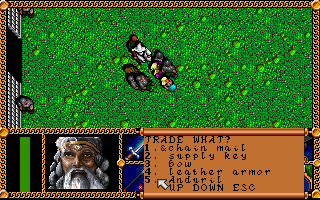


As with WiMe, things get more interesting the more you deviant from the canonical plot. In one sequence, you are set upon by Ringwraiths; a ranger (not Aragorn) shouts at you to flee, and then sacrifices himself to buy you time to escape. But! As I discovered on a later play-through, you can actually charge back in and save him. Using one of your “Elbereth!” words of power will dispose of the ringwraith; at this point, the ranger will join your party, giving you a crucial human ally who helps you with other obstacles as you make your way towards Bree, and afterwards, you can end up with two Rangers in your party. I seem to vaguely remember there also being some sort of, hm, witch or wise-woman or something who could also join you.


Magic was kind of strange in the game. Middle-earth is a very low-magic world, and they did a good job at representing this: only a few characters like Gandalf are capable of casting spells. Mechanically, though, it was a bit strange, since casting spells will decrease a character’s health rather than a separate “mana” pool. Since healing is pretty rare in this game, you were incentivized to avoid casting spells except in dire circumstances, even when your party members had it available to them.

As a side note, while the game invented a lot of stuff, I was generally happy at its humble attitude towards the source material. I even remember the well-written manual, in which the creators admitted that, if Tolkien were still alive, he probably wouldn’t have approved of the game. Tolkien was notoriously skeptical of technology, and the combination of an adaptation of his beloved work and a diabolical instrument like the computer would have likely dismayed him. Nonetheless, even knowing this, they did what they could to honor his story and his setting.

Sometimes I feel like the major driving force in my life has been a desire to explore Middle-earth. It was such a powerful, formative draw for me in my youth, and a big part of the reason why I started programming computers was a desire to do a similar sort of world-building. Any time I play a new fantasy game, I’m indulging in that ancient compulsion to thoroughly explore, to get to know a place, to immerse myself in the imagined land. Usually the new land (Thedas or the Sword Coast or Nirn or Britannia or whatever) is just a proxy for my first love, but on a few rare and precious occasions I’ve felt like I’m actually in the primary world, getting to know more of Middle-earth.

That’s the sensation that, at its best, the 1990 Lord of the Rings game evoked. You have to go into Moria, because of COURSE you have to go into Moria, because that’s a crucial part of the game. You can stick close to the script, and move through it and get out of that dangerous place as quickly as possible. But, if you’re driven to learn more, you can get off the script. You can, as the dwarves infamously did, dig too deeply. You can haul a pickaxe down into the depths of the mine, and actually mine your own mithril. Foolhardy? Undoubtedly. Non-canonical? Unquestionably! Exhilarating? Certainly. Ever wanted to find Durin’s axe? Well, it’s a video game. It doesn’t have to follow the plot of the game. You can find that axe, and give it to Gimli, and it made me feel so very happy to do so.

And, more recently, I’ve gushed here about Sil, an absolutely fantastic roguelike that evokes the Lay of Beren and Luthien. Tasked with cutting a Silmaril from Morgoth’s iron crown, you venture deep into the fortress of Angband, encountering and outwitting or outmatching a huge host of First Age foes. Again, this isn’t canonical - only Beren was able to reclaim a single Silmaril - but it’s so steeped in the lore, and, more importantly, so respectful to the spirit of Tolkien that it stands out to me as the best video game ever created based on Tolkien’s works.


So, to close the loop back to Shadow of Mordor, I think that’s the aspect of it which distresses me the most. Not creating new creatures, or changing the timelines, or even necessarily messing with the Halls of Mandos. It’s just that, for all the nifty snippets of accurate lore about Numenor and the Blue Wizards and Feanor, it seems set in a moral universe that’s completely alien to every primary work Tolkien wrote. There’s no hint of The Song, no idea that Eru Iluvatar is watching over events. It’s the same crappy world of The Dark Knight and 24 and Hitman and God of War and Mafia and Max Payne. There’s no shortage of franchises out there that want to tell the story about A Badly Damaged Man Must Do Dark Things In Order To Exact Revenge Upon Those Who Have Wronged Him. There’s an alarming lack of franchises built around concepts of grace, of enduring rather than returning oppression, of melancholic nostalgia rather than gloomy angst. I wish they had taken advantage of Tolkien’s unique style and perspective rather than painting it with the same ugly brush of sadism that covers so many game franchises.

Thursday, July 04, 2013

Noir

Editor's note: This post is ancient! I found it while going through my old posts and re-tagging them. I think this was originally written in... 2008, maybe? If memory serves, I was planning on giving this game to a friend (which was a production in itself, but that's another story), and decided to sequester this post to avoid tipping my hand. And then decided to forget about it altogether for years. The good thing about retro gaming, though, is that this post is no less applicable now than it would have been then. The unedited text follows.

In the grander realm of Discworld ephemera, I'm naturally most drawn to the small yet compelling field of video games.  Unlike what you might expect from other works, the Discworld games are not re-interpretations of existing stories into a new medium, but rather original tales that draw upon established characters and settings to create new adventures.

There have been several games, but the last and best-regarded is Discworld Noir.  Both "last" and "best" should be understood relative to the competition of other Discworld games, as it is more than a decade old and has been forgotten.  Still, a passionate tiny minority (tinority?) continues to sing the praise of this lost entry, and so after spreading the wealth around to a friend as a gift, I was compelled to seek out another copy to experience it for myself.

It is... well, it is a darn good classic graphical adventure game, with production values that are decent for its time, and a script that is about 75% as good as one actually written by Pratchett would be.  Which is to say that I wasn't blown away, but I was impressed and pleased.  Perhaps best of all, it may be the least buggy of the various 1990's graphic adventure games that I've attempted to play.  I never once had a corrupted save game, got stuck, or crashed.  The sound did occasionally cut out, but other than that it ran like a charm.

Once I actually got it running, that is.  Based on what I'd read online, I knew it would be hopeless to try and run it on my 64-bit Vista system, "compatibility mode" or no.  Fortunately, after the agony of Quest for Glory V, I knew what would be required, and already had a lot of the ground work prepared.  I set up Microsoft Virtual PC, installed Windows 98 SE on it, then installed the game on the virtual PC and ran it.  Poof!  Just like that, I was transported back to classic gaming land.

The basic interface of Discworld Noir will be familiar to anyone who's played a LucasArts or late Sierra adventure game.  You have a single-action pointer that you sweep around the room, right-click to examine an object, left-click to move, and double-left-click to interact with it.  You also have a traditional inventory system that lets you acquire, combine, and use objects.  On top of this conventional interface, though, they have layered a system that's more appropriate to the... mood of Discworld Noir.

As you may or may not be able to guess from the title, Discworld Noir is a detective story.  The single most important thing you use is your notebook, in which you write down clues as you advance the plot.  You can use your clues on items in the world to, or combine them with one another to try and divine connections.  For example, if you have notes about two separate murders, combining them will cause your character to puzzle out the possible connections between the two.

There are occasional frustrations in the puzzle system, but on the whole it's one of the better adventure games I've played.  It achieves the obvious-yet-to-rarely-done trick of scattering around hints about what you should do that make puzzles non-obvious and non-frustrating.  For example, you may ultimately need to use a particular object in a particular place.  You could eventually figure this out yourself, but if you show the object to various contacts, odds are that one or two of them may offer ideas that point you in the right direction of where to use it.

The voice acting is... generally good.  I was much more impressed after I realized that it's basically one guy and one girl doing every person in the game.  There's, I dunno, maybe two dozen or so characters, each of which has an incredible amount of dialogue, including some pretty involved hard-boiled exchanges.  I can cut them some slack for having the occasional cheesy accent.  Some of the characters are really well done.  You hear an incredible amount from Lewton, your avatar, so it's a relief that he's well spoken and entertaining; I never would have lasted the whole game otherwise.  When characters are really frustrating, it tends to be more the conversation/graphic programming than the actual voice acting... there are a few in particular who, whenever you ask them a question, you'll need to watch this really annoying idle animation for a good five or ten seconds before they say "Well........... hmmmmm.....errrrrr...... I don't know."  That tends to be the exception, though.

Oh, and the sound is quite good.  It's noir, pretty jazzy, a bit repetitive in spots but nicely atmospheric.  And, speaking of atmosphere, they totally nail the mood they're going for and keep it up throughout.  Every scene is dark, it's almost always raining, all buildings are shown with severe angles, and so on.

The graphics themselves are kind of hard to deal with.  They live in that awkward adolescence, between the cheerful cartoony primitive animation of early adventure games and the pretty, smooth animation of modern games.  Studios had figured out how to do 3D and texture models, but didn't yet have enough polygons to make really lifelike characters, and so you're stuck with fully-realized yet amazingly ugly people.  Again, the setting of Noir helps here, as, for example, your avatar walks around in a big trenchcoat with a fedora pulled over his face, so you only need to see his creepy eyes and gargantuan chin in the occasional cutscene.  Like most classic games, it's really only a problem for the first hour or so, and after that you get acclimated and don't really notice it much any more.  (Just to emphasize one more time: while the execution is a bit crude, the overall design is quite excellent.)

MINI SPOILERS

This is actually the only Discworld game that I've played, and I'm not extremely tempted to catch the others... not because I didn't like this one, but because I doubt the others would be more appealing to me.  From what I've read, the other Discworld games are based around Rincewind, who is a perfectly fine character but not one of my favorites.  Noir, in contrast, is based around an entirely new character, Lewton, who is the Disc's first private investigator.  Even better, the game entirely takes place within Ankh-Morpork.  After reading more than a dozen of these books, I feel confident in declaring that one can adopt a rough rule of thumb that the quality of a Discworld book is directly proportional to how much time is spent within Ankh-Morpork.

A-M has always been pretty vaguely defined within the books.  Much like the Discworld itself, you gradually learn a lot about specific locations (the Mended Drum, Unseen University, the Patrician's palace, etc.), but unlike other fantasy authors, Pratchett never sees fit to actually provide a map showing just where these things are.  And good for him - that's not the kind of book he writes, and this method gives him perfect freedom to make new geographical declarations whenever it is convenient to a new plot.  A little bit of that flexibility is lost here, because there IS a map provided, but even so, it maintains the overall feeling of amorphousness.  That is, you can see where the docks are, and you can see where Dagon Street is, but it's presented in a more artistic manner, without bothering to define every street name between the two. 

Besides Lewton, a lot of new characters were invented for this game.  However, more than a few classic characters make appearances as well.  These are generally pretty good.  Least enjoyable is Vimes, who only appears in a few scenes, and comes off as just cranky and (!) incompetent.  Since Vimes is my favorite character in the books, I was disappointed in this portrayal.  On the other hand, they do a surprisingly decent job with Nobby, who is notoriously impossible to represent in any form.  He does look entirely too human, but they offset it nicely by giving him weird twitchy movements, and providing decent dialog that captures his peculiar mix of pride, pettiness, and craft.  The Patrician is mostly absent, but when he does appear, you can believe in him.

Oh!  And I can't skip the bizarre tie-in with Discordianism.  The game out-and-out steals from the Discordian mythos: you meet a priest named Malaclypse (the elder, perhaps?) who worships a deity called "Errata," who is the goddess of chaos.  Sound familiar?  Errata was responsible for starting the Tsortean wars.  Malaclypse is also a repository for every conspiracy theory on the Discworld, and was always entertaining to talk with even when he was useless. Anyways, the theft was so obvious that I have to forgive it.

MEGA SPOILERS

The plot itself turns out to be surprisingly good.  The game is divided into, um, I think four acts.  The start of the game is quite slow and boring, with a lot of tedium and some of the least-sensible puzzles of the game.  It gets much better once the murders kick into high gear, though, and becomes downright fun once Lewton turns into a werewolf.  Things become nicely layered as more and more players are added, and it was fun to puzzle out and predict who would betray whom. 

The werewolf bit itself was... wow, pretty surprising.  Only in the Discworld would your main character die halfway through, and continue in the game.  Adding the new "scents" subsystem was cool as well; I just wish that they had ended up doing more with it.  I think that you can collect maybe thirty or so scents, but just a fraction of them are useful, and you couldn't do as much with them as I had hoped.

The cut scenes throughout the game are pretty good, but the ones in the second half are excellent.  I especially enjoyed watching Death appear to take the final murders himself... they totally nailed the character's attitude and speech.  Mooncalf's death was entertaining as well.  "I'm a born-again atheist!" he calls out before getting zapped by lightning - which you can totally see coming from miles away.  Atheists don't last long on the Discworld.

One regret: the actual ending proper was pretty anticlimactic.  Double-click on the flying device, watch Lewton pedal, watch Lewton swing a sword, poof!  Game over.  I'm not sure exactly what I was expecting, but... I dunno, at least interacting in some meaningful way with Nylonepheteh (sp) would have been fun.  Still!  The closing cut-scene was satisfying in an overly referential, cheesy, self-aware way, and I enjoyed it immensely.

END SPOILERS

So, where does Noir fit within the Discworld canon?  I'd label it "worth checking out if you enjoy adventure games AND Discworld."  It's not the greatest adventure game ever, and isn't the best Discworld story ever, but it's quite good at both, and how many chances will you have to find that?

Monday, March 25, 2013

Be Silly

On an off-handed recommendation from Chris Gardiner, the creator of Below, I've recently gotten into Sil, an ASCII RPG strongly based on the First Age as depicted in Tolkien's Silmarillion. Echoing a major section of The Lay of Beren and Luthien, your goal is to enter the depths of Angband, cut a Silmaril loose from Morgoth's crown, and then escape with it. It's an incredibly addictive, difficult, punishing, evocative, fascinating game that is causing me to recall my very earliest games, and also reflect on the interplay of technology and imagination.

Sil belongs to a category of game known as Roguelikes. Descending from the game Rogue, which was created in 1980, dozens of games have evolved that tweak various aspects while retaining certain core fundamentals. The most immediately obvious of these is the interface: a true Roguelike will use only ASCII characters. That means no bitmapped pictures: every creature and item will be represented by a letter, number, or character. So an orc scout will be represented with o, while Gorgol the Butcher is represented with o, a longsword is |, a staircase is >, and so on. Everything is laid out on a simple grid, and as you move from space to space, you gradually discover more of Angband, and encounter more of its denizens.


It takes a while to get into it, but I've been surprised by just how powerful some of the situations can become. Even though there are no images, and, frankly, not even any dialog (although there are a few beautiful phrases from or inspired by Tolkien), I find myself becoming uncomfortably tense while playing the game. When I'm backed up in a corner, desperately hacking away at white worm masses swarming around me, and then I see a brigade of Orc soldiers march into the room, then spot me, raise the alarm, and rush in… well, I feel true despair, in a way I rarely do when playing modern RPGs. When I stumble into a darkened room, I quietly close the door behind me, then creep forward, with a lump of expectation in my throat… and then, if I'm very lucky, when I stumble across the Forge I've been looking for, a wave of relief washes over me, as I realize that I will likely survive to descend further into the depths.

There are a couple of factors that go into this. The big one is how, by minimizing the in-game presentation, the game prompts your mind to create the visuals yourself. That's not too surprising: after all, it's how the novel works. All games used to be like this: whether a text adventure or Rogue, games would provide the plot and structure, and your brain would fill in the sound, music, faces, speech, and atmosphere. And once they get buy-in, games can do incredible things through text. It's fascinating to read stories from people who have beaten Sil, who report with nearly breathless wonder how they fled from Morgoth's mighty hammer Grond, and escaped from the webs of Ungoliant, and slew Lungorthin, the Balrog of White Fire, in desperately frenzied combat. Even today, I don't think any AAA title would be able to do justice to how I would imagine any one of those conflicts playing out, let alone all those and more in a single level. And yet, two guys who forked an open-source ASCII dungeon crawler were able to make it in their spare time. Incredible stuff.

As a side note: I do find it encouraging that many developers are echoing similar conclusions. In a recent update to the Shadowrun Kickstarter, when explaining why they would be using text for story-related material, Jordan explained their plan: "The first of these powerful weapons is what I call 'The Infinite Resolution Rendering Engine' an incredible piece of biotechnology developed over millions of years, capable of presenting the audience such vivid imagery so real they can smell and even taste it. Yes you guessed it, it’s the gray stuff between your ears and the imagination it is capable of. We can’t afford to put everything in our imaginations onto the screen, so instead we decided to put it into your imagination via 'theater of the mind'. By combining beautiful environments and characters with cleverly-integrated text, we hope to inspire you to 'see' and 'hear' things that we could never afford to put on your screen or out of your speakers." That actually seems like a reactionary statement coming so soon after the Playstation 4 media event, which basically equated superior technology with superior storytelling. But I think Jordan's right, and we're hearing the same message in the very thoughtful pitches being made by inXile for Torment.

The other thing that adds to the effective impact of the game is permadeath. This is another aspect that's common to most roguelikes. Unlike most RPGs, where you are encouraged to save your game frequently and re-load if something goes wrong, in almost any roguelike you get exactly one death per character. Once someone dies, there's nothing to do but create another character and start it over again. If they died on the first few levels, you may have only invested a few minutes; if they died in the depths, you might have spent hours and held high hopes for them. Personally, I've seen nearly two dozen of my characters die. It leads to an entirely different style of gameplay. Obviously, it encourages more caution: I'm less likely to take risks, and try to constantly remain aware of my surroundings and have an escape route in mind. It also adds to the sense of reward. For a long time, I could never get below 200' deep. Once I finally did, I felt a surge of pride. Finally, it keeps the game consistently challenging and interesting. I'm actually playing Sil during breaks with my other RPG project, Neverwinter Nights (about which a post will no doubt be made). I recently had a frustrating fight in that game against a Dire Spider. I probably died about ten times in a row, usually getting it down to Near Death before my companion and I succumbed. Each time I died, I would reload, slightly alter my tactics, and then attack again, with the same results. After a while, I started to get annoyed that I had spent close to twenty minutes doing the same thing without making any progress. (Eventually, I had to swap out my companion.) Well, in Sil, that never happens. If a spider kills you, you're gone. And, next time, you'll be VERY careful and VERY prepared before you fight that spider again. Sil forces you to learn, and adapt, and grow. I enjoy playing my RPGs tactically, but I also find that the ability to re-load makes me a bit too much of a perfectionist: if I don't like how an encounter ends, I'll keep trying it until I get it right. I'm weirdly grateful to Sil for breaking me of that habit. (I felt a similar reaction to The Binding of Isaac; while it's a real-time game and uses actual graphics, it's otherwise extremely similar to a Roguelike.)

In some ways, playing Sil makes me hearken back to my very first experiences with a computer. The first computer I ever had access to had two 5 1/4" floppy disks with games. One disk was labeled "Great Adventures II", and had a set of text adventure games. One was set on a nuclear submarine that suffered an accident; another started in a video game arcade in a small town; another saw you marooned on a mysterious island; another had you infiltrating a secret military installment hidden deep beneath the snow. I never beat any of them, but spend so much time in those worlds that I developed vivid images of their contents. The second disk was "Castle Adventure", and it featured ASCII graphics not unlike Sil. The setting of that game was quite different, though: it had much more space, and far fewer enemies, and was much more puzzle-focused and not as punishingly difficult.

Oh, yeah: and it wasn't random. That's the other huge thing about roguelikes: they feature procedurally-generated dungeons, so they're different every time you play. The coding helps guide the layout and the difficulty so the overall progression will feel familiar: you'll mostly be traveling through rooms, which are sometimes adjacent but often connected by corridors; upper levels mostly contain weaker enemies like orc scouts and bats, and have less valuable items like Curved Swords and Pairs of Gloves; occasionally you'll find a particularly powerful enemy wandering the upper levels, or a rare artifact like Orcrist.  Modern gamers are probably familiar with the concept as exemplified by Diablo, which essentially took Rogue's procedurally-generated-dungeon idea and applied it to modern graphics.

So, how is Sil different from other roguelikes? I have to admit that I don't have a ton of experience with the genre; I played around a little with NetHack back in college, but at the time didn't get into it. Most Rogue/NetHack games are a kind of grab-bag of fantasy tropes, frequently taking an everything-plus-the-kitchen-sink approach: you can pick from a variety of races, and dozens of classes (I remember a Tourist class, inspired by Twoflower from Discworld!), and encounter hundreds of monsters, learn hundreds of spells, and find thousands of items. Later on, Moria was more explicitly tied to Tolkien's mythos (the goal was to slay a Balrog in the depths of Moria), but had a very loose interpretation of that mythos, allowing for D&D-style elements like gnomes and paladins. A further descendent, Angband, took action back in time to the First Age and changed the setting to Angband, but added even more elements to an already overstuffed game, and operated under a fundamentally flimsy premise (that a mere mortal could slay the Black Foe of the World).

Sil is based on yet another descendent of Angband (in case you're curious about the full genealogy: Rogue begat Moria begat Umoria begat Angband begat NPPAngband begat Sil), and makes two crucial innovations, in my mind of equal importance: it remade the game as a faithful adaptation of Tolkien's world and works, and it significantly simplified the game's mechanics in order to draw out more interesting tactical considerations. These two factors actually affect one another to a certain degree. Tolkien had a very well thought-out world, which doesn't have a lot of the detritus that litters most latter fantasy novels and games. The most noticeable change may be that of magic. Middle-earth is an example of what's often called a low-magic world: there are some magic forces at work, but it is very rare and generally subtle. Even an incredibly powerful wizard like Gandalf does not shoot forth enormous fireballs from his hands, or give life to inanimate objects, or telepathically communicate with others. And Gandalf is very unusual: as one of only five Istari, he is one of the rare entities with access to any magic at all. Unlike a setting such as Dungeons & Dragons, where any human or elf who wants to can learn magic, mortals in Middle-earth must do without.

So, Sil doesn't have any spells, or any magic scrolls, or familiar summons. It does, however, draw on Tolkien's legendarium to fill out the range of possibilities. Poetry and song play a major role in his works: the very world was sung into existence by Eru, and many of his books describe the power of song wielded by the free peoples: orcs fleeing in terror before the song of warriors, or allies feeling strengthened and emboldened by the songs of friends. Sil uses Song, but it isn't just a re-name of magic: songs work in ways appropriate to the setting. All songs are essentially "sustains": you can only sing one song at a time, and continue it until you decide to stop or until your voice gives out. The Song of Elbereth will fill the hearts of Morgoth's minions with terror. The Song of Slaying will boost your skill at combat, growing stronger with each foe you slay. And, drawing directly from the Lay of Beren and Luthien, there are also subtle songs, like the Song of Lorien that can lull enemies to sleep, and the Song of Silence that can muffle the sound of your passing.

As you may have deduced, the mission here is a bit more nuanced than that found in most Roguelikes. NetHack has you searching for a MacGuffin called the Amulet of Yendor. The original Angband required you to kill Morgoth. Well... that's a bit of a tall order, don't you think? I mean, if the twelve Valar couldn't kill Morgoth, what hope would a single mortal have? Instead, your goal is to accomplish the same feat as Beren and Luthien, and escape Angband with a Silmaril cut from Morgoth's crown. So (and here's where the gameplay gets interesting) there are a LOT of ways to accomplish this. You don't need to buff up a super-powerful warrior who can slay Morgoth in single combat. You could try to follow the path of Luthien, and make your way quietly with stealth and the aid of the Valar. Or you could seek to emulate the great craftsmen like Feanor and design powerful artifacts to help in your quest.

The game seems pretty well balanced in how it allows you to play. Like a standard RPG, you can gain experience by killing monsters. However, you also gain a lesser (but still respectable) amount of experience by simply observing a monster. So, if you are quiet and patient, you can make a great deal of physical progress into the depths of the Iron Mountains and improve your character without needing to fight at all! You can also gain experience by finding and identifying artifacts you encounter. So there are some really interesting trade-offs to consider: should you avoid combat, which is generally safer but will result in a weaker character? Or do you take on your enemies, potentially increasing your skills rapidly, but risking (permanent) death?

I'm still struggling with the answer to that. You find pretty early on that you simply CANNOT prevail in every fight. When you come across a lone orc scout, it can be worthwhile to kill it to gain experience and remove a potential threat. However, if it survives your initial blow, it may yell for help, and before you know it, you're trapped in a narrow corridor, stuck between a half-dozen heavily-armored orc warriors beating you to (permanent) death. So... sometimes it's best just to let the scout go. In particular, the game diminishes the amount of XP you receive for each subsequent sighting and kill of the same enemy type, so you don't even gain anything from grinding out combat against the same weaker creatures. You're inexorably drawn deeper and deeper into the pit, ever further into danger and ever closer to Morgoth's grasp.

As another example of the creators' fidelity to Tolkien, the various races are depicted accurately. In most fantasy games, like D&D, Shadowrun, or Dragon Age, creators try to keep races balanced. Certain races are stronger in some areas and weaker in others: for example, elves are often depicted as more charismatic and magically inclined, but weaker, whereas dwarves are sturdy but less nimble. This is desirable for game-creation purposes, since it gives players more freedom to pick an appropriate flavor for their character without handicapping themselves. However, Tolkien's own lore was very clear: elves are simply superior. Compared to humans, they're immortal, and stronger, and more graceful, and more beautiful, and better craftsmen, and more aligned with the wishes of the Valar... they're simply superior, full stop. So, when playing Sil, if you want the strongest character, you should choose a Noldor elf. The other choices offer different flavor but clearly greater difficulty. The Sindar elves have a slight advantage in archery. The Naugrim (dwarves) are strong and talented smiths. The Edain (high men)... well, they try hard. That's about it.

(As a side note: I was reminded of how Iron Crown Enterprises handled the issue of racial balance in Middle-earth Role Playing [MERP]. They also sought to remain faithful to Tolkien, and you would get the best attribute bonuses by playing as an elf. In their case, they balanced it with the idea of "background points." The concept was that, the more mundane your physical background, the more interesting your childhood and young adulthood must have been to inspire you to turn to a life of adventuring. So, a Noldor Elf would get only a single Background Point to spend, while a Dorwinian man from the shores of Rhun would get five. A background point might give you a larger-than-normal starting supply of gold [perhaps from an inheritance or a youthful caper], or a physical peculiarity like ambidexterity, or a magical artifact. I thought that was a good solution to the conflicting desires to remain faithful to Tolkien and encourage diversity among player characters.)

Sil also does away with the concept of "classes": you don't create a Cleric or Ranger or Rogue. Instead, you have four primary stats (Strength, Dexterity, Constitution, and Grace) and eight skills. Your stats are basically innate, set at character creation. You start with a pool of XP that you can use to buy advances in the eight skills, starting you off on the path you envision for your character. A cautious player might invest heavily in Evasion and Stealth, while a more aggressive character would dump a lot into Melee or Archery. Skills like Perception can help anyone, but there's always a tradeoff: with the limited XP available, you'll never be able to raise every skill in the game. Finally, you can also use XP to purchase Abilities. These are cool: they grant a specific power to your character. If you learn Lore Master, you'll be able to immediately identify items you encounter without needing to use them first. If you learn Precision, you'll more easily get critical hits from bow attacks. Enchantment will let you craft items imbued with special powers. However, the price for subsequent Abilities in the same skill rises rapidly, so most players will need to pick only a couple from each branch before they grow prohibitively expensive.

The final major innovation that caught my attention was the use of small numbers. That might sound like a silly thing: surely small numbers are less interesting than big numbers? I'm used to playing RPGs where I might have a Stealth skill of 67, wield a magical sword that deals a base damage of 83 points, and cast from a pool of 200 mana. In Sil, almost all numbers are single-digit. The first sword you pick up deals between 1 and 4 points of damage; the most powerful two-handed axe I've found so far can yield between 3 and 12 points. I have not yet been able to raise any of my Skills above level 7. I'm currently wearing a Cloak that gives me +2 to Evasion... and I'm ECSTATIC to have it.

Having small numbers makes every single point matter. An RPG like Dragon Age typically features a smooth and gradual improvement in your character's abilities and equipment. Each new weapon you find might be 5-10% better than the one you were wielding before. Each new level up will give you 5-10% more hit points and a similar increase in skills. You feel a bit more powerful, but it doesn't make a huge impact in the progress of the game.

In contrast, in Sil, an increase of a single point means a lot. You can survive noticeably longer, or kill noticeably more easily. I'd initially scoffed when I saw that Precision lowered the critical hit requirement from 7 to 6. Now, it's the first ability I take whenever I play an archer: that one point is huge.

The ultimate effect is to keep things exciting. Finding a single artifact can drastically affect your survivability; depending on the type of artifact, it might even change your strategy. (Again, there are similarities to be found here with the Binding of Isaac.) It also prompts you to think very, very carefully about where to spend your limited XP, since buying a single point in a skill can have such a big effect.

I definitely can't claim to be a good player. It took me a few days of playing to even make it below 200'. Lately I've been getting down to about 300-350' before succumbing, so I think I'm getting better. One major factor is just getting more acquainted with the monsters and mechanics so I know what to do. For example, I now know to kill worms very quickly if I run into them, before they have a chance to multiply. But, I also know to keep a healthy distance from green worms, since they can damage my equipment. Orc patrols used to always be the bane of me; I'm much more patient now, and generally lurk in the corners while they pass.

I've lurked on a few Sil pages - there doesn't seem to be an organized community, but there are some Roguelike forums with occasional Sil threads - and have been really impressed by the intelligence and variety of Sil players. Some of the best players focus on Melee/Stealth builds, while others eschew Stealth entirely. Personally, I started off with a stealth Archer build suggested in a YouTube video, though I've had better luck switching it up since then. In particular, I now only put 2 points into Smithing so I can take Weaponsmith; this frees up a LOT of XP to distribute elsewhere. My general, vague strategy now is to give a minimal amount into Archery, Evasion, and Stealth to improve survivability, then dump everything else into Perception. I can usually get this up to 7 and buy the two Lore abilities by about 250'. Lore Master gives an immediate boost in XP from your un-identified items, which I then roll into Evasion so I can get Sprint. And then... well, then I typically die. But I'm getting further every time, so I feel like I'm on the right track. Long-term, I plan to re-invest in Archery and Stealth again, and operate as a sniper from the shadows, with the ability to flee and vanish when things get too hot.  But, again, I love the variety of paths Sil offers, and sometime I'd love to try with Song-heavy build or something similar.

The balance of the game is really impressive. It's consistently challenging, but so far has not felt impossible. Every single time I've died, I've been able to clearly identify the reason why. Typically, it's either "Oh, I guess monster X has effect Y. Well, next time I should use archery on them from a distance!" or "I should not have attacked that monster until after making sure no other creatures were within earshot." I guess the game is teaching me caution and patience... what a strange idea from a video game!

Into the vast and echoing gloom,
more dread than many-tunnelled tomb
  down awful corridors that wind
    down to a menace dark enshrined;
      down to the mountain's roots profound,
devoured, tormented, bored and ground
by seething vermin spawned of stone;
  down to the depths he went alone...

Monday, May 21, 2012

Shadowran

Since I need to wait until 2013 to get my Shadowrun fix, I decided to check out an instance of the game that I'd never experienced before: Shadowrun on the Sega Genesis. (This is one of the secret joys of being an adult: you get to do all the fun stuff that you'd missed as a kid.) I grabbed an emulator and found a ROM, and soon I was running in the shadows.

I'd vicariously played Shadowrun for SNES back in the day, and remember that game pretty vividly considering how long ago it was. I'd read online that the Genesis version was pretty different, and I have to agree. The Genesis game is a more specialized, team-oriented game. In SNES, your Runner, Jake, becomes an ubermensch: by the end of the game he's an incredibly powerful, unstoppable killing, spellcasting, hacking machine. Genesis follows a more traditional RPG style of classes: you can become any type of player you want, but you need to start as one of three archetypes: the Street Samurai, the Shaman, or the Decker. I think that in SNES you could hire another runner to tag along for some missions, but in Genesis you can create a party of up to three people, counting yourself. I opted to create my character as a Decker - hey, how many games out there let you specialize in hacking computer systems? - and permanently hired a troll Street Samurai and an elf Mage to fill out my group. I got them fairly early, and we grew into a fantastic team. My samurai, a troll named Winston Marrs, initially represented with his powerful (and incredibly illegal) shotgun; I eventually outfitted him with "spurs" (think of Wolverine's claws), subdermal body armor, a heavy combat jacket, and two rounds of cybernetic wired reflex upgrades; as a result, he would charge into combat and smash opponents into oblivion before I could blink. My mage Freya would zap bad guys with mana during fight, but more importantly, she could turn us all invisible while we were infiltrating a corporation's building, or heal us between fights. Me? I had a pistol and would pitch in during fights, but I was really just there for the hacking.

The basic formula for Shadowrun is really simple - magic plus technology - but it combines in some really cool ways. For example, there's none of this silly D&D-style business about mages not being able to wear good armor. You totally can; as a result, magic users can actually stay alive during fights, and can actually do cool stuff. (I'd kind of like to see a Shadowrun movie sometime; just imagine someone blasting lightning out of one palm while they fire a Glock from the other.) There still is a limitation on magic users, in the form of Essence - basically, you love magical effectiveness as you install machines into your body, so while deckers and samurai will outfit themselves with tons of circuitry and metal, shamans and mages will try and remain "pure". It's a good system.

The music in the Genesis game was really good, in a 16-bit way. I think I might need to give the nod to SNES, just because of the awesome Maria Mercurial music, but honestly part of that may be nostalgia speaking. The Genesis game has nicely moody and dramatic ambient music throughout the game, and its main theme (which plays over the title screen and also over some surprisingly moving interstitial scenes) seems to perfectly capture the mood of Shadowrun: grimy, sinister, exciting.

The graphics held up decently well. I actually had more issues with the hairstyles than the graphics; the game came out in the early 90s, and most females still have 80's-style hair, and your main character's sprite seems to have emerged from an Arnold Schwarzenegger movie. Still, I thought it was very playable on the whole. Most of the game is played with overhead sprites (unlike the isometric perspective of the SNES game), which are decently detailed with some good suggestion of personality. I really only have two sprite-related complaints: Freya's hair looks absolutely bizarre, and the random civilian sprite who's wandering around looks way too much like a bad guy. All of your actual encounters with other characters take place in a separate, static dialog screen, with small portraits for each person who speaks. The portraits are low-res but, again, well done, probably more so than the sprites; a few are recycled, but each one is memorable and appropriate to the character. The interface was actually really good. I was playing with a USB gamepad hooked up to my OS X laptop, and after just a few minutes it felt very natural to navigate: A to interact or shoot, B to switch between targets, and C to switch to another character. I actually liked combat in this game much more than the SNES game, which had a bizarre cursor that you needed to move with your directional pad.

I don't remember the matrix too well from the SNES game; I'm sure I saw it, but I don't think I played much of that part of the game. Here, it's mostly optional, but can be tremendously rewarding. Literally. I made way more nuyen (that's "new yen", the currency of Shadowrun) by hacking into data stores and selling what I found on the black market than I made from all my other endeavors combined. It's a very time-consuming pastime, too. In the micro-level, combat against ICE (hey, it's good to see that at least FASA was unashamed about ripping off William Gibson!) could take several minutes of repeatedly pressing the same button over and over again; on the macro-level, most of the money you make has to be re-invested in your decker's computer if you want to be able to crack the more advanced (and thus more lucrative) systems. If someone were to modernize the game, I'm sure this would be the first part to be updated: making ICE combat more varied and challenging and fast. Still, the concept is so strong, and so surprisingly rare that I was still delighted with this part of the game. (Seriously. I mean, after the "hacking" mini-games of Mass Effect and Bioshock, I'm head-over-heals in love with ICE combat.)

And, along those same lines, this game is definitely an early-90s RPG, which in turn means spending a fair amount of time leveling up your characters so they can advance in the story. This is a technique that has been largely eschewed by AAA game developers in the past decade; modern RPGs have so much content, and are so well designed, that you can gain all the upgrades you need just by progressing through the story. Shadowrun is far from the worst offender in this regard. When I found that I was "stuck" due to being under-powered or under-equipped, it would usually just take me about 10-30 minutes of action to become over-powered for the challenge. And leveling up itself can usually be pretty fun. I especially enjoyed going on Corp Runs, with my team stealthily making its way through a highly guarded building in search of a valuable package or a defecting employee. Still, I imagine that in a remake of the game, they would combine the corp runs into the main plot (there are a few there already), and distribute more karma through the main storyline itself.

Speaking of which...

MINI SPOILERS

The story is pretty cool. The whole game takes place within Seattle and the outside Salish-Shidhe Wilderness. In the 2050's future of Shadowrun, the federal government has become a shell of its former self, and the largest powers are the corporations, Native American tribes, and certain tight-knit magical communities like the Sinsearach elves. A lot of the fun of the game comes from your conversations with people as you learn more about the world you inhabit; even when it doesn't directly bear on your quest, it makes the game more interesting.

The plot itself is technically a revenge story, but it resonates more deeply than most. You are Joshua, and your brother Michael was another Shadowrunner who was killed along with his entire team during a run. The story plays out like a detective story, as you cultivate leads, track down suspects, and gradually piece together the story of what happened on the night of Michael's death. This includes several cool plot twists and reversals: people who you might think are your friends turn out to be part of the conspiracy, and other people who you might assume were to blame for killing Michael become crucial allies in your fight for justice.

The actual gameplay is very nonlinear, which I enjoyed quite a bit; it's much more a western style of RPG than the lead-by-the-nose JRPGs that dominated that era of console gaming. At any given time you'll have a few clues that you can follow up on to try and make progress on the mystery, which tend to follow several disparate tracks - some clues may involve searching for a lost Elf in the wilderness, while others may point to a particular corporate stooge in Seattle. And of course, at any time you can contact a Mr. Johnson and go on a shadowrun to boost your money and karma. (For the uninitiated, karma is Shadowrun's rough equivalent to experience or levels; you mainly gain karma by completing shadowruns, and can distribute karma to increase a character's attributes or skills.) The script for the plot would probably look a bit bare by modern standards, but compares favorably to its contemporaries, and is structured well so you get some nice dramatic revelations scattered throughout the game.

MEGA SPOILERS

I was a bit surprised that the dragon showed up to save the day. Isn't the whole point of Shadowrun that you're never supposed to make a deal with a dragon?

I kind of wish that I had gotten Stark (Michael's cybered-up best friend) earlier in the game; he seemed like a cool character, and I liked his connection to my personal story, but by the time I got him Winston was so incredibly powerful that it didn't make sense to switch. Yet another case where a remake could improve the game, by employing the now-common technique of making all recruitable NPCs level up at the same rate, regardless of whether they're in your party or not.

Harlequin's a fascinating guy; I kept expecting for him to reveal that he was actually in league with Thon, or after the same power as Thon, or looking to replace Thon or something. As far as I can tell, though, it looks like he was telling the truth about everything that happened. I guess that, sometimes, you can trust heavily-armed mafia Juggalo elves.

If you find hidden messages in the top-end corporate systems, you can learn a special passcode that lets you hack into the UCAS (United Canadian and American States) system and disrupt a plot to release a virus that would cause a meltdown in the Redmond Barrens Nuclear Power Plant. After you finish that matrix run, you get a special entry in your Notebook explaining what happened and then saying something like, "SEGA of America congratulates you for your efforts!" Awwww! What a sweet thing to say!

Speaking of which - I wish I'd figured this out earlier, but once you save enough to get a top-end decker rig (I was using a Fairlight Excalibur with maxed-out Response, Masking, and Attack, and good levels for Deception and Rebound), I think the fastest way to earn nuyen is to hack into Ito's System, then head to the red DS that's down from the first defended ICE node. Once I beat that ICE, I just grab all the data I can from that node and then log out. Previously, my strategy had been to attack the highest-level system I could; defeat the CPU, then mine the highest-level DS node, only taking 40Mp+ programs and retreating to the CPU whenever the system entered high alert. Doing Ito's system requires much less combat, and even though the 20-30Mp programs will probably be worth less, over the long run you'll be getting more money more quickly. And this way you can avoid the hardest ICE fights against the CPU of his system.

END SPOILERS

I bid a sad and fond farewell to Shadowrun for Genesis. I'm very glad to have played it and to now feel more a part of Shadowrun's legacy. I doubt I'll return to the game in the future, but I eagerly look forward to returning to that setting before too much longer. We're looking forward to what you do, Hairbrained Schemes!

Wednesday, December 22, 2010

Revolutionary Idealists

I first encountered computer gaming through text adventures. The state of the art has dramatically improved since then, and my tastes have evolved as well, but I still have a soft spot in my heart for the story-driven adventure game, and probably always will.

For many years I've meant to check out Radical Dreamers, which holds the seemingly impossible dual role as an entry in the Chrono series of RPG games, as well as a late entry in the text adventure genre. My ambition would prove difficult to accomplish. Not only was Radical Dreamers never released outside of Japan; even within Japan, it was only distributed via a custom satellite modem add-on to the SNES, and so had no "ROM" in the traditional sense.

I finally managed to assemble the necessary pieces to try it, and am glad I did so. It provided everything I was looking for, along with some pleasant surprises along the way.

I would have gladly played this game just for the music. Square is famous for their amazing composers, and Radical Dreamers doesn't disappoint at all in this regard. I continue to be stunned at the incredible sound that they could pull off with 8-bit and 16-bit chips. It all comes down to melodies, and they've crafted more amazing ones here. Much of the music in the game is subtle or ambient, but the themes they do have is incredible.

I was also shocked at how good the writing was, all the more impressive since the game never saw an English release. A group of fans managed to create a language patch that replaces all the Japanese text with English text, but this isn't some slap-dash Babelfish affair. The writing is quite moving, appropriately colorful without seeming baroque, with a wonderful cadence and style to it. All of the characters' voices are well realized as well, down to habits of speech and idioms that they favor.

Navigation through the game is pretty much the same as in any of the great old text adventures, except that instead of North, South, East, West, it's forward, backwards, right, left. That requires you to keep your orientation in mind in addition to your position; on the bright side, it increases your sense of immersion in the world and helps you really visualize the area. It might have been overwhelming on a larger map, but altogether the main game has... probably something less than two dozen rooms, several of which you will probably only visit once. It took very little time for me to become familiar with the geography, so I never did need to draw that map I was planning.

Combat is also oddly fun. For the few text RPGs that I've played, I've been used to very static types of combat: you have a few stock options, like "Attack," "Magic," and "Run,", that show up for each stage of each encounter. Here, the battles are done in storybook mode, "Choose your own adventure" style. For example, one section might prompt you with, "You leap back just in time, and the goblin's morning star smashes into the ground! He moves away from you, snarling. What do you do?" The choices might be, "Grab it!", "Throw my knife at him!" and "Chase him!" Some of the outcomes are random (for example, if you throw the knife, it may only hit him 50% of the time), but others are consistent. Therefore, the standard pain of Square-style random battles is alleviated, because once you figure out how to handle a particular encounter, you can win every time with minimal damage. And, yes, you can take damage. There's no visible health meter, but it's communicated through the text as your bandages grow and your breathing becomes ever more labored.

Before heading into plot spoiler territories: this game also has a really fun variation on Chrono Trigger's "New Game +" mode. You can replay the game after you beat it, but your future playthroughs actually unlock additional stories; since there's no XP, levels, or currency in the game, you can't really bring over any stats from previous runs through the game. I'll get into more detail on these additional stories down below, but I'll mention here that it's well done. All begin in the same manner, but based on some early choices you make, the setting and tone of the game shifts radically. This proves to be a great way to experiment and draw out the possibilities of the creators. Some are flat-out hilarious, while others are macabre and deeply disturbing. Setting each as a separate tale allows this game to cover a wide range of emotions without a jarring internal shift in tone. Think of a Final Fantasy game: typically you'll get some pathos, some drama, some excitement, and some comic relief, staged throughout the game. Radical Dreamers lets them break those elements apart, so you can play one game that's all darkness, and another game that's practically non-stop laughter.

Okay, let's move into spoilerville!


MINI SPOILERS

The relationship of Radical Dreamers to the Chrono universe isn't immediately clear. As best as I can tell, it's vaguely a sequel to Chrono Trigger - you eventually learn through backstory how two of the characters are related to major CT characters. However, it isn't really a prequel to Chrono Cross. This game was created prior to CC, and I guess you can see it as sort of a dry run at some of the ideas from that game. Two of the three major characters in RD, Serge and Kid, are the two main characters in CC. Kid's personality is largely the same in both games. Serge is the narrator of RD, and so has a bit more personality than the silent protagonist in CC, but they seem to be the same character.

In terms of setting, all of RD (at least the main story) takes place in Viper Manor, which the three heroes/thieves are infiltrating in order to steal the Flame. This setting was later loosely adapted into an episode within CC.

Thematically, both RD and CC deal with multiple, parallel universes, in much the same way CT dealt with timelines. This theme is pretty subtle in the main story of RD, only coming out during the endgame sequence. However, it can be seen as part of the whole point of the game, especially when it comes to the alternate stories told after the game finishes. Each of those is a story in another universe, with some similarities to the main one but still fundamentally different. Each has three people named Serge, Kid, and Magil entering the manor; in one, though, Magil is a lovestruck aristocrat who pines for the lost love of his youth; in another, Magil is an intergalactic bounty hunter who has been tracking a nefarious Martian villain.

I do like how the game puts the choice of universe into your own hands. It isn't that you're randomly or sequentially thrust into one and need to respond appropriately. Instead, your own actions determine your reality, including your past. This is a cool, up-to-date variation on the idea that our thoughts create our destiny, which is a nifty mental framework to have.

Back to the main story: it's a pleasant mixture of adventure game and RPG, and thoroughly story-driven. Even the main story itself probably deserves multiple play-throughs, since your choices help reveal more about the characters and their situations. Other than advancing through the plot, which largely centers around tracking down the Flame, the most important factor is your emotional connection with Kid. Serge has a crush on Kid, and the way you treat her (and other decisions you make) help determine whether she will reciprocate that affection. This isn't a dating sim; rather, Kid will be more impressed with you if you act more forthrightly, if you respect her opinions, and so on. Most of these come from one-time choices during the story's span, but you can also further your relationship during some of the random battles you fight.


MEGA SPOILERS

Boy, those Square guys sure can write, can't they? A lot of their plots can sound melodramatic on paper, but as presented within the context of a game, they become extremely moving. Given the short span of RD, its climax is surprisingly heartfelt. Kid sacrifices Lucca's gift in order to save Serge's (your) life; this essentially breaks the bond with CT in order to create a bond with CC.

Lynx's multiple personalities were intriguing, especially in the context of his eventual (re)appearance in CC. In the main story he is cold, calculating, arrogant, and violent. In "Magil: Caught between Love and Adventure" he starts weeping as he sees his daughter elope with "Gilbert". Probably the darkest portrayal comes from the darkest story, wherein he already died years earlier, and has created a cataclysm of suffering in his spirit's wake. I even enjoyed the pathetic, begging Lynx who appeared in Shea's story.

Oh, and since this is spoilerville: I loved Magil's reveal (in the main story) as Magus. Magus may be my favorite character from CT, and prepending that character's incredible story to Magil's mysterious actions here results in a highly compelling composite. From what I read online, the team originally had intended for Magil to also continue over to CC, and it's a shame that didn't happen.


END SPOILERS

I realize that text adventure's aren't everyone's thing, or even most people's thing, but this one is well worth checking out. It's a slight hassle to gather the necessary components, but once you do, you'll be rewarded with a relatively brief (especially in contrast with a typical Square RPG) game that's packed with story, great 16-bit synthesized music, and pathos. Stick around for the alternate stories once the main game is done.

Even if you haven't played in the Chrono universe before, you may enjoy this one. Most of this game has no explicit connection at all to the events or characters of those games, so you won't be missing out on any important plot. If you like what you encounter here, you should definitely consider picking up Chrono Trigger and/or Chrono Cross. CT was originally an SNES game, but has been modernized and redone as a Nintendo DS game; Chrono Cross is a PlayStation 1 game that is somewhat dated graphically, but still aces when it comes to story. Have fun!

Tuesday, November 11, 2008

So This Is How the World Ends

(Cue battle victory music.)

Here we are!  Less than twenty years after the series started, I have finally beaten the Quest for Glory saga!  "Dragon Fire" has long been the most mysterious and unknown quantity in the series.  Expectations were high from me, but so were fears... I had a lot invested in this tale, and badly wanted everyone involved to wrap things up in a satisfying manner.

QFGV almost wasn't.  The first four games built up a devoted and relatively large following, but the series was always kind of an oddball within the Sierra franchise, which had traditionally eschewed RPGs and, by the mid-90s, had determined that traditional adventure games were on their way out.  The Coles had originally envisioned the series as a four-game entry, but "Wages of War" was not included in that calculation... ever since the first entry, they had carefully included references to beautiful Silmaria by the the sea, so it was only fitting that they try and end the series there.  After attempted cancellation and years in the wilderness, the combined efforts of fans writing thousands of letters to the Sierra executives' offices caused them to relent, and at last Dragon Fire was funded, created, and released.

So how did they do?  I'd have to give this entry a qualified "good."  In some respects, it's the best game of the series.  In other respects, one of the worst.  It has a slightly schizophrenic quality that will be especially pronounced to long-term fans: it often doesn't feel like a Quest for Glory game at all, but at the same time, it is fully a part of that universe and contains flashes of intense QFGoodness.

By the time this game came out, the adventure game genre had been officially declared dead, and so it should come as little surprise that the gameplay had some drastic changes.  Most importantly, for the first time it was not using the SCI/AGI engine.  Now, you can line up Hero's Quest and Shadows of Darkness side by side, and declare that they look and feel utterly different, but still, there is a steady continuity between those two, as their underlying platforms gradually evolved from the same codebase.  Similarities in tone and sensibility were thanks to the continued involvement of Lori and Corey, but similarities in feel and strategy were thanks to the classic Sierra engine.

So, right off the bat, the interface announces you're in a different world now.  You start the game floating in a cheerfully three-dimensional space.  Sprites are gone forever.  The icon system of III and IV are now as obsolete as the typing system of I and II; you now use a single cursor to interact with the world.  It is a bit clunky, though I think I like it more than the multiple-icon interface... modern games would be even more streamlined, while this still has some awkward touches.  For example, you right-click to toggle between the "use" and the "view" mode, then left-click to use or look at an item; a better system, which was freakin' used in QFG2 for crying out loud, was to left-click to use or walk, and right-click to look at an object.

The new engine also allows far better graphics than have ever been seen in a previous QFG, though at the same time, it looks pretty awful compared to contemporary games, and hasn't aged as well as the classic sprite-based games.  Still, the particle effects in particular look nice, and I can imagine how amazingly revolutionary they would have seemed when this game first came out.

One particularly odd change is conversation.  In a way, it's like a throwback to III's portraits after IV's full-screen dialog.  But, again, we're looking at models now instead of sprites.  This can feel particularly jarring when you are speaking with characters from previous entries in the game; they have the same name as before, and talk about the same thing, but don't look anything like the people we knew.  As with all the QFG menu-based conversations, I wasn't too happy with how dialog works gameplay-wise... it's always in your interest to select every possible conversation topic and exhaust every chat, which means that talking with people becomes just another rote click-through exercise instead of a thoughtful part of gameplay.  At least the voice-overs are better than in Shadows.  They aren't great, but do a fine job.  Weirdly, there were one or two moments that abruptly caught my attention from the little exposure I'd had when my college roommate was playing through this game: In particular, the part where some(one/thing) says "Don't I.... get a yummy bribe?" 

The other strong feeling of earned deja vu came from the music in the game, which I felt like I knew intimately.  I suppose that this might have also come from eavesdropping on the game, but the memory feels way too intense for that.  Perhaps I picked up the game's soundtrack at some point and listened to it ad nauseam?  I don't think it's in my collection, but that does seem like the sort of thing I easily might have done... I've always been the kind of gamer who would purchase a game's ancillary materials if I wanted to play the game but didn't have the computing power to run it.

Anyways: the music!  I think that this was the first game without Mark Seibert getting a credit, but the music was wonderful.  The tunes are catchy and evocative without ever becoming annoying; they set you in a time and place, whispering at the possibilities of exploration.  My favorite was probably the theme for Silmaria at night.  I thought that the way they worked in the classic QFG theme was wonderful, especially the flute arrangement you can hear near the fountain.

The most obvious change to the game might be its shift in combat.  Every previous game has done combat as a one-on-one battle, with you facing off against an opponent in a match determined by tactics and reaction time.  In Dragon Fire, all combat takes place on the main game screen, and it is a completely different and fully infuriating (at least for me) system.  Basically, think of an incredibly crummy interpretation of Diablo's combat.  There might be twenty enemies on the screen, but only two of them at a time will be doing anything.  I usually ended up fighting by clicking on them a whole lot.  You can theoretically fight using the keyboard, which I would have preferred, but you need to be EXACTLY within range and facing in EXACTLY the correct direction in order to make your blows land, which I could never get right.  Honestly, combat has never been the high point of any QFG, but it felt especially mindless and annoying in this iteration, and is probably foremost on my list of reasons why this doesn't feel like a "real" Quest for Glory game.

Very broadly speaking, the story is enjoyable, with a few specific complaints that I'll address in the spoiler section below.  By now I've come to recognize the hallmarks of a typical QFG plot.  The final villain is always unknown at the start of the game; the hero must gradually earn the trust and respect of whatever peaceful civilized community he has entered; from the second game onward, the villain always wants to unleash some ancient terrible evil upon the world.  So it isn't exactly groundbreaking, but it's fairly well done and entertaining.

In case anyone wants to play the game, I figured I'd share some of the details and pain of getting it to work.

The game actually plays pretty well in Windows using Compatibility Mode; I selected Windows 98.  The problem, though, is that the CD installer does NOT work well in 64 bit Vista.  So, you have a couple of options here.  One is to install on another OS and just copy the files over.  The other is to use Microsoft Virtual PC, install Windows 98 on it, and then map a network drive to your game folder on Vista.  Install your game there.  You may be tempted to play the game within Virtual PC as well.  If that works for you, by all means go for it, but whenever I tried that the game was pretty choppy, with particularly stuttered audio.

Before you start playing the game, be SURE to install the version 1.2 patch.  This game was very buggy on release, and the patch fixes the most severe gameplay bugs.   Again, the patch installer doesn't work on Windows Vista 64 bit, so try one of the above alternatives to fix it.

At first glance, it seems impossible to import your QFGIV character.  The README reveals that in order for this to work, you must manually copy your exported character file into the QFGV directory.   Yes, that's right: the technology for importing is worse in QFGV than it was in QFGII.  Welcome to the brave new world!

Now, the most critical point of all.  About 95% of the way through the game, you'll run across a situation that, on modern hardware and a modern OS, will freeze the game.  You'll see the window and your character's status bars, and can move around the cursor, but the hourglass will show and nothing will ever happen.  I spent half of a Sunday trying to figure this out.  At least in my situation, it was due to the software configuration of my computer.  QFGV shipped with Quicktime 3; we are now on something like Quicktime 7 in the real world.  At this point 95% of the way through the game, it tries to play a Quicktime movie for an in-game cut scene.  Something goes wrong, and everything breaks.  After a lot of trial and error, I found a work-around.  You need to use Microsoft Virtual PC as described above if you haven't previously installed it.  Try installing using the "Typical" instead of the "Full" option (I'm not sure if this is necessary, but is one of the things I had changed.)  Install Quicktime 3 off the disc.  Now, make sure that the QFGV Play disc is recognized by Windows 98 as being in the main CD drive.  In my case, I had been using a virtual CD drive, and I couldn't find a way to make Virtual PC treat it correctly, so I had to switch to a physical CD that I inserted.

Once all those things are in place, I'd recommend playing the game in Vista (or XP or whatever) right until the point shortly before the game freezes.  Save your game.  Put in the CD.  Boot Microsoft Virtual PC for Windows 98.  Load that game.  Watch the cutscene.  Save your game.  Switch back to Vista/XP.  Keep playing, but be aware that you'll need to switch back to 98 again in about 10 minutes or so, so be ready to do the same thing again.  On a related note, at least on my computer, the game would crash on Vista if I had the CD in my drive, so I had to eject it before starting on Vista.

One quick way to check and see if you'll need to worry about this situation is to try and play the Introduction video.  If you see this video when you launch the game or when clicking on "Introduction" from the main menu, then you should be in good shape and won't need to worry.  If not, then I'd suggest taking whatever steps necessary now to set things up right; otherwise, you run the risk of investing a dozen or more hours into this game and then finding that, on the brink of victory, you cannot beat it.

Oh, and a side note: even though you should see if the Introduction video plays, you might not want to actually watch it before starting the game.  It actually gives away a lot of plot; it's more of a preview than a true introduction.  It's worth watching towards the end, but if you want to be surprised, give it a pass early on.

While we're on the topic of bugs: despite the gameplay fixes in Patch 1.2, the game still will sometimes crash on you.  Fortunately this is rare; unfortunately, it is extremely common in the endgame, which uses a lot of sound and particle effects not found elsewhere in the game.  As is true with all Sierra games, save early and save often.  In the final battle, I accumulated something like twenty separate save files as I wore down my opponent's health.

Also, be aware that save games sometimes become corrupt - in my experience, roughly one in twenty saves or so.  You won't notice this has happened until you try to load the game, at which point it crashes.  To minimize the pain, save in a variety of slots, and don't go too long between saves.

And, on a related note, even though the worst gameplay bugs have been patched, it is still relatively easy to get into a situation where you can't do what you want.  Usually this just means missing part of a conversation or some extra points, but sometimes can have more serious consequences, depending on your goals for the game.  Again, save early and regularly.  If worst comes to worst, you may need to go back several hours, but it will be better than starting again from scratch.

Oh, and one more thing: for a thief, there is an object that you may acquire sometime during the game.  You will expect to receive a reward for this object.  In order to get that reward at the end of the game, it must be in your backpack.  It isn't enough to have gotten it, to let people know that you have it, to have it in your storage chest.  Even though it's heavy, keep carrying it around, or you'll be like me and need to play through the last, incredibly buggy hour of the game TWICE.

If this sounds like a lot of work for a "fun" game - well, yeah, it is.  Sadly, this is the reality of playing games from the late 90's on today's computers.  Is it worth it?  I thought so, but then again, I'm a die-hard fan.  If you're already determined to play this game, take the above as instructions on how to avoid much of the pain; if you're wondering whether this Quest for Glory thing would be fun, I have to say that there are more productive places to put your time.

MINI SPOILERS

I played as a thief again.  I'm not sure, but I think this might be the best thief game in the series.  It's certainly the best since QFG2... after the shocking absence of anything fun to do in Wages of War, and the paltry single robbery available in Shadows of Darkness, you have a thrilling variety of targets to take on in this game.  The designers took steps to enhance the role of the thief as well, bringing you two new tools: the pickpocket knife (used to pick the pockets of townsfolk) and the blackjack (a VERY satisfying weapon that you use to thunk people over the head, after sneaking up to them from behind).

My thief-related complaints are few.  I think that stealth is too undervalued in this game.  In their defense, it is pretty realistic - the programming obviously pays a lot of attention to line of sight, and to the level of light, so it is much easier to sneak successfully at night than during the day.  Still, with a Stealth of 600, I found it impossible to ever sneak around opponents in daylight.  I would think that such a master thief would be able to conceal himself and get around.  More importantly, it would have made portions of the game a lot more fun for me.  I did NOT become a thief so I could click five hundred times on my enemies to kill them all; I became a thief so I could do as little fighting as possible and still get around.

Disarming traps wasn't that great, although at least it was challenging, unlike in Shadows.  For the harder ones, I ended up keeping a notebook and pen by the computer, and quickly sketching out the figures as they were revealed so I could recall them.  Once you get the hang of it, it's fairly easy.

A lingering complaint for the series: its selection of skills feels half-baked.  I was infuriated when I learned that they dropped Communication for this game.  I exercised this skill constantly from its introduction in II all the way through its uselessness in IV.  And then, poof!  It's gone!  Adding insult to injury: the main use of Communication back when it did anything in II and III was to allow you to drive harder bargains with merchants.  Of course, this seems like something a thief might be good at, right?  The quick-talking swindler, the flashy confidence man?  The insult is that this role, of lowering bartered prices, has been shifted onto HONOR.  Freaking honor!  That really makes me mad... you don't get lower prices by being an honorable person, you get them by being DIShonorable.  And, guess what character class is guaranteed the lowest Honor of all?  That's right: the thief!  So that ticked me off.  The rest of my complaints are more pedestrian: as with all of these games, some skills are useless.  Here it's Climbing and Acrobatics.  I think my Acrobatics went up all of like 2 points throughout the game.  You can practice your Climbing a little more, but the important thing is just using your rope, and it doesn't seem like you can ever fail to climb.  I was a bit surprised at lock picking, too... you don't have a ton of places to practice it (as per usual, having only a handful of targets), and there's a part near the end of the game where I actually failed to pick a lock, for the first time in forever.  That was fine - I just tried a few more times and got in - but still, it was a bit weird.

The puzzles in this game were OK.  I found myself turning to gamefaqs more often than before; I'm not totally sure if this is because they were too hard/obtuse, or if I was just impatient to wrap things up.  Some of the puzzles are quite clever; I'm thinking now of a particular door you have to open, and as a thief you must use three items to do it, the first two being relatively obvious, the third extremely non-obvious, but really clever once you realize what it's doing.  Other times, it's a puzzle that makes sense in the end, but would be very hard to predict ahead of time.  Like, for example, there's a part in the game where a lever snaps off in your hand when you try to pull it.  I restored a game, figuring I had messed something up.  Nope: the lever is SUPPOSED to break, and then you replace it with a spear, and then use the spear as a lever.  I suppose this sort of makes sense, but isn't intuitive within the game.

There is a return of science from QFGIV, which I enjoyed.  There are actually two scientists within the game - one you can meet by day, and the other by night.  This is a thread which entered the series late, but still provides me a lot of pleasure.

The game creators were obviously extremely cognizant of their fans, and throughout the game you get to meet people from all of the previous installments.  Rakeesh has now been in almost as many games as you have.  Erasmus and Fenris are here and back to their old selves (though, of course, they don't LOOK anything like they did in the first game).  Just as cool is the way they finally show a lot of what they've been talking about in previous games.  Every game before now shipped with a game manual presented as a "Famous Adventurer's Correspondence School" guide.  Well, in this game, you get to meet the Famous Adventurer himself.  Also, every game since the first has talked about dragons, and the original Hero's Quest/QFG even had a dragon on the box cover; it's always been a bit of a tease, but now you get to see a dragon for real.  These touches feel well executed, at least to me, a final "thank you" from the game's creators to its fans.

One new innovation that I LOVED was the romance aspect.  Your hero has been kind of James Bond-ish up until now, meeting and kissing attractive women throughout several games, but finally you get to choose, pursue, woo and marry the woman of your dreams.  Now, I don't want to get expectations too high.  This isn't as cool or well-done as the romance system in Baldur's Gate 2.  And you are limited in your choice - there are just four possible brides for you out there, some of whom you won't encounter until towards the end.  Still, it's really fun and adds another level to the game... figuring out who will give you the time of day, puzzling out which gifts will warm their heart, and continuing to pursue them. 

(One quick note of caution: if you are the thief, and want to wed the girl from the bar, you'll need to move relatively quickly.  I found out too late that the task she sets you on once you propose is impossible to complete after the guards have been moved.)

The pace of the game is a little odd.  It's completely wide-open early on: you have freedom to move anywhere on the main island, can fight a lot of monsters, do a bunch of puzzles.  Once you actually start the first Rite, things switch over to a more traditional QFG-ish time-based system, with events happening in sequence.  Now, a quick note: while you are theoretically competing against other contestants, and are regularly exhorted to move quickly, as far as I can tell you will never run out of time on any Rite, and no other challenger will beat you (unless you explicitly permit them to do so).  So, take your time.  This is especially true if you are hoping for maximum points.  Every time a new Rite starts, talk with everyone in Silmaria.  Think of everything you can do related to your current Rite.

I liked the point system in this game.  Points have been in every game since the first, generally offering a maximum of 500, and have been very visible as you play.  Here, you are rewarded with a special chiming noise whenever you earn points, but they are much less visible to track.  The maximum is 1000, but I think it's actually possible to get more than that; it's just capped at 1000 even if you go over.  This is a huge gift to obsessive-compulsive gamers everywhere.  No, you do not need to play the game again from the beginning just because you forgot to make the thief sign to the Cloaked Man on the third day.

This game also adds "Deeds", which are textual descriptions of the things you did to earn points.  This, to me, is a more satisfying way to review your achievements.  In a great touch, at the end of the game you can see a list of all the Deeds that you did NOT accomplish; this gives a great opportunity to identify things to do on later replays, or determine whether it's worth playing through again.  Each character class has its own set of Deeds, though, so as a thief I only saw the missing Deeds for my own class.

MEGA SPOILERS

One hypothetical about romance: what would a wide-open playing field have looked like?  I think Nawar is supposed to be the thief's match, but she's kind of... small-time, you know what I mean?  I opted for Elsa, personally - sure, she looks goody-goody now, but she knows the thief sign, used to lead an army of brigands, and can be surprisingly deceptive in her dealings with Minos.  In an ideal world, though... I can imagine the thief connecting with Dinarzad from Shapier, and between them expanding the Thieves' Guild into that famously closed city, building an empire of wealth and trickery.  Also, I'm a little bummed that you apparently cannot woo Erana if you're a thief.  This is playing against type, I know, but that's the fun!  You're supposed to be this sneaky guy who nobody knows is a rascal.  If you could even fool Erana - well, that would be incredibly entertaining.

In keeping with the "best thieving game of the series" theme: the Chief Thief contest and the apprehension of the Blackbird were hugely entertaining for me.  I love role-playing, and this was role-playing at its best.  I really enjoy feeling like you're part of an organization, and climbing to the top of that organization at the peak of the series was a delight.  I thought Ferrari made a great adversary, frankly much better than the real villain.

And that brings us to my greatest criticism of the game.  I think that Minos is the weakest, least satisfying villain of the series.  And that takes some doing, given the confusing and lackluster demon lord thing from Wages of War.  First of all, there's no art to it.  From the very first time he opens his mouth, you're supposed to be thinking, "Oh, this guy is the Big Bad!"  Everyone talks about how clever he is, but anyone with an ounce of sense would have invested the time in not sounding like an evil mastermind.  Even before that, though, the game's "Introduction" video clearly shows Minos ordering the assassination of King Justinian.  So, even though most of the game is supposed to be solving the mystery of who killed Justinian, it's really over before the beginning.  And that flatness of presentation continues all the way through the "climax" when he kills himself to release the dragon.  It just isn't even remotely believable.  Why would a guy with so much wealth and power kill himself just to spite another country?  I'm not saying it can't be done, just that this game gives us no reason to think he would have done so.

In contrast, think of Ad Avis from QFG2.  In some ways that was a similar setup: some unknown force is causing suffering in a city.  There, though, Ad Avis was an unknown quantity.  You simply had no idea who he was for most of the game; if you solved a particularly tricky optional quest, you would get an early warning of his name, and when you spoke with others about him, you tapped into a sense of menace and danger.  Arriving in Raseir, you encountered a stark vision of his evil aim; even then, though, you were directly interacting with his underlings and puppets, not the man himself.  You met face to face, and found him to be powerful, talented, and charming.  By the time you met him face to face on the tower, you had gone from nothing to a clear understanding of his motives and agenda.  Few moments in gaming have been more satisfying to me than when you toss a dagger at that pentagram. 

That's a good way to do it.  In contrast, Minos is nothing.  A wisp.

At least once Minos is out of the way you get to meet the dragon.  Now, there's no subtlety to the dragon, no motivation: he is a being of pure destruction.  But at least he's big, he's powerful, and he offers a really interesting fight.  After a entire series of one-on-one fights, you have an epic confrontation of five - five! - heroes joining forces to bring down the most powerful monster in existence.  A freaking dragon!  That was really fun.  Even with the constant crashing.  And the way that the roof would randomly cave in regardless of what I did.  Basically, even saving every thirty seconds throughout that fight and reloading more often than I would have thought possible, it STILL was a lot of fun.

The end-end game was reasonably satisfying. I kind of chuckled that, once again, the game ends inside a palace, with various people clustered around to testify how wonderful you are.  That said, there were still some things I would have done differently.  First, it would have meant a lot to have actually HEARD from Rakeesh, Toro, Shakra, etc., instead of just seeing them standing there mute.  And once again, things felt kind of... small.  I mean, you're the kind of a whole country, right?  And you see a grand total of, uh, fewer than a dozen people at your coronation.  It's just one of those jarring RPG things, like how when you fight in the Coliseum there are hundreds of cheering fans, and yet when you walk around the city it seems to have a total population of around twenty.  This problem is hardly unique to QFG, and frankly the only place where you can convincingly get large and differentiated crowd is in the benighted MMORPG sub-genre.

As I hinted at before, the first time I beat the game, I was astonished and infuriated to find that I was not the Chief Thief.  After reading online I figured out what had gone wrong, and did some cursing.  Then I grimaced, reloaded, and played through the entire endgame again, including regular switching between Vista and 98.  My ultimate reward was the final scene - I was quite happy that it took place after the coronation, since, after all, for the thief this will be the true crowning achievement, not some stupid crown or getting to rule a dumb kingdom.  I was doubly pleased when, at the end, you and Nawar get to heavily make out, despite Elsa's earlier announcement of your betrothal.  After all, back in the day the Famous Adventurer called out "playboy" as one of the advanced career tracks for the successful thief.  You're living the dream, baby!  Living the dream!

END SPOILERS

All in all, my feeling about QFGV is that it is an... odd game.  It's fun, and makes a nice capstone to the series, while at the same time it feels quite unlike anything that's gone before.  If you play as a thief and enjoy the thieving aspects, you might find yourself thinking that this is the best game of the series.  If you're addicted to classic Sierra-style puzzles, you'll likely be disappointed and think this is the worst of the series.  It is far from all that I had hoped, but much better than I had feared.  As franchises go, that isn't bad.  So long, Quest for Glory!  It's been a fun ride.