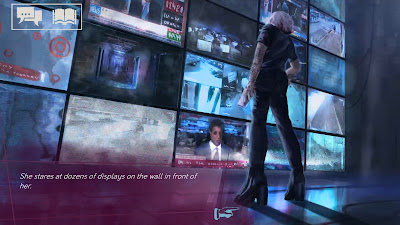
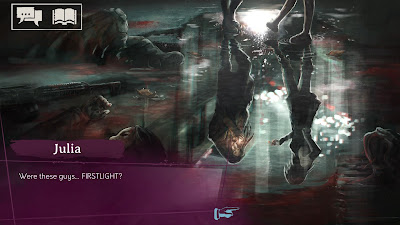
Visually, the two games are very similar, with a classic visual novel style. Almost all of the characters are vampires, and thus have a significant gothy vibe. The settings are cool: all the locations are in New York City, but instead of the major tourist locations we mostly stick to run-down industrial districts, overgrown community parks or quiet residential streets. The visuals in Shadows are stylistically similar but more impressive, particularly with subtle animations and lighting. Characters are static but seem to "breathe" with faint fluctuations. You'll sometimes see a pedestrian jogging by in the background, or a flickering police siren, or the flash of lightning over the Brooklyn Bridge. These add a lot of life to the atmosphere.
MINI SPOILERS
Gamewise, though, Shadows is pretty different from Coteries. Shadows is a very straight visual novel. You can occasionally choose which of two or three locations you will visit on a given night; these locations can sometimes provide a bit of background lore or insight, but they're mostly just flavor. You are playing as a predefined character, Julia, who speaks almost all of her lines unprompted. Occasionally you can choose between one of three dialogue responses. These have a minor impact on NPC's opinions of you and can influence their future dialogue. At five points during the game, you need to choose between two options. Sometimes this is a course of action, but more often it's just deciding how you feel about something. These five choices collectively determine which of two endings you will receive for the game.
Overall, it's much less game-y than Coteries was. You can't choose between different player characters, you always have access to the same Powers, you don't need to worry at all about your Hunger level, feeding is just a stylistic choice, using your Powers doesn't have any consequences, your side-missions are all standalone vignettes instead of an evolving plot, NPCs don't really track their opinion of you.
MEGA SPOILERS
The irony is, though, that Coteries has a lot of game systems that don't actually mean anything in the end: it doesn't matter what you do, the story always ends in the same way. Shadows has almost no game systems, but it does allow you to influence the outcome, albeit in an oblique way.
Somewhat amusingly, the Steam achievements for the two endings are labeled "Good Ending" and "Bad Ending", although they arguably should be reversed. The "Bad" ending is the one where you hold on to what remains of your humanity, make up with your girlfriend, and strike out west for a life of freedom. The "Good" ending sees you mercilessly pursue power and achieve your putative goal at great cost.
So, which is better, Shadows or Coteries? I enjoyed Coteries more while playing it, but after finishing both I think I give the edge to Shadows. I'm a huge sucker for player agency, and having at least the possibility of a lighter ending made the whole experience feel fun.
As for the actual plot: It was pretty enjoyable. There are a lot of callbacks to Coteries, which I mostly enjoyed, though if I hadn't played the game somewhat recently much of it may have gone over my head. The plot felt both more sprawling and more focused than in Coteries. Sprawling in that all of the side-quests were pure flavor and didn't tie in to the main plot at all, unlike Coteries where the side-quests determined who was in your coterie and would accompany you at the end. But it's more focused in that you learn relatively on what the main point of the game is ("Find out who killed Boss Callihan and why"), unlike Coteries which felt like "You're a vampire, now go do vampire things and see what happens."
The tone of the game felt very different from any other V:TM game I've played. Apparently this is due to the protagonist being a member of the Lasombra clan, which I haven't encountered; that, in turn, seems to be due to some recent meta-plot development, which have moved the Lasombra out of the Sabat and into the Camarilla fold. Anyways, it was a little startling to learn that the PC has a mortal girlfriend (not a ghoul!) who knows that the PC is a vampire and is cool with it. But, it's explained well in-game as being due to the Clan's hatred of slavery. In general, Julia seems to be much more in touch with her previous mortal life than other V:TM characters, and she regularly bumps into old friends and colleagues without it being a big deal.
I don't generally prefer predefined characters in games, but Julia had a great voice and was a lot of fun. She's cynical and sarcastic, but her cynicism is fueled by a strong sense of justice and a belief that the world could be better than it is. She's also bright and well-read, with references ranging from Bulgakov to meme culture. While still a gloomy game, there's a lot of good humor sprinkled throughout, thanks mostly to Julia's perspective on events.
END SPOILERS
I'm not a big expert on White Wolf lore, but am learning more all the time. About 99% of my information comes from video games, and 1% from going down wiki rabbit holes while looking up stuff from the video games.
As I've mentioned before, I do really appreciate how Paradox is handling the World Of Darkness property. It's a bummer that V:TM:B2 has been canceled, but that hasn't held up the trickle of lower-price-point games like these. It all helps with the worldbuilding and keeping the scene vibrant. I really appreciate games like these as palette cleansers between the often daunting RPGs that I can't seem to stop playing.
I have a short update on a very long game, and a long update on a very short game, both published by Paradox Interactive!
I've abandoned my Feverian run of Stellaris, thanks entirely to my own stupidity. The game had been going great: my "be nice or we'll beat you up" hegemony had absorbed every single empire in the galaxy shortly after 2300, and my empire was already researching future techs. I'd vassalized and absorbed a few other empires, was the sole Council member in the Galactic Community, terraformed all my planets into Gaia worlds. And then, like an idiot, I rivaled the Fallen Empires.
I think I was remembering my previous Pacifist game, where it was surprisingly hard to get the FEs to attack me, so I wanted to start preparing the groundwork early. And I was just starting to build Gateways, so Influence was in shorter supply than ever. But of course you can't choose when the FEs will attack you. Oddly enough, it wasn't the Fanatic Xenophobes, but rather the Fanatic Materialists who came after me. Their Fleet Power was maybe 25% or so higher than mine, and at first they did the trademark brain-dead FE thing and flew away in the exact opposite direction. But once I started attacking their bases they quickly returned and annihilated me, including my brand-new Juggernaut. Alas.
It would be interesting to keep it going and try to recover, but I decided to call it a game and try something else out. During a recent Steam sale during Paradox's annual convention, they offered big discounts across their entire catalog. I picked up a handful of other Stellaris DLCs I wanted, like Distant Stars and Ancient Relics; and I also grabbed Vampire: The Masquerade: Coteries of New York, which is by another studio called Draw Distance but published by Paradox.
It was pretty big news a couple of years ago when Paradox acquired rights to the World of Darkness, which have languished since the demise of Troika. The big reveal was the proper sequel to Bloodlines, which I have been excited for and then alarmed about. But in addition to that big-budget game, Paradox has also been partnering with a surprisingly wide range of developers for lower-budget indie-esque takes on the property. I don't remember seeing an approach like that before; the closest analogue is probably Lucasfilm, making a bunch of Star Wars-themed games across a wide variety of genres and game types.
Coteries of New York was one of the (or perhaps the?) first games to come out under the new arrangement. At first blush, it looks a lot like a visual novel. It's very text-heavy, with no recorded dialogue. The vast majority of scenes show a single character standing in front of a background scene, delivering dialogue, and eventually culminating in a three-choice response from you.
That said, the production values are a lot higher than you'd expect from a Ren'Py-type visual novel. The backgrounds in particular are fantastic. When looking at a map of New York City, the arterial streets pulse with blood. Flickering fluorescent lights battle against downpouring rain to illuminate a darkened storefront. Dancers jump and writhe in the background of a club.
The visual design is also fantastic. The character designs are a real highlight, with the vampires looking brooding and magnetic. The city itself is wonderfully gritty; you're often just around the corner from some famous tourist spot, scraping up against the real hard edges of the city, with potholed streets and rusty drainpipes and overgrown bushes.
The overall writing and dialogue are really good. There are a handful of minor typos, and a couple of places where it seems like some lines are just skipped: you have to press "Continue" twice to advance, and then see a response without any prompt. But with so much text these minor hiccups don't really stand out. Each character has a nicely distinctive voice, recognizable motivations and personality. Almost all of the action in the game is communicated through text instead of visuals, and they do a great job at making you viscerally feel the punches and gunshots and metallic taste of blood thanks to the evocative writing.
Music is great in the game, with a mix of ambient tunes and background sound, but there are some inexplicable silent stretches in the game that made me miss it.
And the gameplay? Well, the introduction is a pure straight-up visual novel. There are lots of branching paths choose-your-own-adventure-style, but no real mechanics. Once you move into the main game, there's a bit more gameplay, but it's very light. The game really just has one mechanic, Hunger. Your Hunger increases slowly over time, and more rapidly if you take physical damage or use vampiric abilities like Presence or Fortitude. Hunger decreases when you feed on humans. I never saw what happens when Hunger gets too high, but presumably it's Very Bad.
From what I can tell, you should pretty much always Feed whenever the game gives you the opportunity to do so; these chances just come up at predefined points during specific stories, so you can't seek them out when Hunger gets high. There are a few symbols that appear on Hunger-related options, and sometimes they are unavailable, which I think might mean you have too much or too little hunger? The symbols were honestly a bit annoying, they only tell you what they mean once and you can't look it up again later, either in-game or anywhere online.
In practice, most Hunger-related situations feel like a wash. Using a vampiric power will increase Hunger while letting you avoid damage; not using the power will deal you damage and thus increase Hunger. If you Feed early in a mission, you'll probably face an encounter later that increases Hunger again. Not always, though! The game does generally make sense, and based on what you know about situations and characters, you might be able to navigate through a scenario without ever using a Power or getting injured.
All of this power and hunger and blood stuff lines up very well with my previous experiences in Vampire: The Masquerade: Bloodlines, and presumably with the original White Wolf pen-and-paper game. Overall the game feels very lore-friendly. Stuff is explained well in-game and aligns with the overall mythology and mood of V:TM.
While hunger is the one mechanic, you do have a good amount of control over what your character does, mostly driven by mission selection. In the main part of the game, you can choose what to do each night. Most nights you can do two things, some nights only one. Usually a given subplot will have a slight pause between acts, forcing you to spread your attentions a bit instead of just following one line until its conclusion.
Unlike, say, the Shadowrun video games, you will only be able to do a limited number of sidequests during the course of the game. There are a limited number of nights, and the main plot automatically progresses on specific nights regardless of your actions. I think you're best off going "deep", picking a couple of specific stories and following them through to completion, rather than going "wide", starting a bunch of different stories. Which specific stories you follow don't seem to matter much, but at least one should probably involve recruiting coterie members.
MINI SPOILERS
Coteries of New York is good on the "choice" front, but not so good on the "consequences" side. For example, you can pick one of three characters to play as; but based on what I've seen after 1.5 playthroughs, the main part of the game is the game for all of them, with some relatively minor flavor text differences. You seem to have a lot of choices in how you progress through the introduction, but either you get railroaded into the same main plot or the game ends early. I was curious if your actions during that phase could cause you to become aligned with another faction, but it doesn't look like you can.
People do pay attention to how you treat them. For coterie members, that seems to affect whether they agree to join you or not. For other characters it affects their dialogue. Different people like different things and require particular approaches: for some people, you have to be really direct and project a tough image, while for others you have to be deferential and polite.
So, the game does track your words and actions, but that's the only thing it tracks. There aren't any items to collect or gear to upgrade or powers to learn or anything. It's all about relationships.
MEGA SPOILERS
This seems like a prime example of a "buy it on sale" game. I feel kind of bad writing that, since I always say that I want shorter games, and at about five hours for a playthrough this is actually a pretty awesome length for me. But the actual ending, while very appropriate to the lore and mood of Vampire The Masquerade, feels unsatisfying.
I was reminded in some ways of the Shadowrun games. In both universes, you are only a tiny insignificant pawn of far greater forces: the megacorps and the dragons of Shadowrun, or the ancient senior vampires and centuries-old traditions and societies of V:TM. I feel like the Shadowrun CRPGs do a good job at honoring this setting by emphasizing the impact you can make on a small slice of the world, even if you can't hope to change the status quo. In CoNY, you are left feeling like you had no agency or purpose at all, which is a much more deflating feeling for a player. (Though, granted, very much in line with my understanding of the tone of V:TM.)
END SPOILERS
As noted above, this game is on the short side and might be something to wishlist rather than purchase; I was really happy with it at $8, but I might have been more bummed at $20. If you really like vampires, though, this game delivers them in spades.
It's available on Steam for all computers, and on consoles, including the Switch. I actually feel like this would be an excellent game for mobile play: it's divided into nice short storytelling chunks, is text-heavy, and doesn't have any time-sensitive action gameplay. It would be great for commutes and plane flights now that we're doing those again. It's interesting to me that it isn't available for tablets or phones, since it isn't extremely technically advanced and seems like a great match for those devices.
While I didn't love this game, I did thoroughly enjoy it, and will be checking out the sequel once it's on sale too. Paradox has been publishing a bunch of World Of Darkness games, some of which seem to be even more text-heavy than this one. This seems to be a sensible direction for TTRPG adaptations, to try out a bunch of different projects with different partners aimed at different markets, rather than putting all of your eggs in one basket and hoping that a decade-long effort bears fruit.
In many ways, the visual novel (or text adventure!) adaptations seem to be closer to the experience of playing a pen-and-paper roleplaying game with a GM than a graphically-intensive first-person open-world game would be. It's all about imagination, and words can be incredibly evocative if we let them be.
I kind of vacillate between this blog being a record of all the stuff I've read / played / whatever, and just being a pressure valve for when I have something in particular I need to get off my chest or I want to work through some ideas. In the earlier days of this blog I would occasionally put together round-up posts that minimally checked the boxes for media I'd recently consumed. This is something like that! Mini spoilers on each topic below.
I've continued working my way through two fun real-world-but-also-science-fiction-y series. The first is the Company by Kage Baker. I previously wrote about In the Garden of Iden and Sky Coyote, and just finished Mendoza in Hollywood. Mendoza is a wonderful protagonist, and it's really cool to see her continue to mature and adapt to her role. She's nowhere near as cynical as Joseph, but is slowly moving in that direction. This novel was especially interesting because it felt much more focused on Company employees, unlike the first two which (as I recall) paid more attention to the natives. We're getting a better sense of the very broad range of personalities among the Immortals and their various goals and quirks. I'm also really digging the development of the overarching mythology. This series had very specific rules laid down from the very start, and we're now getting more and more indications that those rules aren't as absolute as they once seemed. It's a long series and I'm not in a particular rush to get through it, but I'm getting more intrigued the further I get.
Also, as promised, I'm continuing to make headway in Charles Stross's Merchant Princes series. The writing gets better and better with each book, especially the dialogue, which has been getting more natural while still being fun and snappy. My favorite aspect, though, is the gonzo approach to plot. The stakes keep on getting raised to higher and more ludicrous levels, with (mega spoiler) interdimensional weapons of mass destruction and the recent revelation of Dick Cheney as the latest grand villain. The characters are a lot of fun too: the supporting actors can seem a little thinly sketched at first, but across multiple novels they've had plenty of opportunity to grow more complex and endearing. But Stross also doesn't have any hesitation about killing off beloved characters for dramatic effect. The most frustrating thing about these books is their cliffhanger endings, which are really egregious even for thrillers. I'm slightly tempted to wait until the series is officially over before going any further, but may not be able to hold out, we'll see!
A few months ago I played and loved Butterfly Soup. I didn't give it its own post... it's pretty clear that the game wasn't created for me, and I don't think I have much of value to say about it, but I thought it was incredibly charming and thought-provoking and kind of inspiring. Min in particular is an incredible character, and I couldn't help laughing at almost everything she says: she's a tornado packed into a tiny human body, throwing all of her passion and fury at anything that gets in her way. It's especially great to see how the game interface can uniquely enhance her presentation: little touches like the way the screen shakes whenever she speaks do a lot to enhance her surreal qualities, and is a wonderful use of this medium.
(End spoilers!)
It'll probably be a little while before my next media post. Continuing my recent nonfiction reading on economic topics, I just picked up the famous Piketty book on Capital in the Twenty-First Century. I'm pleasantly surprised at how readable and engaging it is: I was expecting a more dense financial tome, but it's clearly written for a general audience, structured very clearly, with patient and welcoming language. It's also been a fun surprise to see so much attention paid to plots and characters from novels by Jane Austen, Honore de Balzac and other 19th century novelists. Still, it is a long book and much less of a bedtime read than Stross or Baker, so it'll take some time for me to finish.
Any time I write about a visual novel game, I feel the need to preface it by saying "I don't play many visual novels," which feels increasingly inaccurate as the number of entries in this tag grows. While by now I've completed a good half-dozen or so, though, I'm very aware that the ones I'm attracted to are outliers, that consciously seek to challenge the tropes of the form. Which, again, is odd, since it means that I've spent many more hours playing critiques of visual novels than I have playing "normal" visual novels.
This has been true of the Christine Love games, which remain some of my all-time favorites, and is true as well for Doki Doki Literature Club, a free Steam game that has exploded in popularity, through... hm, I wanted to say "word of mouth", but everyone is very hesitant to go into much detail about it. The Love Conquers All games play with the genre's form, subverting it and critiquing it, but ultimately embrace it. DDLC, on the other hand, sometimes seems to be out to destroy the genre: cutting right to the heart of gaming in general, but visual novels in particular, exposing some serious problems with the structure and content of such games and, ultimately, kind of calling for action.
So: Visual novels can be about anything, can be told in any sort of voice, can have a variety of gameplay elements or no gameplay at all. However, from what I can tell, the most popular forms of visual novels (at least in the US) are "dating simulators". In its most stereotypical form, you play as a first-person (never seen) male protagonist, moving through a story that sort of doubles as a harem of eligible women, selecting dialogue and action that will prompt one (or more) of them to fall in love with you: you generally "win" by having a mate at the end of the game.
MINI SPOILERS
At first glance, DDLC is a note-perfect addition to this turnkey formula. It's set in a school. You are a somewhat aimless student. Your childhood friend invites you to join the literature club, which you quickly learn is full of "four incredibly cute girls!" Each has their own distinctive personality quirk, easily-recognizable interest, and is very motivated to get to know you better.
The actual gameplay feels rather light. You almost never get dialogue options, and can't influence your player character's personality or story: you love manga, don't read many books, are slightly shy, and want to get along with everyone. The insertion of gameplay is one early unique element in the game: at the end of each night, you write a poem. You do this by selecting from a series of words. Chibi versions of the love interests appear on the screen and will react as you select them: between this and the in-game dialogue, you can get a sense for what type of content each person prefers, and can write a poem that will appeal to them.
As a side note: I opted to impress Yuri, mostly because she's the least child-like character. The dialogue focuses on the idea that she prefers poems that have a lot of imagery and symbolism, but from what I can tell, she actually prefers scientific words (universe, infinity, etc.) and complex multi-syllabic words. Actual imagery and symbolism (rainbow, flower, etc.) count as "cute" words and will appeal to Natsuki instead.
Anyways: For the first half or so of the game, the gameplay mostly consists of doing one of these poem-writing exercises, then just "click to continue" for 20+ minutes of dialogue for the next day, then repeating with a new poem. You do get some opportunities to decide in what order you will show your poem to the others, which slightly affects dialogue but doesn't count as a major choice. I think there's just one proper in-scene choice, where you choose who to side with during an argument.
This segment of the game is long and played very straight. I'd avoided any detailed spoilers, but, well, just the opening screen of the game gives a hint that something is coming, and my radar was activated for any signs of incoming strangeness. There are just a handful of lines over the first couple of hours that indicate everything is not what it seems: occasionally someone will say something slightly odd, or do something without any explanation. This is mostly addressed in-game through your character's own reactions. Later on in the week, some of your classmates' poems grow increasingly unsettling, but "you" respond by going "That's kinda weird, but hey, I don't know much about literature."
As I was playing, I kept waiting for the other shoe to drop. I kept waiting for a really long time. I'm uncertain whether this long wind-up is necessary... I kinda felt like the pattern was established after the first day or two, and it honestly got a little painful to sit through the longish, stereotypically drawn-out-but-inconclusive scenes with Yuri.
MEGA SPOILERS
In retrospect, though, the long time spent in the first act pays strong dividends in the later ones. By setting so much content in place, the eventual turn feels much more meaningful and less gimmicky than it would with a shorter story. The sheer amount of material almost wears grooves in your mind while playing, its very repetition establishing "this is how things are", and so once that material changes, the difference feels profound.
This is most obvious in the text and disturbing art, but what I'm thinking of now is actually the music: that happy ditty theme-song constantly plays for hours as you play, long past the point where you stop paying attention to it, where it becomes purely ignorable background music. So it is DEEPLY unsettling when just a few notes in that song change to a minor key. This slight diabolical chord instantly sends shivers down your spine: even absent any other signifiers, you are alerted that something is wrong, the center is decaying.
It's around this time that I decided to continue playing the game during a well-lit weekend afternoon. I can enjoy horror, but those early elements were already freaking me out enough that I knew I didn't want to go to bed in the middle of it.
So: The game takes an abrupt out-of-tone turn, coming to a shockingly sad end. And that's where the weirdness really starts to kick in. You're taken back to the main title screen, but it's different now: letters in the menu have been corrupted, as have some character images. And you'll quickly find that your save game files have all been deleted!
Pressing on, you start a new game, but it's... different from before. Nonsense text appears on the screen at random intervals. After a false start, and then another, it starts again, but a bit differently: the overall plot and thrust of the game is the same, but the details are different. A sense of malaise hovers at the edge of the dialogue. Visuals glitch. The music grows ever more unsettling, like a nightmare calliope.
The limited gameplay now feels like a tight constriction: before I might have aesthetically preferred more freedom to express myself, but now it's like I'm tied into a straitjacket, loaded onto a crash-test car, hurtling forward towards something awful, with no opportunity to escape.
There's a compelling sense of mystery at this stage of the game: it's obvious that Things Are Not Okay, but who is behind it? And why? My suspicions were directed towards Monika from early on, but as time goes on and everyone's behavior grows more erratic, it became increasingly difficult to discount Yuri as being the architect of whatever was going on. Still, I tend to be stubborn in my gameplay, so even as it seemed like a worse and worse idea, I continued along the Yuri track.
Around this time, the game starts actively fighting you, in some really fun and surprising ways. When prompted to choose who you will spend time with, you come to find that you're fighting the mouse cursor, which keeps gradually shoving over towards "Monika" while you try to move it elsewhere. Soon after, it blocks you from saving the game, telling you there's no point any more.
After yet another horrific "ending", the game further degrades, with you seemingly stuck inside a loop in a macabre scene as corrupted text spews out. After spending ages clicking through, I tried reloading earlier saved games or exiting and restarting, but no matter what you do you're immediately taken back to that sad scene. At last stuff gets cleaned up, the fourth wall gets torn down, and the plot is explained.
The game gets awesome here - I don't even want to talk about it in the Mega Spoilers, but it simultaneously gets less mysterious and more chilling. It evokes one of the best bits of Analogue: A Hate Story, but with even better ludonarrative harmony. I figured out pretty early on how to proceed, but the dialogue (or, okay, monologue) around this point is so good that I let it play out for another cycle before proceeding. (It's great to see that the game is so explicit about what you need to do: people who already know can feel like they're one step ahead of the game, while everyone else can get unblocked, and learn something new in the process.)
The final coda is refreshing, then surprising. I was actually down to explore the Sayori arc a bit more - as long as she isn't actively murdering people, it doesn't seem like it's necessarily that bad - but the "Shut it all down!" ending is super-satisfying, both in-game and in real life.
Anyways: I've kind of recapped the plot without getting into any of the themes, which is at least as memorable as the formal trickery. The story focuses on something that I've been worrying about for years, in my own games as well as those I play: non-player character agency in video games. I wrote about it at some length in my Shadowrundevlog, and DDLC tackles it head-on.
So: Ultimately, characters aren't real people. They're created by writers and developers to fulfill certain roles. This is also true in fictional novels and comic books and all sorts of media. In video games, though, this can seem especially pernicious, because the player interacts with these "people", and they respond to him or her.
First up, there's this ambiguity of identity between the player and the player character. To what extent are these purely fictional relationships being forged between the in-game avatar and the other NPCs, and to what extent is a relationship being created between the real-life player and those same characters (or, I would argue, the creator of those characters)? If you've ever done something nice in a game, and had an NPC say "Thank you for helping me, CHARNAME! You are a good person!", you might have gotten a small, warm, fuzzy feeling in your stomach. "That's right," you might have said. "I am a good person!" We create identification between our real selves and our fictional virtual selves, and derive pleasure from the achievements of the latter.
That pleasure generally increases as characters grow more believable and complex. But, as players grow more focused and invested in the game, they can start to ascribe too much meaning and importance to these fundamentally artificial and unrealistic relationships. It's a step beyond, say, reading romance novels: you aren't just admiring or aspiring to something, but sort of onanistically identifying with your avatar.
That same believability gets particularly insidious in the context of video-game romance. It's one of those things that outsiders to the form can see a whole lot more clearly than those of us who play a lot of games: it is weird to have a lot of people throwing themselves at you and professing their undying love because you clicked a couple of buttons. They have no choice - they are just characters programmed to do so - but it can be tempting to think of this as an earned "conquest". The big risk, of course, is those sentiments bleeding over into the real world: believing that love is a game, that if you choose someone and select the right things that they will give you their affection, and if they don't then something is defective.
DDLC seems to take aim at the central conceit of having characters programmed to love you and blows it up. I think there are other potential solutions, though. While I've complained about this in the past, I increasingly like BioWare's approach to romance: not just restricted romance, where some characters have certain preferences which may exclude the player character, but also characters like Aveline and Harding, for whom you can express affection but who will not reciprocate. At the very least, this pops the illusion that everyone in the world has the hots for the player and that their lives revolve around him or her. In my own work, I've tried to double down on tension between the player character and the NPC to create the impression that they have free will: ultimately, of course, a fictional character doesn't have agency, but allowing them to veer off in other directions, express disapproval, or second-guess their choices can at least make this an illusion that love is something which is given, not won.
I'm still kind of mulling over what DDLC was saying. It feels like a somewhat nihilistic message, turning away from something artificial in our entertainment, as opposed to the Christine Love games, which are more about finding something valuable in our games and then bringing that back with us to the real world. But both get a lot of well-earned and well-crafted mileage by skating along the line between reality and fiction, between player and avatar, and leave you with plenty to think about.
END SPOILERS
I have a hard time recommending Doki Doki Literature Club. The subject matter will be offputting to a lot of people, and even people who really enjoy one aspect of it may end up disliking the other. But I do think it's one of the most well-crafted games I've played recently. It does very specific things to create tension, to heighten reactions, to draw out your emotions and induce whiplash. I've already found myself thinking about how techniques in this game might be adapted to hypothetical future projects of my own. DDLC can be a hard game to enjoy, but it's a very easy game to admire, and I think it has a ton to offer anyone who wants to provoke emotional responses in other people, as well as players who are interested in peering behind the curtain and exploring how experiences like this can work.
I've been a big fan of Christine Love's games ever since my first experience with Digital: A Love Story, one of the most emotionally affecting games I've played. She's also formed almost the entirety of my experience with visual novels, a subgenre of adventure games that are text-heavy and relatively linear, accompanied by striking character and background art. Analogue: A Hate Story was brilliantly designed with clever mechanics and a compelling story, and Hate Plus has the best example of breaking the fourth wall that I've ever seen in a video game.
Given all those positive experiences, I was eager to pick up her latest, with the Fionna Apple-esque title "My Twin Brother Made Me Crossdress as Him and Now I Have to Deal with a Geeky Stalker and a Domme Beauty Who Want Me in a Bind!!", but almost universally referred to by the relatively short title "Ladykiller in a Bind". I was also hesitant: the game is cheerfully pornographic, shifting from the more cerebral romantic thrust of her earlier games into a joyous celebration of queer and kinky sexuality. That sounded intriguing, but also intense, and I held off for a while before picking it up.
Due to the subject matter, the rest of this review should probably be considered NSFW. I'll refrain from any naughty images, but there's some suggestive captions in the screenshots.
Christine Love continues her tradition of mechanical innovations. Where Analogue featured an in-game command prompt and a nonlinear database of records, Ladykiller's marquee feature is probably its conversation system. In a typical game dialogue system, you are presented with a node of text, and then select one of several mutually exclusive responses, each of which leads to another node (similar to classic "Choose Your Own Adventure" structures). This system has been a hallmark of computer games for approximately five centuries.
Ladykiller upends that. Now, conversation prompts are shown as soon as they become relevant, and continue to display while they remain relevant. It is extremely rare for you to be forced to choose something to say. Most often, other people will continue speaking, and the initial responses might be joined by others that become relevant as the conversation continues, different items eventually fading and disappearing as they cease to apply.
I'd read a description of the system before playing, and it ended up being a lot better than I expected. I had thought it was a real-time system, with constantly advancing text and a quick trigger finger required to pick the best option in time. Instead, the actual mechanics are the same as any visual novel: you read one node at a time, and can click any node to proceed. The big difference is that you almost always have a "continue" option, which advances to the next node, but does not necessarily dismiss the existing options.
The overall effect is terrific, a natural-feeling conversation that ebbs and flows, one you participate in but do not dictate. Personally, I tended to play it cool, always waiting to hear as much information as possible before interjecting (which, as I'm typing this now, I realize is exactly my conversational style in real life), and only making choices at the last possible moment before they fade away. And quite often I would choose no option, either because I was unhappy with any of them or because it seemed most in character to remain silent.
I was intrigued by the silence option. I was reminded of an experiment I made back in the original Antumbra which felt like a pale imitation of this: I had a goal that the player character could go through the entire game as a silent protagonist, and so every conversation had a "Remain Silent" option. I really liked the concept of it, and thought way too much about the meta-implications of it (I, as a developer, cannot anticipate every action that my players will want to take, and so I wanted to always give them the opportunity to protest the limited options I gave). In practice, nobody seemed to care much about it one way or the other. It was also a bit of a pain to write for, since I always needed to give a believable reaction to the other speaker AND still manage to advance the plot, so I dropped it for the sequels.
Anyways: here, skipping conversation prompts doesn't necessarily mean that your character ("The Beast") will remain silent. Sometimes she'll just shrug, sometimes she'll say something neutral like "I really couldn't care less", and sometimes she'll actually make some other statement not covered by the earlier ones. So it's a bit less pure than I'd been imagining, but still works really well. In particular, it feels like a great out to give to the player, even if the character doesn't necessarily remain speechless.
I write a lot on this blog about the links and divisions between players and characters, but Ladykiller puts those to shame, creating an almost dizzying level of mediation between you and the story.
MINI SPOILERS
So: there's you, the person playing the game, who can be anyone (male, female, other, straight, gay, other, young, old). There's the character you're playing, The Beast (18 years old, female, lesbian). Then there's the character SHE'S playing, The Prince (18 years old, male, possibly asexual). The Prince has a very well-defined character: he's an asshole, manipulative, ruthless, bright. The Beast's character is fairly well-defined (rebellious, poor student, confident, amorous), but you can exert a fair amount of influence on its expression (how generous she is, how trusting, how ambitious).
So, for almost any choice you face in the game, you need to process through three questions, which are almost guaranteed to be in conflict:
How do I, the person playing the game, feel about this action? (Personally, I'm drawn to the boring "be nice to everyone and make everyone like me" school.)
What would The Prince do in this situation, so I can avoid blowing my cover? (He would probably be cruel and haughty.)
What should The Beast do here? (Kind of a mediation between the two, but I'm trying to hold true to my perception of her character.)
And certain scenes go even deeper down the rabbit hole: when spending time with The Flame or The Lieutenant, they may ask you to play out a scene to advance their own goals, adding even another layer of indirection to make my head spin.
My overall strategy, such as it was, was to try and be compassionate around the people I cared about, even when it led to increased suspicion. (In the mechanics of this game, you lose when suspicion rises high enough, although it's relatively easy to lower... for a price.) I would compensate by acting like The Prince when it wouldn't bother other people or when around people who I disliked. This worked... okay. I had to sleep with Beauty once to erase my suspicion, and did so again the next time it rose high, although in retrospect I could have skipped the second time since I didn't gain any suspicion on the final day.
Oh, yeah: sex is mandatory in this game. But, in the theme of mediated experiences, it isn't mandatory for the PLAYER. There are options to skip all sex scenes, and a hilarious option to make all the characters wear ugly Christmas sweaters during otherwise-nude scenes. But story-wise, each night ends with you making love to either the shy and sweet Stalker (named the Hacker in my game), or the scary and sexy Beauty. There are mechanical benefits attached to each: more votes to win the contest from the Stalker, or a free pass on suspicion from the Beauty. You can either pursue the mechanics and select your romantic partners to advance that goal; or you can select a romantic goal and then adjust your behavior to negate the mechanics (e.g., avoid suspicion during the day to ensure you can spend every night with the Stalker). I kind of muddled through both. In retrospect I kind of wish I had focused on the Stalker... but that would have made it harder to pursue some other the other characters' storylines in the direction I wanted, so, idunno.
MEGA SPOILERS
Like a lot of visual novels, LKiaB features romance "routes": series of scenes related to potential partners. The first route I followed was that of The Flame (née The Photographer), the only "pure" lesbian on the ship. But, of course, since this game is confusing, she doesn't see you as a natural partner: she sees your asshole brother.
I liked The Flame. Everyone in the game acts scared of her, and she is manipulative, but... I dunno, I liked the way she talked? She's clearly ambitious, but you get a hint of the insecurity underlying it?
Like most (?) of the daytime routes, you can get up to some hanky-panky with The Flame, but it isn't really fully consummated in the same way as The Stalker and The Beauty are. I might have played a little differently if I'd understood that - heck, I probably will if and when I replay. It's still good, you really get to know the characters well and have a relationship arc with them, but you can't end up with any of them.
My next focus was The Lieutenant (aka The Nerd). Man, I really liked her! I'm not usually into the tsundere thing, but she was AWESOME, and I probably laughed at her dialogue more than anyone else's. She's SO uptight and rigid and sheltered and AGHAST at all this ILLEGAL UNDERAGE DRINKING going on around her.
I might have been bummed if I'd done her route first, but since my expectations were tempered by The Flame, I ended up really loving it. I like that you kiss, and it isn't this magical wonderful enjoyable experience. (Her reaction is terrific, befuddled and slightly incredulous.) There are some really good lessons that The Beast imparts near the end of this route, which (as is so often the case in Christine Love games) I'll be seeking to apply to my own life.
The Lieutenant is one of the few characters where I felt like I (as the player) was very out of step with how The Beast perceived a situation. I really, genuinely, honestly liked The Lieutenant, but The Beast canonically finds her shrill and untalented. The Beast only begrudgingly finds a limited aspect of The Lieutenant to like, while I admire all of her.
I didn't get through much of his "route", but I was surprised by how much I liked The Athlete. It just was... nice, relaxed, friendly. In retrospect I wish I had done this first, and I'm pretty sure I will if I play it again: he's an ally, someone who provides useful information and advice, and seems like he could make a perfect wingman. Plus you don't need to worry about suspicion with him like you do for most other characters.
In the end: I "nope"'d out of the Day 7 stuff and got what appears to be the default ending. Which I'm happy enough with. I was actually basically on-board for the whole kidnapping plot and ransom demand, and might have cooperated from the start if I'd known what was going on. Based on the information received in the game, the father seems like a thoroughly unpleasant man, and I'm all about striking a blow against the imperial capitalist system. (I do really enjoy the ridiculousness of the dialogue in these sections. "Don't even worry about it!") I did kind of kick myself for not taking the opportunity to get back my motorcycle, though... it looks like that might unlock another ending. I'm pretty sure that, if I do replay, I'll shoot for an ending where it's just me and the Stalker riding off into the sunset.
END SPOILERS
I haven't written enough about this, but the dialogue is HILARIOUS. There's always been great humor in Christine Love's games, but usually it's sandwiched between dark and ominous themes. Here, the bulk of the game is joyous and silly and ridiculous, with just some darkness coming near the end, but most of the time it's a great forum for terrific one-liners, catfights, obscure pop-culture references, and just straight-up silliness.
The art is also terrific, with every character very well defined and unique, attractive in often-unconventional ways. I also loved all the animations, subtle movements that really help sell the characters: the little wobble The Stalker makes when she's embarrassed, the screen shaking whenever The Lieutenant is chewing you out, the incessant winking from The Beast. And the backgrounds look gorgeous: I've never been on a cruise ship, and I find it hard to believe that they actually look this nice.
So, yeah! I really enjoyed this game. It definitely isn't for everyone, even people who enjoyed the earlier Digital/Analogue games, but it's a really fun and unique outing, both as a game and as a story. Speaking personally, it was a really interesting introduction to some sexual and gender-related interests and experiences that I'd been vaguely aware of before but hadn't really known much about; I'm not going to pursue any of them, but I think I've gained a greater understanding of the different types of people in this world and things they like, and I think that's a good thing.
Albums! I debated how much to censor these, and ended up taking out all the ones with exposed naughty bits but leaving in the ones with fully-clothed sexiness and adult language. They're still NSFW, just not as NSFW as they could be.
As it stands, though, it's felt more like something I need to work through rather than move on from. Usually, after I finish a video game or novel or movie, I'm left with a burst of thoughts and questions and reactions. That's a major function that this blog serves: to capture and help me process that response in the moment while it's fresh. As time goes on, my emotional and (ugh) intellectual ardor gradually fades. I'm left with a handful of major impressions, and head off to consume my next piece of entertainment.
Life Is Strange, though, is one of a handful of things that has actually grown more significant after I finished it. In the immediate aftermath of the final episode, I was primarily obsessed with the technical details of the plot and metaphysics: figuring out who did what, who was lying, how various powers worked, reconstructing the timeline(s), and so on. I've gotten to a point where I'm more or less satisfied with all that: finding an answer that satisfies me, or concluding that there is no definitive answer, and choosing to either leave it ambiguous or adopt a particular headcanon that appeals to me. With that out of the way, though, I find myself left with... feelings, and reflecting over the characters themselves: the situations they were in, their relationships with one another, what it meant for them, whether it means anything for me.
And, well, that isn't a problem that can be solved. I can see why so many people are still drawing fan-art and such more than a year after finishing the game. While the game itself comes to a definitive end, the characters are so fully-realized that we keep on thinking about them.
As noted before, I've slipped into a mode of "MOAR CONTENT!", devouring even tangentially-related Life Is Strange material. One item that has been on my radar for several weeks is "Love Is Strange." This is a free, fan-made game which has become very popular within the LiS community.
I was hesitant to check it out. I thought that it would suffer in comparison to the professional game it's based off of, and was worried that it might somehow diminish my appreciation for the source material. Fan-created games don't have a great track record... even finishing something at all is a minor miracle, and making something people will be happy with is an even greater challenge. Still, I noticed that a lot of my favorite artists and bloggers frequently referenced it, which encouraged me to take the plunge to download and play it.
I'm really glad that I did! While it explicitly pulls from Life is Strange, it very much feels like its own beautiful thing, and not some pale imitation. For starters, it's set in an alternate timeline (or AU as the kids are saying these days): the same characters exist and have the same personalities (very well captured and represented by the authors), but the events in Life is Strange never took place. Love is Strange takes place one year later, without any super-powers or crimes or drama. It's an appealing but very low-key storyline, essentially a dating simulator, that's almost entirely focused on Max's relationship with her classmates.
The game itself belongs to the genre called "visual novel", dialogue-heavy games with static images. I haven't played many of these before; the only ones I can think of off hand are Christine Love's fantastic Analogue/Hate games. As people who are better-informed than me have pointed out, Love has created games that are really clever subversions of and commentaries on the visual novel format; but since visual novels are primarily popular in Japan, and her games mainly reach a North American audience, a lot of what they're doing is lost on us. Anyways - I really liked the Love games, and that background helped me feel at home when playing Love Is Strange.
MINI SPOILERS (for both Love Is Strange and Life Is Strange)
They did a really good job of capturing the voices of the different characters; I could totally hear Ashley Burch's voice in my head while reading Chloe's lines, or Hannah Telle's interior monologue when reading Max's thoughts. The characters all make sense based on what we saw during the game; at the same time, they weave in new details and plot threads that keep things engaging and interesting.
I think that, in a lot of cases, they wanted to evoke emotional reactions that paralleled what we experienced in Life is Strange. So, for example, Kate is facing new bullying. It's far less vicious than what she went through earlier, and both the cause and solution are original, but it feels kind of like an echo to her dramatic story in Episode Two. It's deeply cathartic to help her work through her problems, offering her support but letting her stand on her own and find her strength. Likewise, Chloe's plot can feel like a metaphor for both the ending of Episode Four and the Bay ending of the game. Depending on the decisions you made in the earlier game, you might be able to revisit a particular feeling, or perhaps explore a path you'd previously left untrod.
There are a total of four "routes" in this game: Chloe (duh), Kate (awww!), Victoria (!), and Rachel (!!). Unlike some other VNs, you don't bounce between characters during the game: instead, you pick one near the start, and then just focus on them for the duration of the game. That really helps replayability, since 90%+ of the content is new for each route (including multiple new locations and unique journal entries).
The dialogue mostly runs on rails, but there are... I dunno, maybe a half-dozen or so branching choices during each route. These can have some fairly significant impact, both on the direction of the story (where you go, what activities you perform) and your relationship. So far I've just played the Kate and Chloe routes, and I was happy to discover that I had achieved the "true" ending for both of them. It wasn't exactly trivial - I had to think carefully through a couple of choices to decide the best thing to say - but, again, they've done such a good job at faithfully representing the existing characters that we can draw on our knowledge of Life Is Strange, in addition to the text within Love Is Strange, to grok the other person's values and needs.
END SPOILERS (for Love/Life Is Strange)
Ultimately, I think Love Is Strange is kind of a hangout game. Much like a long-running TV show in which we've come to enjoy spending time with characters, it's fun to simply relax with them for a bit, without huge earth-shaking consequences hanging over our heads. It feels like a long, protracted release of breath after the intensity of Life Is Strange. I found myself thinking of the Mass Effect 3: Citadel DLC, which similarly gave the gift of more time with people we'd grown to love.
Of course, Citadel had the benefits of an entire AAA studio behind it, plus all of the original writers reprising their roles. Love Is Strange's origin story sounds miraculous: a bunch of fans on tumblr discovered that they shared a love of the same game, and passed around text and graphics and game code until they created this. That's incredibly cool! Oh, and something I haven't mentioned before: the music is great. It doesn't use "real" licensed tracks like Life Is Strange, but its background instrumental music fits the mood really well, and a couple of tracks in particular are quite emotionally stirring.
I've followed quite a few fan-game efforts over the years, and while there have been some amazing successes (Fall from Heaven 2, Counterstrike), they are vastly outnumbered by ambitious projects that have petered out. It's a big testament to the team for accomplishing this, and by proxy a testament to Dontnod for creating a game that inspires such enduring devotion in its fans.
While I was exploring the exciting new world of visual novels, I decided to pick up another entry that has popped up in my Steam Discovery Queue a couple of times. Highway Blossoms, a "kinetic novel" from Alienworks. I'd deliberately avoided researching it, and was initially disappointed when I realized that, unlike the other visual novels I've played, this one doesn't have any choices. No branching dialogue choices or gameplay sections or anything: just clicking through to advance the story.
After a very short time, though, I forgot my disappointment and got fully wrapped up in the story. The pacing is excellent, the dialogue punchy, and plot revelations are
carefully tuned to flow at a pace that keeps things intriguing without
seeming rushed. It also has a higher level of visual polish than Love is Strange; where LiS has a semi-impressionistic style loosely inspired by the Life Is Strange aesthetic, Highway Blossoms has a gorgeously vibrant aesthetic with sharply-designed characters and vivid backgrounds. While it looks similar to many other VNs, there is more movement on the screen. Characters will occasionally move around, backgrounds will slowly pan or zoom, clouds may float overhead. There are also some really pretty, very subtle lighting effects: seated around a campfire, characters will be lit by pulsing embers as the logs crackle and pop.
MINI SPOILERS (for Highway Blossoms)
Since Highway Blossoms doesn't have any choices, it of course only has one "route", that of Amber and Marina. Fortunately, it's a great one! They're terrific characters, as vividly drawn narratively as they are visually. Amber is the main narrating character. She's very independent, fairly private, deeply skeptical of the world around her, resourceful and nostalgic. Marina is opposite and complementary: bouncy, joyous, naive, trusting.
Those two characters utterly dominate the narrative and screen; when Marina steps away for a moment, it's unusual enough for Amber to comment on. However, they aren't the only characters; unlike other VNs, where almost everyone you see is romance-able, here there's a varied supporting cast that provides assistance and obstacles to the main relationship. These are more stereotypical characters, but engaging and fun.
Even more than the supporting characters, though, I think the environment does a great job at setting the mood and driving the story. The southwestern setting is fully realized, in the gorgeous backgrounds and evocative writing and lonely atmosphere. This is one part of the country that I've never really explored, and playing this game has pushed it high up on my list of future vacation destinations: the stark raw beauty and often alien surroundings makes the story... somehow both more epic and quieter, if that makes sense. There's a sense of timelessness and insignificance when you contrast the brief lives of these humans with the ancient rocks that will outlast them. At the same time, though, the absence of life on the barren rocks makes the vibrancy of human connection even more beautiful and precious.
The pacing of the main romance is fantastic. Amber's attraction to Marina is obvious from the very start, and it seems likely to be reciprocated. But Amber's natural reticence, skepticism, and recent emotional baggage keeps her at an emotional distance from Marina. It takes a long time of shared struggle and experiences to bring them together, and they don't fully connect until about five hours into the story. Among other things, this makes their love feel incredibly earned, more of a natural evolution of their characters than something presented for our enjoyment.
The romance itself also does a great job with consent. I've played a fair number of games with romances (typically RPGs), and am used to the PC and NPC deciding that they want to get together and then doing it. Highway Blossoms has made me reconsider how to present and portray consent... in the past I've thought that it would seem like a minor roadblock to overcome or a point of affirmation, but here it's... well, it's really tender and sweet, a genuine discussion that's integrated into their relationship rather than a barrier that guards the perimeter. It's also subtle, without a great deal of attention drawn to it, but that makes it all the more endearing: two people checking in on each other and making sure they're still on board as things develop.
END SPOILERS (for Highway Blossoms)
In the end, I was more than satisfied with my purchase of Highway Blossoms. Per Steam, it lasted a bit over six hours, and delivered a non-stop stream of high-quality storytelling (aided and abetted by terrific art and music).
That did kind of get me wondering, though… can you really call it a game? The only real user interaction is clicking to advance the story, which is more or less identical to, say, turning the page in a book. At the same time, though, it uses the media that we associate with games: it’s played within the Steam interface, mouse and keyboard in hand, looking at the monitor, absorbing the graphics and text and music and sound effects describing “our” character’s journey. It’s game-like, even if it isn’t a game.
And that raises a kind of existential question: what DOES make something a game? If Highway Blossoms had contained a single branching dialogue choice, would that have magically transformed it into a game? What if it contained a single dialogue choice that didn’t impact the rest of the story at all?
I don’t have an answer yet. I know it was good, and can worry later about whether it’s a game.
Highway Blossoms also made me think more about narration styles. I’ve grown accustomed to thinking of video games as fiction that’s told in the second person, but HB reminds me that this definitely isn’t required. It’s a fully-fledged first-person-narrated game, with Amber telling the story and revealing her inner thoughts.
I’m still thinking through the implications of this. One fairly obvious one is that a first-person narration puts more emphasis on the character, while a second-person narration focuses on the player. There isn’t a whole lot of room for the player to color their perceptions of Amber. They might have different REACTIONS to her, admiring or disliking or pitying various aspects of her personality and story, but I think every player will more or less agree on who she is and what she’s like. In contrast, a western-style RPG will typically give the player immense leeway to define their perception of the character, assigning them different quirks and traits.
To be a little less vague: A first-person narration could include a line like "I feel sad." But a second-person narration would almost never say "You feel sad". It might create a scenario in which tragic things occur, and might give the player the option to select an option that says "I feel sad". There's a deep-seated assumption that developers shouldn't assign or assume emotional responses to the player, but of course it's totally valid to assign those responses to the character.
And, of course, all of this makes me think of Life Is Strange (I may never stop). This is technically also a first-person game: Max is giving her own thoughts on things, providing her own descriptive text and objectives and such. But, with the player’s control over the character, there’s much more opportunity to shape your idea of the character. Many things stay constant: she’s always somewhat withdrawn, empathetic, observant, tenacious. Depending on how you play her, though, she may have different levels of attraction to different people, be relatively braver or more cautious, pragmatic or idealistic. It ends up feeling like a collaboration between the developers and the players, coming to a consensus on who this person is. That’s probably also true, to a lesser extent, in Love Is Strange: there are fewer parameters to play with, but we’re still more or less shaping our vision of Max and hoping that this version will find happiness. In contrast, Highway Blossoms’ protagonist is more or less presented as a fait accompli, and in Christine Love’s games, the protagonist is almost entirely defined by the player (or perhaps even one and the same).
So… I guess my very weak conclusion is that both the narrative voice and the player input can contribute to the player’s perception of the protagonist. I’ve adopted a particular gospel about “good” game writing, using a certain set of tools to accomplish a type of result, but this excursion into the foreign land of visual novels reminds me that there’s no one right answer. Depending on the goals of the developer, they might choose to use different tools in order to shape the player’s experience and create the kind of game they want to make.
Some other random thoughts:
Every single visual novel game I’ve played has used the Ren’Py engine. It’s kind of nice having a consistent interface and set of controls to learn. Once I learned that clicking the middle mouse button would hide the UI in one game, I could immediately start using it in the other. It was also interesting to discover the journal, which is a lot more significant in Love Is Strange but is still present in Highway Blossoms. I doubt that I’ll ever build something with Ren’Py, but I am kind of curious how modifiable it is; each game includes a programming credit, so there’s probably at least some scripting involved beyond the text and images. The most complex game remains Analogue: A Hate Story, with a surprisingly dramatic command-line terminal; nothing in Love Is Strange or Highway Blossoms reaches that level, but each of them does include their own innovations, like the achievements in LIS or the wonderfully dynamic lighting in HB.
I’m not sure how common this is in the genre, but the visual novels I’ve played have all been fairly long. Highway Blossoms clocks in at around six hours; Hate Plus requests that you play it over three real-world days. One practical effect of this is that we spend a lot more time getting to know the characters and absorbing them; in this respect, the experience is a lot more like a TV show than a movie. There tend to be multiple arcs, both shorter ones that drive individual segments as well as a bigger over-arching one that spans the length of the game. It’s… nice. AAA games often reach for a more cinematic aesthetic, but these days I’m more drawn to serialized television shows, and this approach rewards you with a more relaxed, thoughtful, sometimes deeper game.
Finally, because I can’t stop thinking about Life Is Strange, here are a handful of half-baked musings that don’t merit their own post and so will piggy-back on this one:
MEGA SPOILERS (for Life Is Strange, somehow, still):
I’ve been thinking about names a lot lately. I don’t think that every name in the game is significant, but a few do pop out. One big example: Chloe PRICE. It’s really evocative of the final choice you have to make, the sacrifice, the price to pay. Either she IS the price, what you might give up in order to save the town; or she HAS a price, the sacrifice to make in order to be with her.
Also, the title “Life Is Strange” itself grows in meaning the more I think about it. I’d initially interpreted this as “Gee, lots of weird stuff keeps happening!” By the end of episode five, though, I’d come to think of it as meaning, “Chloe’s continued existence is unnatural”. We give her the gift of life in the first episode, but that knocks the universe out of alignment; the longer she continues to live, the greater the chaos grows. I don’t really LIKE this interpretation, since it’s an argument for Bay > Bae, but it’s a compelling one.
END SPOILERS (for Life Is Strange)
Oh, yeah: albums! Here's Love Is Strange, here's Highway Blossoms. Both contain minor spoilers in the images and major story in the text and captions.
Yup! I’m feeling a lot better about visual novels now than I did after watching Welcome To The NHK. I doubt that they’ll replace RPGs as my genre of choice, but it’s been fun to see the different approaches they have to storytelling and become more acquainted with the conventions of the form. There are a couple of intriguing elements in these visual novels that I think could be adapted well to other games, and it always feels good to add another element or two to my creative toolbox.
On a more personal level, I’ve really appreciated the relatively calm and reflective mood of these games. Sometimes you want to make difficult decisions and save the world, but often you want to spend time with the people you love, and these games are great at offering the latter.