How weird is it that there are multiple cyberpunk bartending games out there? After the excellent Red Strings Club, I was looking forward to another spin on the, uh, genre, with VA-11 Hall-A: Cyberpunk Bartender Action. There are some surface similarities: both are dialogue-heavy, have a retro art style, feature strong transhumanist themes, and, y'know, involve mixing drinks for a parade of colorful futuristic patrons. That said, the games ended up feeling very different: in tone, in gameplay, in message.
The Red Strings Club featured a surprisingly varied set of gameplay mechanics, from crafting with a lathe to drink-muddling to suspect-confronting to hacking and so on. Valhalla has a surprisingly limited (yet effective) mechanic: mixing drinks. That's basically it. Select the ingredients, optionally add ice or age, shake it up and serve. That's pretty much 95% of the game.
This is especially interesting given that this is such a dialogue-heavy game with a branching plot. While your main action is mixing drinks, the vast majority of your time in the game is spent reading dialogue, both of your own character and of your patrons and coworkers. For quite a while I kept expecting to get a traditional dialogue menu: say A or B in response to this statement? That never comes. Instead, the branches follow your actions. Serve someone a drink with extra alcohol? They might loosen up more and become more talkative, or fall asleep under the bar. Mess up their order? They might leave in a huff. Remember their favorite from last time? They'll grow more attached to you. All along you'll keep talking to them: you can't adjust your character's attitude or voice, so Jill remains a very distinct character. And an incredibly likeable one, too! While others will periodically comment on how she seems cold or distant, you have the benefit of seeing her warm relationships with close friends, as well as her inner thoughts, and I grew very fond and protective of her over the course of the game.
There are only a handful of non-bartending actions that I can think of. There are a couple of one-off mini-games, which are brief but fun, and give you the chance to interact with folks outside of your normal routine. The other big one is the Jukebox: at the start of each shift, you load up the songs to play. At first glance this is entirely superfluous - who cares about the music? - but it becomes super-interesting. The tone of a conversation can change drastically depending on what kind of music is playing behind it: the words might be exactly the same, but you'll pick up a different vibe depending on whether the music is aggressive, melancholy, playful, triumphant, or whatever. And it's all random! I'm left thinking that I may come away with a pretty different impression of the game's story and its characters based on when the tunes I selected happened to be playing, versus someone else who did everything the exact same time but ordered their songs differently (or even read significantly faster or slower than me, causing the music to drift over different conversations).
It would be interesting to hear the game "scored" by someone who knew in advance which conversations were coming up and selected songs accordingly. I'm also left wondering how other video games might turn out differently just by changing their music and keeping everything else exactly the same; I'm reminded of those awesome movietrailer edits that drastically change the impression of a movie by just changing the sound.
Anyways: I'd cycled through the jukebox dutifully, going forwards and then back each time I could select songs, but eventually realized that I was landing on the same ones over and over. I finally started to mix it up more near the end and heard quite a few tracks that had never come up before. If I were to do it over again, I'd probably either keep a single playlist up until it had played all the way through and looped back, or else make use of the "Shuffle" feature to give more variety.
There isn't much else in the way of gameplay tips, but here are a few random observations:
You can't lose the game, only get different endings, so don't stress too much.
But you can get different / better outcomes, so it's worth paying attention.
Money is tighter than you think. Don't waste it on stuff you don't need.
Exception: It's worth buying the Tea very early on.
The "Flawless Service" bonus is pretty much essential if you want to avoid distraction and pay all of your bills. You might be able to miss one or two days' bonus, but not more than that.
On the rare occasions when you have free reign to pour any drink, it's worth leaning towards higher-priced ones. Remember that the Bottled drinks are all $500.
But at the end of the day, your commission on drinks will always be pretty small. Tips and bonuses are far more important.
Pay attention whenever people are talking about drinks: what they enjoy, why they enjoy it, stories they've heard about drinks. Most of that information will come in useful later.
Clicking the plus sign in the top left of the title screen lets you play the "Prologue" and "Anna". These are chronologically set before the start of the game. I think it's probably slightly better to play them after the end, since they don't include any of the tutorial information of the main game. You can't save while playing these and the progress isn't tracked, so you can do them at any time to get a more detailed look at events that are referenced during the game.
I think it took me about a week to play through the game, usually playing for about 1-2 in-game days per real-world day. That seems like a good cadence, as recent events would stay fresh in my mind. You could definitely "binge" this in a more compressed session, which would probably make it easier to remember special drink preferences.
MINI SPOILERS
Besides Red Strings Club, the other game I thought about a lot was Read Only Memories. I had to double-check that this game is from a different developer, because there are so many references to that game here. Hassy ads pop up multiple times, there's a Robot Turing toy, and your boss Dana has a long story about her time on the Neo-SF police force, and I'm like 80% sure that the partner she describes is a character in ROM. I'm curious if the two games shared common personnel, or if it was more of a love letter or homage to the other game. Likewise, it was really fun to see Christine Love show up as an unseen but significant character in this game. It felt kind of like a Kickstarter backer reward sort of thing, though I didn't see anything in the credits related to crowdfunding, so that also may have been an homage.
One thing all these games have in common is positive portrayal of LGBTQ characters, with those portrayals ranging from the sympathetic to the exuberant. Valhalla seems more... relaxed, maybe, than other games in this space. There's a wide range of orientations and identities on offer, but they tend to be secondary attributes of the characters, unlike ROM, where those identities seemed central. Jill is mostly interested in women, but had boyfriends while growing up and has some preferences when it comes to men. Jill carries a torch for Alma, who is frustratingly straight. Jill's ex-girlfriend Lenore was only ever interested in women. Same with Betty. Dorothy likes everyone.
There's a fair amount of transhumanism in this game, which is most obvious with phenomena like "cat boomers" such as Stella who have received genetic and cybernetic enhancements, but seems widespread enough to be almost mundane: Dana has a metal arm, and Alma has metal hands, and neither of them think about it much at all. The game is more interested in artificial intelligence and the possibility of created beings becoming compatible with humanity. Here, that is mostly explored through "Lilim", essentially androids who freely move among humans, carrying on their own jobs and passions, somewhat like but not the same as people.
For the most part this is all very cool. The character of Dorothy can be a bit unsettling: on her own terms she is fun and sweet and exuberant, but it's pretty jarring to connect her physical appearance with the acts she performs. I think this is getting at something we as a society will be dealing with in a couple of generations: when behaviors and relationships between certain people are negative, if those same relationships can be acted out virtually and without harming others, do they become okay? It feels like the game is saying "Yes," though I might be reading too much into it.
Apart from Dorothy, the other character who gave me serious reservations was Donovan. It's a bit... odd that there's just a single person of color in the game, and he's hands-down the most detestable: threatening, condescending, leering, predatory, conniving. I don't think this is intentional, but it still kind of bothered me.
On the other hand, it's interesting that the game front-loads your least pleasant customers. Right off the bat you're serving Donovan and the worst iteration of Ingram, and the game seems kind of dire. As the days go on, though, you spend time with old friends (Alma), friendly customers (Becky and Deal), and sweet new clients (Kira*Mika, Sei, Stella). I thought that was a bold choice. I would naively think that you would want to welcome people into a game like this with the most fun and pleasant people, and then progress on to the harder customers after you have the ropes down. On further reflection, though, setting the bar low is probably a better design. You come to really appreciate the good customers later, after getting your expectations set so low, in a way you might not if folks were nice to begin with.
MEGA SPOILERS
For the most part, though, I really liked everyone in the game and got very invested in their relationships. It seems like there are multiple endings; I got the "Alma" ending, though in retrospect I kind of wish I'd aimed for Sei instead.
The game ends on a much deeper emotional level than I'd expected, dealing with grief and healing and nurturing. I'd kinda hoped for some kissing, but this is good, too! I'd come to care a lot for Jill over the course of the game, and I feel good about her future after all she's done at the end.
END SPOILERS
Another really fun indie game for the books! It looks like there's already a sequel planned, N1RV ANN-A, which I'll definitely keep an eye open for. I'm impressed at how they managed to make such a strong story-focused game without any of the ordinary interfaces of an adventure game or visual novel or other conventional structure, and am looking forward to returning to this world and sensibility in the future.
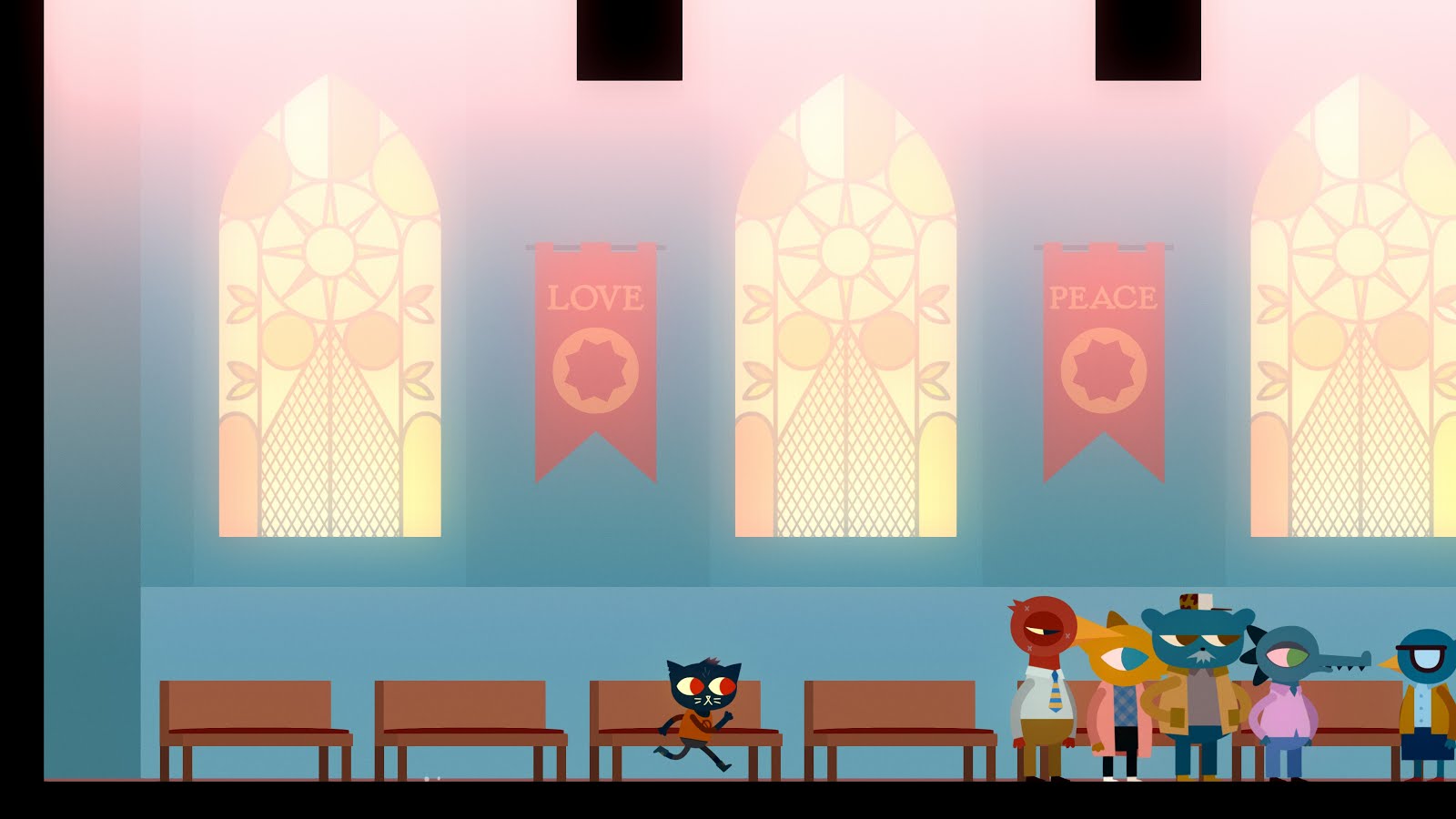
Night in the Woods is one of the rare games that I've both been looking forward to playing and know almost nothing about. It isn't a sequel or from a familiar developer or based on an existing story. But it's frequently been mentioned alongside a variety of games that I know and dearly love, so I treated it with reverence, studiously avoiding spoilers or, really, any information at all.
In retrospect, I probably didn't need to be that paranoid. It isn't a particularly twisty game, and would probably still be as enjoyable if you went in knowing the characters and overall plot. Regardless, it's always nice to go into something cold and have it delight you.
From the minuscule amount of information I'd gleaned prior to playing, I'd vaguely thought that it would be similar to Oxenfree: following a group of young people revisiting a familiar place, encountering unusual phenomena, solving puzzles. However, it ended up being a lot more like Life Is Strange, oddly crossed with Dex. It has a marvelously relaxing structure for most of the game: you don't feel rushed, and can spend your time wandering the environments, chatting with friends and strangers, looking for hidden things in nooks and crannies. It focuses on relationships, both rekindling older ones from your childhood and forging new ones. It handles some of the same themes as Life Is Strange, treating serious topics with respect, albeit with much more humor. The actual gameplay feels surprisingly similar to Dex, a side-scrolling cyberpunk game I enjoyed recently. Both are prominently focused around city navigation, which is primarily side-to-side but with some interesting wrinkles that keep it from feeling too flat. Both make great use of vertical space and movement, Night in the Woods even more so, opening up entirely new vistas as you learn how to climb to the rooftops. They use parallax to great effect, giving a nicely 3D feel while keeping simple 2D controls intact. Dex has some fun hidden secrets you can find via exploration, and Night In The Woods has a lot more, which can easily become the main activity in the game.
I guess the dialogue is kind of similar too. It doesn't use the real-time system like Oxenfree, but more of a conventional system where your character automatically speaks most lines, and occasionally pauses for you to select a response. Where Dex and Life Is Strange both had menus of responses, though, Night in the Woods usually only has two choices. Most dialogue choices don't lead to significant branching plots; there are branching plots, but those are more due to actions you take than the lines you say. The protagonist Mae has a very well-defined personality and backstory, so roleplaying isn't exactly a huge part of the game, but it's still great to tune her responses to various situations.
One thing that's a little unclear is when a dialogue choice will have a big impact. Most of the game follows a fairly similar pattern where you wake up, explore the town, chat with friends, and end up doing something that night with one of them. (Which, now that I think about it, is actually really similar to the old "School Simulator" games I used to make back in the day.) Anyways, sometimes when a friend asks "You wanna hang out?" and you say "Yes" it ends all your activities for the day, and other times it means you do something together during the day but can keep on planning. It's definitely not a huge deal. You can't lose the game, and since you have multiple days to do things you can even finish optional side-content that you were planning on doing that day. I think it's actually written pretty well, as I can usually tell in retrospect that "Oh, yeah, I should have known that would happen". Just something to potentially keep in mind.
If you were to just beeline for those conversations and end the days, you could finish the game very quickly. It would probably still be fun, but I absolutely loved the vast array of stuff to do. Most of these are fun in and of themselves, again like Life Is Strange. You get more insight into characters, both your close friends and the background people who make up the town. And you learn more about the town itself: its history of mining, manufacturing, and labor strife; its crumbling local businesses and the efforts of the chamber of commerce to turn things around; what people do for fun and where they go and what they want to happen. And there are lots of nice little mementos to unlock: you have a journal, and add cool little doodles and notes as you find and do things, and occasionally earn a Steam achievement for accomplishing something off the beaten path.
It's also totally worth doing stuff just for the dialogue itself. It's so, so wonderful. I was going to say that it's natural, but it isn't in the same way that, say, Oxenfree is. It's maybe a little heightened, hilarious, clever, profane, alternating between delightful stupidity and running in-jokes and really elaborate metaphors and associations.
The personalities in the game are so strong and vivid. Late in the game there are some scenes that take place in total darkness, where you can just see the words being spoken, not who is speaking them, and you can immediately tell who is delivering each line: the vocabulary, the cadence, the style, have been so brilliantly and consistently defined that they are instantly identifiable. And those personalities carry through to the art as well, whether Gregg's adorably spazzy arms or Bea's perpetually downcast eyes. I love these people so much.
MINI SPOILERS
Starting to dip into the actual plot somewhat... yet another aspect of the game that I enjoyed and that reminded me a bit of Life Is Strange was its really nice portrayal of religion. Like Max, Mae isn't exactly a believer, but she's close to people who are, and they are treated respectfully and their faith is portrayed positively, as a source of comfort and strength. I especially liked how Mae's mom works for the church, and seeing how their family life intersected with the church felt very true to my own experiences in a similar family. The church is a spiritual place, but it's also a workplace, a very human place. I felt particularly strong nostalgia for the church library, a sort of sanctuary within a sanctuary, a calm refuge filled with books and peace.
Like so much of the game, the church isn't a core element of Night in the Woods; I'm pretty sure that you could complete the entire game without even laying eyes on the church, let alone going inside or chatting with the great pastor (who reminds me a lot of my Aunt Fran). But it's a key institution in Possum Springs, a respected moral voice speaking up and caring for the poor and disadvantaged people on the fringes of society.
In another part of the game, you chat with an old-timer who grew up with your grandfather, and she reminisces about how the church was one of several pillars of the community, along with the union hall. There's a really cool and strong economic message that builds throughout the whole game, starting off as a kind of vague and generic nostalgia for "the good old days" and morphs into a surprisingly explicit call for leftist mass action. The original founders of Possum Springs lived dangerous and dirty existences, risking their lives in the mines for the benefit of the greedy bosses, and they formed the unions and fought for a better lot in life. This resonated really strongly for me having recently read Strike! and similar books over the past year, and I was swept up again in the history of bold labor movements of the 19th century.
From the very start of the game, there's a consistent focus on the economic situation in Possum Springs and how that's affecting the local culture. There's plenty of "economic anxiety" to go around: like many rural towns around America, Possum Springs seems to be shriveling up. Once-grand stores have been shuttered, vacant businesses line the downtown, people who were once proud to work a union job in a factory are now bagging groceries or forced to live on charity. Near the end your father gets at the part that pains him the most: even more than the loss of high(er) wages, there's a lack of respect, on the part of the bosses and those who still wield influence. There's still great pride and culture in Possum Springs, but people are worried for the next generation: young people don't see any good opportunities locally and are leaving for big cities, forever. Those who remain feel a variety of emotions, from resignation to bitterness to fury. Selmers stunned me with her amazing poem: "some night i will catch / a bus out to / the west coast / and burn their silicon city / to the ground".
I'll talk in Major Spoilers about how some people are addressing this problem, but I'll note now how much this game seems to be tapping into the zeitgeist. Your friend Bea is a member of the Young Socialists, working for social and political change. Your dad decides to form a union, and you can promise to support him on the picket line. Anyways, it all reminds me a lot of the current energy around the DSA and Antifa and other elements of the resurgent left, and I absolutely love how this game connects the modern movement to its historic antecedents. (Again, without really making the game about that - it's a very strong part of the story, but you never feel like you're playing through a polemic. [Even though it probably is.])
The game is also very modern in its matter-of-fact handling of orientation and identity. Gregg and Angus are an absolutely adorable couple, high-school sweethearts now making a life together, well-liked by all. Well, almost all. Late in the game Bea shares her harsh-but-realistic take on the couple: Angus can do a lot better than Gregg, and sooner or later he'll realize that. But it's the same sort of criticism that would apply to any small-town 20-year-old pair. I'd kind of shipped Mae and Bea for most of the game, but Bea seems pretty clearly straight. Mae, though... I absolutely loved the party scene where she discovers how much she loves to dance and flirts with that occult college girl. The game never pins down her sexuality, and never asks you to define it either: she's just a girl who really wants to wrestle people and talk about their feelings.
I got to know Bea really well over the course of the game, while Angus remained mostly a mystery. I really liked how the game seems to reward you for focusing on the people you care most about: when you spend more time with them, you learn more about them and they open up more to you and you build a stronger relationship. It's the opposite of how most games seem to be structured, where you have a perverse incentive to save the stuff you care about the most until the end and do the less interesting things first. Here, I'm pretty sure that I missed out on Angus's whole mission by putting it off for so long, and I'm guessing that I might not have spent that night in the city with Bea if I'd waited too long. Anyways... I sometimes get bummed by knowing that I missed out on some content, but I absolutely loved it here, since it was the direct consequence of what I cared about and how I spent my time.
MEGA SPOILERS
So, the big question: just who were the people in the Death Cult of Conservative Uncles? They're definitely individuals within Possum Springs, but are they people we've actually met in the daytime, and if so, who? During that scene in the mine I'd speculated a bit based on the attitudes they articulated: perhaps your cranky neighbor, or the stoop-sitter near Selmers, or someone on the Chamber of Commerce? But they're still around the following day, so I guess not. (Or perhaps they were able to escape?) It's interesting to think that, for example, the gravedigger really could have been the ghost after all, reconciling the apparent conflict between your and Bea's theories.
It feels like a solvable mystery. The people have such distinctive voices, I feel like you could probably match those words against other voices in town and find some matches.
I'm also left wondering what they look like under their robes. When you see them all gathered together, everyone looks so uniform, but Possum Springs is so unique, with distinct profiles for cats, alligators, birds, bears, and so on. I'm curious if the cult is drawn exclusively from one particular species of animal, or if the robes are deliberately concealing their varied body types beneath. Or it could just be an art aesthetic thing that the game designers liked and I might be reading way too much into it.
I'm still mulling over and cheering on the Big Reveal at the end. It is so cool and so hard to thread that needle between the supernatural and the realistic, and it feels really disappointing when stories mess it up, and frustrating when they sidestep it after establishing that tension. This was just a huge tour de force, and I was reminded a bit of, say, David Mitchell's climactic metaphysics unveiled in The Bone Clocks, revealing a detailed system and purpose behind decades of foreshadowing. I adore it when a work goes on record and goes: yep, there is something supernatural going on, and this is how and why and with who.
The whiplash made it all the more fun: you're in a dreamlike state and see the ghost and are convinced it's all real. Then Gregg shoots it with a crossbow and the ghost yells and swears and runs away: the mystique is broken, reality re-established. And then you find what's beneath it all, and the awe grows even larger. The cult members are all mortal, even mundane, regardless of what they serve. That said, though.... if you look closely, you see that that one particular "ghost" does have a bit of a fading effect on his sprite; he's slightly shimmering into the background in the cave, even while the rest of the "ghosts" are firmly opaque. And it does seem like he's flying at the end when he comes up out of the mine shaft.
Could he be possessed by the spirit in the well? There seems to be some precedent for this; we've learned that the cult's founder could walk through walls, so perhaps this one has been "chosen" in some way to carry out the spirit's will. But that's also odd, since it seems like the spirit wants you as a disciple, and doesn't want you to be hurt, so why would it support one who intended harm for you? I dunno. And I suspect that this particular mystery will remain unknowable.
Among other things, the big reveal seems to give some forgiveness to Mae and her history: she wasn't crazy, or wasn't just crazy. This is another area (the last one, I promise!) where NitW seems to dovetail with LiS: both games address mental health in honest, serious, and respectful ways. In the end, though, Night in the Woods is both more detailed (Bea diagnoses Gregg, seemingly accurately, with bipolar tendencies) and maybe a bit more optimistic. Depending on how you play Life Is Strange, mental health might seem like a difficult-but-manageable challenge or an insurmountable obstacle. Night in the Woods closes on some really sweet messages, though. I teared up a little when Bea tells Mae something like, "I can help you find someone who can help you." I've never heard that before, and I'm definitely filing it away for future reference. There are ways to support others without becoming responsible for them, and help is out there: even if you've run into your own Dr. Hank, there are better options, you just need to find them.
END SPOILERS
I liked this game a lot! It may end up being one of the rare indie games that I replay some day: now that I know how to make all of the jumps, I want to explore more of the town during the early days; and I want to spend more time with different people and learn more of their own stories. It's a lot of fun to play, and can also feel really important in the topics it handles and the weight it gives to them. And I haven't even talked at all about the wonderful music, or the wonderful way Mae's eyes swivel up to watch Beatrice on the porch, or the beautiful stars, or the rat babies, or.... well, there's a lot. And still more to find! Judging by the concept art unlocks, I still have about half (!) of the secrets left to find. I do feel satisfied by the game I've played and the story I've heard, and I'm glad to have the option to head back for even more. Like a delivery pizza, this game is good as hell.
This is a beautiful time of year. We're close to the summer solstice, so days are long, with bountiful sunshine filling the hours. And so, of course, I'm spending those long summer days hunched over a laptop, prying into forbidden secrets and raising an army of minions to subvert the natural order and plunge the world into its doom.
The game is Cultist Simulator. It was created by Alexis Kennedy, a founder of Failbetter Games and the creative force behind Fallen London (my longest running online gaming experience) and Sunless Sea (a wonderfully atmospheric and odd roguelike which I embraced). That's quite a pedigree, but I was a bit skeptical of Cultist Simulator when it was first announced. I don't really like playing as "bad people" in games, and while I was confident it would be well-designed, the subject matter didn't seem like it would speak to me. I passed on the Kickstarter and have mostly ignored its development, including a long and very transparent Early Access phase.
The response to the game has been positive, though, including in the Failbetter communities in which I participate, and so I took advantage of a launch-week promotion and picked it up. It proved to be shockingly addictive, and I've found the gameplay and lore occupying much of my waking life, even when I'm not actually playing.
The addictiveness is real. The overall experience of playing Cultist Simulator feels uncannily like playing a good game of Civilization: "just one more turn" has become "just one more minute", and it gets really hard to pull yourself away from it. In Civ, you might be about to log off for the night, and then realize that you're just two turns away from completing a Wonder that you've been working on for a while. So you stick around to finish that as a good stopping point. Except then France declares war on you the next turn. So now you need to marshal your army and order everyone to the front.
Likewise, in Cultist Simulator, you might be wrapping up an Expedition to unearth ancient monoliths and planning to log off once you uncover its arcane treasures. But then Inspector Wakefield shows up and starts prying. You're debriefing a patron on your latest eldritch studies, which will surely catch his attention; but as soon as that's done, you'll need to put a Heart Disciple to work to prepare for the Notoriety that will be produced by your expedition team. So you do that, but then your research bears fruit and you uncover a new level of Edge that will allow you to perform a powerful Summon. And you need to do that summon now, before your Fleeting Memory fades. And now your Expedition is done, and you've uncovered a new Tool that will allow you to elevate a Disciple further, but only after you have finished the coverup...
And before you know it, your evening has vanished, as schemes and plans whirl and evolve in your head.
Before addressing gameplay, let's get the negatives out of the way first:
The text is really tiny and hard to read. Between this game and Sunless Sea, I'm kind of astonished that people put such effort into creating rich, word-dense narrative games, and seem to pay so little attention to making those words physically easy to read. And I'm lucky enough to have decent corrected vision; I'd hate to be someone with legitimately poor eyesight.
The mechanics feel needlessly obtuse. This is clearly by design and so I can excuse it, but that doesn't keep it from being extremely frustrating for the first hour or so of play. I do think it's much more in keeping with the theme than Sunless Sea; that game also had a steep learning curve, but since Cultist Simulator is all about flailing around and experimenting and unearthing secrets, the opaque gameplay definitely matches the narrative.
And, I think that's it for negatives! Do keep your expectations in check: the game is about 100MB large, with minimal art and no video or animation or 3D models. It's very much one of those games that plays out inside your head as opposed to in front of your eyes. MINI SPOILERS
When I first read about this game, it sounded like it was influenced by Aleister Crowley, or maybe HP Lovecraft. Once I got into it, though, it reminded me a lot more of From Hell, Alan Moore's seminal graphic novel about William Gull. I got this most strongly in my interactions with the Mansus. I had stumbled into it in my first game, not knowing what I was doing, and couldn't remember how I had made it happen or how to go back. I went through a second game never reaching it, desperately trying one act after the other, muttering to myself "I must go back to that place! I have to know!" There is this desire for knowledge, for revelation, that pushes you forward, and can prompt you to do things you ordinarily would not consider.
I eventually won a victory with a Grail cult pursuing the Sensation goal. It's kind of squicky... I had intended to try for Heart or Knock or something, but got impatient while waiting for other lores to turn up in the very early game, and reasoned that I was probably going to lose soon anyways. As with Sunless Sea, though, the lessons you learn in your early failures significantly improve your survivability later.
There were some VERY close calls, though. There were three or so times where I would definitely have lost by going insane or succumbing to despair if I hadn't lucked out with a visit to the Mansus at the last second. (Sometimes literally: less than one second remaining before failure.) As I got further along, I grew more paranoid, and would more aggressively treat my Fascination or Dread as they appeared. Dreaming on these is a good strategy, but I also really like using them as Trappings for cult business or otherwise tossing them into slots where they can be consumed.
Lo-fi games like this are so fascinating because you get caught up in the mechanics of play, and then are abruptly reminded of what concepts and flavor those mechanics map back to. I started laughing as I was approaching the endgame as I realized just what I was doing: after a long period of being cautious, avoiding detection, minimizing potential harm, I was now shoving one prisoner after another into the Spider's Gate, hoping that their blood would reveal the Grail Influence I craved. Then, once I grew impatient at how long it was taking me to find hirelings to imprison, I started locking low-level pawns into my closet. "These anonymous fools will serve me in death as they never could in life!", I might have said.
And... it worked! The steady stream of prisoners kept my appetite fed and kept the Mansus open. I'd been distracting Ezeem in my parlor, nattering at him about inanities, and then sat bolt upright as an Imperative of Appetite came to me. We raced to the basement, recited the Devouring Mysteries, and boom: game over!
In keeping with the Civ parallel, the ending might feel a little deflating after such a long and challenging game, but I didn't begrudge it at all. The entire game has been text, so it's very appropriate to get more text here, and I definitely won't demand a rousing animatic from a tiny developer.
There are quite a few things I'll do differently if I play again:
Not sell the mirror.
Focus earlier on higher-level Expeditions. I'd assumed that the more obscure ones were more difficult, but as far as I can see, they are not.
Start doing Expeditions as soon as I can field Disciples. The Tools you get from here are incredibly helpful and accelerate all sorts of things.
Start summoning earlier. I'd been scared off by the warning of creatures escaping. They only can escape while being summoned, and the damage they cause is minor. Especially when using the Rite of the Map's Edge, they're more or less free and can help with all sorts of stuff.
Sell off most Spintria. I'd been stockpiling it throughout the game in the expectation that it would be needed in the endgame, but it's almost useless; I think I used it twice. It sells for a lot, and I now think that focusing on commissions is probably the best way to make money, if you can handle the Mystique. Anyways, I ended up with over 100 Funds just from cashing in most Spintria, and it's very nice to not live hand-to-mouth.
Aggressively recruit people with Talk. Again, I'd been worried about attracting attention, but it's totally fine, especially if you don't have Notoriety. In an earlier game, I'd done almost all my recruiting via Peculiar Rumours, but that's much worse, as you always get Notoriety.
Be more careful about subverting low-level lore and/or stockpiling Tier 6 Lore. I spent days stuck outside the Stag Door because I had subverted my Moth lore and couldn't answer the riddle, finally getting it only after I had retrieved a much higher-level Lore and breaking it down.
I think I might try for a Moth cult next time, as the ability to destroy evidence seems very useful. Heart would be thematically nice as well, though maybe not especially useful if I'm drowning in Mystique. I'm starting to think that it could be good to alternate between periods of high Mystique (recruiting members, fulfilling Commissions) and periods of low Notoriety (just Expeditions). Expeditions take long enough that most of your Mystique might burn off by the time one is done, and you should be able to time your Heart member to start dragging in Notoriety at the time you complete the mission.
I'm unsure about the best background. My victory came with the Bright Young Thing, who I had initially viewed as a throwaway run: you can't access any of the special jobs, and your initial inheritance is only a temporary boost. But, the BYT does get access to more Health, and I now think that might be a solid choice: you can earn a lot more Reason and Passion by studying books, and even though I started out without much of either I ended up with more of that than I could use. Health is a lot harder to come by. That said, the Doctor was one of my favorite runs, as you never need to worry about taking a break from Institute work to pursue your other goals. My one run as a Detective was also intriguing. You can earn a LOT from the top-level Investigating job, and will get plenty of Reason to always get the best income. It also has a much longer cooldown than clerical work, giving you more flexibility to alternate it with other tasks. But the mechanics of this would probably get annoying in the endgame, as you would end up with tons of useless Evidence. (This is an area that honestly feels a little buggy, and I wouldn't be surprised if the late stage of the Investigating job is patched in an update.) All that being said: like I said above, in the future I might just neglect the mundane job and instead focus on commissions.
END SPOILERS
Anyways! I'm definitely taking a break for now. Addictive games like this can be a lot of fun, but I also need to treat them with caution. It sounds like there are at least some expansions planned, and it'll be interesting to see where it goes next. There are already some elements like the headquarters and spintria that seem ripe for new functionality, and I'm sure there are more which I haven't even imagined yet.
So, um, yeah. The Cat Lady just might be the scariest, most disturbing video game I've played. It's kind of hard to evaluate entries in the genre; in much the same way it's tough to compare the fear generated by The Haunting to The Descent to Psycho, it's hard to compare System Shock 2 to Silent Hill 2 to The Cat Lady. But I'm pretty confident in saying that The Cat Lady probably has the most pernicious, sustained, permeating sense of dread. Every element of the game seems to be decaying, curdling, coming apart and revealing the horror that lies beneath.
Some other horror games are more focused, tuning in on one particular type of experience: enemies creeping up on you from just outside your field of vision, or sudden onslaughts of violence, or frightening imagery. The Cat Lady, while on its surface a very simplistic presentation (two-dimensional images, one-dimensional movement, mostly black-and-white graphics), manages to draw on an amazing range of tools to disorient and disgust. Those simple backgrounds twist and fade and flicker, calling their own reality and the protagonist's sanity into question. Tiny bodies expel unearthly screeching. And blood! Blood spurting everywhere, or discovered as evidence of past traumas.
There's plenty of violence in this game, but it takes many forms. There's the threat of violence, dangled over characters, freezing them or alarming them. There's active violence, often abrupt and unexpected, but sometimes premeditated and sadistic. And above all there's the evidence of violence, the awful discovery of untold misery that has paved the way and ended or destroyed prior lives. Which, of course, sets up the threat of future violence to echo the past, continuing the cycle.
All of this is very convincingly sold through the simple-but-relatable character designs, married to some really fantastic voice acting. One of my few quibbles with the game is that, while the actors all have terrific vocal tones (English accents FTW!), the technical quality of recordings can vary quite a bit. This was a low-budget game, and I get the impression that many or most of the actors just used their laptop mikes to record, so you'll sometimes get a subtle background hum or popped P's. Still, the emotion behind the dialogue is so persuasive that it didn't interfere with my enjoyment at all.
MINI SPOILERS
The game starts with the protagonist committing suicide. Things rapidly get worse for her.
As is often the case for these sorts of games or movies, Susan's plight is inextricably tied to questions of her sanity; these become explicit in the second chapter, when she wakes up in a psychiatric hospital, under observation after her "failed" suicide attempt. The root question is: did she really meet "The Queen of Maggots", and is she really immortal? The answer, within the context of the game, seems to be a tentative "Yes": it's possible that her earlier experiences were just hallucinations as part of a near-death experience, but she really does seem to come back to life after her subsequent murder. I suppose it's possible that this entire sequence is a hallucination, but if so the entire game would seem to be suspect, and I don't think there's enough evidence to support that. (That said, it is really interesting to see Susan's movement and perception visibly alter while she's on medication; these effects are very similar to her death experiences, which is one small suggestion that they are a mental rather than a physical journey.)
So far I've just been talking about the content of the game. The story and presentation is the main star, but the gameplay is sometimes used to great effect, immersing you in Susan's plight rather than just linking scenes together. I think the best example of this comes in Chapter 3. This is the one part of the game that directly deals with Susan's mental state. You receive two meters, one for her anxiety and one for her comfort. Anxiety ticks up whenever something happens to distress Susan: an object breaking, the lights going out, catching sight of an object with a troubled history. Any one of these can cause a large and abrupt jump in her distress. By contrast, every time Susan takes care of herself, her comfort meter rises just a sliver: paying her bills, cooking a hamburger, enjoying a cigarette.
It's all so fragile. I already cared about Susan, but being responsible for her in this way increased my motivation tenfold. On my first attempt, her night ended poorly: after an argument with her neighbor, she fell into a spiral of despair, cutting herself and sobbing throughout the night. I took advantage of the fact that this was a video game and not real life: I reloaded, peeked on Google to see how to make things better, and played through it again. Things that don't even register to me in real life became quiet and significant victories: keeping the lights on, making a nice cup of tea.
I get the impression that some people will particularly enjoy The Cat Lady for how it presents and represents depression, treating it seriously and exploring it without sugarcoating it. In my case, the game has made me realize just how lucky I have it. I'm incredibly fortunate in my personal life, and the strong pillars of support I have underneath me allow me to just shrug off things that might send someone else into a tailspin of sadness. If I scorch my pan while cooking dinner, I'll sigh, laugh at myself, then order a new one online and grab something else from the fridge to eat. But someone who already has a negative self-narrative might see this as yet another chapter in "Chris Can Never Do Anything Right" and/or "The Universe Is Out To Get Chris," and might become non-functional while working through the sadness.
Ultimately, this section strongly motivated me to be kinder. We don't know how secure or insecure the strangers in our lives are, and even small gestures from us can have enormous impact. Even tiny things like keeping a seat open on the subway, or responding with a smile rather than a frown after someone bumps into you, might continue to reverberate for the other person long after I've forgotten it.
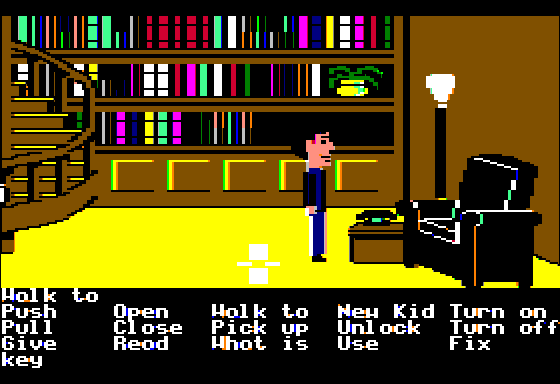
The "sanity meters" were a clever addition; I kind of wish that they'd been present in more of the game, although it would have been hard to maintain their effectiveness over a longer time. In general, The Cat Lady tends to play out as a traditional adventure game: you move around, collect items into your inventory, and figure out how to use them to solve puzzles. For the most part, these are pretty logical, and given enough time you can puzzle them out on their own. I think there were just two times that I needed to resort to Google to find a solution; in both cases I felt retroactively justified, as the solutions weren't very intuitive. (In one case, you need to turn on a hot water tap, then keep it running for a minute until it steams up the room to reveal letters written on a mirror. The physics make sense, but it's not an intuitive action to take.) I think I also spotted a couple of visual allusions to Maniac Mansion, which was pretty amazing.
The game is divided into seven chapters. Each has a really good, strong focus: there's an overarching plot, but also very specific self-contained goals and mechanics within each sequence. I found myself wondering whether the creators had originally intended this as an episodic game, which seems to be the preferred way to distribute adventure games these days and would have lent itself rather well to this story.
They do a great job at gradually spinning out the plot over the course of the game. Some bombshells are dropped relatively early, which sort of lurk beneath the surface for a while, before finally being revealed and explained. These aren't exactly plot twists, more of an ongoing exploration and fleshing-out of a really sympathetic three-dimensional character.
I was slightly disappointed that they ultimately gave an explanation for Susan's depression. It honestly felt more compelling to me when it was mysterious and unexplained; I spent much of the game imagining that Susan had just slowly aged into her depression, which seemed more alarming and relatable to me than the eventual revelation that there was a Big Dark Secret Past responsible for her suffering. That said, though, given that they did give a background for her condition, I thought it was a great one: it was unique and unexpected, with a fantastic level of detail (that argument is agonizing) that makes it feel like a genuine core of the character and not a contrivance to place her into this situation.
MEGA SPOILERS
I'm still mulling over Susan's epiphany that the Queen of Maggots is her own self-hate. That seems to call into question the reality of the QoM, which in turn appears to invalidate Susan's immortality. While playing I'd interpreted this as an internal mental conversation or hallucination of some sort. After considering it more, though, I'm leaning more towards the idea that the QoM is a "real" externalized entity that was created by Susan's despair. Maybe somewhat equivalent to the Guardian of Ultima IX, or gods as depicted in American Gods or Discworld: created through mental energy, but able to physically impact the world once created.
I was really surprised, and delighted, to have a genuinely happy ending. I was not expecting that at all! The whole game was relentlessly bleak and dark, with only a few moments with Mitzi breaking through with little sparks of light and grace. It felt incredibly earned, though: we ultimately see that this has been a long, hard journey that Susan has been on, and at the end she finds what she could never have hoped for: hope itself, and a reason to keep on living.
END SPOILERS
I'll have a hard time making any blanket recommendations for this game, thanks to its gory and disturbing content. Still, players who are able to stomach the dismal elements will be richly rewarded. Yes, the game is unremittingly bleak and dark; but that same darkness helps the brief flashes of light shine all the brighter. It treats forbidden topics of depression and suicide with such candor that it earns the right to show a path forward. Not with a saccharine assurance that everything will be okay, but with small acts of grace and bravery.
As it stands, though, it's felt more like something I need to work through rather than move on from. Usually, after I finish a video game or novel or movie, I'm left with a burst of thoughts and questions and reactions. That's a major function that this blog serves: to capture and help me process that response in the moment while it's fresh. As time goes on, my emotional and (ugh) intellectual ardor gradually fades. I'm left with a handful of major impressions, and head off to consume my next piece of entertainment.
Life Is Strange, though, is one of a handful of things that has actually grown more significant after I finished it. In the immediate aftermath of the final episode, I was primarily obsessed with the technical details of the plot and metaphysics: figuring out who did what, who was lying, how various powers worked, reconstructing the timeline(s), and so on. I've gotten to a point where I'm more or less satisfied with all that: finding an answer that satisfies me, or concluding that there is no definitive answer, and choosing to either leave it ambiguous or adopt a particular headcanon that appeals to me. With that out of the way, though, I find myself left with... feelings, and reflecting over the characters themselves: the situations they were in, their relationships with one another, what it meant for them, whether it means anything for me.
And, well, that isn't a problem that can be solved. I can see why so many people are still drawing fan-art and such more than a year after finishing the game. While the game itself comes to a definitive end, the characters are so fully-realized that we keep on thinking about them.
As noted before, I've slipped into a mode of "MOAR CONTENT!", devouring even tangentially-related Life Is Strange material. One item that has been on my radar for several weeks is "Love Is Strange." This is a free, fan-made game which has become very popular within the LiS community.
I was hesitant to check it out. I thought that it would suffer in comparison to the professional game it's based off of, and was worried that it might somehow diminish my appreciation for the source material. Fan-created games don't have a great track record... even finishing something at all is a minor miracle, and making something people will be happy with is an even greater challenge. Still, I noticed that a lot of my favorite artists and bloggers frequently referenced it, which encouraged me to take the plunge to download and play it.
I'm really glad that I did! While it explicitly pulls from Life is Strange, it very much feels like its own beautiful thing, and not some pale imitation. For starters, it's set in an alternate timeline (or AU as the kids are saying these days): the same characters exist and have the same personalities (very well captured and represented by the authors), but the events in Life is Strange never took place. Love is Strange takes place one year later, without any super-powers or crimes or drama. It's an appealing but very low-key storyline, essentially a dating simulator, that's almost entirely focused on Max's relationship with her classmates.
The game itself belongs to the genre called "visual novel", dialogue-heavy games with static images. I haven't played many of these before; the only ones I can think of off hand are Christine Love's fantastic Analogue/Hate games. As people who are better-informed than me have pointed out, Love has created games that are really clever subversions of and commentaries on the visual novel format; but since visual novels are primarily popular in Japan, and her games mainly reach a North American audience, a lot of what they're doing is lost on us. Anyways - I really liked the Love games, and that background helped me feel at home when playing Love Is Strange.
MINI SPOILERS (for both Love Is Strange and Life Is Strange)
They did a really good job of capturing the voices of the different characters; I could totally hear Ashley Burch's voice in my head while reading Chloe's lines, or Hannah Telle's interior monologue when reading Max's thoughts. The characters all make sense based on what we saw during the game; at the same time, they weave in new details and plot threads that keep things engaging and interesting.
I think that, in a lot of cases, they wanted to evoke emotional reactions that paralleled what we experienced in Life is Strange. So, for example, Kate is facing new bullying. It's far less vicious than what she went through earlier, and both the cause and solution are original, but it feels kind of like an echo to her dramatic story in Episode Two. It's deeply cathartic to help her work through her problems, offering her support but letting her stand on her own and find her strength. Likewise, Chloe's plot can feel like a metaphor for both the ending of Episode Four and the Bay ending of the game. Depending on the decisions you made in the earlier game, you might be able to revisit a particular feeling, or perhaps explore a path you'd previously left untrod.
There are a total of four "routes" in this game: Chloe (duh), Kate (awww!), Victoria (!), and Rachel (!!). Unlike some other VNs, you don't bounce between characters during the game: instead, you pick one near the start, and then just focus on them for the duration of the game. That really helps replayability, since 90%+ of the content is new for each route (including multiple new locations and unique journal entries).
The dialogue mostly runs on rails, but there are... I dunno, maybe a half-dozen or so branching choices during each route. These can have some fairly significant impact, both on the direction of the story (where you go, what activities you perform) and your relationship. So far I've just played the Kate and Chloe routes, and I was happy to discover that I had achieved the "true" ending for both of them. It wasn't exactly trivial - I had to think carefully through a couple of choices to decide the best thing to say - but, again, they've done such a good job at faithfully representing the existing characters that we can draw on our knowledge of Life Is Strange, in addition to the text within Love Is Strange, to grok the other person's values and needs.
END SPOILERS (for Love/Life Is Strange)
Ultimately, I think Love Is Strange is kind of a hangout game. Much like a long-running TV show in which we've come to enjoy spending time with characters, it's fun to simply relax with them for a bit, without huge earth-shaking consequences hanging over our heads. It feels like a long, protracted release of breath after the intensity of Life Is Strange. I found myself thinking of the Mass Effect 3: Citadel DLC, which similarly gave the gift of more time with people we'd grown to love.
Of course, Citadel had the benefits of an entire AAA studio behind it, plus all of the original writers reprising their roles. Love Is Strange's origin story sounds miraculous: a bunch of fans on tumblr discovered that they shared a love of the same game, and passed around text and graphics and game code until they created this. That's incredibly cool! Oh, and something I haven't mentioned before: the music is great. It doesn't use "real" licensed tracks like Life Is Strange, but its background instrumental music fits the mood really well, and a couple of tracks in particular are quite emotionally stirring.
I've followed quite a few fan-game efforts over the years, and while there have been some amazing successes (Fall from Heaven 2, Counterstrike), they are vastly outnumbered by ambitious projects that have petered out. It's a big testament to the team for accomplishing this, and by proxy a testament to Dontnod for creating a game that inspires such enduring devotion in its fans.
While I was exploring the exciting new world of visual novels, I decided to pick up another entry that has popped up in my Steam Discovery Queue a couple of times. Highway Blossoms, a "kinetic novel" from Alienworks. I'd deliberately avoided researching it, and was initially disappointed when I realized that, unlike the other visual novels I've played, this one doesn't have any choices. No branching dialogue choices or gameplay sections or anything: just clicking through to advance the story.
After a very short time, though, I forgot my disappointment and got fully wrapped up in the story. The pacing is excellent, the dialogue punchy, and plot revelations are
carefully tuned to flow at a pace that keeps things intriguing without
seeming rushed. It also has a higher level of visual polish than Love is Strange; where LiS has a semi-impressionistic style loosely inspired by the Life Is Strange aesthetic, Highway Blossoms has a gorgeously vibrant aesthetic with sharply-designed characters and vivid backgrounds. While it looks similar to many other VNs, there is more movement on the screen. Characters will occasionally move around, backgrounds will slowly pan or zoom, clouds may float overhead. There are also some really pretty, very subtle lighting effects: seated around a campfire, characters will be lit by pulsing embers as the logs crackle and pop.
MINI SPOILERS (for Highway Blossoms)
Since Highway Blossoms doesn't have any choices, it of course only has one "route", that of Amber and Marina. Fortunately, it's a great one! They're terrific characters, as vividly drawn narratively as they are visually. Amber is the main narrating character. She's very independent, fairly private, deeply skeptical of the world around her, resourceful and nostalgic. Marina is opposite and complementary: bouncy, joyous, naive, trusting.
Those two characters utterly dominate the narrative and screen; when Marina steps away for a moment, it's unusual enough for Amber to comment on. However, they aren't the only characters; unlike other VNs, where almost everyone you see is romance-able, here there's a varied supporting cast that provides assistance and obstacles to the main relationship. These are more stereotypical characters, but engaging and fun.
Even more than the supporting characters, though, I think the environment does a great job at setting the mood and driving the story. The southwestern setting is fully realized, in the gorgeous backgrounds and evocative writing and lonely atmosphere. This is one part of the country that I've never really explored, and playing this game has pushed it high up on my list of future vacation destinations: the stark raw beauty and often alien surroundings makes the story... somehow both more epic and quieter, if that makes sense. There's a sense of timelessness and insignificance when you contrast the brief lives of these humans with the ancient rocks that will outlast them. At the same time, though, the absence of life on the barren rocks makes the vibrancy of human connection even more beautiful and precious.
The pacing of the main romance is fantastic. Amber's attraction to Marina is obvious from the very start, and it seems likely to be reciprocated. But Amber's natural reticence, skepticism, and recent emotional baggage keeps her at an emotional distance from Marina. It takes a long time of shared struggle and experiences to bring them together, and they don't fully connect until about five hours into the story. Among other things, this makes their love feel incredibly earned, more of a natural evolution of their characters than something presented for our enjoyment.
The romance itself also does a great job with consent. I've played a fair number of games with romances (typically RPGs), and am used to the PC and NPC deciding that they want to get together and then doing it. Highway Blossoms has made me reconsider how to present and portray consent... in the past I've thought that it would seem like a minor roadblock to overcome or a point of affirmation, but here it's... well, it's really tender and sweet, a genuine discussion that's integrated into their relationship rather than a barrier that guards the perimeter. It's also subtle, without a great deal of attention drawn to it, but that makes it all the more endearing: two people checking in on each other and making sure they're still on board as things develop.
END SPOILERS (for Highway Blossoms)
In the end, I was more than satisfied with my purchase of Highway Blossoms. Per Steam, it lasted a bit over six hours, and delivered a non-stop stream of high-quality storytelling (aided and abetted by terrific art and music).
That did kind of get me wondering, though… can you really call it a game? The only real user interaction is clicking to advance the story, which is more or less identical to, say, turning the page in a book. At the same time, though, it uses the media that we associate with games: it’s played within the Steam interface, mouse and keyboard in hand, looking at the monitor, absorbing the graphics and text and music and sound effects describing “our” character’s journey. It’s game-like, even if it isn’t a game.
And that raises a kind of existential question: what DOES make something a game? If Highway Blossoms had contained a single branching dialogue choice, would that have magically transformed it into a game? What if it contained a single dialogue choice that didn’t impact the rest of the story at all?
I don’t have an answer yet. I know it was good, and can worry later about whether it’s a game.
Highway Blossoms also made me think more about narration styles. I’ve grown accustomed to thinking of video games as fiction that’s told in the second person, but HB reminds me that this definitely isn’t required. It’s a fully-fledged first-person-narrated game, with Amber telling the story and revealing her inner thoughts.
I’m still thinking through the implications of this. One fairly obvious one is that a first-person narration puts more emphasis on the character, while a second-person narration focuses on the player. There isn’t a whole lot of room for the player to color their perceptions of Amber. They might have different REACTIONS to her, admiring or disliking or pitying various aspects of her personality and story, but I think every player will more or less agree on who she is and what she’s like. In contrast, a western-style RPG will typically give the player immense leeway to define their perception of the character, assigning them different quirks and traits.
To be a little less vague: A first-person narration could include a line like "I feel sad." But a second-person narration would almost never say "You feel sad". It might create a scenario in which tragic things occur, and might give the player the option to select an option that says "I feel sad". There's a deep-seated assumption that developers shouldn't assign or assume emotional responses to the player, but of course it's totally valid to assign those responses to the character.
And, of course, all of this makes me think of Life Is Strange (I may never stop). This is technically also a first-person game: Max is giving her own thoughts on things, providing her own descriptive text and objectives and such. But, with the player’s control over the character, there’s much more opportunity to shape your idea of the character. Many things stay constant: she’s always somewhat withdrawn, empathetic, observant, tenacious. Depending on how you play her, though, she may have different levels of attraction to different people, be relatively braver or more cautious, pragmatic or idealistic. It ends up feeling like a collaboration between the developers and the players, coming to a consensus on who this person is. That’s probably also true, to a lesser extent, in Love Is Strange: there are fewer parameters to play with, but we’re still more or less shaping our vision of Max and hoping that this version will find happiness. In contrast, Highway Blossoms’ protagonist is more or less presented as a fait accompli, and in Christine Love’s games, the protagonist is almost entirely defined by the player (or perhaps even one and the same).
So… I guess my very weak conclusion is that both the narrative voice and the player input can contribute to the player’s perception of the protagonist. I’ve adopted a particular gospel about “good” game writing, using a certain set of tools to accomplish a type of result, but this excursion into the foreign land of visual novels reminds me that there’s no one right answer. Depending on the goals of the developer, they might choose to use different tools in order to shape the player’s experience and create the kind of game they want to make.
Some other random thoughts:
Every single visual novel game I’ve played has used the Ren’Py engine. It’s kind of nice having a consistent interface and set of controls to learn. Once I learned that clicking the middle mouse button would hide the UI in one game, I could immediately start using it in the other. It was also interesting to discover the journal, which is a lot more significant in Love Is Strange but is still present in Highway Blossoms. I doubt that I’ll ever build something with Ren’Py, but I am kind of curious how modifiable it is; each game includes a programming credit, so there’s probably at least some scripting involved beyond the text and images. The most complex game remains Analogue: A Hate Story, with a surprisingly dramatic command-line terminal; nothing in Love Is Strange or Highway Blossoms reaches that level, but each of them does include their own innovations, like the achievements in LIS or the wonderfully dynamic lighting in HB.
I’m not sure how common this is in the genre, but the visual novels I’ve played have all been fairly long. Highway Blossoms clocks in at around six hours; Hate Plus requests that you play it over three real-world days. One practical effect of this is that we spend a lot more time getting to know the characters and absorbing them; in this respect, the experience is a lot more like a TV show than a movie. There tend to be multiple arcs, both shorter ones that drive individual segments as well as a bigger over-arching one that spans the length of the game. It’s… nice. AAA games often reach for a more cinematic aesthetic, but these days I’m more drawn to serialized television shows, and this approach rewards you with a more relaxed, thoughtful, sometimes deeper game.
Finally, because I can’t stop thinking about Life Is Strange, here are a handful of half-baked musings that don’t merit their own post and so will piggy-back on this one:
MEGA SPOILERS (for Life Is Strange, somehow, still):
I’ve been thinking about names a lot lately. I don’t think that every name in the game is significant, but a few do pop out. One big example: Chloe PRICE. It’s really evocative of the final choice you have to make, the sacrifice, the price to pay. Either she IS the price, what you might give up in order to save the town; or she HAS a price, the sacrifice to make in order to be with her.
Also, the title “Life Is Strange” itself grows in meaning the more I think about it. I’d initially interpreted this as “Gee, lots of weird stuff keeps happening!” By the end of episode five, though, I’d come to think of it as meaning, “Chloe’s continued existence is unnatural”. We give her the gift of life in the first episode, but that knocks the universe out of alignment; the longer she continues to live, the greater the chaos grows. I don’t really LIKE this interpretation, since it’s an argument for Bay > Bae, but it’s a compelling one.
END SPOILERS (for Life Is Strange)
Oh, yeah: albums! Here's Love Is Strange, here's Highway Blossoms. Both contain minor spoilers in the images and major story in the text and captions.
Yup! I’m feeling a lot better about visual novels now than I did after watching Welcome To The NHK. I doubt that they’ll replace RPGs as my genre of choice, but it’s been fun to see the different approaches they have to storytelling and become more acquainted with the conventions of the form. There are a couple of intriguing elements in these visual novels that I think could be adapted well to other games, and it always feels good to add another element or two to my creative toolbox.
On a more personal level, I’ve really appreciated the relatively calm and reflective mood of these games. Sometimes you want to make difficult decisions and save the world, but often you want to spend time with the people you love, and these games are great at offering the latter.