I really, REALLY need to move into the city.
Tuesday night I had what felt like the chance of a lifetime: going to hear Neal Stephenson give a talk about just just-released new book Anathem. Not only is Stephenson one of my all-time favorite authors; he also is a relatively shy person who rarely ventures into public. Although I've avidly followed his career for many years, I've never seen him in public. Due to an incredibly generous person, I was able to attend an event he gave. It utterly transcended the standard book tours I'm used to, which generally consist of an author reading from their latest work, speaking for a little while about their interests, past and future writing, and then answering questions.
I knew from the start that it was going to be big. The event was held at the Regency Center in San Francisco, a classic performance space and ballroom that is used today for various events. I arrived quite a bit after the advertised 7pm start time, but there was still a really long line left around the building. No, correction: There were TWO really long lines, one for general admission, and the other for special people like me. Thanks to advance work by an ally, we didn't even have to go to the end of the special line, and were whisked inside in very little time.
There are three rooms inside the Regency, and this was held in the largest of them. It looks like a pretty nice space, and there was also a spacious lobby and annexes for bookselling. Also a cash bar, always welcome at literary events. I snagged a copy of Anathem (signed! first edition! totally worth $32.50!), then sat down to chat while I waited. And waited. And waited. This whole time I kept nervously looking at my phone as the minutes advanced. Granted, the invitation had been advertised as 7pm-11pm, but still, I had anticipated that we would kick off the event at 7, wrap up between 8-8:30, and then Neal would start signing books. I should have expected that an author of Neal's stature doesn't need to spend hours signing books, and in any case there were way too many people for him to process. With that out of the way, what could they possibly have planned for four hours?
I have to say that, while the room looked pretty nice, I was very unimpressed with the sound quality. Throughout the entire night we had to deal with buzzing, humming, interference, and general shoddiness in the sound department. This would have been bad enough, but it turned out that a significant portion of the evening would be given over to music, which is even less forgiving of undesired noise. The event organizer came out around 7:50 to explain that they were still working on the sound, and introduced the musical entertainment.
Later on, Neal would explain that when he started writing Anathem, for inspiration he would listen whenever he could to live performances of medieval and ancient sacred music. This meant frequent concerts with two groups, one out of Portland and the other out of Seattle. I wasn't totally clear on whether we were hearing one of those groups, or another group that had formed since then. After hearing him describe what they were singing about, I decided it was pretty cool. Sacred music gives glory to God; he thought it would be interesting to create secular sacred music that would give glory to mathematical principles, philosophical truths, and other "pure" secular concepts. So what we were actually hearing included a song that delivered a formula for finding prime numbers; a recitation of the digits of pi; and a few other things that I've forgotten.
So, in retrospect, cool stuff. At the beginning, though, it just sounded goofy, poorly engineered, and incomprehensible. Much like the troublemakers in the back of the room, we began making snide comments and parodies, re-imagining the chant as a computer remix or a crowd-rousing anthem. "Let me hear the ladies in the back!" "Ommmmmm, ahhhhhhh, ommmmm". "Now let me hear the fellas!" "Ommmmmm, ahhhhhh, ommmmm."
Neal finally took the stage a bit after 8, and I knew I was doomed to run out. If I was going to hit my bed before midnight, I'd need to catch the 9:30 train home, which meant leaving before 9. Still, an hour with Neal was infinity% more than I'd had before, and beggars cannot be choosers.
Neal has a sort of quiet yet powerful presence. He's rather tall and has an impressive beard, which sticks out more given his shaved scalp. He is famously shy, and has written a really interesting essay on being an introvert. However, he doesn't stammer or anything. He has a good, dry sense of humor in person that the audience just lapped up. After giving the house some time to fix the sound again, he briefly introduced the story, and announced that he would be reading something from the start of the book, "Since anything later on would not make any sense, and in any case you don't know the vocabulary yet." From here he plunged into the book.
He has a good reading voice. Not the best I've come across, but still quite good... he doesn't try for flashy moves like providing distinct voices to each of his characters, instead focusing on clearly communicating the prose. And that prose... well, I get the feeling I'll have a different impression once I've actually read it, but it struck me as a mix between "The Diamond Age" and "The Baroque Cycle". It uses a first-person narrator who isn't completely aware of what's going on, and a surprising amount of the text is concerned with people trying to overcome language and conceptual barriers that are hampering their communication. As they continue to talk, it becomes clearer that it is not just these surface-level obstacles that are causing confusion, but fundamentally different underlying goals and orientations.
After the reading came - more music! It was now explicitly clear that the orientation of the evening would consist of literary moments with musical interludes. It's a really cool idea that I applaud, except for my frustration at it cutting into limited Neal time.
I should back up here and mention that this particular event was held under the auspices of the Long Now Foundation. This is an interesting group of people who are working to change humanity's orientation so we focus on long-term instead of short-term thinking. The creator noticed that, when he was growing up in the 1960's, everyone thought of The Year 2000 as being The Future. Twenty years later, in the 1980's, 2000 was still The Future. It became even more pronounced during the 1990's, when our national brain turned towards the apocalyptic, and we seemed incapable of conceiving what would happen past The Year 2000. (Side note: it seems appropriate that "The End of History" was written around this time. Even notwithstanding changes in the global political alignment, it's hard to imagine that audacious title being written after the turn of the millennium). He became concerned that we as a species were proving incapable of long-term planning, for considering problems and projects that could span generations. The Long Now is dedicated towards re-orienting the way we view ourselves and time so we force ourselves to consider the long term.
As a way of promoting this idea, the Long Now has driven some attention to the Millennium Clock, a timekeeping device that measures time in the tens of thousands of years. As he described it, the clock does not run totally on its own. People need to prepare for it and maintain it, which requires planning that will cross decades, centuries, and millennia. I may have this wrong, but I think that the clock ticks every year, chimes every decade, and a cuckoo comes out every century. The entire scale is vast, challenging us to measure our achievements within the spans of time it alots.
Neal was involved in early discussions about the Long Now project and incorporated some of the ideas into Anathem.
VERY MINI SPOILERS
In this world - and it is another world; he was careful not to set it on Earth, to make it clear that he wasn't imagining a potential future of the Long Now Foundation - a society has been built around a concept similar to the Millennium Clock. There is a - I'm not totally clear what it is yet, but it sounds like a very large city or something - that has a set of doors. The doors only open on a certain interval, say once every ten years. While they are open, anyone can freely enter or leave, but once they shut, people must remain where they are for the duration. This means that, for example, an engineer might sequester himself for a decade, during which time there will be no contact at all with the rest of the world. He will be free to work on problems that interest him and pursue his research without being distracted by everyday life.
He was careful not to give away too much of the plot, but I get the impression that this ends up being a sort of "Morlocks and Eloi" system, similar to what he described in "In the Beginning... Was the Command Line." The society's thinkers and elite nerds will gravitate towards the isolation of the inside, while the bulk of society lives freely outside. It sounds like there are certain tensions that arise between these groups. At times, the outsiders view the insiders as just curiosities or tourist attractions. But, when a very big problem looms, they rely on the geniuses inside to get them out of trouble.
I found myself thinking of the Twilight Zone episode... I think the title is "Time Enough at Last." What strikes some people as a horrifying future - being left all alone on the planet Earth with no other human being around - would, to a few, be a kind of paradise. This is the ultimate division between extrovert and introvert, and if you're all the way towards the latter end of that scale, nothing could be better than living in a world by yourself.
I'm sure there's much, much more going on in this novel - apparently people communicate by singing, and there's gotta be a ton of plot and rambling discourse thrown in there - but the idea of that long-time-based society seems interesting enough in itself to drive the novel.
END OF VERY MINI SPOILERS
In case you were curious: yes, while I was sitting there I was fully aware of the irony. The entire event was about a book largely centered around the premise that we as a species should take a long view of time, and I was obsessing over whether I'd be able to catch my 9:30 train. I guess that just makes it more memorable for me. I tried to convince myself that I was actually following the spirit of the book - "If I was thinking in the short term, I'd tell myself, 'This is awesome, I'm having fun, so I'll stay until it's over,' but instead I am taking the long view with foresight and planning and so am taking the right action to make sure I get a good night's sleep tonight." I nearly convince myself. I'm almost certain that, in the very long view, I would remember an extra 2 hours with Neal and his crazy mathematical sacred chanters more than I would remember the aggravation of paying for a long cab ride and a night with just 4 hours' sleep.
The real solution: I need to move into the city so I can do cool stuff like this without the details of life getting in the way.
In the meantime, though, I was delighted to squeeze as much Neal out of the evening as I could. I am now going to stop writing, crack open this book, and lose myself in the world that Neal has created.
Tuesday, September 09, 2008

Monday, September 08, 2008
In lighter news...
I want to balance my negativity with happiness.
Organizations with whom I am well pleased:
Organizations with whom I am well pleased:
- Kansas Division of Motor Vehicles: For working through confusing issues with me, and not even charging me for it. You are a rare gem that brings luster to the acronym DMV.
- Cook's Illustrated Magazine: For being one of the only periodicals that does not include loose subscription cards between its pages. You save me time and aggravation, and both me and my carpet thank you.
- Electronic Arts: I am generally not a fan, but I wish to give them credit for making an online store where you can purchase games for digital delivery.
- Warm Planet Bikes: For making my wonderful new job possible. I am still amazed that you guys do what you do.
- Trader Joe's, Whole Foods, and Cosentino's: For employing people who smile at me and make me feel welcome. I now shudder whenever I need to go to Safeway or Lucky.
- The San Francisco Chronicle: For being a newspaper site that does not nag me to register or pay for extra access. Oh, and for also, you know, reporting the NEWS.
- San Jose Public Library System: For saving me hundreds - no, thousands of dollars - in book purchases; for keeping the King branch open late at night and on Sundays; and for opening a beautiful new branch in Willow Glen and breaking ground blocks from my apartment.
- The State of California: For preserving parks and shoreline of amazing natural beauty, and acting with foresight to help me breathe clean air. (Note: This praise is contingent upon passage of the 2008 budget.)
Why I Still Don't Read The Mercury News
Since my hissy fit over my hometown newspaper's inability to properly report facts that a child should know, I've been quite successful in cutting it out of my life. It lost the home tab on Firefox, and to be honest, I haven't missed it. As planned, the Chronic has filled in the gap appropriately... I would like more South Bay news, but they do actual, y'know, reporting, and I'm pretty pleased with them.
Today, riding on the VTA from Diridon to my apartment, I sat next to a discarded copy of today's paper. Curiosity overcame my rage, and I picked up the "Technology" section. I noticed that the cover article, with a graphic that covers fully half of the page (hooray for filler content!) was titled "Mobile house hunting". Given that this affects both how I acquire and hope to spend my money, I was hooked and started reading it.
I lasted as far as the second paragraph. Here, in its entirety, is the first sentence:
"Despite the housing market downturn, many Americans are still house hunting, and they helped send sales of smart-phones and wireless devices to nearly 21 million units in North America last year."
How do I begin to wrap my mind around the stupidities contained within that sentence?
First of all, let's consider a hypothetical conversation.
"Mary dearest, we must decide what cell phones to purchase."
"Franky dear, let us get those free phones from Verizon."
"Mary, have you forgotten that we will be purchasing a house later this year?"
"Oh, you are right, Frank! We must spend $400 apiece to purchase Blackberry smart phones. Because we are house hunting."
"This is the smartest decision we will ever make."
I defy the author to find a single person in the universe who based their purchase of a smartphone on its house-hunting capabilities.
As with my previous hit-and-run with the Mercury News, I couldn't continue after that. If your article is introduced by an unjustifiable statistic, why should I read any more?
Good by, Mercury News, and good riddance. Maybe I'll check in next year and see how much farther you have fallen.
Today, riding on the VTA from Diridon to my apartment, I sat next to a discarded copy of today's paper. Curiosity overcame my rage, and I picked up the "Technology" section. I noticed that the cover article, with a graphic that covers fully half of the page (hooray for filler content!) was titled "Mobile house hunting". Given that this affects both how I acquire and hope to spend my money, I was hooked and started reading it.
I lasted as far as the second paragraph. Here, in its entirety, is the first sentence:
"Despite the housing market downturn, many Americans are still house hunting, and they helped send sales of smart-phones and wireless devices to nearly 21 million units in North America last year."
How do I begin to wrap my mind around the stupidities contained within that sentence?
First of all, let's consider a hypothetical conversation.
"Mary dearest, we must decide what cell phones to purchase."
"Franky dear, let us get those free phones from Verizon."
"Mary, have you forgotten that we will be purchasing a house later this year?"
"Oh, you are right, Frank! We must spend $400 apiece to purchase Blackberry smart phones. Because we are house hunting."
"This is the smartest decision we will ever make."
I defy the author to find a single person in the universe who based their purchase of a smartphone on its house-hunting capabilities.
As with my previous hit-and-run with the Mercury News, I couldn't continue after that. If your article is introduced by an unjustifiable statistic, why should I read any more?
Good by, Mercury News, and good riddance. Maybe I'll check in next year and see how much farther you have fallen.
Thursday, September 04, 2008
Manhunter
I finally broke down and got a Playstation 3. The game that did me in, and the one I bought with my purchase, was Grand Theft Auto IV. I finally have a next-generation console capable of playing the latest and greatest games. So, of course, I'm spending my evening playing classic Sierra games from the 1980's and 1990's.
I'll do a full GTA IV review at some point; suffice to say for now that it is giving San Andreas a run for its money in the Best Series Entry championship (and, thus, a spot on my Top Five All-Time). As weird as it sounds, I feel like San Andreas is underrated - I read a lot of reviews when GTA IV came out that said something like, "Finally, a game with a protagonist who feels like a real character!", prompting me to wonder if I was alone in finding CJ to be a complex, interesting character. Be that as it may, Niko is compelling in his own right, and in my opinion the best advantages of this technological advance is not greater explosions, but the ability to realistically render his sad eyes.
So GTA IV is awesome, but you can just spend so much time battling gangsters from every ethnic mob imaginable (orthodox Jewish crooks? really?), so I was pleased to have a diversion in the form of the Quest for Glory II Remake. As previously noted, Hero's Quest / Quest for Glory is one of the most influential series that I've played, and QFG2 had some particularly intriguing elements. It makes some surprising departures from its predecessor, adding realistic timed events, a revamped combat system, and the concept of "honor". The setting is very exotic as well, set as it is in an Arabian fantasy.
QFG2 is the only game in the series that was never made available with VGA graphics. In one of their few good moves of the past 15 years, Sierra gave their blessing to ADG Interactive to remake the game and update the graphics. This took them, um, six years. Yeah. I first heard of this project ages ago, and never really tuned in, so I was pleasantly surprised to learn that they were finally releasing it.
I'm used to retro gaming only becoming available through open-source projects. This can happen in one of three forms. First, you have platform emulators like DOSBOX or WINE. These aren't targeted at a specific game, or even for games in general; instead, they try to trick a game into thinking that it is running on a particular operating system (like MS-DOS 5) and hardware (like a 286), and transform its behavior to play nicely with modern computers. Because they are the most widely useful, these tend to be the most advanced, and you have the advantage of experiencing the game in close to its original format, including the true graphics and sound.
The second category is an engine rewrite. My favorite example of this is Exult, a project that I've followed for nearly a decade that is dedicated to resurrecting Ultima VII. Unlike platform emulators, engine rewrites are focused on a particular game (like Ultima), or occasionally a set of games that share the same underlying engine (such as Sierra's SCI, or LucasArt's SCUMM). These games re-use the original game files, which generally include audio, images, and scripting, but rewrite the core engine that handles things like saving games, combat, and overall game logic. Because these projects aren't seeking to emulate an entire platform, they can often get started more quickly - it actually isn't that hard to, say, decode a Sierra image and draw it to the screen. Because they're focused on particular games, they can often get a dedicated team around them quickly, assuming that the game in question is popular. And depending on how the project is run, the end result may be easily portable to a wide variety of platforms like Windows, Mac, Linux, Amiga, OS/2, etc. etc. In my experience, though, after an initial burst of enthusiasm, these projects generally bog down. Writing a good engine is hard, especially when you don't have insight into how the original worked. (Projects tend to follow "clean-room" implementation rules, since there are legal issues with reverse-compiling and modifying the original code.) Often an engine will become 50% effective in the first few months, 90% effective by the end of the first year - and then never actually finish. There are always those last few annoying edge cases, which often have to do with historical peculiarities like the EMS memory model of the early 1990's or re-implementing artificial intelligence.
The final category is a full game rewrite or "tribute". This approach tosses all the original content - icons, sound clips, game logic and source code - and remakes it from scratch. Examples include FreeCiv, Tetris, Pac-Man and countless games that never made it past the alpha stage. The problem here is that, in general, someone who is an excellent coder is not also an excellent artist, musician, QA engineer, and promoter. Even decades ago, games required teams of a dozen or more people, who were being paid to work full-time on the game. It's no wonder that people don't try this with modern games. Even when they restrict themselves to games that used to fit on a single 360KB floppy, it's really hard to stick with these things - either they're shooting to be as good as the original, in which case, why bother? or they're trying to update it to take advantage of modern device capabilities, in which case it's really hard to program and make it look good.
With all that background: The QFG2 remake was NOT an open source project. I kept on wondering what this project would have looked like if it was. What ADG did was periodically release teaser screenshots or the periodic YouTube video showing the progress they were making. In an open source project, people could have downloaded code as it was being developed and experience the game in whatever its current state of maturity was. Personally, I probably would have tried it out as soon as an early alpha became available. I would have spent an hour building it, maybe submitted a couple of minor patches that would be justifiably ignored ("Hey, you know what would be awesome? If you took these patches that cleaned up your compiler warnings! All right!"), and then played it for ten minutes. I would think, "This is really cool! Ah, what memories it evokes." Then, "Well, it's clear that they have a lot of work left to do." Finally, "I see enough segfaults in real life. I don't need to deal with them in gaming, too." I would have then ignored it until it was officially released. The problem, though, is that open source projects don't have the same release cycle of commercial software. You typically get to that 90-95% threshhold relatively rapidly, most people adopt it, and then development chugs along for a bit longer while the final kinks are worked out, but most people never update because they're happy with what they have. So I might have grabbed a beta, been disappointed, and never returned; or I might have waited for years and years. Which is what I ended up doing, except I didn't have the choice, and all things considered maybe that's OK.
So, how is the game itself? Pretty good. It looks nice, although again, keep in mind that this is just a VGA remake, and even that makes it sound better than it is, since the actual output is apparently 320x240 pixels. So, while it's far better looking that the original, it is a far, far cry from anything like modern games.
Interestingly, even though this is a full rewrite, gameplay seems to be identical to the original: dialog is exactly the same, the settings screen is exactly the same ("Silly Clowns" and all), even the alley system works the same (although it looks much different). They did make a couple of user-selectable options that control how the input works and how tough the alleys are to navigate.
Oh, controls probably deserve a special mention. My one complaint so far is that they also switched the game to use the later icon-based method, largely replacing text input. This makes me sad. Granted, most people will find this system far more intuitive and friendly, but I actually find it quicker to just type "look chico" than to right-click four times, move my cursor to the left of the screen, and then click. I dunno. I think movement based on the cursor makes a lot of sense - walking using the arrow keys was always tedious - but for all other game interactions, I would prefer to be using the keyboard.
So I was happy and nostalgic, but also a little unsatisfied. I'm not even sure why, but for some reason I downloaded (does it count as "pirated" if a game is over 20 years old?) "Manhunter 2: San Francisco." I think I first learned that this game existed just a month or so ago, when I was doing some browsing related to the QFG2 remake. It slightly predates my main period of infatuation with Sierra, and is a definite peculiarity. Just the little material I found online piqued my interest, so I decided to try it for myself.
Hmm, where to begin.
Sierra isn't really a family-friendly company, "King's Quest" notwithstanding. Games like Police Quest and especially Leisure Suit Larry were pointed at adults, and took the sort of liberties you might expect. That being said, the Manhunter games predated those series, and their combination of weirdness, gore, and darkness are unlike any other Sierra game I've played.
MINI SPOILERS
Disclaimer: I haven't played the first Manhunter (set in New York), and am only partly into the second one.
The Manhunter games are set in a post-apocalyptic future, after the Earth has been invaded and Humanity enslaved. When reading the backstory for the game, I was suddenly reminded (for the first time in YEARS) of the "Tripods Trilogy", a Scholastic sci-fi series I read in elementary school that dealt with the aftermath of a similar enslavement. Here, though, the invaders are the Orbs, basically giant flying eyeballs. They tightly control every aspect of human life, but cannot directly affect anything. Instead they rely on their robot creations, or, when the robots are inadequate, Manhunters, humans who have been privileged to carry out the Orb's bidding.
I probably wouldn't have grabbed this game if San Francisco hadn't been in the title. It actually seems relatively faithful to the city, which is surprising and cool. The game was set far enough ago that much of the city has changed - there's no tower at Rincon Hill, no dot-coms in SOMA, and most startling, the freeway on-ramps to the Bay Bridge are still intact. You can visit the Embarcadero Fountain (today known as Justin Hermann Miller Plaza), various piers, Victorian apartments, and multiple spots in Chinatown (more on that later). The gameplay itself is also very different from most Sierra games, and I was extremely surprised to read that it evidently uses the same engine as "Mystery House" and other pre-King's Quest Sierra games. Most of the game is shown in the first person, with you clicking through a series of static frames. Many of these are simple, showing a landscape, but some are cinematic, dramatically portraying a gruesome corpse or charging dog. Occasionally the game shifts into third-person perspective and you can actually see your Manhunter, clad in his mandatory robe, as he shuffles through the city solving a murder case.
Other elements are vintage Sierra, especially hitting Tab to bring up your Inventory screen. But, there is no typing in this game. Much like games a decade later, you move a cursor around the screen (using the keyboard, ew!) and select things that look interesting. This seems both retro and ahead of its time, because it actually follows the one-cursor-for-every-action model, not the multiple action selection that Sierra would adopt first. This is actually less annoying than many of those games, because the cursor clearly changes shape when you're on an item you can interact with, so you aren't left to click on everything in the screen in the hopes of finding the magic pixel. (Although, in certain dire straits, you may feel compelled to sweep the cursor over the entire screen.)
Gameplay is a mish-mash of the mystery game, which requires you to investigate various locations and collect clues, and mini arcade games, which range from the tolerable to the infuriating, but at least are varied. You might need to stomp on face-eating rats, dodge between boxes to avoid homicidal robots, keep your balance on a slippery bridge over a pool of acid, or swim to a drainage pipe. The controls are different for every mini-game, and while none are particularly fun, they do break up the action nicely.
Despite the aliens, probably the most anachronistic aspect of the game is its use of racial stereotypes. While playing the game, I was really struck by just how recent the PC movement in our country has been. I don't think you could actually call the game racist, but it does have a confused and odd perspective on the Asian people who make up a large fraction of San Francisco's population. Chinamen are portrayed with bright yellow skin, slanty eyes, and long mustaches. You will be either surprised or annoyed to learn that there are apparently ninjas in Chinatown. Probably the most hilarious thing I've come across so far, though, is this evil-looking levitating Buddha statue.

One thing I really appreciate about the game: it's willing to make the player do the hard work of unraveling the mystery. You collect clues in the form of newspaper clippings, corpse sightings, identification cards, etc., and need to piece them together yourself. There is no real exposition or narration in the game to explain what has just happened. This contributes to the very raw feel of the game.
I have to admit that I've been relying on Gamefaqs as I make my way through this, specifically the oldest Gamefaq that I know of in existence. I try to avoid these kind of hints, especially for adventure games, but the controls and mini-games are annoying enough that I know I would drop this game if I had to go through it unassisted. So far, most of the puzzles have been reasonable, but there are a few I would never have gotten on my own... for example, figuring out that you need to take four pinches of powder from the urn with the "Heaven" symbol on it. I'm treating this as a historical artifact as much as an actual game, so I'm perfectly willing to compromise my pride to uncover more of the game.
END OF SPOILERS
It doesn't really surprise me that Manhunter proved a dead end in Sierra's quest to build franchises. However, the very idiosyncrasies that killed it are what make it interesting today. I can't say that it's a better game than King's Quest I, but I have no desire to play King's Quest I again. There's a certain sense of danger in Manhunter, both from the scenes of violence in the game and the unconventional style that drives it, and that sense keeps me off balance and intrigued.
I'll do a full GTA IV review at some point; suffice to say for now that it is giving San Andreas a run for its money in the Best Series Entry championship (and, thus, a spot on my Top Five All-Time). As weird as it sounds, I feel like San Andreas is underrated - I read a lot of reviews when GTA IV came out that said something like, "Finally, a game with a protagonist who feels like a real character!", prompting me to wonder if I was alone in finding CJ to be a complex, interesting character. Be that as it may, Niko is compelling in his own right, and in my opinion the best advantages of this technological advance is not greater explosions, but the ability to realistically render his sad eyes.
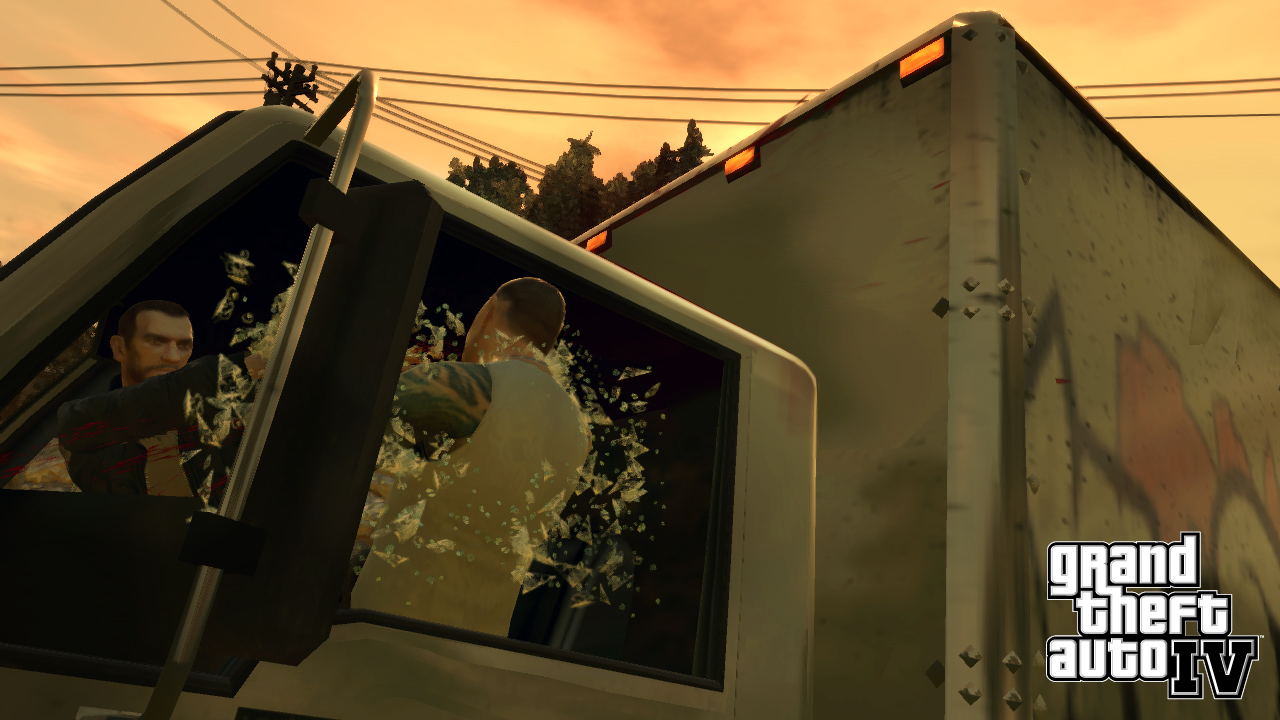
So GTA IV is awesome, but you can just spend so much time battling gangsters from every ethnic mob imaginable (orthodox Jewish crooks? really?), so I was pleased to have a diversion in the form of the Quest for Glory II Remake. As previously noted, Hero's Quest / Quest for Glory is one of the most influential series that I've played, and QFG2 had some particularly intriguing elements. It makes some surprising departures from its predecessor, adding realistic timed events, a revamped combat system, and the concept of "honor". The setting is very exotic as well, set as it is in an Arabian fantasy.
QFG2 is the only game in the series that was never made available with VGA graphics. In one of their few good moves of the past 15 years, Sierra gave their blessing to ADG Interactive to remake the game and update the graphics. This took them, um, six years. Yeah. I first heard of this project ages ago, and never really tuned in, so I was pleasantly surprised to learn that they were finally releasing it.
I'm used to retro gaming only becoming available through open-source projects. This can happen in one of three forms. First, you have platform emulators like DOSBOX or WINE. These aren't targeted at a specific game, or even for games in general; instead, they try to trick a game into thinking that it is running on a particular operating system (like MS-DOS 5) and hardware (like a 286), and transform its behavior to play nicely with modern computers. Because they are the most widely useful, these tend to be the most advanced, and you have the advantage of experiencing the game in close to its original format, including the true graphics and sound.
The second category is an engine rewrite. My favorite example of this is Exult, a project that I've followed for nearly a decade that is dedicated to resurrecting Ultima VII. Unlike platform emulators, engine rewrites are focused on a particular game (like Ultima), or occasionally a set of games that share the same underlying engine (such as Sierra's SCI, or LucasArt's SCUMM). These games re-use the original game files, which generally include audio, images, and scripting, but rewrite the core engine that handles things like saving games, combat, and overall game logic. Because these projects aren't seeking to emulate an entire platform, they can often get started more quickly - it actually isn't that hard to, say, decode a Sierra image and draw it to the screen. Because they're focused on particular games, they can often get a dedicated team around them quickly, assuming that the game in question is popular. And depending on how the project is run, the end result may be easily portable to a wide variety of platforms like Windows, Mac, Linux, Amiga, OS/2, etc. etc. In my experience, though, after an initial burst of enthusiasm, these projects generally bog down. Writing a good engine is hard, especially when you don't have insight into how the original worked. (Projects tend to follow "clean-room" implementation rules, since there are legal issues with reverse-compiling and modifying the original code.) Often an engine will become 50% effective in the first few months, 90% effective by the end of the first year - and then never actually finish. There are always those last few annoying edge cases, which often have to do with historical peculiarities like the EMS memory model of the early 1990's or re-implementing artificial intelligence.
The final category is a full game rewrite or "tribute". This approach tosses all the original content - icons, sound clips, game logic and source code - and remakes it from scratch. Examples include FreeCiv, Tetris, Pac-Man and countless games that never made it past the alpha stage. The problem here is that, in general, someone who is an excellent coder is not also an excellent artist, musician, QA engineer, and promoter. Even decades ago, games required teams of a dozen or more people, who were being paid to work full-time on the game. It's no wonder that people don't try this with modern games. Even when they restrict themselves to games that used to fit on a single 360KB floppy, it's really hard to stick with these things - either they're shooting to be as good as the original, in which case, why bother? or they're trying to update it to take advantage of modern device capabilities, in which case it's really hard to program and make it look good.
With all that background: The QFG2 remake was NOT an open source project. I kept on wondering what this project would have looked like if it was. What ADG did was periodically release teaser screenshots or the periodic YouTube video showing the progress they were making. In an open source project, people could have downloaded code as it was being developed and experience the game in whatever its current state of maturity was. Personally, I probably would have tried it out as soon as an early alpha became available. I would have spent an hour building it, maybe submitted a couple of minor patches that would be justifiably ignored ("Hey, you know what would be awesome? If you took these patches that cleaned up your compiler warnings! All right!"), and then played it for ten minutes. I would think, "This is really cool! Ah, what memories it evokes." Then, "Well, it's clear that they have a lot of work left to do." Finally, "I see enough segfaults in real life. I don't need to deal with them in gaming, too." I would have then ignored it until it was officially released. The problem, though, is that open source projects don't have the same release cycle of commercial software. You typically get to that 90-95% threshhold relatively rapidly, most people adopt it, and then development chugs along for a bit longer while the final kinks are worked out, but most people never update because they're happy with what they have. So I might have grabbed a beta, been disappointed, and never returned; or I might have waited for years and years. Which is what I ended up doing, except I didn't have the choice, and all things considered maybe that's OK.
So, how is the game itself? Pretty good. It looks nice, although again, keep in mind that this is just a VGA remake, and even that makes it sound better than it is, since the actual output is apparently 320x240 pixels. So, while it's far better looking that the original, it is a far, far cry from anything like modern games.
Interestingly, even though this is a full rewrite, gameplay seems to be identical to the original: dialog is exactly the same, the settings screen is exactly the same ("Silly Clowns" and all), even the alley system works the same (although it looks much different). They did make a couple of user-selectable options that control how the input works and how tough the alleys are to navigate.
Oh, controls probably deserve a special mention. My one complaint so far is that they also switched the game to use the later icon-based method, largely replacing text input. This makes me sad. Granted, most people will find this system far more intuitive and friendly, but I actually find it quicker to just type "look chico" than to right-click four times, move my cursor to the left of the screen, and then click. I dunno. I think movement based on the cursor makes a lot of sense - walking using the arrow keys was always tedious - but for all other game interactions, I would prefer to be using the keyboard.
So I was happy and nostalgic, but also a little unsatisfied. I'm not even sure why, but for some reason I downloaded (does it count as "pirated" if a game is over 20 years old?) "Manhunter 2: San Francisco." I think I first learned that this game existed just a month or so ago, when I was doing some browsing related to the QFG2 remake. It slightly predates my main period of infatuation with Sierra, and is a definite peculiarity. Just the little material I found online piqued my interest, so I decided to try it for myself.
Hmm, where to begin.
Sierra isn't really a family-friendly company, "King's Quest" notwithstanding. Games like Police Quest and especially Leisure Suit Larry were pointed at adults, and took the sort of liberties you might expect. That being said, the Manhunter games predated those series, and their combination of weirdness, gore, and darkness are unlike any other Sierra game I've played.
MINI SPOILERS
Disclaimer: I haven't played the first Manhunter (set in New York), and am only partly into the second one.
The Manhunter games are set in a post-apocalyptic future, after the Earth has been invaded and Humanity enslaved. When reading the backstory for the game, I was suddenly reminded (for the first time in YEARS) of the "Tripods Trilogy", a Scholastic sci-fi series I read in elementary school that dealt with the aftermath of a similar enslavement. Here, though, the invaders are the Orbs, basically giant flying eyeballs. They tightly control every aspect of human life, but cannot directly affect anything. Instead they rely on their robot creations, or, when the robots are inadequate, Manhunters, humans who have been privileged to carry out the Orb's bidding.
I probably wouldn't have grabbed this game if San Francisco hadn't been in the title. It actually seems relatively faithful to the city, which is surprising and cool. The game was set far enough ago that much of the city has changed - there's no tower at Rincon Hill, no dot-coms in SOMA, and most startling, the freeway on-ramps to the Bay Bridge are still intact. You can visit the Embarcadero Fountain (today known as Justin Hermann Miller Plaza), various piers, Victorian apartments, and multiple spots in Chinatown (more on that later). The gameplay itself is also very different from most Sierra games, and I was extremely surprised to read that it evidently uses the same engine as "Mystery House" and other pre-King's Quest Sierra games. Most of the game is shown in the first person, with you clicking through a series of static frames. Many of these are simple, showing a landscape, but some are cinematic, dramatically portraying a gruesome corpse or charging dog. Occasionally the game shifts into third-person perspective and you can actually see your Manhunter, clad in his mandatory robe, as he shuffles through the city solving a murder case.
Other elements are vintage Sierra, especially hitting Tab to bring up your Inventory screen. But, there is no typing in this game. Much like games a decade later, you move a cursor around the screen (using the keyboard, ew!) and select things that look interesting. This seems both retro and ahead of its time, because it actually follows the one-cursor-for-every-action model, not the multiple action selection that Sierra would adopt first. This is actually less annoying than many of those games, because the cursor clearly changes shape when you're on an item you can interact with, so you aren't left to click on everything in the screen in the hopes of finding the magic pixel. (Although, in certain dire straits, you may feel compelled to sweep the cursor over the entire screen.)
Gameplay is a mish-mash of the mystery game, which requires you to investigate various locations and collect clues, and mini arcade games, which range from the tolerable to the infuriating, but at least are varied. You might need to stomp on face-eating rats, dodge between boxes to avoid homicidal robots, keep your balance on a slippery bridge over a pool of acid, or swim to a drainage pipe. The controls are different for every mini-game, and while none are particularly fun, they do break up the action nicely.
Despite the aliens, probably the most anachronistic aspect of the game is its use of racial stereotypes. While playing the game, I was really struck by just how recent the PC movement in our country has been. I don't think you could actually call the game racist, but it does have a confused and odd perspective on the Asian people who make up a large fraction of San Francisco's population. Chinamen are portrayed with bright yellow skin, slanty eyes, and long mustaches. You will be either surprised or annoyed to learn that there are apparently ninjas in Chinatown. Probably the most hilarious thing I've come across so far, though, is this evil-looking levitating Buddha statue.

One thing I really appreciate about the game: it's willing to make the player do the hard work of unraveling the mystery. You collect clues in the form of newspaper clippings, corpse sightings, identification cards, etc., and need to piece them together yourself. There is no real exposition or narration in the game to explain what has just happened. This contributes to the very raw feel of the game.
I have to admit that I've been relying on Gamefaqs as I make my way through this, specifically the oldest Gamefaq that I know of in existence. I try to avoid these kind of hints, especially for adventure games, but the controls and mini-games are annoying enough that I know I would drop this game if I had to go through it unassisted. So far, most of the puzzles have been reasonable, but there are a few I would never have gotten on my own... for example, figuring out that you need to take four pinches of powder from the urn with the "Heaven" symbol on it. I'm treating this as a historical artifact as much as an actual game, so I'm perfectly willing to compromise my pride to uncover more of the game.
END OF SPOILERS
It doesn't really surprise me that Manhunter proved a dead end in Sierra's quest to build franchises. However, the very idiosyncrasies that killed it are what make it interesting today. I can't say that it's a better game than King's Quest I, but I have no desire to play King's Quest I again. There's a certain sense of danger in Manhunter, both from the scenes of violence in the game and the unconventional style that drives it, and that sense keeps me off balance and intrigued.
Wednesday, September 03, 2008
The Comedy of Excellence
I have a confession to make. It's a pretty serious one for a self-described literature nerd like myself. I... well, I'll just come out and say it: I don't really enjoy Shakespeare's comedies.
Oh, this is not at all a knock against the Bard. I love (most of) his tragedies, admire his histories, and like half of the romances. I haven't come across many works, in any medium, that contain the philosophical angst of Hamlet, the sense of wonderment in The Tempest, the rousing excitement of the Prince Hal saga, or the devastation of King Lear.
But the comedies? Not so much. I enjoyed watching the movie version of Much Ado About Nothing, and got a kick out of some of the dialog in Taming of the Shrew, but for the most part, his comedies were strictly required reading for me, nothing more. There's just wasn't... enough there. In comparison with the more serious works, his characters felt flat. The pacing was weaker, with the action held captive during supposedly witty exchanges. They didn't transcend the moment and speak to the human spirit. All of which might have easily been forgiven, were it not for one final factor: I didn't think they were funny.
Now, like most people, when I read Shakespeare, I need help. His language is different enough from ours that a good chunk of vocabulary is likely to be obsolete, and because we were raised on another continent hundreds of years in the future, we will miss many references that were timely for his audience. Just think of trying to show "This Is Spinal Tap," say, to a crowd in 1650 Bombay. And so, we usually read Shakespeare with a crutch: either on the same page or as endnotes, an editor provides explanations for parts that are likely to confuse us. This is always a delicate balancing act: provide too much and you risk drowning the reader in a mass of words that distract from the poetry; provide to little and you leave him helpless to understand what's happening.
And that really is the main problem: humor that needs to be explained is never funny. I love The Far Side, but as soon as someone says, "I don't get it," you know that hope is lost. Even if you are able to point out the joke, it will never be as funny as if they had found it on their own. Humor described is humor denied.
And so, when I learned that Shady Shakespeare was doing two comedies this summer, I confess to mixed feelings. I like the Bard and get a kick out of this troupe and their venue, but I wasn't exactly relishing the prospect of sitting through a comedy. They weren't even the two I liked!
I arrived early in the park and enjoyed a nice picnic dinner (cold pizza, juicy heirloom tomato, ripe peach) under a shady tree, near a sprawling and boisterous Muslim cookout. I walked over to the amphitheater about half an hour before The Comedy of Errors was scheduled to start at seven. As I expected, it was already filling up, but I was able to snag a spot along the edge just three rows back.
My optimism began to rise as I took in the stage and perused the program. Shady Shakespeare had absorbed one of the cardinal rules of our universe: everything is better if you add pirates. The director had chosen to move the play's setting from the Italian coast to the Caribbean, and as a result the stage was filled with parrots, pirates, barrels, and other such objects. The best part is, it actually works. The play calls for a port city, a certain atmosphere of danger, storms, and thriving commerce, all of which could be provided in Tortuga as well as Ephesus. Actors dressed as merchantmen, Old World governors, swashbucklers, even voodoun and Chinese traders.
Things got off to a great start when the three buccaneers - who would form a sort of Greek chorus through the play - came to the front and led use "merefolk" in a series of sea shanties, including classics like "Blow the Man Down" and "Fifteen Men on a Dead Man's Chest." This was great fun, as well as a good idea. Shady Shakespeare gets a lot of children in these shows, and increasing participation is always smart. Additionally, I just really like having excuses to sing out loud. I was pleasantly surprised by how well I remembered these old pirate songs, some of which I haven't heard for years since I heard them on old Disney material.
And when the play proper began, I was even more delighted to discover that - gasp - I was enjoying the play! And it wasn't just the atmosphere of the performance... I was genuinely amused by what was going on. What was happening?
As I thought about it, it made perfect sense. Other than the director's notes, there was no explanation or glossary about what was happening. As I directly experienced the play, I either got the jokes and laughed, or didn't and waited patiently for the next one. There was no opportunity for my type-A brain to say, "Wait, what?" and interrupt the action for several minutes as I flipped through endnotes.
A lot of credit has to go to the actors as well. Performing Shakespeare is always a challenge, and they did a great job: not only did they play their roles well, but they also worked very hard to provide non-verbal clues as to what was being verbally communicated. The play was staged with a great deal of mime, play-acting, broad gestures, and expressive speaking. You might not catch a particular term, but it's hard to miss the meaning when someone grabs a body part or feigns a kiss.
Furthermore, I was reminded once again about how PHYSICAL plays are. The Comedy of Errors is renowned for being the most slapstick-heavy of Shakespeare's plays, but even apart from the regular swatting and beating that takes place, the production makes it clear that there's at least as much humor to be had in double-takes, pratfalls, funny accents, and audible expressions of extreme emotion as there are in, you know, the words. Of course this makes perfect sense, and these are all things that are very hard to capture on the printed page. Think of, say, reading the script for "Austin Powers" as opposed to seeing the movie. You'll still chuckle at a few of the jokes, but so much of the humor is impossible to capture in black and white letters.
The more I reflected on it, the more I realized that I owed Shakespeare an apology. I just hadn't given the comedies a chance. I've only read them, rarely seen them. It should have tipped me off that the rare one I had seen (albeit in movie form) was thereafter deemed "one of the good ones."
It does give me some food for thought. It's interesting that the more serious works hold up so much better in purely textual form than the comedies. I've never seen King Lear performed, and in all honesty am not sure that I want to, but the raw power and despair on the page are very compelling. I wonder if this is because of human nature, that the physical is somehow more closely bound to the humorous, and the mind is more closely bound to the serious. Or it may be related to my own experiences. I'm much more likely to read dramatic novels than light humor, so perhaps I'm more primed to absorb certain messages from printed material.
There were just a few things that I wish Shady Shakespeare had done differently. The sound cues felt a bit overly broad - did we really need to hear a slide whistle every time someone fell down? I'm a little torn on this, since, again, there were a lot of children in the audience, and having that multi-media delivery may have helped convey the comedy better. The other complaint is more with the source material (hey, William's been dead for centuries, so what's he going to do about it?) - the slapstick really is too much for me. I was never a bit fan of Loony Toons or other entertainment that relies on you laughing when someone hurts someone else, so it was a bit hard to enjoy watching someone get slapped upside the head repeatedly. On the other hand, most of the non-slapstick physical humor was excellent, including an amazing over-the-top scene where Antipholous's (sp?) "wife" seduces him on the street.
Some people might complain about how contrived the play is. It has not one, but TWO sets of identical twins, each of which unhelpfully shares the same name, and the play ends with a deus-ex-machina that would make even "Romeo & Juliet" embarrassed. Me, I have a nearly infinite capacity to forgive the implausible if it's funny. It's not like "Family Guy" is a paragon of perfectly logical thought.
With my love of Shakespeare's comedies newly revived, I'm now looking forward to catching "Twelfth Night" this weekend. The Bard marches on!
Oh, this is not at all a knock against the Bard. I love (most of) his tragedies, admire his histories, and like half of the romances. I haven't come across many works, in any medium, that contain the philosophical angst of Hamlet, the sense of wonderment in The Tempest, the rousing excitement of the Prince Hal saga, or the devastation of King Lear.
But the comedies? Not so much. I enjoyed watching the movie version of Much Ado About Nothing, and got a kick out of some of the dialog in Taming of the Shrew, but for the most part, his comedies were strictly required reading for me, nothing more. There's just wasn't... enough there. In comparison with the more serious works, his characters felt flat. The pacing was weaker, with the action held captive during supposedly witty exchanges. They didn't transcend the moment and speak to the human spirit. All of which might have easily been forgiven, were it not for one final factor: I didn't think they were funny.
Now, like most people, when I read Shakespeare, I need help. His language is different enough from ours that a good chunk of vocabulary is likely to be obsolete, and because we were raised on another continent hundreds of years in the future, we will miss many references that were timely for his audience. Just think of trying to show "This Is Spinal Tap," say, to a crowd in 1650 Bombay. And so, we usually read Shakespeare with a crutch: either on the same page or as endnotes, an editor provides explanations for parts that are likely to confuse us. This is always a delicate balancing act: provide too much and you risk drowning the reader in a mass of words that distract from the poetry; provide to little and you leave him helpless to understand what's happening.
And that really is the main problem: humor that needs to be explained is never funny. I love The Far Side, but as soon as someone says, "I don't get it," you know that hope is lost. Even if you are able to point out the joke, it will never be as funny as if they had found it on their own. Humor described is humor denied.
And so, when I learned that Shady Shakespeare was doing two comedies this summer, I confess to mixed feelings. I like the Bard and get a kick out of this troupe and their venue, but I wasn't exactly relishing the prospect of sitting through a comedy. They weren't even the two I liked!
I arrived early in the park and enjoyed a nice picnic dinner (cold pizza, juicy heirloom tomato, ripe peach) under a shady tree, near a sprawling and boisterous Muslim cookout. I walked over to the amphitheater about half an hour before The Comedy of Errors was scheduled to start at seven. As I expected, it was already filling up, but I was able to snag a spot along the edge just three rows back.
My optimism began to rise as I took in the stage and perused the program. Shady Shakespeare had absorbed one of the cardinal rules of our universe: everything is better if you add pirates. The director had chosen to move the play's setting from the Italian coast to the Caribbean, and as a result the stage was filled with parrots, pirates, barrels, and other such objects. The best part is, it actually works. The play calls for a port city, a certain atmosphere of danger, storms, and thriving commerce, all of which could be provided in Tortuga as well as Ephesus. Actors dressed as merchantmen, Old World governors, swashbucklers, even voodoun and Chinese traders.
Things got off to a great start when the three buccaneers - who would form a sort of Greek chorus through the play - came to the front and led use "merefolk" in a series of sea shanties, including classics like "Blow the Man Down" and "Fifteen Men on a Dead Man's Chest." This was great fun, as well as a good idea. Shady Shakespeare gets a lot of children in these shows, and increasing participation is always smart. Additionally, I just really like having excuses to sing out loud. I was pleasantly surprised by how well I remembered these old pirate songs, some of which I haven't heard for years since I heard them on old Disney material.
And when the play proper began, I was even more delighted to discover that - gasp - I was enjoying the play! And it wasn't just the atmosphere of the performance... I was genuinely amused by what was going on. What was happening?
As I thought about it, it made perfect sense. Other than the director's notes, there was no explanation or glossary about what was happening. As I directly experienced the play, I either got the jokes and laughed, or didn't and waited patiently for the next one. There was no opportunity for my type-A brain to say, "Wait, what?" and interrupt the action for several minutes as I flipped through endnotes.
A lot of credit has to go to the actors as well. Performing Shakespeare is always a challenge, and they did a great job: not only did they play their roles well, but they also worked very hard to provide non-verbal clues as to what was being verbally communicated. The play was staged with a great deal of mime, play-acting, broad gestures, and expressive speaking. You might not catch a particular term, but it's hard to miss the meaning when someone grabs a body part or feigns a kiss.
Furthermore, I was reminded once again about how PHYSICAL plays are. The Comedy of Errors is renowned for being the most slapstick-heavy of Shakespeare's plays, but even apart from the regular swatting and beating that takes place, the production makes it clear that there's at least as much humor to be had in double-takes, pratfalls, funny accents, and audible expressions of extreme emotion as there are in, you know, the words. Of course this makes perfect sense, and these are all things that are very hard to capture on the printed page. Think of, say, reading the script for "Austin Powers" as opposed to seeing the movie. You'll still chuckle at a few of the jokes, but so much of the humor is impossible to capture in black and white letters.
The more I reflected on it, the more I realized that I owed Shakespeare an apology. I just hadn't given the comedies a chance. I've only read them, rarely seen them. It should have tipped me off that the rare one I had seen (albeit in movie form) was thereafter deemed "one of the good ones."
It does give me some food for thought. It's interesting that the more serious works hold up so much better in purely textual form than the comedies. I've never seen King Lear performed, and in all honesty am not sure that I want to, but the raw power and despair on the page are very compelling. I wonder if this is because of human nature, that the physical is somehow more closely bound to the humorous, and the mind is more closely bound to the serious. Or it may be related to my own experiences. I'm much more likely to read dramatic novels than light humor, so perhaps I'm more primed to absorb certain messages from printed material.
There were just a few things that I wish Shady Shakespeare had done differently. The sound cues felt a bit overly broad - did we really need to hear a slide whistle every time someone fell down? I'm a little torn on this, since, again, there were a lot of children in the audience, and having that multi-media delivery may have helped convey the comedy better. The other complaint is more with the source material (hey, William's been dead for centuries, so what's he going to do about it?) - the slapstick really is too much for me. I was never a bit fan of Loony Toons or other entertainment that relies on you laughing when someone hurts someone else, so it was a bit hard to enjoy watching someone get slapped upside the head repeatedly. On the other hand, most of the non-slapstick physical humor was excellent, including an amazing over-the-top scene where Antipholous's (sp?) "wife" seduces him on the street.
Some people might complain about how contrived the play is. It has not one, but TWO sets of identical twins, each of which unhelpfully shares the same name, and the play ends with a deus-ex-machina that would make even "Romeo & Juliet" embarrassed. Me, I have a nearly infinite capacity to forgive the implausible if it's funny. It's not like "Family Guy" is a paragon of perfectly logical thought.
With my love of Shakespeare's comedies newly revived, I'm now looking forward to catching "Twelfth Night" this weekend. The Bard marches on!
Subscribe to:
Posts (Atom)