I have a backlog of half-written posts waiting to be published, mostly on hold because I'm getting deeply wrapped up in Europa Universalis IV. There is a time-sensitive thing coming up, though: the primary election here in California! As usual, here's my personal take on each race and measure. I'm skipping over uncontested races.
I'm honestly not very passionate about a lot of these offices, so there's less color commentary here than normal. But that doesn't mean it's unimportant! In local and county races, candidates can win outright with 50%+ in the primary, not even appearing on the more-popular November ballot. The smaller turnout in the primary also means your vote counts for more and has a bigger impact.
One of several unexpected things to come out of my play-through of Disco Elysium was a fresh update to my reading list. The creator published an "Inspirations and Recommendations" guide that lists works in several media which had some influence on the unique world and game experience of Disco Elysium. Most of the books were new to me (other than China Mieville), and I've been feeling very eager for new experiences evocative of DE, so I got cracking.
First up is The Glass Key, a hardboiled noir detective novel from Dashiell Hammett. I've heard of Hammett, of course, but haven't read him before; in fact, as I think about it I've come to realize that I probably haven't read any noir novels. That seems a bit surprising since I say that I like noir, but that's probably based on me really enjoying a tiny number of specific movies.
The Glass Key was an excellent read. A few things jumped out at me about it. First of all, all of the narration is very surface-level and completely focused on physical descriptions. The book tells us what a character says, how he walks, where he looks, when his breath grows labored, when his hand twitches. It never tells us what he's thinking. That doesn't mean that the character doesn't have an interior life or isn't mulling things over! But it means that we're always at least a step behind, trying to parse meaning out of behaviors and not only figure out what's going on but what the character thinks is going on.
Reading this book reminded me a lot of watching a movie. Of course, movies also are very focused on surface appearances and, bad voiceovers notwithstanding, tend to show what characters do and let us infer how they feel. This similarity extends down to the periodic phone calls, which put me in mind of a classic Bob Newhart routine: we only hear a single side of the conversation, with periodic ellipses elliding the other party's responses, and try to fill in the gaps ourselves.
MINI SPOILERS
The novel's protagonist is Ned Beaumont, a sort of antihero. I was never completely clear on exactly what his deal was, but he seems to have played a big but undefined part in assisting the rise of a corrupt political/criminal machine system run by Paul Madvig. The novel is set during Prohibition and Madvig oversees a network of speakeasies and crooked government contracts, backed up by bought-and-paid-for elected officials.
Very early on a murder occurs, with Ned finding the body, and I spent much of the novel wondering whether he was trying to solve the mystery or cover it up. Ned has a lot of history with Paul and other characters, so even when he's talking with them there's a lot that goes unsaid and is simply understood between them, but not to us the reader. Ned is really unusual: not a private detective or another "typical" noir role, but he does use his clout to obtain an official commission as an investigator for the DA's office... and then proceeds to use that commission to further his own private financial interests.
There's a pretty sizeable cast of characters: Ned is present in every scene, a few others like Paul and Jack appear fairly regularly, some play large roles for a short time, and a few make brief but memorable impressions before disappearing forever.
MEGA SPOILERS
I mulled over the possible culprits quite a lot over the course of the book. One early favorite theory of mine was that Ned himself was the murderer: that scene starts with him standing over the corpse, and it seemed somewhat plausible that he had done the deed himself to protect Paul, with their subsequent vague conversations communicating this situation without saying it out loud. The nature of those conversations was actually more reversed, with Ned at least somewhat suspecting Paul of the crime. I did wonder if the senator had done it, or one of the women in Taylor's life. Ultimately we learn that the senator did it himself, but the revelation of his motivations was still pretty surprising to me.
The book ends on a somewhat brutal note, with Ned revealing to Paul that he isn't just leaving town and their relationship, but also leaving with Paul's crush Janet. As is usually the case in this sort of genre and era, I have a really hard time believing the romantic decisions of women; Ned seems like an old and beat-up and not particularly nice man, while Janet seems like she's about nineteen, beautiful, rich, smart and tenacious. (I recently re-watched Casablanca and have a similarly hard time picturing the young ingenue Ilsa falling for crusty old Rick; I do wonder if expectations and standards were very different back then, or if it's a sort of fantasy built into these stories or what.) The last few sentences are kind of crushing, ending the book as a whole on a decidedly melancholy note.
END SPOILERS
The Glass Key was a pretty perfect book for my renewed public transit commuting lifestyle: short, punchy, intriguing without being overly complex, vivid and exciting. I can see why Robert Kurvitz likes it so much: it isn't directly evocative of Disco Elysium, but you can see how some bits of its DNA made its way into parts of the game.
I continue to enjoy China Mieville's works as I come to experience more of his range. He occupies an interesting position, with a deeply idiosyncratic and fully-formed sensibility on display in his seminal Bas-Lag books, much like I would expect from a top-tier genre writer; but he also roams far afield, with much more grounded novels and even really compelling non-fiction.
"Kraken" is an interesting entry. I'm tempted to describe it as a sort of crosshatch between his Bas-Lag books and The City & the City; it has the deep eldritch horror vibes of the former, but is set in modern Earth like the latter. It has a pretty different feel than either of those books, though, with much shorter chapters and a very kinetic style.
The City & the City is modern, but also kind of timeless, and feels like it could be set any time between 1950 and 2030. In contrast, Kraken is very specifically a book set in 2008, and is filled with highly topical references: 3G networking, lolcats, Amy Winehouse's song "Rehab", and so on. I honestly found it a bit distracting, and reading this made me understand why authors generally avoid adding bleeding-edge references to their novels. I do wonder if it might work better 20 years from now when those references have all faded into a generic "past".
MINI SPOILERS
Billy is the protagonist in this book, and I was pretty annoyed by him early on. For the first hundred pages or so there's an endless loop where he sees something strange happen, he says, "This can't be happening!", he sees more strange things happening, says "This can't be happening!", and so on. To be fair, if I was in that situation myself I'd have a similarly hard time accepting it, but as a reader it's aggravating to have the protagonist just flatly deny things over and over without variation. By the halfway point of the novel, though, Billy evolves and becomes a more active protagonist instead of a mere observer, and he's actually pretty likeable by the end. He makes some really bad decisions along the way, but we can see that he's very loyal towards his friends, curious about the world, driven to figure out what's going on, and brave enough to put himself at risk to protect others.
We meet many other factions over the course of the book, one of the first being the police, specifically an X-Files-ish outfit called the FSRC. Their background is pretty interesting; their official remit is investigating cults and extremist religious sects, but they end up getting roped into any supernatural/mystical issues because London isn't willing to admit that such issues exist. They kind of seem like the "good guys", since they're trying to solve the case and protect the city against criminal elements, but most of what they do ends up making things worse. For example, Kath Collingsworth summons a bunch of cop spirits in what seems to be an earnest attempt to advance the investigation, but the only purpose those spirits serve is to harass Wati. By the end Kath comes off as pretty decent, while the other members of her squad do not.
There are maybe one and a half "good" factions, and dozens of "bad" factions. These bad factions lean heavily into horror. Goss & Subby are definitely the most memorable and scary of the bunch. Mieville does a great job with words in making these two vivid and terrifying: they have weird behaviors, and an incongruously jovial manner of speaking coupled with sudden, shocking acts of violence. It helps that nearly all of the characters in the novel already know and are terrified of them, which we as readers easily buy into.
Mieville is particularly good at evoking dread in his books, and gets to do so a lot in Kraken. Gunfarmers are mentioned early, and you get a sense of the scope of their menace but not why they are so feared. Eventually you learn, and it's very scary indeed! We keep meeting really vivid and bizarre groups of people, to the point where the novels feels like an extreme urban fantasy version of The Warriors. There are "Knuckleheads," people wearing motorcycle helmets concealing clenched fists where their heads should be. A faction of Nazis who embrace hedonism along with sadism. The gunfarmers, with cursed religious zealotry and a living nightmare for left-wing arms-control advocates. (I think there was also a handlinger reference early on? But it seems to be a different creature on Earth than it was on Bas-Lag.)
I suspect that a lot of people reading Kraken will already be familiar with Bas-Lag, and while this is a very different universe and fairly different style, quite a few things evoke those earlier works. The Tattoo himself and his Workshop feel very reminiscent of the Remade from New Crobuzon, the product of bizarre and sadistic magical surgeries. As with the world of Bas-Lag there's a sweeping range of distinct characters, but they're slightly more grounded here. Mieville does a good job at making his big cast out of memorable individuals, which avoids the frustration I sometimes feel in a book with many names to keep track of.
Likewise, the plot is twisty and sprawling, but I was able to follow it, and the various twists felt well planned rather than arbitrary. I enjoyed the progressive illumination of the storyline and backing mythologies, which went through quite a few fake-outs and reversals between villains and victims, as we come to learn who is actually the animating force behind things rather than merely reacting to them.
MEGA SPOILERS
I suspected relatively early on that Vardy was behind the plot, grew more confident of that when he was conspicuously missing in action during the contrived apocalypse, and ultimately felt vindicated in my suspicion. My favorite aspect of the climax, though, was definitely the revelation of Grisamentum's plot. It's so weird but it makes a sort of internally coherent sense, more so since we're reading about it in this book; it would almost certainly feel less convincing in another medium like a movie. The final confrontation with Vardy in the museum wasn't as visually awe-inspiring as the Raw Shark Texts-ish battle with Grisamentum; but reflecting on the stakes of Vardy's plot made it more impressive despite the more static composition of that stand-off.
END SPOILERS
Overall, I feel like Kraken is one of my less favorite China Mieville books, but I still enjoyed it quite a bit, which says a lot about how I feel about him as an author. It's a kind of odd book to place: not a relatively approachable "in" to his writing like The City & the City, and not an iconic achievement like Perdido Street Station or The Scar; but people like me who've already come to enjoy his writing will likely appreciate the familiar-yet-original spirit of this novel.
I've been hearing good things about Disco Elysium for two years now, and I'm pleased to say that it exceeded my high expectations. It's a really original game that's also very fun to play, taking the elements I love best from RPGs and adventure games and doing things I've never seen done before with them.
When describing it to people, I sometimes hesitantly reference Season 1 of True Detective, or Twin Peaks: it's an ostensible murder mystery that explores a colorful community and veers into some mystical-feeling territory. It's a lot more political than those shows, though, and a lot more funny as well. So maybe toss in some of Dirk Gently's Holistic Detective Agency and, I dunno, maybe China Mieville's The City & the City. I don't have nearly as many video games to compare it to. It's nothing at all like Police Quest, isn't nearly supernatural enough for Gabriel Knight, way more playful and fun than L. A. Noire, plus, y'know, this is an RPG. As I described in my first post, I can't really think of any other RPG that's had a similarly broad yet simple attribute system. I guess maybe the Torment games are the closest analogues, at least in having an amnesiac protagonist and a lot of self-directed character determination, but Disco Elysium has far more varied and reactive possible paths through the game.
A few quick gameplay notes before getting into plot:
I'd mentioned before that, while the voice acting is very good, I found myself skipping through most of the lines. Fortunately, there are several options available in the game to modify the use of voiceover. About halfway through the game I switched to "Classic" and I absolutely love it: it works kind of like old-school Baldur's Gate, in that when you start a conversation you'll hear the first few lines spoken by the character, but from then on it's text-only. That works way better for me in a game like this with a ton of text. We're now almost a decade into the isometric RPG renaissance, which has long had an awkward relationship between copious amounts of text and long voice acting, and I really hope that more games offer Disco Elysium's options in the future to switch between different modes of voicing.
MINI SPOILERS
I tried to stay spoiler-free while playing this game, but whenever I got a new Thought option I looked it up on the wiki to see if its results would be worth taking. I prioritized Thoughts that granted bonus XP; I didn't exactly min-max, and I'm sure a thorough playthrough would get more levels than me. Anyways, by the end of the game I had enough skill points to raise all of my Intellect and Psyche skills to 8 and to put three pips into each Physique and Motorics skill. Just something to keep in mind for builds. (My initial attribute allocation was 4/6/1/1, but I took a Thought that raised all learning caps to 3.)
Similarly, by the end of the game I was able to buy every purchasable item except for a vanity thing that cost 700 Real, even without selling much of value. Money feels tight and scary on Day 1, but after two particular encounters and making it to Day 3 there isn't anything to worry about for the rest of the game.
Don't be afraid to fail Red Checks. It's often necessary to proceed in the game.
Clothing isn't as critical as I had initially thought. Swapping clothes can make a noticeable difference in passing White and Red checks; but there are an order of magnitude more passive checks than active checks, and you won't typically be notified of failed passive checks. Once you have a stable outfit, it's probably best to spend your Skill Points to fill in gaps and bring as many skills as possible up to the higher levels. Passive checks are usually just fun and for flavor, but they'll also often open up new lines of questioning, and while out in the world they can do things like reveal hidden rooms or items.
MEGA SPOILERS
After my previous post, I continued my hard-core Communist run through the game. This leads through an interesting encounter with a Communist "cell", which you soon realize is just a glorified book club. It seems a bit silly and close to pathetic, but culminates in a surprisingly beautiful moment of wonder and grace.
I also recovered from my initial Boring Cop snafu and pivoted into Superstardom, which was fun but I didn't feel as invested in that angle as the Communist one. I had almost no Apocalyptic points in this run, but I think that could be a really fun angle for the future: I can imagine a full-on Crazy Harry approach where you take speed and smoke and mutter about the end of the world.
While I took care to become more interesting, I still continued my standard RPG behavior of trying to make everybody like me. Fortunately, that isn't incompatible with being weird. As long as you aren't calling people racist names they'll generally tolerate your eccentricities. (As a rule, people do not like being called racist, but that didn't stop me! I don't need to be friends with those people!)
Your relationship with Kim is the most important, and we struck up a good rapport early on. He could see how hard I was trying, even if I kept failing, and I thanked him profusely for his orientation and help.
Alongside all the humor, there's also a lot of powerful emotional content here, including an achingly poignant portrayal of the heartbreak and grief that follows the end of a romantic relationship. In this area especially, it's fascinating to think about how all of the various parts of your psyche are acting to protect you, but in the process encouraging maladaptive thought patterns and behaviors. I don't think that this is necessarily a game about psychology, but stuff like that really hits home and feels like a thoughtful and serious treatment of how our minds work.
Oh, and the worldbuilding is really impressive too. I mentioned before that it took me a little while to realize that this was a completely original world, and not just a fictional country in our own. By the end of the game, I'm pretty sure that it's a straight-up different universe and not just a dream or purgatory of our own. That sense of familiar things actually being different continues throughout, though. Communism is a great example: upon hearing the name, you naturally assume that it's the same as our world's Communism, with Mazovian Socio-Economics primarily concerned with the ineluctable forces of history devolving power downward and ending in the hands of the workers. In Disco Elysium, it has very similar vibes - pro-proletariat, anti-fascist, egalitarian and communal - but the underlying philosophy seems to be pretty different, deriving from metaphysics more than dialectical materialism. Similarly, the musical genres mentioned in the game exactly match ours: rock, disco, hardcore; but "rock" is sad and slow, a reactionary music of the bourgeoisie.
Also! I can't close this post without talking about how I deeply, DEEPLY loved the nightclub plot. I think it's insane that Disco Elysium has a better club than any modern Shadowrun game. It's everything that I ever wanted: doing the work to find a venue, prepare it, upgrading the sound system, collaborating with musicians to make the most HARD CORE music ever. And dancing! Seriously, the high point of this entire game was, without a doubt, the moment that I convinced Kim Kitsuragi to get down and funky on the dance floor. I love this game so, so much.
Favorite Attribute: I thought Psyche, but turns out it was Intellect!
Favorite Person To Beg Money From: Mega Rich Light-Bending Buy.
Favorite Tool: Your journal.
Favorite Voice: Hard to pick one! The narrator, I guess, despite turning him off. Character-wise, perhaps Evrart, who is super-interesting to listen to.
Favorite Ally: Kim Kitsuragi.
Favorite Enemy: The Deserter.
Favorite Adversary: Gosh, lots of great choices. Perhaps Ruby, despite her short screentime.
Favorite Thought: For concept, Inexplicable Feminist Agenda. For mechanics, Actual Art Degree.
Favorite Book: Lots of great choices! A Brief Look At Infra-Materialism was pretty fascinating. I had an especially great time playing Suzerainty (I got two points!), and loved my breathless reactions to The Man From Hjelmdall.
Favorite Music: Maybe the Smallest Church in Saint-Saëns? It has a really cool Tom Waits sound.
The Whirling-In-Rags theme is wonderful too.
And don't forget the final mix of Hard Core Anodic Disco!
Favorite Minor Character: Arrrrrrrggggghhhh, don't make me choose! (Egghead.)
Favorite Map: Maybe the basement of the Doomed Commercial Arena?
Least Favorite Activity: Walking all the way to visit Evrart and then walking all the way back. I really wish there was a fast travel point near the shipping container.
Favorite Visual: The camera slowly panning out to reveal the high spire of the church. Runner-up: Hypothetical bullet trajectories traces in Klaasje's room.
Favorite Animation: Harry's sick dance moves.
Saddest Scene: Geez, so many to choose from, but I'll probably pick the recurring dream of Dora.
Coolest Psychological Development: Volition discovering that your instincts have been compromised. Runner-up: Encyclopedia being 100% useless during the examination of Moralism (along with the cross-chatter of your other thoughts seeking to avoid the mention of Dolores Dei).
Favorite Quest: Finding the reckless driver.
Favorite Achievement: Biggest Communism Builder.
Favorite Artwork (In-game): "Un Jour Je Serai De Retour Près De Toi". Runner-up: The ruined stained-glass window featuring Dolores Dei and her retinue.
Favorite Portrait: Ruud Hoenkloewen's is really affecting. Lilienne's is good. Egghead's is amazing. I just love the huge range from very abstract to stylized.
Favorite Drug: I don't use that stuff, man. (But I did buy a pack of cigarettes near the very end for an art project.)
END SPOILERS
Disco Elysium succeeds on pretty much any scale I can think of. It's a great story, with a complex plot that unfolds believably. It's a fun game, with unique but easily grasped mechanics. It's emotionally affecting, somehow managing to meld together horrific crimes and macabre scenes with laugh-out-loud funny dialogue, whimsical flights of fancy and sincere fraternal bonding. It's unafraid to wear its politics on its sleeve, while also recognizing that the world is a big place and too complex to reduce to a slogan. Something beautiful happened here.
Disco Elysium has been on my to-play list for years now, almost from the moment it came out. It's the kind of game that people excitedly talk about at parties, and the kind that spawns screenshots posted from accounts that you didn't realize played video games.
It's an RPG, and a particularly precious kind: One that isn't from the fantasy or sci-fi genre. You play a detective, investigating a surprisingly baroque murder mystery. It's a very dialogue-heavy game, but unlike a lot of very dialogue-heavy games, this one has some very crunchy mechanics behind it. You have four main stats, a whopping 24 attributes, ten clothing slots, and a vast array of secondary characteristics that the game tracks. There are two separate health pools, many consumables, XP and money and shops. Oh, and also entire additional systems like Thoughts, where you further develop your character by pondering and eventually accepting specific ideas (which could be moral, political, personal, or whimsical in nature).
The system is crunchy, but (at least to anyone who's played RPGs) not at all intimidating. Skills all make sense, there are many many paths to success, and the core challenge mechanic is a simple 2D6 roll. Perhaps most importantly, failing skill checks does not mean failing the game. I have gotten to a couple of "Game Over" screens, but only by making catastrophically terrible choices (usually after the game specifically warns you against them). Most skill checks are labeled as "White checks", which means that you can try them again after leveling up the relevant attribute or making some breakthrough in the case. The rarer "Red checks" can only be attempted once, but failing these just puts the story down another path, one that might be at least as good. As one example, there's a spot where you can pitch an investment plan to a businessman. You can try to pitch a good idea or a bad idea. If you succeed in pitching the good idea, you get the funds. If you succeed in pitching the bad idea, he turns you down. But if you fail in pitching the bad idea, then you also end up with the funds. Things like that keep the game nice and snappy. I still find myself reloading after failed checks, but that's just from force of habit and not because the game rewards it.
I'd originally planned to write up a post after finishing the game, but I'm digging it enough and finding it deep enough that it seems worth a mid-(?)-game check-in. This post will mostly focus on mechanics; I'll try to save the plot and character stuff for a later post.
Somewhat like Planescape Torment, you play a single (initially nameless) PC, who has a predefined backstory but who you can build in pretty much any way you like. My initial skill allocation was 4 Intellect, 6 Psyche, 1 Physique and 1 Motorics. Whenever I have the chance, I like to make RPG characters who are more talky, hence this loadout. It's worked fine - I'm sure all builds are viable - but I am wishing that I'd gone for something more like 3/5/2/2. First of all, starting with a single point of HP means a single point of damage can kill (at least until you pick up healing items). I'm also limited to only investing a single skill point into half of my attributes. As I'm getting further into the game, I'm seeing how this limits me from unlocking quite a few passive dialogue checks.
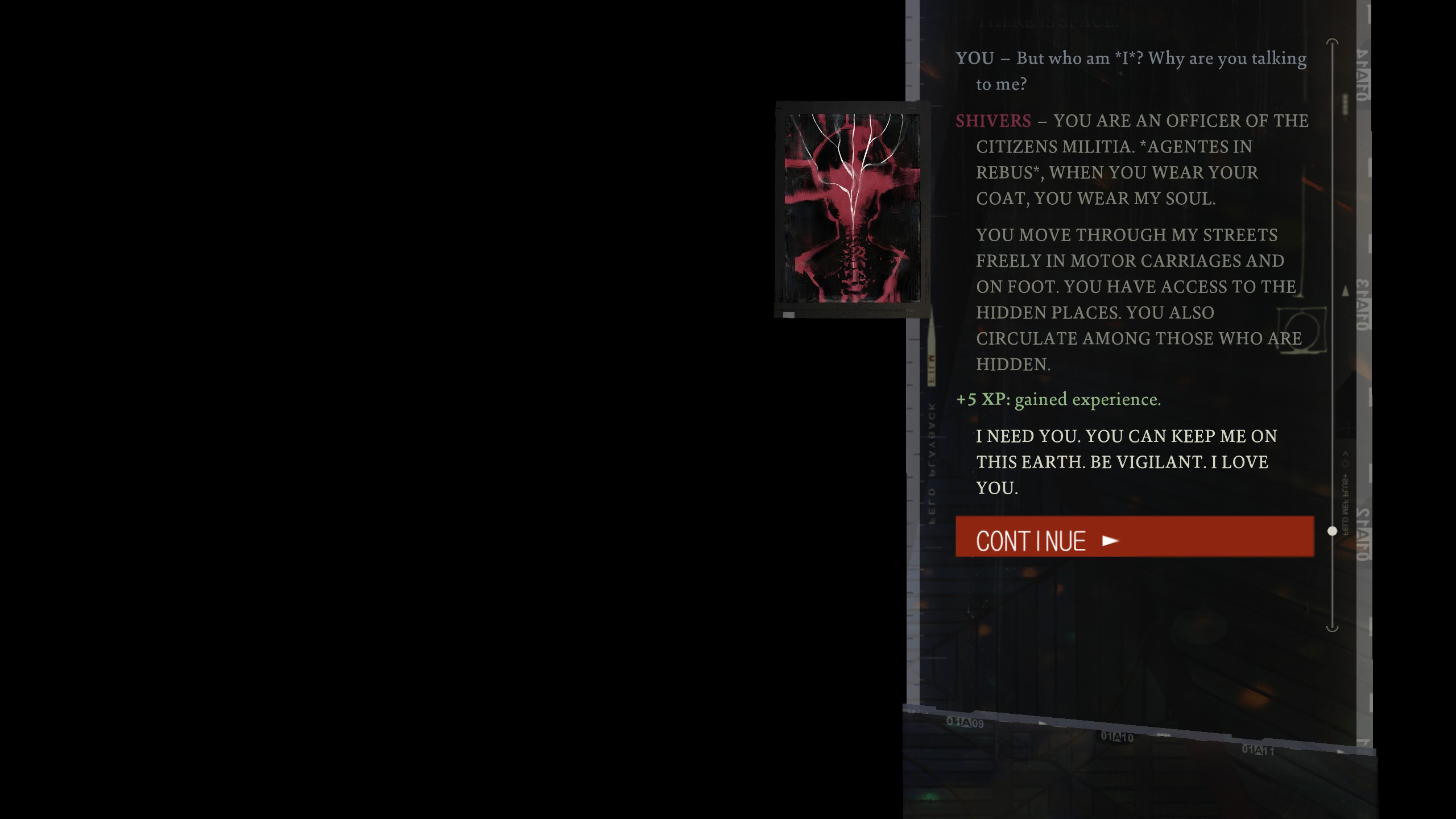
More broadly, the attribute breakdowns are a lot more diverse and interesting than my assumption of "INT / CHA / STR / DEX" went. Psyche includes things like Suggestion and Empathy that I use a lot; but it also includes things like Authority that I shy away from, or Esprit de Corps that I don't have a whole lot of use for. I'd assumed that Physique was for more of a dumb, brute-force approach; but really it's more about being in tune with your body. It has some really cool stuff, like "Shivers", which is a kind of sixth-sense that alerts you to what's going on in the city around you. Likewise, Motorics includes things like Interfacing (stealing or picking locks), but also Composure, which is more about how you hold and present yourself. In some situations, Composure might be more helpful for navigating a conversation towards your desired outcome than a more seductive approach would be.
For a while I was pushing all of my skill points into my preferred Psyche attributes, then into the Intellect ones. From what I've seen, though, the benefits start tapering off around a level of 8 (including your clothing bonuses). Levels beyond that can actually start to sabotage you: an excessively high Empathy might cause you to take the side of a serial killer, or a very high Authority might make you get into fights you cannot win. So now I'm trying to level up my lower skills as well.
Clothing is a great way to fine-tune your stat loadout for specific checks. Early on most of the items you pick up give balanced bonuses and penalties, like "+1 Electrochemistry, -1 Rhetoric". As you get further into the game you find more items that give net bonuses. I do kind of wish that there was a better UI for this: all of your clothing items are in one big jumbled category, which isn't bad at first but gets unwieldy once you have a couple of dozen things in there. It would be great to sort them by body-part category or by skill type.
Leveling is pretty fast in this game: you get little dribs of 5XP while noticing things during your investigation, and larger rewards of 30XP or 70XP for making progress in one of your (many!) tasks. Every 100XP gives you a new skill point to spend. Instead of increasing an attribute, you can also unlock a Thought Cabinet slot, which you can then use to learn a Thought. I'll admit that I cheat and look up the rewards for potential thoughts before researching them; that isn't strictly necessary, but you have limited slots and I'd rather not spend additional levels in forgetting a thought.
Thoughts present themselves to you in dialogue, or more often monologues, as your character reflects on something they've seen, heard or felt. This usually ends with the choice to "Accept thought" or "Discard thought". From what I can see, you should always choose "Accept thought". Doing this just adds it to the list of available thoughts to internalize; you don't have to learn it, and accepting will keep that option open.
One of the first thoughts I unlocked was the "Sorry" copotype: my inner monologue noticed that I was apologizing for everything, and had decided that that was my primary characteristic. I was initially indignant: How dare you call me that?! I don't want to be a "Sorry Cop"! But on further reflection I realized that I had, in fact, been almost non-stop apologizing. For good reason - there's some rough stuff that apparently went down before the start of the game, and it's in my nature to say "I'm sorry" when someone mentions how bad they're feeling. Anyways, unlocking that Thought was kind of a wake-up call for me. Yes, I had been acting sorry, but I didn't want to be The Sorry Cop, so I made a deliberate choice to stop apologizing for everything and work on being more interesting. And it worked! There are some other really fun copotypes to unlock; I'm currently an Art Cop, but Apocalype Cop sounds really fun too, not to mention the iconic Hobo Cop.
Hobo Cop is one of the few specific things to have penetrated my consciousness during the last few years of not playing this game. As is often the case, I feel like I've been rewarded for my tardiness, as I am playing the "Final Cut" edition. This has a few minor additions, and also the big change of being fully voice-acted. The voice-over actors are great, but it's just SO MUCH, man. I read quicker than I hear, and from early on I've gotten in the habit of skipping forward during dialogue.
MINI SPOILERS
The game's tone varies a lot. It's often sad, sometimes grim, occasionally macabre. I find that I'm playing this game in shorter chunks than usual, as I need to step away from the mouse for a bit to digest and recover. But it's also really funny, and has some genuine moments of sweetness.
Early on I thought that the game was set in our world, and went through the first half-hour or more of the game trying to place the "Insula" and figure out where the various countries were located. (I'd pictured it as something like a "The City & the City" situation, with a fictional city set in our real world.) I eventually figured out that the whole world is original, which is cool. I'm on record as disliking having to learn entire new mythologies every time I pick up a new RPG, but this one is so different in setting and tone that I don't mind at all.
It is interesting how real world phrases will occasionally slip through, like "Franco-Nigerian". That makes me curious if there is some connection between our worlds after all. It seems plausible that this case is playing out during a dream, with the dream-like quality of being evocative of the real world but different in all the details. The highly impressionistic art style seems like it might support that idea. Or this could be a world we've entered after death, and are processing our life experiences. The title "Elysium" seems to nod to this interpretation, as does a later conversation with the White Pines negotiator Joyce.
I do really love the alternate "history" shown in this game. Political factions are similar to our own world, and they have familiar cadences but take place in different years and countries and with different people. One of the most obvious example is that communism was invented by Kras Mazov, who seems a clear doppelganger for Karl Marx. In this world, though, Kras actually participated in a revolution. As in our own world, a business-oriented liberal order has become ascendant, while communist and fascist factions try to make up for their smaller numbers with boisterous action.
Besides the political stuff, though, the technology itself is intriguing. They have "Radiocomputers", which use tape; when someone explains how they work, though, you realize that their tapes are different from how our own were constructed. They have air travel, but since jet engines can't penetrate the Pale they rely on ballistic airships instead. Nuclear power is well advanced and carries the same hazards as on Earth. Automobiles exist but have very different styling, and you eventually learn that their inner components are different as well. The genre as a whole is kind of uncategorizable: it's too modern to be steampunk, not advanced enough to be science fiction. It might be adjacent to weird fiction, but with a much lower emphasis on eldritch horrors.
The reactivity in this game is absolutely insane. Having written some reactive RPG dialogue in my time, I'm in absolute awe at all of the variables the game tracks and all of the ways the narrative can change, while still seeming coherent and natural. As one specific example, one of my very first tasks was to perform an autopsy on the corpse. I failed to get the body down, and got sidetracked doing other things for three days. In the meantime, though, I was vigorously chasing down witnesses and interviewing suspects, and had uncovered basically the whole story of what had happened from my conversations with the Hardies and Klaasje. So when I finally did the autopsy, Lt. Kim and I knew what we were looking for, and the dialogue was all about how the evidence fit (or didn't fit) the story. But if I'd done the autopsy first like I was supposed to, I'm sure that all of my later interviews with those witnesses would have referenced the evidence I'd found. Likewise, throughout the autopsy we referred to the victim as "Lely", which was the name Klaasje knew him by. But if I hadn't met Klaasje yet, he would have just been "the hanged man". Shortly after finishing the autopsy, the search for his boots completed and I learned that his real name was Ellis Kortenaer; if I'd called the station before the autopsy, that name would have been used instead. And, again, this is all voice-acted! Unreal.
END SPOILERS
Disco Elysium is living up to the hype, which is saying a lot. It's ticking all of the boxes that I'd hoped Torment: Tides of Numenara would: an unusual RPG with immense player choice and huge reactivity, grappling with large themes and philosophical ideas. Disco Elysium also feels incredibly grounded, though: despite being fictional, the characters are highly relatable, their struggles are our own struggles, and so those philosophical ideas have a heft that's often missing in RPGs. You can have a blast focusing on solving the murder mystery, but I think pretty much everyone will get caught up in the swirl of ideas and challenges the game has to offer.