Wednesday, February 23, 2022

Corporate Overlords

Stellaris has lately occupied the place for me that Civilization used to hold in the 90s and 2000s: the strategy game I keep coming back to in between other gaming ventures, endlessly replayable, with a long personal list of variations I want to try and new victory conditions to achieve.


One of the things that kept Civilization fresh was periodic expansion packs, typically two or three per main entry. Stellaris has far surpassed that, with 18 pieces of DLC and counting, ranging from minor cosmetic additions to major overhauls of systems or new dimensions of play. Thanks to the largess of my brother Andrew, my latest game included two brand-new (to me) big expansions: Megacorp and Nemesis. I'm not quite finished with that game, but I've defeated the Crisis (which arrived in 2420, a new record for me!) so it should be smooth sailing from here on out. This post mostly focuses on the "new" things, with some coverage of said game.

In order to get the most out of the Megacorp expansion, I decided to play as a Megacorp. In future games I won't necessarily do that; I see now that the expansion adds a lot more stuff besides literal Megacorps, so I wouldn't have been missing out if I'd gone with something else. That said, Megacorps are really interesting to play as, particularly for diplomatically-oriented playstyles like mine. Megacorporation is a new government type, roughly equivalent to an Oligarchy but with a unique set of civics to choose from. There are a few minor changes to diplomacy; in particular, you can't vassalize other empires or make protectorates or tributaries, but you can make them Subsidiaries: you agree to defend them, and they pay 25% of their Energy income to you.

The defining feature of a Megacorp, though, is Branch Offices. You can open Branch Offices on planets settled by other civs that you have a commercial pact with. This costs an amount of Energy and Influence scaling with the distance from your borders. Once established, you earn Energy income based on the Trade value of the planet. You also gain the ability to build Megacorp Buildings in your branch office. These are usually symbiotic buildings that give a benefit to both the hosting empire and to yourself. My personal favorites were:

  • The Commercial Forum gives them a Merchant job and you 25% more income from the planet.
  • Corporate Embassy gives them a few Clerk jobs and boosts your Diplomatic Weight, increasing the Economy part by 5%.
  • Mercenary Liason Office gives them a Soldier job and their armies from this planet some extra starting XP, and giving you more Naval Capacity.
  • Temple of Prosperity gives Prosperity Preacher Jobs and increases Spiritualist Ethics Attraction (more on this below).
  • Xeno-Outreach Agency gives them a boost to Trade Value and increases your empire's Immigration Pull.


There are a lot of other building options, but most of them give you a flat amount of resources like some Minerals or Food, which I didn't find very useful; a boxed-in Megacorp that can't expand on its own might find them useful, though. You are limited to constructing a maximum of 4 buildings per planet, though, and less than that based on the level of the capital building. There are some pretty interesting factors to consider when planning the buildings. Some, like the Commercial Forum, provide more value based on the wealth of the planet. Others, though, provide a flat bonus regardless of the Trade. In my game I only opened Branch Offices on high-value planets, but I could definitely see an argument being made for always opening them, and just focusing on the right bonuses for each planet.

My empire was named the Hanar Mercantile Guild, but on further reflection we were basically space Scientologists: a ruthless for-profit religion that collected staggering sums of money from the entire galaxy, and poured the proceeds into real estate and further expansion of our evangelizing. Specifically we followed the "Gospel of the Masses" and "Free Traders" civics, later adding "Mastercraft Inc." as our third one. I took Fanatic Xenophile for the large 20% Trade bonus, but the extra Envoys also came in very useful when buttering up other civs to approve commercial pacts. I opted for Spiritualist mostly to get the Gospel of the Masses civic. This was my first game taking Spiritualist as an ethic, but all of my games so far have included large Spiritualist populations: due to my xenophile playstyle, I sign agreements with Spiritualist empires and inevitably get a crabby Spiritualist minority to placate. Gospel of the Masses gives you bonus Trade for every Spiritualist pop on your planet or on a Branch Office. Imagine my surprise when I discovered that I was the only empire in the entire galaxy to be Spiritualist! I had my work cut out for me. These dianetics weren't going to e-meter themselves.


I selected Hegemon as my Origin so I could bootstrap a Trade League. As with my other Federation or Hegemon starts, I was prepared to restart if I had a bad position or allies, but this one was pretty good. The Jesselniks had plenty of room to expand to the west, the Bosh'tun were soft-boxed-in by a xenophobic fallen empire to the south but could still grow a bit, and I had lots of room to grow east. I put all of my starting Envoys into supporting the Hegemony, until my Cohesion got up to 100, at which point I convinced the other two starting civs to reform into a Trade League. There is huge synergy between the Trade League and Megacorp: automatic free commercial pacts with all members, bonuses to trade value, trade route protection, and so on.


Another huge advantage of the Trade League is that it unlocks a unique Trade Policy that combines Consumer Benefits with Marketplace of Ideas. So each Trade gives you 0.5 Energy, 0.25 Unity and 0.25 Consumer Goods. I ran that for most of the game, which lets you cruise through Ascension Perks and avoids a common early-game resource bottleneck. Before long I was running a large and consistent surplus in Consumer Goods. Fortunately, Megacorps have discounts when trading on the Galactic Market (and even bigger discounts when they host the Market). In the past I've manually sold large batches of items when I hit my limit and built Resource Silos on starbases to increase my capacity. This time I was good about setting up automatic monthly trades, selling off excess items (consumer goods, food) and buying useful things (alloys). There's a little bit of micro involved there thanks to the fluctuating prices, but overall it let me run a leaner and more efficient economy without huge stockpiles of useless goods. Eventually, though, I was offloading so many consumer goods that their value had cratered to something like 0.1 energy per good, so later in the game I swapped back to pure Wealth Creation. I still had a surplus of Consumer Goods and my income skyrocketed.

Trade is huge for megacorps. In all of my other games of Stellaris, trade has been something you passively acquire as you build city districts: you hope to keep as much of it as you can, but it's a mildly beneficial side-effect. For megacorps, though, it's absolutely worth focusing on trade: you can get a lot of trade multipliers, so clerks will generate more energy than the equivalent technicians would. You also have the flexibility of adjusting your trade policy and directly converting trade into unity and consumer goods (assuming you're in a Trade League, which you should be). You also have easier access to Merchants, giving a further boost to trade generation. But all of this means insane Piracy levels thanks to the extremely lucrative trade routes back to your capital. Fortunately, there are several Federation perks and Galactic laws that can increase your base trade protection, but even so my navy was kept busy for a long time while I desperately hunted the Gateway technology.

The boosted Trade can feel borderline broken at times. One big example was dealing with Fallen Empires: they could have Overwhelming Technology and Fleet Power, and still be ranked as Pathetic relative to me due to the insane strength of my Economy. This let me do some stuff that I would otherwise never get away with, like colonize systems adjacent to the Fanatic Xenophobes.


One complaint I'd read online was that if you play as a Megacorp, you inevitably end in a galaxy with multiple other Megacorps, which isn't fun since they'll aggressively open their own Branch Offices and block you from expanding your corporation. I'm not sure if that's changed or if I was just lucky, but I didn't encounter any other megacorps in this game.


As I said above, the Megacorp expansion adds a lot of stuff besides the titular Megacorps. The Caravaneers are fun; somewhat like the Curators from Distant Stars, they're a unique Empire with a more story-based Diplomacy interface and some cost/reward choices to make. They remind me of Ferengi from Star Trek, eager traders who love commerce. You do need to keep on your toes, as some of the deals are good but many are objectively bad. There's also a bunch of related events that can trigger when they're around, some of which have very rewarding outcomes. I didn't luck out on any of the mystery boxes I purchased. Very late in the game I was bored and decided to destroy their home base, which ended up being really fun and funny: in addition to some instant loot, you also gain a permanent increase to your Opinion with all other empires, and unlike everything else in the game it does not decay. Furthermore, shortly after you destroy their base, they'll pop back up again in an adjacent system, where you can destroy them again, and collect more loot and a stacking opinion bonus!


Megacorp also adds a bunch more Megastructures. These don't require taking an Ascension Perk, which is a nice change from the ones Utopia added. I acquired basically every new structure other than the Mega Art Installation. I conquered a ruined Sentry Array and restored it, built a Strategic Coordination Center (which boosts your naval cap, starbase cap, defense platforms, and sublight speed) and an Interstellar Assembly (boosting diplomatic weight and opinion). I also made the Science Nexus and the Mega Shipyard as usual.


One minor gripe I have with the game is that so many big parts of the game only come at the very end of the tech tree. By the time you can start actually building your first megastructure, you're researching future techs. It feels weird to build a Science Nexus after you've already learned all of the unique technologies. And while the Interstellar Assembly is cool, by the time I could build it I had already passed the "I Am The Senate!" threshold of running roughshod over the entire galactic community. Instead of the megastructures requiring a lot of investment and then propelling you forward (as with Civilization Wonders), they're built by empires that are already ahead of everyone else and then ensure that nobody could possibly catch up. I'm not necessarily complaining, since I like being ahead, but I think they would be way more interesting if they were available earlier in the game.

While Megacorp made big obvious changes to my game from the very start, the Nemesis expansion didn't really become a factor until later in the game, but I liked that. The mid-late game tends to be the least exciting, so anything that shakes that experience up is good!

I'd previously played a game with the Espionage system. Somewhat like how Federation unlocks many more options related to Federations, Nemesis unlocks most of the functionality of espionage. I think I like it. It gives you some levers to interfere with other countries without actually going to war with them, which is a good match for the types of games I typically play. The base-game Gather Intelligence is borderline useless, but the Nemesis-only Operations can be pretty cool, especially options to steal technology or to poison relations between two allies. The main downside is that espionage eats up a valuable Envoy; but as a fanatic Xenophile I was swimming in envoys, and would often park them spying on my biggest rivals while I wasn't completing First Contacts or building up Cohesion. Broadly, espionage gives you something different and potentially useful to do.

The Traditions were a bit different this time around; thanks to the extra tree offered by Nemesis, I had to choose which ones to pursue. For the first time ever, I did not choose Discovery: science is incredibly useful, but I tend to take a commanding science lead relatively early in the game, and I (correctly) believed that I would do well even without taking this. I grabbed Expansion early to support my rapid growth out, finished Diplomacy to soften up other empires to join my Trade League or at least sign a Commercial Pact, took Mercantile to further supercharge my Trade, and filled out with all-round strong traditions like Prosperity, Domination and Harmony. 


Likewise, I did not take Technological Ascendancy like I normally do. I explored some brand-new ones I was curious about, like Consecrated Worlds to support my Spiritualist faction, Universal Transactions to supercharge my Megacorp orientation, and Xeno-Compatibility to benefit from the influx of immigrants I was receiving. For the ascension path, I took Psionic Ascension again. I've always enjoyed this one for the writing, but by the end of this game I realized that it would work much better for a xenophobic empire. Psionic is a very powerful trait, but only your founder species gets it, so you'll be much better off if 100% of your pops are Psionic than if only 5% are. Similarly, Psionic Leaders are amazing, but in my game I had to cycle several dozen new leaders before a Psionic one would pop. And unfortunately it looks like Xeno-Compatibility won't pass down the Psionic trait to hybrid species, so that particular combination wasn't nearly as useful as I had hoped. I have yet to try the Synthetic or Bio ascendancy paths, so I'll probably try one of those the next time I play a Xenophile game.


MINI SPOILERS

This is my third time opening the L-Cluster and my third time discovering the Drakes. That's a pretty good outcome, but according to the wiki it should only happen about 20% of the time, so that's a little weird. I'd like to experience something different in a future game. Likewise, I got the Unbidden again in this game, maintaining a 100% streak of encountering that particular Crisis. It isn't too surprising since I always ban robits and always discover jump drives. I might shoot for a full synth game in the future to try and trigger the Contingency, or maybe just use my Game Settings to invoke the Scourge. As with my last game, this one (on Captain) was pretty anticlimactic. I had a Federation Fleet, a Galactic Fleet, and a bunch of Battleship Fleets. They all flew to the Unbidden insertion point within a couple of weeks and wiped them all out by the time they'd taken three systems. It's a far cry from my first victory, where I desperately retrofitted all of my surviving ships to properly outfit them to counter the Unbidden's shield-and-laser build.


END SPOILERS

Since then I've mostly been amusing myself with Galactic Community shenanigans. I got myself appointed Galactic Custodian (even before the Crisis triggered) and have mostly gotten my way, but not always! A new wrinkle of the latest game version is that when you send an Envoy to Improve Relations and have the appropriate Diplomatic Tradition, there is a small chance each month that the Envoy will earn a Favor from that empire. Now, in the past I've bought up Favors and used them to achieve diplomatic agreements or persuade a federation vote. But they can also be used to add 10% of the other empire's Diplomatic Weight to your own vote in a Galactic Council vote. Which is a long way of saying that, if a total of 10 Favors are called in against you in a vote, then it will completely wipe out your own position: even if you have more Diplomatic Weight than everyone else combined, with enough Favors they can block your votes. Which feels a little frustrating, but also kinda exciting, as it's a rare example of a catch-up mechanic in Stellaris.


I can't really blame them for trying to block me, though: everyone was mostly cool, even when I was voting more powers to myself, but my big scheme was to push through the Divinity Of Life series of resolutions that boost Spiritualism and slow down and eventually ban robotics. Again: I was the only Spiritualist empire in the entire galaxy: more than half of the others were Fanatic Materialists, and quite a few had started Synthetic Ascension, so it really was a matter of life-and-death for them. I failed a couple of times on the vote, which always has a 20-year timeout before you can re-propose. I vigorously used my Council and Custodian powers to hustle votes open and closed as soon as I could, trying to burn off opposing favors faster than they could be re-acquired. This late in the game I actually had an Influence surplus, and once it reached the 1k max I re-proposed the Divinity proposal. I cashed in a bunch of opponent Favors, which were much smaller than mine but were able to counteract the 6 or so against me. I kept a close eye on the vote, and as soon as I could gavel the session closed I did so. There was much howling and gnashing of teeth, but that same proposal weakened the diplomacy of the Materialist opposition, so I needn't fear its repeal. Already the winds of change are blowing, as civs are finally joining me in embracing Spiritualism and paying for their audits.

I have a while left to go in this game and am not sure if I'll run out the clock, end it, or try for something big. I was tempted to try and become the Crisis in the 75-80 years I have left; I'd saved my final Ascension Perk just in case I decided to pursue that.  But you can't become the Crisis as a Xenophile, and I'm Fanatic. Doing the ethics shift would be pretty tedious, so I might save that for another time. Although, there are ethics shifts if I decide to become the Galactic Emperor, or if I get a "lucky" roll in the Shroud and get a Chosen One, so... we'll see.


I am glad that I was able to more-or-less wind up this game when I did. A new update to Stellaris is imminent, and it looks like it will be pretty disruptive. But potentially really good! The focus is reworking Unity, which sounds amazing to me. In every game that I've played I finish with a ludicrous surplus of Unity: all ascension perks claimed, all Unity Ambitions active, and still millions of Unity points piling up with nowhere to go. And that's without ever building any autochthon monuments or otherwise focusing on Unity: in this game, with the Spiritualist boost and Priests, it was even more ridiculous. Anyways, the change is wide-ranging, but it seems like the gist is that Unity will be used for intra-empire activities that have previously cost Influence: stuff like deciding elections, reforming the government, issuing edicts, managing factions and so on. Influence will continue to be used for extra-empire activities, like making claims, building Outposts, proposing Galactic Community resolutions, and so on. I'm sure it will take some getting used to, but in principle I think it's a fantastic change that makes sense and will keep both resources valuable.

Tuesday, February 22, 2022

Waiting To Exhale

I rarely read short stories, and even more rarely write about them, but I'm about to make an exception! I just finished "Exhalation", a collection of stories written by Ted Chiang. My friend Dan gave me this book last year in a clever and heartwarming bid to get both of us reading again. I had basically no expectations going in; all that I knew about the author was that he wrote the story that was later adapted into the (excellent) movie Arrival, so it was a lot of fun to get acquainted with a new (to me) writer and voice.


MINI SPOILERS

I think it's fair to describe this as a book of sci-fi stories, but it takes some time to make that assessment, mostly because the very first story reads like something out of Arabian Nights. On further reflection, though, even that story is basically sci-fi, even if set during the Caliphate. Someone constructs a device, that device has very well-defined effects, and then the story explores the effects of that device.

Ted seems to play with the same idea across multiple stories. One early concept is fate. That opening story, The Merchant and the Alchemist's Gate, features a very constrained form of time travel: you can travel to the future or the past, but you cannot truly change anything. If you do something in the past, then you have already done that thing in your past: all of history has already been written. A much shorter story called What's Expected Of Us? has a similarly rigid view of fate. Here, someone invents a device that consists of a button and an LED. The LED lights up a few seconds before you press the button. This seems like a toy or a gimmick, but has profound implications that basically disprove the existence of free will. Both stories seem to say that we cannot change anything, but the emotional impact of that revelation is opposite. In the latter story it causes existential dread and a desperate plea to act as though our actions matter even when we know they don't. In the former story it's mostly a sense of comfort and relief: everything is happening as God has planned, and we needn't agonize over what might have gone differently.

I'd be tempted to say that Ted is a firm believer in determinism or predestination, but he then explores the exact opposite perspective in the last story of the collection, Anxiety Is The Dizziness of Freedom. In this world, pressing a button on a device causes a quantum divergence that leads to two parallel universes emerging from that moment. They are essentially identical at first, but gradually vary as time goes on. In one universe you might get into an argument with your spouse while in another you make love; in one universe you might find a dropped wallet on the sidewalk and decide to return it, while in another you may never see the wallet, or might find one and decide to keep it. In this story and this universe, everything is changeable, not fixed. The diverging realities show that we're all capable of making good choices or making bad choices, and the story gently urges us to be good.

The story that most touched me was The Lifecycle of Software Objects, which sometimes felt like it was written for me. As a software developer, it resonates strongly from both a business and a programming standpoint. With the long scope of the story it captures the obsolescence and decay of digital platforms, programming languages and techniques. It also is very evocative of the online fan communities I've been a part of. I think of something like the Baldur's Gate mod scene and sites like Gibberlings 3 and Spellhold Studios and Sorcerer's Place. Baldur's Gate was a big game back in the day, but most people have moved on to newer and flashier games or left gaming entirely. But a hard-core committed group remains active, more than twenty years later: writing new content and swapping stories and experimenting with new campaigns. Sometimes a seismic shift occurs, like Mac OS dropping support for 32-bit programs, and a good slice of that community will just vanish. The people in that community have passion, but passion isn't enough, you need money to convince programmers to do the boring and tedious job of migrating 20-year-old software to something that will run on your new laptop. Beyond all the tech stuff, this was also probably the most emotionally affecting story: the digients are vulnerable and cute and tragic, while Ana and Derek have incredibly relatable desires and struggles. For a while I resisted reading more of the story because I dreaded where it might be going: not being too familiar with Chiang's writing, I could see it ending with a heartwarming resolution or a funny twist or a soul-crushing loss or a terrifying horror show. In the end it's melancholy and mature, leaving several threads tantalizingly untied but with a lot of thought about where things are headed.

Most of Ted's stories seem to basically take place in our world: he adds an invention or a discovery and then explores how it would change things. A handful of the stories take place in clearly different universes, though. The first is the titular "Exhalation", which was a delight to read mostly because I initially assumed that it did take place on Earth and was narrated by a human, and I had to keep readjusting my mental frame of reference every couple of paragraphs. Another striking story set in what ultimately turns out to be another universe is Omphalos. Unlike Exhalation, the world of Omphalos does seem very earth-like, with cities and lecture halls and a postal service. The world seems slightly askew, suggested early on with alternate spellings for places like Arisona, Yosemeti and so on. The narrator of this story is a "Church scientist", an archaeologist who finds evidence of God's creation by examining tree rings and other natural phenomena. This world consists entirely of believers, and for good reason: there is physical evidence that the world is six thousand years old, and the oldest human remains have no belly buttons, proving they were created and not born. There is a Church, which focuses directly on worship, but all other fields, especially the sciences, also seek to honor God by uncovering more signs of His work.

MEGA SPOILERS

The trippy revelation eventually comes in Omphalos: in this universe, there is a God, and He did create the universe, and He does have a special plan: but that plan doesn't involve this world. Another planet is the center of the galaxy, and the one the narrator lives on is just background, a distant light in the sky for the chosen ones to look up at. It's another shattering revelation that upends peoples' sense of values and purpose, but the story ends with a determination to continue learning and living (which is a decision that the people in "What's Expected Of Us" weren't able to make).

END SPOILERS

I've been poking away at this collection for quite some time. For better and worse, it's easier to mix in short stories with other readings, and earlier this week I was alarmed to discover that I was in the middle of reading four separate books. That's far too many, but also an encouraging change from some points in the pandemic when I was having a hard time reading any books at all! I now have that number back down to a far more manageable two books. I am pretty happy with my leisurely journey through this collection, though, as it's allowed each story to linger a bit longer and allowed me to chew on them a bit more. There's a lot to like in here, from the graceful writing to the fascinating scenarios to the thoughtful consideration of moral action, and I'm looking forward to reading more in the future.

Monday, February 21, 2022

Reset

I've been a distant fan of Jason Schreier's work for some time. He's almost certainly the best journalist covering video games. There are lots of great columnists and critics, but the vast majority of "journalism" in the field is just reprinting corporate press releases. Jason is very different: he actually interviews front-line developers, gets scoops on how and why projects failed, and has deep insight into the causes of the many problems that repeatedly plague this field. I've eagerly devoured Twitter threads from him, a few long-form articles, and even a great podcast appearance on Bullseye. It was a particular treat to read Press Reset, his second nonfiction book.


This book combines several of my current obsessions: video games, labor and capital. It reinforces a lot of my prior beliefs, but adds a deeper layer of understanding and nuance. In lots of ways, the book feels tailor-made to my interests. It starts off strong by opening with a chapter on Warren Spector, one of my favorite game designers of all time. And it doesn't just start with Deus Ex, but goes back to Steve Jackson Games and Origin Systems. One of my frequent old-man gripes is how the Ultima franchise is completely missing from contemporary discourse about games. I'm very aware that there are MANY games out there, and I've only experienced a narrow sliver of them (mostly in the RPG/adventure/strategy genres), but somehow the book manages to keep playing all of my hits: Ultima, System Shock, Rock Band, BioShock, XCOM and more.

One reason for this is that, as I've previously heard but not fully understood, game development is a relatively small and collegial field where the same people keep bumping into each other: someone leaves, starts a new company, hires their old colleagues, those colleagues leave and start their own company, which then re-hires people from the first company, and so on. That sort of cross-pollination is infamous in the Silicon Valley tech world, and it's fun to see how that plays out on the national (or even international) video game market as well.

Location is one of the major themes of the book. Jason keeps coming back to just how hard it is to work in games: the sudden surprising layoffs that happen when a game does poorly, when a game does well, when a game doesn't do anything. Software developers in Silicon Valley startups can find other gigs within the Bay Area; people working in the film industry in Los Angeles can look for other projects when their previous one ends. Gaming shares the same market volatility but not the same geographic cohesion. If your Austin gig ends, you might need to relocate to Rhode Island for the next one, then Chicago for the one after that, then Montreal, then Melbourne. The companies almost all offer the salaries and 401(k)s that you would expect from a white-collar job, but the actual employment pattern is much closer to seasonal work. Near the end of the book, Jason focuses on this as one aspect of volatility that seems solvable:  the boom-and-bust cycle seems very unpredictable and doesn't have an easy solution, but the rise in remote working during the pandemic may (may) offer a path forward that's less disruptive to peoples' lives.

Heh, I feel like this blog post is unusually disjointed, which is strange because Jason's book is very smooth and coherent! I'll hit a few more random thoughts:

One small section that I particularly loved was a brief description of the development cycle for Ultima Forever. That's actually a game that I was tracking somewhat closely on this blog, from my initial confused excitement ("BioWare is rebooting the Ultima franchise?! That's awesome!) to my dawning skepticism ("Oh, wait, EA just branded another studio BioWare. And it's mobile-only. Hmmmm.") to my inevitable crushing disappointment. It's a thing that I followed closely, but now I realize just how little I understood about the project: why it happened, who was involved, what their goals were and what they took away at it. I really only saw the tip of the iceberg, and after reading this book I understand so much more about what was happening beneath the surface and why.

This is a relatively ground-level book, mostly focusing on the experiences of individual developers as opposed to the whole studio: what it feels like to get called in to a pizza party and told that you're being laid off without severance, or the camaraderie of sitting in an open office with seven other people trying to make combat in a game feel great. But there are a few parts where politics intersect the story, always in very interesting ways. One of the most bonkers plots has to do with Curt Schilling's 38 Studios, which takes a long and messy detour through Rhode Island GOP politics. Organized labor isn't much of a factor for the book, but in the very end Jason does broach union organizing as a nascent force in the industry and one that offers a potential solution to the workers' pains. Jason makes clear his own personal bias, writing in a footnote "I can speak from personal experience here - at Gawker Media, we organized [a union] in 2015, which helped protect us from potential problems when our company went bankrupt in 2016 thanks to a vengeful billionaire."

Jason doesn't come off as very polemical, but personally I found my mind often drawing connections between the specific harms detailed in this book and the universal problems created by our current flavor of capitalism. As one specific example, a lot of the problems with EA have to do with the fact that the executives only care about quarterly results, so their decision making is entirely driven by what will most please analysts in the coming months. As Jack Bogle would say, though, it's counterproductive short-term thinking: you can easily juice your numbers a bit for this quarter by closing down a studio or rushing a game to market, but that same action will also kill off a beloved franchise that would otherwise pay well for decades or more. The executives are focused on counting instead of focusing on what counts. But those execs are acting in their own rational self-interest thanks to their compensation structure: they'll make millions if they fail, and hundreds of millions if they succeed, so why wouldn't they go for it? While the Warren Specters of the world are happy making games that are merely profitable, Wall Street and the C-suite demand exponential growth, no matter the human toll. As with so much of America, changing this dynamic will probably require changing our ownership structure. What would it look like if workers had seats on the EA board in Redwood Shores? Or if executives knew that they would be at the same company twenty years from now, reaping what they sowed back in 2022?

I do find it hard to mentally categorize exactly where video game workers should fall in the labor hierarchy. On the one hand, they're treated very poorly in some very unique ways. Crunch, which Jason doesn't dwell on a whole lot, is one of the most egregious: video game companies will hire people for salaried positions, then use social pressure to make them work 100-hour weeks instead of the 40-hour they should. But, on the other hand, these are still white-collar workers who are earning six-figure salaries, have health care and comfortable work environments. The layoffs always sound terrible, but I was surprised by how many times workers describe the process as being "very kind" or "generous", with many months of severance and active assistance in locating new positions; lots of workers don't get that sort of support. (Interestingly, this is one area where the hated Electronic Arts seems to actually be really good, while cool independent studios seem far more likely to ask people to continue working without pay after running out of cash and then leave them insolvent.) A lot of it seems to come down to just how badly people want to work in this industry: people who are very passionate about games will make sacrifices and accept a lot of turmoil in order to do it. Which sounds positive - passionate people love working on games! - but seems to be cynically exploited by studios to treat workers less well. Late in the book we hear about several people who leave the video game industry entirely and take other jobs, like writing entertainment software: inevitably, their new jobs pay better and are infinitely less stressful than their previous ones. Of course, all workers should be treated well, and video game developers winning more rights shouldn't take anything away from lower-status jobs.

It's kind of astonishing just how many ways games can go wrong. Like a lot people who play games, I've had a relatively simplistic view of it: "Someone wants to make a game, everything is going great, and then the big mean publisher comes in and tells them that they need to ship it before it's ready, and it all turns out terrible!" Well, that is one thing that does happen. But, at least judging by Press Reset, the publisher is just as likely to save a game as destroy it. BioShock Infinite, for one, was careering towards disaster thanks to the mercurial management of Ken Levine, before 2K sent in someone to make the company focus on finishing the game. And yes, there are lots of times that the publishers are pushing hard for something that financially benefits them. Gamestop looms large in the second half of this book: thanks to a rise in reselling physical media of games, sales correspondingly dip, which makes EA and other publishers demand content that can't be resold: an online pass or multiplayer code or something, which harried developers then try to graft into the game they want to make. Or the publishers decide that traditional games are dead, and now everything has to be an MMORPG. Or a mobile game. Or a MOBA. Or whatever the flavor of the week is.

There are two particularly crushing and bizarre stories. One is The Bureau: XCOM Unclassified. Everyone who was working on this game hated it: it was started at a separate studio, then transferred over to 2K Marin. It wasn't their idea, and it wasn't a genre or style of game that they had experience in making. And, as gamers, they were baffled as to why it existed: XCOM was a turn-based strategy game, with a recent and well-loved update from Firaxis, so who the hell was the market for an XCOM third-person shooter? After reading a book about publishers killing off cool and promising new games, it's beyond strange to keep reading about how 2K would not kill off this game that was behind schedule, over budget, and that everybody (everybody) hated.

Similarly, Mythic Entertainment's mobile version of Dungeon Keeper is bizarre, but probably even more sad. The studio was trying to stay afloat after losing money for many years, and pushed by EA to make a mobile came to compete against Clash Of Clans. (I am not at all tuned into the mobile game market, and was stunned to learn that Clash Of Clans has earned over six billion dollars!) The OG Dungeon Keeper was a beloved 90s icon, a quirky and subversive strategy game from the legendary developer Bullfrog. At first this seemed like a good candidate for a mobile game: the mouse point-and-click interface of the original game translates well to tapping on a screen. But EA kept demanding more and more monetization, in the form of inserting timers that would slow down the game unless players paid real money to skip. The developers recounting the experience come off as glum and defeated: it didn't feel fun to play with all those timers, but, after all, EA is the one with all the market research and business insight, so they must know something that Mythic didn't. And the game came out, and Mythic was flayed alive for ruining a classic. Which seems so much more heartbreaking than making something you were proud of and enjoyed that didn't get to see the light of day.

There's a lot more good stuff in this book, but those were the stories that most grabbed my attention. The book does reinforce my preexisting relief at not working in the games industry: I'm sure that there are a lot of joys, but it does not seem to treat people well. And the increasing specialization of the field seems like a turn-off: thanks to the scope and technical fidelity of the latest games, someone can't just be, like, an artist in a game, they need to specialize on specifically lighting scenes, or just defining joints, or just animating movements or something. It's good to see smaller indie studios still carrying that torch, though. I'll be curious to see where the industry moves in the future. In some ways it seems like AAA games are already slowing down: we've gone nine years without a new Grand Theft Auto and eleven years without a new Elder Scrolls. I'm curious if we'll see an increasing bifurcation, with expensive and rare tent-pole games along with a steady tricky of $10-$30 small-studio efforts, or a recalibration of the industry that pays appropriately for appropriate labor and changes its product as a result. That's what the title "Press Reset" ultimately refers to: given that the current situation is so bad, could we start over and do things differently in the future?

Sunday, January 30, 2022

SONY

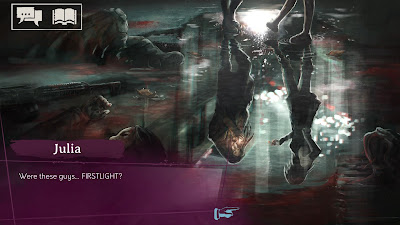
After conquering the massive and delicious beast that was Wrath Of The Righteous, I turned my sights to a significantly smaller quarry: Vampire: The Masquerade: Shadows of New York. This is a sequel to Coteries of New York, which I played last year and enjoyed.


Visually, the two games are very similar, with a classic visual novel style. Almost all of the characters are vampires, and thus have a significant gothy vibe. The settings are cool: all the locations are in New York City, but instead of the major tourist locations we mostly stick to run-down industrial districts, overgrown community parks or quiet residential streets. The visuals in Shadows are stylistically similar but more impressive, particularly with subtle animations and lighting. Characters are static but seem to "breathe" with faint fluctuations. You'll sometimes see a pedestrian jogging by in the background, or a flickering police siren, or the flash of lightning over the Brooklyn Bridge. These add a lot of life to the atmosphere.


MINI SPOILERS

Gamewise, though, Shadows is pretty different from Coteries. Shadows is a very straight visual novel. You can occasionally choose which of two or three locations you will visit on a given night; these locations can sometimes provide a bit of background lore or insight, but they're mostly just flavor. You are playing as a predefined character, Julia, who speaks almost all of her lines unprompted. Occasionally you can choose between one of three dialogue responses. These have a minor impact on NPC's opinions of you and can influence their future dialogue. At five points during the game, you need to choose between two options. Sometimes this is a course of action, but more often it's just deciding how you feel about something. These five choices collectively determine which of two endings you will receive for the game.


Overall, it's much less game-y than Coteries was. You can't choose between different player characters, you always have access to the same Powers, you don't need to worry at all about your Hunger level, feeding is just a stylistic choice, using your Powers doesn't have any consequences, your side-missions are all standalone vignettes instead of an evolving plot, NPCs don't really track their opinion of you.


MEGA SPOILERS

The irony is, though, that Coteries has a lot of game systems that don't actually mean anything in the end: it doesn't matter what you do, the story always ends in the same way. Shadows has almost no game systems, but it does allow you to influence the outcome, albeit in an oblique way.


Somewhat amusingly, the Steam achievements for the two endings are labeled "Good Ending" and "Bad Ending", although they arguably should be reversed. The "Bad" ending is the one where you hold on to what remains of your humanity, make up with your girlfriend, and strike out west for a life of freedom. The "Good" ending sees you mercilessly pursue power and achieve your putative goal at great cost.


So, which is better, Shadows or Coteries? I enjoyed Coteries more while playing it, but after finishing both I think I give the edge to Shadows. I'm a huge sucker for player agency, and having at least the possibility of a lighter ending made the whole experience feel fun.

As for the actual plot: It was pretty enjoyable. There are a lot of callbacks to Coteries, which I mostly enjoyed, though if I hadn't played the game somewhat recently much of it may have gone over my head. The plot felt both more sprawling and more focused than in Coteries. Sprawling in that all of the side-quests were pure flavor and didn't tie in to the main plot at all, unlike Coteries where the side-quests determined who was in your coterie and would accompany you at the end. But it's more focused in that you learn relatively on what the main point of the game is ("Find out who killed Boss Callihan and why"), unlike Coteries which felt like "You're a vampire, now go do vampire things and see what happens."


The tone of the game felt very different from any other V:TM game I've played. Apparently this is due to the protagonist being a member of the Lasombra clan, which I haven't encountered; that, in turn, seems to be due to some recent meta-plot development, which have moved the Lasombra out of the Sabat and into the Camarilla fold. Anyways, it was a little startling to learn that the PC has a mortal girlfriend (not a ghoul!) who knows that the PC is a vampire and is cool with it. But, it's explained well in-game as being due to the Clan's hatred of slavery. In general, Julia seems to be much more in touch with her previous mortal life than other V:TM characters, and she regularly bumps into old friends and colleagues without it being a big deal.


I don't generally prefer predefined characters in games, but Julia had a great voice and was a lot of fun. She's cynical and sarcastic, but her cynicism is fueled by a strong sense of justice and a belief that the world could be better than it is. She's also bright and well-read, with references ranging from Bulgakov to meme culture. While still a gloomy game, there's a lot of good humor sprinkled throughout, thanks mostly to Julia's perspective on events.

END SPOILERS

I'm not a big expert on White Wolf lore, but am learning more all the time. About 99% of my information comes from video games, and 1% from going down wiki rabbit holes while looking up stuff from the video games.


As I've mentioned before, I do really appreciate how Paradox is handling the World Of Darkness property. It's a bummer that V:TM:B2 has been canceled, but that hasn't held up the trickle of lower-price-point games like these. It all helps with the worldbuilding and keeping the scene vibrant. I really appreciate games like these as palette cleansers between the often daunting RPGs that I can't seem to stop playing.

Monday, January 24, 2022

Queen of the Netherworld

Like many readers, I've noted a trend over the last couple of decades where the future depicted in sci-fi novels draws closer and closer to the present. Dystopias and cyberpunk novels were set a century or more in the future; lately, those genres are often set a decade or less away. It can feel like we're approaching the singularity, with real-world tech and politics drawing closer to a static "future" that is receding more slowly than we are advancing.


Termination Shock fits within that trend. Set sometime in the 2030s, its global conflicts and technological advances seem just a small hop away from today's experiences. It isn't the first time Neal Stephenson has worked in the near-present, of course: he's been doing that since the start with The Big U and Zodiac, through to near-future tales like REAMDE. But those weren't really science-fiction-y in the way that Termination Shock is.

MINI SPOILERS

The quick summary of Termination Shock is that it's a novel about climate change. Not a sudden shocking event like the lunar catastrophe in Seveneves, but what we've been reading in the newspaper for decades: slowly increasing temperatures, melting ice caps, and rising sea levels. This touches off an existential crisis for the large number of humans living near an inconsistent "sea level": Houston, Venice, Singapore, The Netherlands, Marshall Islands and more.

At the same time that the Earth's climate is deteriorating, its governments are decaying as well. The United States bears the brunt of this: it is a global laughingstock, unable to govern itself, unreliable and untrustworthy to other countries. Democracy is still alive and vibrant in constitutional monarchies like the Netherlands and the United Kingdom, but is globally on the decline, with a hegemonic China projecting influence and a nationalist India flexing its muscle. While TS seems to be in a separate timeline, you can also imagine it as a small step from our present into the future of Snow Crash's microstates.

Some of those microstates are devolved ancient city-states, such as the City of London and Venice. Others are new, most notably the Flying S Range in West Texas. Its proprietor, the eccentric billionaire T. R. Schmidt (aka T. R. McHooligan) doesn't even bother to declare independence from the US: he hires a massive security apparatus that functions as a de-facto army, buys and repairs a derelict freight line for infrastructure, and starts firing salvos of sulfur into the Earth's atmosphere, utterly confident (and correctly so) that the dysfunctional national government won't notice what he's doing or mount a coherent response to him if they do.

Why is he doing this? Well, to stop the rising sea levels. One clever thing that both Neal and TR do is turn away from the overwhelming immensity of global climate change, and choose to focus on a particular threat that demands a response: the rising oceans, which threaten to inundate Houston and cause billions of dollars in damage and lost property. Ejecting sulfur into the outer atmosphere scatters the incoming rays from the sun, redirecting some of them away from the earth's surface, thereby lowering global temperatures. He's replicating the natural process that occurs in massive volcanic eruptions, which have always had a cooling effect on the planet afterward.

While this is a book about climate change, Neal seems determined to avoid the "environmentalist" label. One particularly curious element is the universal derision directed towards the Greens in the book. I would think that their long tradition of activism would position them to be the heroes, but instead they're somewhere between adversaries and nonentities. Apparently this is because of the Greens' antipathy towards geoengineering projects. I don't know enough about the movement to say if that's realistic or not, but while reading this book I did wonder if the whole thing is a elaborate exercise in reverse psychology to recruit conservatives to the environmental cause. "No, no, please don't stop global warming! The Greens will hate that! You'll own the left so hard!"

MEGA SPOILERS

Greens aside, one thing I really appreciated is that this book has a lot of adversaries, but not villains. On the macro level, the end of the book has a big showdown between China and India. India's actions seem "bad" on the surface, just because they're messing with more of the characters we've been following; but we also know that they have extremely good reasons for their actions (cooling temperatures interfere with the monsoons that provide water to the Punjab and food to all of India). Bo seems like a sinister presence throughout the book, showing up unexpectedly to verbally spar with Willem and even apparently engineer a massive catastrophe to destroy the Maeslantkering. By the end, though, it seems like his actions have mostly been for the good, as unnerving as they are: it drives the acceptance of action to combat climate change and, arguably, save the human species from ruin.

On a more micro level, two of the many protagonists of the novel are Red and Laks. Each of them have personal quests, master a craft, grow and evolve, collaborate with other people, join a higher cause. Both also seem to just be really great people who you'd like to hang out with. And yet the novel ends with the two of them fatally confronting one another. It's sad and inevitable, not thrilling and cathartic like, say, taking down El in Fall or Abdullah Jones in REAMDE.

People usually mention two things when they talk about Neal Stephenson: his nerdy digressions and his abrupt endings. Both of those are on good display here, but more controlled than normal. The tangents here are generally (though not always) germane to the main plot: we learn a ton about the Netherlands' engineering works before we see how they are threatened; there's a great and long yarn about German settlers in Texas setting off a chain of events leading to fierce marauding feral hogs, and a long digression about air conditioners, all setting up a fantastically bloody meet-cute. I did have some moments of wondering "When are we going to get to the fireworks factory?!" during T. R.'s long-delayed tour into West Texas, but the journey is entertaining.

And the ending is... pretty fine. As with his last two books there's a bit of a shift in the last third of the book with a jump forward in time and a shift in tone, but it isn't nearly as disruptive as the earlier ones. I think he just wanted to skip over some boring bits. Very roughly speaking, the first third of the novel explains the stakes, the middle third shows what's being done, and the final third shows who's trying to stop it. The conflict feels a little arbitrary; it could have climaxed in Braazos just as easily as Pina2Bo, and it feels a bit shaggy-dog-y to bring Laks from the Himalayas down to West Texas. But it's a fun, relatively tight plot. On the one hand it's a seemingly random place to end the story, without much information at all about what's going on with The Line or other sites; but we can also see the trajectory things are heading in, with a hopefully-somewhat-chastened TR willing to collaborate and India recognizing the importance of the project.

I somehow haven't talked about Saskia yet! She's great. She was my favorite character in this book, and one of the more enjoyable protagonists from his novels. I honestly didn't even know that the Netherlands still had a monarchy; I wiki'd a lot of stuff while reading this book, even more than usual. There's a ton I like about Saskia, from her practical skills to her level-headed judgment to her woman-of-a-certain-age approach to sex, but what I most appreciated was probably her somewhat-ironic position as the biggest advocate for democracy in the book. Everyone else is a loner or seeking power or both. Saskia is institutionally positioned as a kind of foe of democracy, but she is unhesitating in her support of peoples' right to collectively make decisions to govern themselves, which is a rare bit of sunshine in the often-grim future of this book.

END SPOILERS

Termination Shock was a great read. It feels more put-together than most of Neal's other books (which I love dearly): it still has some of the rambling nerdy sidetracks that are a hallmark of his writing, but it seems a bit more focused than I'm used to. I do wonder if that's related to the present danger that the book confronts: not some hypothetical dystopia that may rise in the future, but the mundane suffering we experience now that gets worse each year. It's definitely not a polemic, and it's surprisingly hard to pin down Neal's political thoughts on the matter, but it carries its own sense of urgency and importance with it. While still being an exciting and intriguing read that will send its readers down countless wikipedia rabbit holes!