Last month I finally achieved a dream I've held for many years: playing Fall from Heaven 2 on a Mac laptop. Fall from Heaven 2 is my favorite game and I really like the idea of being able to take it with me wherever I go. (In our current environment, that means whether I'm in the living room, or the bedroom, or the kitchen, or...). Years ago I bought Civilization IV Complete on Steam specifically to do this, only to discover that, while Civ IV itself runs on Mac, FfH2 requires modding the DLL, which only exists in the Windows version.
For my own future reference, and anyone else searching for how to do this on Google, here are the steps I took in 2020. We'll use WINE to install Steam, Civ IV and FfH2 and play this insanely fun game. The earlier steps can probably be used to play other Windows-only Steam games on OS X.
Step 1: Get a Mac, ideally a MacBook Pro. Civ IV is a very old game so you don't need a very high-end graphics card, but the emulation does add a lot of overhead. I'm running a 2016 MBP with a ~3GHz CPU, 16GB RAM and a Radeon Pro 460 with 4 GB video RAM. FfH2 runs just as smoothly on this machine as it does on my dedicated Windows gaming box, but the fan runs constantly and I can only play for maybe an hour or so before draining the battery.
Step 2: Stay on Mojave (10.14), not Catalina (10.15). The Mac has never been a great gaming machine, but the 32-bit-apocalypse has annihilated what few options existed for the platform. If you're planning on doing any sort of gaming on your Mac, even pure native gaming, you'll want to stay on Mojave. If you've already taken the plunge and are regretting it, you can follow these steps to go back, provided you have a flash drive.
Step 3: Download the Steam installer for Windows. Visit the main download page, but instead of the nice big appealing "Install Steam" button, click the tiny Windows icon below it. This will download SteamSetup.exe, which you can put in your Downloads folder or anywhere else.
Step 4: Install the Wineskin Winery Unofficial Update. I used version 1.8.4 but you should probably grab whatever the latest stable (non-testing) version is. The specific file to download will have a name like "Unofficial.Wineskin.Winery.zip". Unzip this. You can keep the .app file in your Downloads folder.
Step 5: Run the Unofficial Wineskin Winery. This is basically an installer for setting up Winery, which in turn creates a stand-alone emulated environment. You're essentially making a Windows environment on your Mac.
Step 6: Next to "New Engine(s) available!", click the plus sign. Find an engine to download. Specifically, you'll likely want the latest version. In my case that was WS11WineCX19.0.1. The "WS11" is for "Wineskin 11", which is newer than "WS9" or "WS10". You'll also want to click the button to update the Wrapper.
Step 7: Click "Create New Blank Wrapper". I'm naming mine "SteamGames" and will use that for the rest of these steps. Your computer will freeze and you'll see some ugly Linux-style dialog windows. That means it's working! Once it's created, view it in the finder.
Step 7: Double-click SteamGames.app. This will bring up a Wineskin window. Click Install Software, Choose Setup Executable, and then navigate to the SteamSetup.exe you downloaded in Step 3 above.
Step 8: Follow through the setup steps, accepting the defaults for everything. Select the option to run Steam when it finishes. The auto-updater will now run and download the actual latest version of Steam, which may take some time.
Step 9: This might be a good point to review what software we're actually running. Winery is what manages all of your Windows installations. You will probably only run it once and can close it any time. Wineskin is your virtual emulated environment; while it's running, your fake Windows box is running. Finally, any Windows programs that are running within your Wineskin will also get their own entries in the Dock. You can also find them in the Activity Monitor, which can be useful for troubleshooting.
Step 10: Once Steam updates and exits, Wineskin will ask you to select what is the actual .exe you want it to use when launching in the future. Click the drop-down and select steam.exe, then click OK.
Step 11: Quit Wineskin, then double-click SteamGames.app again to launch Steam.
Step 12: Log in to your Steam account. This is running the real, actual Steam from Valve and so it will prompt you for the Steam Authenticator or any other items you have on your account.
Step 13: After logging in, you will see the Steam icon and maybe some windows with friend requests and/or featured games. But... where is Steam itself?? It's complicated! Quit Steam (either by right-clicking its icon in the Dock or left-clicking and then selecting Steam from the top menu bar). If you come from the future and do see Steam here, you can skip down to step X.
Step 14: Right-click on SteamGames.app and select "Show Package Contents". This will open a new window with links to your C: drive and Wineskin.app. From now on, you can click Wineskin.app to return to the Install screen, or you can click on SteamGames.app to launch Steam. While setting things up, I like to keep both windows open so I can quickly select either one.
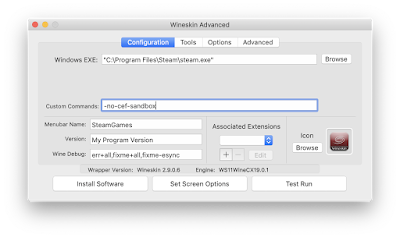
Step 15: Open Wineskin.app, then select "Advanced". We're going to modify a few things here, for both Steam and (eventually) FfH2.
Under Configuration, In "Custom Commands", paste in the argument "-no-cef-sandbox" (without quotes). This will let the Steam interface appear properly.
Switch to the Tools tab, then open Config Utility and select the Libraries tab. In "New override for library:" select "msvcr81" and click "Add". Then select it, click "Edit...", and change from "Native then builtin" to "Native (Windows)". This will fix a crash when starting new games in FfH2.
Still in the Tools tab, click "Winetricks". Type in "msxml3". Expand the results, there should just be a single one. Click "Run" and wait for it to finish. This will fix a crash when launching with MNAI installed.
While we're in here, click "Options" and check the option "Use F1, F2, etc. as standard function keys". (This is optional, but is really nice for games like Civ4/FfH2 which make heavy use of the function keys.)
Step 16: Exit Advanced, then double-click SteamGames.app. Hooray, now we can see Steam!! But... it's blank?! If you're coming from the future it might be fixed and you can skip to step 18. Otherwise, read on!
Step 17: Click the Steam menu in the upper left, then open Settings and select Interface. Uncheck the options:
Enable GPU accelerated rendering in web views
Enable smooth scrolling in web views
Enable DirectWrite for improved font smoothing and kerning
Click "OK" and restart Steam when prompted. Huzzah, you should now see your Steam library!
Step 18: Assuming you already own Sid Meier's Civilization IV: Beyond the Sword, you can select it from your Library and click "Install". If you haven't bought it yet, you should be able to grab it from the Store. The actual install process works exactly like it would on Windows and may take a while.
Step 19: Once it's installed, run the game from within Steam. Assuming you prefer playing in windowed mode: click Advanced and then Options, uncheck the Full Screen option. You may need to adjust the resolution to find something you like; on my 15" monitor, the 1440x900 resolution gives me a good-sized window. Higher resolutions can push the window beyond the desktop space, so it's better to start smaller and work your way up than vice-versa. You can probably also set the graphics options to High; as usual, old games have a hard time recognizing superior modern hardware. Exit and restart to apply graphic changes. Once back in the game, click Single Player and then Play Now! and start a new game with all the default settings to ensure that the game runs properly; if there are issues with video playback or sound or anything, this is the perfect time to troubleshoot.
Step 20: Save your game, then reload that saved game. If this all works and nothing crashes: Congratulations! You have a stable install of Civ IV: BTS running on your Mac! Exit the game and Steam.
Step 21: Optional, but if you happen to be a software developer or are otherwise familiar with Git, I recommend initializing a git repo in the root of your Civ IV install (under steamapps) as well as in your My Games folder (under Documents). Commit and save a snapshot of what everything looks like. This will make it way easier in the future to roll things back if your setup becomes unstable. You can make other branches or commits to support switching between different stable configurations; for example, you could try out Magister Modmod in a separate Git branch while keeping vanilla FfH2 safe.
Step 22: Now, we're going to install FfH2. I'm specifically going to install the latest official release and MNAI-U, which is basically the best "vanilla" experience available today (no new gameplay features but tons of quality-of-life improvements, AI upgrades, and bugfixes). You can put all of these into your Downloads folder.
Note that we are not downloading nor installing Blue Marble. It's a really nice UI, and would technically work with our setup, but isn't compatible with other modmods. So we're omitting it now so we can try other modmods in the future.
Click "Download Now" to get version 2.7.1 of More Naval AI. Unlike the previous downloads, this is a zip file instead of an EXE.
Download the latest version of MNAI-U. As of this writing, that is 2.8.1.
Step 23: Re-open Wineskin.app. Click "Install Software" again, "Choose setup executable", and then navigate to FallfromHeaven2041n.exe and start the installation. If you have followed all the defaults so far, you should install into the folder "C:\Program Files\Steam\steamapps\common\Sid Meier's Civilization IV Beyond the Sword\Beyond the Sword\Mods\Fall from Heaven 2\". IMPORTANT: Double-check that it is installing into "Sid Meier's Civilization IV Beyond the Sword/Beyond the Sword/Mods" and not the higher-level "Sid Meier's Civilization IV Beyond the Sword/Mods" folder! Once the install finishes, you will see an error from Wineskin warning that no new executables were found. This is totally fine! We're just applying our changes to the game we previously installed.
Step 24: Repeat the above step for FfH2041o.exe. This will look pretty much identical to before, but with a much smaller required space of ~60MB. You still want to select the "Beyond the Sword/Mods" folder for this step, not "Beyond the Sword/Mods/Fall from Heaven 2".
Step 25: Repeat the above step for FfH2media.exe. Again, install into "Mods".
Step 26: Quit the installer, re-launch SteamGames.app, then launch Civ IV. Click "Advanced", "Load a Mod". Verify that "Fall from Heaven 2" appears here. Select it and click "OK". Civ IV should exit and then re-launch. You will soon see Hyborem, scary!
Step 27: Click "Single Player" and "Play Now!" to start a new game. Accept all the default options. Observe whether the intro video plays. Once in the game, save the game, then load the game. If that works, congratulations! You have a stable version of FfH2 running on your Mac! Exit the game. If you're using Git, now is a great time to take a snapshot of your setup.
* If your game is crashing here, double-check that you have the msvcr71 override from Step 15 set up.
Step 28: It will be tedious to switch mods each time we want to play, especially since once you've played FfH2 it's incredibly hard to go back to regular Civ. In Steam, right-click on "Sid Meier's Civilization IV - Beyond the Sword" and select Properties. In Launch Arguments, put "mod=\Fall from Heaven 2" (without the quotes), then OK. Click Play. This time you should directly go into the FfH2 Hyborem title screen instead of the BTS Apostolic Palace. Hooray! Exit the game and Steam.
Step 29: If you're satisfied with playing pure-vanilla FfH2, you can stop here and be happy for the rest of your life. But if you've ever played with MNAI and BUG and the rest, you can never go back. So we're going to go one step further and install MNAI-U.
Switch back to the folder with Wineskin.app. (Remember, you got here by right-clicking SteamGames.app and selecting "Show package contents.")
Look for "drive_c" which is, you guessed it, the C:\ drive.
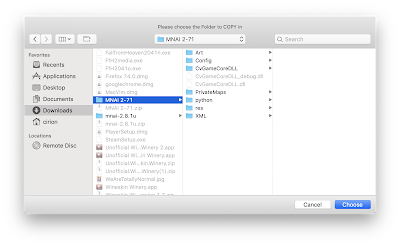
Navigate all the way down to "drive_c/Program Files/Steam/steamapps/common/Sid Meier's Civilization IV Beyond the Sword/Beyond the Sword/Mods/Fall from Heaven 2/Assets" (phew!).
Now, in a separate Finder window, go to your Downloads.
Unzip "MNAI 2-71.zip" if you haven't already.
Select all the contents (not the folder itself), right-click and copy.
Now, switch back to the "Assets" folder in your drive_c. This should include a "CvGameCoreDll.dll" file.
Right-click in this folder and click "Paste".
You should see a warning that "Art" already exists. Click "Apply to All" and then "Merge".
Finished!
Step 30: We're almost done, I promise! We're going to do the same as Step 29, but this time copy from "mnai-2.8.1u", and paste into "Fall from Heaven 2" (one level above "Assets"). Once again, Apply to All and Merge.
Step 31: Re-launch SteamGames.app. You know the drill by now: Start BTS, Single Player, Play Now!, all default options. Once in the game, look in the upper-left of your screen, just to the right of your civilization's banner. If you see a red-and-black ant-looking icon, congrats! You have access to BUG and, not coincidentally, More Naval AI Unofficial. You can click the BUG icon to open up an extremely thorough list of options; personally I'm happy with the defaults. Save your game and load the save to confirm that everything is kosher.
Step 32: We got it done in five bits! That took a lot of effort, but was well worth it to get access to such an endlessly entertaining game. If I was in quarantine for the rest of my life and could only play one game, this would be it, hands-down.
One of the odd things about our current moment is how people use oblique phrases to refer to it. Like, for example, "our present moment." I've been really struck by this in the last couple of weeks of watching YouTube videos and reading blog posts and tweets and Facebook updates and all sorts of stuff. How often people will say things like "Obviously, things aren't great now, and I thought we could all use some cheering up..." or "Because of the current situation, maybe you want to learn how to make awesome omelets right at home..." or "Like the rest of you, I've been seeing my home in a new light, and maybe these drapes can help brighten yours..." I've imagined someone in the future, say ten or fifteen years from now, playing back an old podcast or vlog or something and having to stop and wonder: "Wait, what happened back then? What are they talking about?" There's an elision in our discourse that's really fascinating to me: I think it's the first time in nineteen years that we've truly felt like everyone is on the same page for what we're talking about and explicitly calling it out is... I dunno, gauche or wasteful or something.
This post is partly a reaction to that. My experience isn't particularly interesting compared to what everyone else is going through now, but I kind of want to dispel that lacuna and talk about what's been going on!
I have no clear memory of when I first heard of the coronavirus. I rarely read science or health articles that pop up in my feeds, so I'm sure I saw a headline at some point and didn't bother reading it. I think the first sustained discussion of it I saw was in mid or late February, when I was briefly following Matt Stoller after reading Goliath: he was sounding the alarm loudly, and had been for some time: not just the looming public health crisis and cost of lives, but also the supply chain disruptions that even then were starting to show up. But, to be honest, I mostly dismissed him as a crank - he complained more about Obama than about Trump when discussing the coronavirus and seemed determined to kneecap any left-leaning politician.
I started to pay some attention in early March, when the first of my company's clients started mandating all their employees to work from home. I'm not totally sure what internal discussions they had leading up to that, but some executives had recently returned from an unintentionally extended stay in Asia, and it's possible that contributed to their decision. I started to consider actually taking it seriously a week later, when Google and Twitter started mandating all of their employees to work from home. At the same time, I was personally skeptical that there was a cause for alarm. Partly that's probably my generally optimistic outlook on life: I tend to think that things will work out fine, and more often than not they do. I've also grown somewhat inured to short-term alarms about, say, large storms or other disruptions. There's often a media frenzy, people rush out to buy bottled water and toilet paper, then everything is fine. I didn't want to be a "prepper" and deliberately continued living my life like normal, to some extent proud that I wasn't "freaking out."
This lasted, uh, two days. The second Friday of each month is our "Dev Friday," when the company caters in a meal for everyone and we gather for an all-hands (small-)company-wide meeting. The management team had been keeping an eye on developments: there was no official policy from any government body, but the accelerating private-sector-led lockdown efforts made it increasingly clear that there was some cause for concern. Early in the week we officially canceled our all-hands, reasoning that it might plausibly fall under the umbrella of "large gatherings" that had led to conferences and concerts and sporting games getting shut down. At the last minute, an announcement went out on Thursday afternoon that we would be working from home on Friday and for the following week.
That Friday and the weekend immediately following stand out as one of the more chaotic moments of the coronavirus crisis. Which is actually rather encouraging; on the whole people have been very careful and respectful. But that weekend there was a mounting crush on supermarkets and big-box stores as families across the Bay Area decided that they needed to stock up. I think this is entirely reasonable: we'd all been told to prepare to spend two weeks in quarantine if infected, and to minimize unnecessary outings and travel, so of course people who ordinarily would only keep a week's worth of food at home would suddenly decide that they need twice or triple or quadruple as much. But this all happened in a short amount of time, and we've all seen the result: alarming pictures on social media of bare shelves, no bread, no milk, entire aisles wiped out of bottled water (??) and such.
My own personal experiences were much calmer. I was mentally kicking myself for not making similar trips in the weeks previous when I was posturing (to myself! not even to anyone else!) at how chill and non-alarmist I was being. But, as I took inventory of my home, I found that I was in good shape. The big item people were worried about (and are still worried about) is toilet paper; but I've always bought that in bulk, had gotten a huge 48-pack a month or so before, and had more than enough. Likewise I was all good on paper towels and facial tissue and hand soap, all boring stuff that I buy in large quantities and keep around. On the food front, I keep a permanent small stash as part of my earthquake preparedness kit, and on top of that there's all the random stuff I have in my cupboard at any time. My amount of food was definitely sufficient, especially since, unlike an earthquake, I didn't need to worry about running out of water or losing electricity for my freezer or my stove. I had (and have) plenty of dried beans and grains and all sorts of stuff.
Still, while I had plenty to eat, I wouldn't be eating well. My normal diet includes a lot of fresh fruits and vegetables, which is healthy, but is not something that you can just stock up on. My thoughts immediately turned to my beloved local farmer's market, which I patronize throughout the year. Was it still going to be open? I did some Googling and did not get a clear answer. The official page for the market hadn't been updated in 8 years and, of course, didn't reference the coronavirus. I'd read that some local markets, like the one in San Carlos, were shutting down indefinitely. Another market organizer was quoted as saying, I imagine somewhat incredulously, "People need to eat food! We can't just shut down."
Fortunately, my market had the latter philosophy. I was somewhat nervous going there, having spent too much time the previous night scrolling through photos of doom and gloom from Safeway, Target, Whole Foods and other major retailers. In contrast, my market was totally fine. There were about as many shoppers as usual, and people seemed to be more conscientious about giving each other space. All the sellers were there and seemed to be in good spirits. I bought a little more than I normally would; fortunately it's the late winter and early spring crops in season, so the foods are already tilted towards sturdier and more storage-friendly options.
With these fresh foods, I determined, I was all set for the weeks to come. I tend to do a fair amount of my shopping online anyways, and could get necessary items shipped to me. I have pretty fast Internet for entertainment and remote working. I'd picked up my enormous copy of Capital and Ideology from the library earlier that week, giving me plenty of reading material. And... that was it! It felt oddly comforting to feel like I was all prepared and ready, still a little frightening to think of the changes in the world and the potential spread of illness, but I felt like my little corner was warm and secure and safe.
Immediately after that somewhat chaotic weekend, things somehow ramped up to an even more alarming tone on Monday. There had been some previous government movements over the prior month or so: Mayor London Breed had declared a State of Emergency in San Francisco before the first reported case in the city, and there had been targeted guidance against gatherings of 1000 people, then 500 people, then 50 people. On Monday, though, the Public Health Officers of most counties in the Bay Area issued by far the most strict thing yet: an official legal order to "shelter in place." Millions of people throughout the region were commanded to stay in their homes. The exceptions were vanishingly small: you could leave to buy food from the grocery store, or get medicine from the pharmacy, or to exercise outside. Anyone who didn't work in an "essential business" and couldn't work from home no longer had a job.
There was a fair amount of alarm over the order, coupled with acceptance. I started to wonder: How would it be enforced? Would cops start arresting people who are outside? That seemed ludicrous, but, to be fair, the idea of shutting down the economy also seemed ludicrous just a week earlier. Fortunately the orders were well-written, accompanied by a much longer interpretive FAQ that helped spell out what was and wasn't allowed.
The order was scheduled to last through Friday, April 7th, just over three weeks. Even at the start I was a little skeptical that it would be over that soon: either this was all a false alarm, which seemed increasingly unlikely; or we hadn't even started a pandemic, which seemed like it would definitely last much longer than three weeks. But having some sort of timeline was helpful. On the work front, we had initially envisioned rolling week-long work-from-home periods, deciding each Thursday whether to remain closed the following week; with the official Order in place, we could just point to that as our guidance for when to return to the office.
Everything kept happening faster and faster. We had barely gotten our head around the Shelter In Place order when the State of California issued its own Order later that same week. This was very similar to the Bay Area's Order, with one significant difference: It was indefinite, with no announced termination date. Needless to say, that felt ominous. But it was also somewhat cheering to think that what we had been doing for the last week was the right thing, that we were on the right track, and that more people were doing the same things. And I did have more and more of a sense of "we": a sense of pride and connection with my local community, knowing that millions of people around me are going through similar experiences for similar goals.
I joked early on that I felt especially well prepared to shelter in place. I'm a natural introvert and am perfectly happy spending time by myself. My favorite activities include reading, playing video games, cooking, and other stuff that I do at home anyways. That said, while I'm sure I have it easier than most people, it definitely has not been a super-fun experience. One early thing I needed to figure out was how to work from home. I actually really enjoy being at the office and, even though my job can easily be done remotely, I almost never work from home unless I have an appointment or some specific need to do so. I'd initially thought, optimistically, that at least work would be more relaxing: I'd be slicing two hours of commuting out of every day, freeing up ten whole hours each week, which sounded great. But after the first couple of days I felt the opposite: I ended each day drained, anxious, unhappy. I came to realize that I was working non-stop: not even taking walks during the day, not stopping for lunch, just hunched over my laptop endlessly.
I gradually rolled out more structure. One silly thing about my setup is that I have a home-office-type room here, but it's far from my wireless router and so my video call quality in that room is poor. I like working in my dining room, which has lots of natural light and a rock-solid wireless connection. But that naturally causes work to bleed into non-work. I started keeping a rigid work schedule: opening my laptop at a certain hour, setting an away message and tipping the lid mostly closed during lunch, and closing it altogether at another hour. For the first week I sat in one of my dining room chairs, but then I started rolling my office chair in to the dining room in the morning and rolling it back into my home office at night. I think that helps a lot too. Fundamentally, I'm really missing that hour of commute at the end of my workday that helps me disconnect from my work thoughts and get relaxed for my evening. I think these tweaks to my physical environment have helped. I still don't have as much separation as I would like, but I'm feeling psychically much healthier in the evening than I was before.
You'll read a lot of the same advice in articles on how to work from home. Try to keep a routine, shower, put on work clothes, and so on. My company has also made a strong effort to keep a level of social engagement during this time. In the physical office, people really enjoy going to get coffee in the morning. There are usually multiple "runs" throughout the morning, depending on which of two options people prefer and when they arrive at the office. On that first... hm, either Friday or Monday I started an ad-hoc Slack video call for a virtual coffee run: we're all in our own homes, sipping our own coffees, but we can all see each others' faces and chat about what we're doing, which feels really comforting and nice. That very soon morphed into a semi-official company-wide coffee outing as a recurring optional meeting invite. Originally it was on Google Meet (hangout), but, like many other people, we've found that Zoom has a much better interface for seeing lots of people at the same time (as opposed to focusing on the one person who's currently talking). I was initially skeptical that this would work, as it seems like having more than a few people in the same unstructured video call is a recipe for chaos. But it's actually been great, and an oddly accurate approximation for how our real-world coffee experiences go. A few folks are more chatty and extroverted, others of us are quieter but still chime into the conversation, everyone is smiling and friendly. There's a very appealing looseness to it, with different people popping in on different days and ducking in or out based on their imminent meetings.
In addition to those video chats, my daily walks have been really nice. I typically go for one walk around 10am and another around 2pm, although that can shift a lot depending on what meetings I have scheduled. The route I walk takes maybe 20-25 minutes. Interestingly, it isn't one that I regularly walked in the many years I've lived here. My normal exercise is a great trail with a steep hike up to and along a ridgeline; it's close to home, but still requires a car to get to. When I do walk locally, it's usually to a destination in the downtown area. This particular route crosses a railroad track and loops through a residential neighborhood, including a long stretch with a linear city park. It isn't super-scenic, but I've come to really treasure it. There's almost no traffic, a few other pedestrians, some interesting houses to look at and some green spaces to walk past.
It seems like the number of people exercising outdoors has been gradually increasing over the month of the lockdown. It still isn't congested, but whereas before I would see maybe 3 other walkers during one of my jaunts, now it's often more like 12. I wonder how much of that is from people getting laid off and spending more time at home, and how much is from people feeling stir-crazy indoors and needing to get out, and how much is just random variations during the day. I've also noticed more cats prowling around outdoors.
The local Bay Area governments determined that our regional order is complementary with the statewide order, so both are in effect at the same time. The Bay Area one was officially updated on March 31st, further cracking down on some activities and extending the duration out through May 3rd. There has been consternation about large groups of people flocking to parks and beaches on the weekend to see friends, not observing social distancing. The state has closed parking lots as a result, and our local order now says that while being outside for exercise is permitted, you cannot travel further than 5 miles from your home. That doesn't directly affect me since my routine walk falls well within that boundary, but it is a little sad to think that I can't legally go to my favorite park even if I wanted to. They've also closed dog parks and other areas where people were congregating.
The other major update since this all started has been around wearing masks. Since shelter-in-place started, I have seen more people wearing masks than usual, but everyone has been following the official pleas to not use medical-grade N95 masks. Recently, the CDC updated its guidelines: previously they said that wearing masks was unnecessary, but now they recommend everyone in public places to wear a homemade, non-medical mask. From my reading of the order, it sounds like this is a strong recommendation if you're going to a store or a similar location where you may even temporarily be within 6 feet of another person. But it doesn't sound like it's required if you're just out walking in your neighborhood as long as you keep your distance from other people. I was flummoxed when I first heard the new recommendations: I don't own a sewing machine, or even a needle and thread, and don't have a hot glue gun or similar fastening device. But fortunately there is a good video from the CDC for making a bandana mask, and there are also options based on old T-Shirts, none of which require sewing equipment.
I made a mask, and have only used it once. This morning, in fact! For yet another trip to the farmer's market. In the month since shelter-in-place started, I have gone shopping three times, once to Trader Joe's and twice to the farmer's market, and this is my first outing since the new CDC guideline. I was actually kind of surprised by how few people were wearing masks. Every vendor was, but only maybe about a third of the shoppers; even the lady who seemed to be organizing the market was maskless.
It seems like each place is coming up with their own guidelines on how to safely operate, both on a market-by-market and even a stall-by-stall basis. At this market, some of the produce stalls were set up as normal with vegetables stacked on tables, but the whole stand blocked off with police-style yellow tape. Instead of each shopper handling the veggies, you tell the worker what you want to get, and they bag it for you. Which I think is great, in the circumstances... I mean, ordinarily one of the things I love about farmer's markets is picking out what I want to get, but of course it makes tons of sense to minimize cross-contamination with strangers.
I've been thinking a lot about how to pay: what's the least-risky thing to do? I actually finally set up my Android phone specifically to be able to use contactless payments at Trader Joe's: you don't need to touch the same PIN pad as other shoppers or hand bills to the clerk, just wave your phone to pay. At the markets I typically use cash, but a few vendors are set up to take credit cards. I asked this stand if they took cards, and they said "Yes", so I handed one over, thinking that it was probably safer. And then realized that they were using a Square terminal, and I still needed to sign for the transaction. I was one of the first people there this morning and was probably one of the first people to touch that screen, and hopefully they're wiping it down throughout the day, but still... it's so funny how things we never thought about before are now fraught with meaning! I'm not a germophobe or anything, but I did pause for a second before touching that screen to finish my transaction.
I paid cash at the other stalls.
Turning back time a little: I think my Trader Joe's visit was the second week of the lockdown. It is funny how grocery stores have become incredibly important now, as basically the sole sanctioned activity we can participate in. I wanted to wait for the initial wave of panic shoppers to pass and for stores to have a chance to restock. This would be my first "real" shopping trip since the coronavirus got on my radar: again, I had enough food at home for sustenance, but unless I was content eating beans and weird ancient grains for weeks I wanted to build out my larder.
I've always really liked my neighborhood Trader Joe's. Every TJ's is different and they're almost all great; this one in particular isn't nearly as hectic and busy as most others in the Bay Area. I've been going there for years, recognize most of the staff, I like their products and prices and overall cheery demeanor. I've been impressed by how they are managing things in this period. As soon as the official Shelter In Place order came out, they implemented strong social distancing policies at all of their local stores. They limit the number of shoppers inside at one time to protect against crowding. Outside, people peacefully assemble in a long, long line.
I'd been keeping an eye on the store throughout the week, trying to get a sense for when it was busiest, and eventually headed over on a Tuesday afternoon. They marked out 6-foot distances with pieces of masking tape, which is a fantastic way to visualize the distance you're supposed to keep and remind others to do the same. The line was longer than I expected, but not terrible. I think I waited for about 20 minutes to get inside. As the worker ushered me in, she squirted hand sanitizer into my hands and told me that the shopping basket handles had already been disinfected. I grabbed a basket and started shopping.
As with my farmer's market run, I did end up buying more than I normally would. TJs has a limit of 2 per item, which I think is a great way to defend against hoarding. Personally, I want to make as few trips as possible to minimize my risk and others', so I feel fine about getting more food than usual; I think in normal times I probably go to TJs once every 10-14 days, and now I would like to go monthly if possible. Anyways. For the most part they had everything I wanted. There were some minor substitutions I made: they were out of the brown basmati rice I prefer, but had plenty of white jasmine rice, which is perfectly good. I got the stuff I normally like to get: frozen salmon fillets, ground turkey and hamburger buns, lots and lots of nuts. The one thing they were completely out of that I wanted was flour, both white and whole-wheat. That was actually a bit of a bummer: I'd finally gone to the store in large part because I was running out of flour and only had enough for one more cycle of my sourdough starter. But in the circumstances it still felt like a successful trip.
I got home, put away all my groceries and then went online to look for flour. It was completely out of stock at Target and Safeway and other online-ordering places. I checked on eBay and was shocked at the prices people were asking, like $40 for a 5 lb bag of all-purpose flour. I then went to King Arthur Flour. Their site warned that they were running behind and that orders would be delayed a week or two, but that they were working as hard as they could to ship stuff out. I ordered two bags of all-purpose and one of whole-wheat, not batting an eye at the $8 shipping charge.
The flour did come, almost exactly one week later; I think they did overnight shipping or something once it finally went out their door, since it arrived super-quickly after shipping. I was pleased, as I had exactly no flour left at home, but one fresh loaf of sandwich sourdough that I'd squeezed out with my remnants. I was mostly excited for baking. In the last few weeks I've rediscovered a love for sweets, and have baked my way through cookies and brownies and cakes. With the flour shortage I'd sort of cobbled together some weird gluten-free flours I'd accumulated, which turned out OK, but it's very encouraging to have real proper flour again, and I'm already thinking about what to make next.
I am very curious how I'm going to come out of this period physically. My activity level is down quite a bit from before; I no longer have those great long hikes on the weekend, and even my mid-day walks are shorter than what I would normally walk during my commuting days. On the flip side, I think I'm eating healthier throughout the day: no burritos or pizzas or fried chicken sandwiches, and instead lots of fresh fruits and veggies. But on the other flip side, I've redeveloped a sweet tooth and am eating more dessert throughout the day, too. But probably fewer salty snacks. So, I don't know! I'm probably going to lose some muscle, and I'm curious whether I'll gain fat, and how much if so.
And then there's my hair. I've kept up my shaving, and I did get a haircut maybe two weeks before SIP started, so I'm probably in a better position than a lot of people, but I'm definitely getting shaggy. On the other hand, I usually wait too long before getting a haircut anyways, so it doesn't look that unusual to people. If we do lift this order by May 3 I think I'll still be within the bounds of social acceptance; if it's much longer, I'll probably start considering doing something drastic.
As I mentioned before, in a lot of ways my life under the SIP order has been almost exactly like before: I read books, I play video games, I write long and rambling blog posts. I've definitely found myself craving more social interactions, though, and have treasured the connections I have. I typically call my parents about twice a month; lately I've been calling them every week, initially because I wanted to check in and make sure they were doing OK, but increasingly because it's nice to chat and we have so much to talk about. I've checked in with an elderly neighbor to make sure she's doing all right and to offer to go shopping for her. I reached out to a friend who canceled their baby's baek-il two weeks before SIP started, yet another thing that seemed like an overreaction at the time and now seems incredibly wise.
Reaching out and talking with people has been good. I've started doing other things that have not been as healthy and good, and have been trying to identify and curb those. Almost as soon as SIP started I began taking my laptop to bed with me so I could play games right before I fell asleep. That was terrible, one of the many things that sounds like it would be a fun distraction but ends up playing havoc with my physical and mental health, so I forced myself to stop after a few days. I've also tried to be much more conscious of how I consume media. In many ways this is a natural outgrowth from my obsession over our seemingly decades-long presidential race, which I had an obsessive focus on even before this started and a lot of that attention has just moved directly over to the politics of the coronavirus response. It's kind of tough: I feel like I'm in front of a keyboard for like 80-90% of each day, and even without thinking of it, when I'm between tasks I'll just mindlessly open a new tab to visit the Washington Post or Twitter or Google News or another site. From there I'll instantly see many outrageous stories, click into them, and get increasingly mad and despairing over what people are or aren't doing.
This habit has been much harder to break than bringing a laptop into bed, as it's been a longer time coming. I try to recognize when it's happening and just close the tab I opened and move on to something else productive, or at least something that won't expose me to the endless stream of daily news. I try to compensate with more limited and focused sources of information. There is a lot of important stuff happening and there is information that's useful for us to know, but there's only, like, one or two really important things that happen each day that directly affect our lives, and anything beyond that is mostly for entertainment or enraging purposes. My media routine currently looks something like the following:
In the morning I'll scan clips from the previous day's Colbert show, Last Week Tonight, or a similar palatable humorous news source.
Most weekdays at noon, Gavin Newsom will give a live address on the current response in California. Regular readers of this blog will know that I've had a long-standing dislike for Newsom, but I've been impressed by his leadership during this crisis and have come to find these updates genuinely reassuring. They're directly applicable to the state where I live, they are sober and recognize the gravity of the situation, and it's also incredibly encouraging to be reminded that we have a government able and willing to take action to help people. I don't watch these all straight through, but it's one thing I allow myself.
After work and before supper, I'll give myself up to 30 minutes for news and social media. This usually means a quick scroll through the top three screens or so of my Facebook feed, an update of my highly curated Twitter feed, and finally letting myself read the WaPo to see what big things happened today. I've also started checking in on Nextdoor at this time; I've had an account for a few years but I think have only logged in once or twice before now. There's nothing earth-shattering in there, but it's interesting to read about, like, what restaurants are still doing carry-out and local charity drives and similar things.
Weirdly, I'm trying to watch more movies and/or TV at night, partly to remove the unstructured time that drives me back to social media. I find that it's increasingly difficult for me to focus on watching something, though. That's another trend that's been happening for a while and seems to be accelerating now. I kind of instinctively want to pick up my phone or crack open my laptop as soon as the opening credits start showing. I have gotten through a few things, though, including my long-delayed first-ever viewing of Indiana Jones and the Temple of Doom. More often, though, I'm finding video games to be my better recreation. I'm way better at focusing on them, and do enjoy the sense of progress and achievement they lend.
Other things that have been good for me? Podcasts, for one. I've been a regular listener for well over a decade now, and the conversational tone of lots of the comedy podcasts I enjoy has been particularly appreciated now. It's been cool to see how some long-running institutions have evolved, particularly comedy podcasts like Comedy Bang! Bang! and Hollywood Handbook that thrive on in-person interactions, which are now being recorded over Zoom from the hosts' and guests' private homes. I've particularly enjoyed seeing video clips from Hollywood Handbook and seeing how they're still incorporating producers and engineers, who are always present but rarely heard while recording in the studio, and see how their presence and enthusiasm helps guide new guests' experiences through this strange show in this strange time. And it's been wonderful to see new slice-of-life podcasts pop up, too. My favorite comedian and prolific podcaster Paul F. Tompkins started a wonderful new podcast with his wife Janie Haddad Tompkins, resulting in the terrific Stay F. Homekins. It's fun and relaxing and intriguing: we're catching up with the two of them catching up at the end of their day over a few glasses of wine. It's nice to feel included, to hear their experiences and small-scale joys and fears and wonders.
And music is great, too. One particular solace that I want to call out is Womb, the third album from Purity Ring, one of my favorite bands. This was such a wonderful, surprising gift. It's been five years since their last album, Another Eternity, came out, and probably at least three years since they last played a concert or even updated on social media. I'd kind of thought that they were gone for good, and it made me so happy to get an entire new album from them. It's a great album for this time, too. I love the darker and challenging tone of their debut Shrines, but the brighter and warmer sound of Another Eternity is great too, and Womb follows in that very welcome vein: upbeat, uplifting, complex but riddled with optimism. The album has been out for about a week now and I've listened to it countless times. It makes me happy, which is a precious feeling.
And we're all doing this. Each locked in our own homes, each reaching out, finding ways to connect to one another. Figuring out how to keep creating our art in this time, how to share that art, how to build our communities. It's a strange and sometimes scary time, but we're better equipped as a species to handle it than we've ever been in the past. I've never before felt so grateful for the Internet, for text messages and video chats, for digital music and mail-order coffee. I hope that once we get through this time we'll be able to find some things of value and bring them forward with us.
(I was tempted to title this post "Love in the Time of Coronavirus", but a Google search instantly established that, uh, it's been done.)
As I keep muttering to myself while pacing back and forth in my living room, "The government-mandated shelter-in-place order is a great opportunity to get caught up on reading!" My main reading project at the moment is my long-anticipated "Capital and Ideology". Thanks to the indefinite closure of the county library system, it looks like I may end up having three months or so to make my way through this 1000+ page tome. Unfortunately, it isn't exactly light reading. One of countless ironies of this period is that while I feel like I ought to have plenty of time to read things, my actual attention span has been badly fragmented, so wending my way through thousands of years' worth of interwoven economic, social and political history is, uh, taking a while.
Which is one of many reasons why I was relieved when my pre-ordered copy of We Are Totally Normal landed in my mailbox last week. This young-adult novel weighs in at a much more palatable 200+ pages, and its tales of high-school drama and early loves are resonating a lot more with me now than the evolution of trifunctional societies.
As with Naomi's earlier book, Enter Title Here, WATN did a great job at transporting me back to my own high-school years and remembering long-forgotten details of that era. Where ETH mostly took place within the academic year and focused on classes and grades and college applications, WATN is almost entirely about the social life outside of school: the parties and friend groups and rumors and chats. One of many things that WATN nails is how much of high school socializing is waiting for people to show up: hearing that someone is on their way, hanging out with others by a car, talking about what you're going to do once they finally get there.
MINI SPOILERS
WATN is primarily a love story, but it's also deeply about popularity, in much the same way ETH was about success. The book is a great, constant reminder that the concept of popularity is very subjective and depends on the eye of the beholder. In the early pages of this book, I thought of the protagonist Nandan as an introvert, mostly because he's following Pothan and Ken and being literally and figuratively driven by their goals. But, in his later conversations with Dave and others outside of his primary social circle, we quickly learn that he's actually on the popular side of the school: lots of other people like and admire him and want to be around him.
Throughout the whole book, Nandan has a singular focus on power and control, seeing almost every social interaction as a dominance hierarchy. Particularly in the back third or so of the story, he thinks a lot about who has power, how it's used, how it flows over the course of a night. As badly as he wants love, he seems to want power even more. One of the lowest emotional points in the book comes when someone (I think Avani?) tells him "You're not a leader" after he goes swimming in the lake and discovers that nobody followed him. This seems much more devastating to him than the romantic and sexual obstacles he encounters, which he tends to take more in stride, as opposed to his bitter fixation on whether people like Avani see him as important.
This whole concept is pretty foreign and fascinating to me! Unlike a lot of the other dynamics in this book, I have no memory of thinking that way in high school, of categorizing people into hierarchies and worrying about my place in that structure. I do think I was very fortunate to have a stable and drama-free group of friends, though; my experience was probably more like Mari's, and I get the feeling Mari is also baffled at how Nandan sees the world. It is intriguing to think that there's this whole elaborate, high-stakes fraught political game being played immediately adjacent to people who have no idea that it exists and wouldn't care about it if they knew.
While I can't directly relate to the game, though, I hugely enjoyed reading about it. There's a large number of characters making up The Ninety-Nine and other social factions in Nandan's high-school world, and each of them are vividly and crisply defined. You get a really good sense of who each person is, how they fit into this org chart, and can swiftly get caught up in their drama: so-and-so was childhood friends with her, then they drifted apart, but still want to be friends, but it's hard because she doesn't like her girlfriend, and so on.
Oh! Have I mentioned yet that this is a gay romance novel? It is!
I keep wanting to describe the story as "sweet", and compared to ETH it is, but "sweet" isn't quite the right word for it. It is really cute to read about Nandan crushing on Dave, picking up on the signals being returned, navigating the joys and awkwardness of a new relationship. But it isn't an unfettered joy, and the way the story focuses on Nandan's internal obstacles rather than external roadblocks makes this an occasionally moody, often raw romance.
MEGA SPOILERS
I have to admit that I don't have much experience with the romance novel genre, either gay or het, so I can't easily compare WATN to other books. Reading through it, though, I was reminded of how quickly the #discourse on sexuality has changed within my lifetime. I grew up not knowing what the word "gay" meant, thinking it was just a bad word used to taunt people. I didn't personally know any gay people until I was... maybe sixteen or seventeen years old. Soon after I became an adult, the push for gay civil rights entered the mainstream political conversation, led by a "We're born this way!" push that aligned sexuality with race: it was presented as an immutable and unchangeable element, as ludicrous to deny as denying the color of someone's skin. That presentation may have helped the startlingly quick legal triumphs in courts and then in legislatures to enshrine recognition and rights for gay relationships. But today that sense of immutability is itself rejected within the movement on the left: we embrace fluidity, question rigid categorization, and look at "They're born that way!" as an embarrassing anachronism that denies people their agency and freedom.
All that being said, I think WATN is a perfect novel for the present moment. I think that in an earlier generation the act of being gay itself would be radical and exciting, plenty of drama to drive a story on its own. The stereotypical queer pop-culture story goes like "Guy doesn't feel like he fits in, then discovers that he's gay, and then everything makes sense and is better, the end." I think we've seen lots of stories where people question their straight sexuality and it leads them into discovering that they're gay, and I personally have never seen a portraying of someone questioning their gay identity after they've come out. Nandan is buzzing with uncertainty and doubt. At every stage of his relationship with Dave he questions himself: Why am I not more excited? Should this feel better? Is it me, or us? This is coupled with an occasional level of self-disgust: he feels like he's coated in an oily sheen, or becomes uncomfortably aware of what their tongues are doing, which in turn causes him to wonder if maybe he's actually straight after all.
But this story isn't undercutting or denying queerness, at all. These are all deeply human experiences. Being a teenager, being full of hormones, reconciling your lived experiences with the frameworks you've learned through culture, desperately wanting an ideal and receiving reality instead: of course that's at least as difficult for queer kids to navigate through as straight kids! It's a journey for everyone, and some details may be different for different people, but we don't come out knowing all the answers, and even if we somehow did, those answers can change over time as we and our circumstances change. And that's fine. Well, "fine". It's often stressful and confusing. But also exciting and liberating and a huge part of what makes us human.
END SPOILERS
A few final random thoughts:
This was probably my favorite passage:
He just wanted to be loved. Or not even that. Actually that's the crazy thing - it's hard to feel loved. What really feels good is when somebody else is willing to accept your love. He was walking around with all this love in his pockets and nobody to spend it on.
That really resonates with me. Nandan can sometimes get so caught up in his capers and schemes that he doesn't see what's in front of him, but he can also be incredibly perceptive and empathetic.
I don't read many YA novels, and I'm not sure how much of the youth dialogue is from how kids today actually talk, and how much is based on what they read. The word that keeps giving me pause is "LOL". Do people actually say "Ell oh ell" now? Or "Loll"? Or is it an idiomatic replacement for "He laughed," much as earlier generations of novels might have written "Ha!"? I am a dinosaur.
There is really awesome, specific grounding in the Bay Area. More specifically in the stretch around Los Gatos and along Highway 17 into Santa Cruz. I used to live and work in that area, and I loved all the accurate details that get mentioned in passing like the crashed cars off of Skyline. Stuff like this isn't explained within the book but is instantly recognizable to locals, and wonderfully connects the novel to our time and place.
Overall I think that We Are Totally Normal is a warmer and more heartfelt book than Enter Title Here. ETH had a more shocking and outrageously funny energy, while WATN has more lovable characters. I'd like to personally spend time with most of the people in this book. And that's not just the quarantine talking!
I think we're all finding our own personal silver linings to the current social-distancing, sheltering-in-place regime. One of mine is guilt-free gaming, and specifically buckling down and playing through the finale of Pathfinder: Kingmaker. It actually did end up feeling a bit like a neglected household chore: I thought "Oh, I'm so close to the end, I should just finish it," then winced at the thought of enduring one more tedious, frustrating battle against the Wild Hunt. But, much as I've finally fixed that one chair and repaired that one electric light, I've finally done the necessary and defended my queendom.
I would say that for me, the game roughly breaks down to be about 30% awesome, 40% fun, 25% fine and 5% aggravating. Which is not bad! But it's a long game, so that 5% leads to hours and days of lulls. But countless more hours of wonder and excitement. It's almost certainly the longest story-based RPG I've ever played, and, notwithstanding its warts, one of the most satisfying.
Before dipping into spoilers, here are a few random thoughts that may be of interest to others playing the game. They aren't, like, the most important thing of "5 Things I Wish I Knew Before Playing Pathfinder: Kingmaker," just a couple of items of personal interest.
Regarding romance: You can advance most romance content by just talking with your love interest at the capital, but certain romance scenes will only play while the two of you (and others!) are camping inside a quest area. They do not play when camping on the world map, which is where I camped like 98% of the time. I think that you may need to get these conversations to get the conclusion to your romance.
Regarding builds: Your party is well-balanced, and you can pick from up to 11 companions to fill 5 available slots (12 companions with the Wildcards DLC, and infinite companions if you want to generate your own from the Pathfinder Academy). Much like the earlier BG games, this means you can be whatever you want, and honestly can be kind of useless and let your party carry you. I doubt that I'll play again, but if I do, it would be interesting to be a Monk: You find some cool unique weapons and robes that only Monks can wear, and there are no Monks on your team. (The other "missing" classes are Druid, Paladin, Slayer and Sorcerer, but I didn't see any similarly unique equipment for those.) There are two times in the game when you're on your own without your party; you shouldn't plan around that, but it's worth holding onto extra potions or scrolls or things for that.
Okay, let's get into it! We'll call these
MEGA SPOILERS
Things I Liked
Romance. I would have liked more romance content, and for the romances to be deeper - but I say that about literally every RPG romance, and Pathfinder is better than most. It did what it tried to do and was sweet. I especially want to call out the very cool polyamory angle for some of the romances, it was designed very well and made sense, both in terms of the story, the characters and the mechanics.
Characters. What I liked best about your party is how dynamic they are: everyone gets some good growth and evolves over the course of the game, as a result of their experiences and conversations with you. I'm thinking of stuff like Harrim's journey, which in the early chapters seemed kind of boring and one-note, but ended up being really nuanced and interesting. This is the rare game to strike the balance between giving your party members agency, and giving your player character influence over them.
Villains. There are a lot of them, but they are each distinct and have sensible motivations for why they do the things they do; I especially appreciate that some of them have Good or Lawful alignment while still threatening your reign. There are also some good roleplaying options while encountering them, and you often have the option to bring them to your side or otherwise help determine their fate.
Voice acting. The amount is inconsistent throughout the game, with plentiful voiceover during plot-critical dialogue and then long periods of silence during other conversations. But I like that for this style of game which is so text-heavy. It does add a lot of character, particularly bringing alive people like Linzi and Amiri.
Music. It's super-memorable and catchy and atmospheric. It's really remarkable that I never got sick of it with as long as the game is. There's great development of themes over the course of the game, too; it's very cool to hear the kingdom theme in a new mix near the finale.
Core mechanics. The crunchy numbers and rules feel really solid. They're varied and interesting, with lots of useful options to choose between. They are definitely complex, but the similarity to D&D helped a lot. It doesn't feel excessively balanced like Pillars of Eternity did, but also doesn't offer just "one right way" to approach builds.
Kingdom management, sort of. It felt really good to have an ongoing connection with the people in your barony, on a macro as well as a micro level. There are a few interesting choices, both in the level-up throne room events and in how you choose to resolve various problems. Some of the mechanics were fun, and I still really like the dice-roll with bonuses and maluses that resolves political events.
Things I'm Lawful Neutral On
The economy. It does pass my primary test for an RPG: there are things that are worth buying, and not enough gold to just buy everything. That said, there is lots of jank and needless complexity: some stuff, like books and bottles of alcohol, is completely useless but not considered "junk" and thus you need to manually search for and click to sell dozens of items scattered through the hundreds of things you're carrying. And on the other hand, a few items (like an Emerald) is actually required to complete a quest, but is considered "junk" and will almost certainly be sold by you. I hate inventory systems in RPGs in general, but Pathfinder: Kingmaker isn't worse than most.
Choice and consequences. Early, seemingly random decisions can have huge and devastating consequences 150 hours later. I'm thinking now in particular of Kanarah and Kalikke's fate, which is based on a single choice you make much earlier in the game. To its credit, the story does make sense, and the consequences flow from the choices, but it still feels rough. Even rougher for me was losing Jaethal: I'd taken her side consistently throughout the game, varying from my standard Good approach to indulge her Evil tendencies and always backing her up. In contrast, I'd sided with Tristan only maybe 50% of the time. But, in the end I lost Jaethal and kept Tristan, which was a hit to the core party composition I was planning to run with through the end of the campaign. From reading online, it's possible to save both, but requires a very specific route through their respective personal quests and some metagaming knowledge. I dunno... I do really like your choices having impacts and your decisions having meaningful consequences, it just feels frustrating when they seem tenuously connected and temporally distant.
Things I Disliked
Saving times. Loading saved games and loading new areas takes a while, which I'm used to, but even a "quicksave" will freeze the game for a good 10+ seconds by the end of the game. This did get a bit better once I installed the Cleaner mod.
Kingdom management, sort of. After an initial giddy thrill at all the subsystems and options, it's very deflating to realize that so much of it ends up being useless, both mechanically and narratively. 95% of buildings are pointless. Opportunities are pointless. About half of the Economy projects are pointless, and about a third of the Other projects. 100% of Curse projects are pointless, except for one particularly obscure ending of the game that you won't be able to get unless you also follow a few other specific metagaming routes. Story-wise, it's frustrating to invest so much effort and so many resources into improving your kingdom, and seeing all your stats at maximum levels and all your advisors reporting how awesome things are, and then as soon as a story beat happens it shifts to "Everything is falling apart! Your citizens are abandoning you! Everyone has lost confidence in your rule!" Which... I mean, what's the point of having a Loyalty stat if there's zero difference between Loyalty I and Loyalty X when the manure hits the windmill?
The Darven/Hellknights quest. It's really weird and dumb. I told Darven to go away and attacked him, then Linxia acted like I had allied with him. Most of the quests in PF:K can provide at least the illusion of meaningful choices, so it's particularly jarring for this one particular quest to be so railroaded. The rewards at the end are good, but it's such a nothing story filled with annoying characters, aggravating all the way through to the final slide about it at the game's end.
Things I Hated
The Wild Hunt. Bullshit, terrible, un-fun, grindy fights. It reminds me of playing Dragon Age 2 on Nightmare difficulty: not at all rewarding or interesting, just a slog to get through. It's especially infuriating since the boss fights in this zone are so underwhelming: I killed the Wriggling Man and the Knurly Witch and the one other tree guy in about 10-20 seconds each, but the "trash" fights leading up to them drag on for minutes. There are so many of those fights and they're all the same and they're all terrible and boring and I hate them. It really sucks to have this be one of the last things you experience in the game, which up until then has generally fun, varied, interesting combat. It's right up there with Vampire: The Masquerade: Bloodlines in souring the ending by throwing tons of bad guys at you, burning off the goodwill the game has painstakingly built up up until the finale.
That's It!
I should probably summarize the story, so here we go:
I played as Guchok, a Half-Orc Bard. She started as Lawful Neutral and gradually drifted into Lawful Good over the course of the game. This is mostly because, like vintage D&D, the moral choices in PFK lean towards "be a decent human person or be a terrible psychopath?". But I like to imagine that it's also because Guchok grew as a person, shifting from primarily being self-interested in establishing a base of power to feeling personally involved in the needs of her companions and subjects.
I romanced Octavia, which was a great and really interesting romance. I didn't invite Reoganar to join in, but also never pushed Octavia to break up with him. So I guess we just had kind of an open relationship, since I was technically also dating Kanerah on the side; that relationship didn't seem to ever conclude, but I'm not sure if that's because the Octavia one pre-empted it or if it was because I rarely quested with Kanerah or something else. When Octavia and Reoganar finally split I was super-supportive, we had some sweet talks together (where I bit my Lawful tongue and sided with her Chaotic whims), and it ends up being surprisingly traditional, which, given where it started, was entirely unexpected.
I had good relationships with pretty much everyone and did all of their personal quests. Valerie fought and defeated her tormenter, got a scar, then forgave the Shelyn crew and adopted a laissez-faire attitude towards their faith, getting healed in the process. Amiri killed her old chief, elevated her friend to lead the tribe, and made peace with the spirit who owned her sword. Octavia rescued the Technic League prisoners, tracked down her mother, reconciled and got her title. Linzi recruited her old teacher, exiled her old bully, and wrote a searing expose on abuses within the Academy. Jaethal was pure evil, resurrecting her foes against their will, taking forbidden knowledge on dark rituals, and making her daughter into a thrall. Kalikke used Kanerah as bait to save the Sweet Teeth from the Soul Eaters, then Kanerah wanted to voluntarily join the Forefather, and quit angrily when I killed him anyways. Harrim came to accept his role of creative destruction, and first grudgingly but eventually with some satisfaction. Jubilost won the Inconsequent Debates and selflessly donated his prize to a random deserving gnome. Ekundayo turned away from the path of vengeance over his dead family and started a new life with the tavernkeeper. Okbo is a good boy. Nok-Nok retained his high opinion of himself, gaining even more confidence and embracing the title "Hero," all while openly worshiping Lamashtu and erecting statues of himself and Guchok. Reoganar killed his Technic League captors, grudgingly let his "owner" escape, and found the depopulated tribe that had birthed him. Tristan stole the Oculus, then rejoined my team, and pledged to return to Sarenrae after the quest was complete.
Running through main-plot stuff: I made peace between the mites and the kobolds. I killed both the kobolds and the trolls. I saved both Jhod and Kesten, then burned the Everblooming Flower. Tristan took the Oculus before I could stop him. I killed Vordekai and then annexed Varnhold, bringing Maegar Varn into my court. I pursued Amiri before Tristan, rescuing her, then finding Armag and defeating the Sisters. I spared Armag's life but made Dugath the new chief. I was generally polite but unyielding towards Pitax, pressing back hard against libel while avoiding violence as long as possible. I convinced all of the various Pitaxian stakeholders to support my conquest; once done, I executed the drug-dealing thieves guild leader, turned the Academy management over to new blood, and reinstated the old nobility to govern Pitax. I fought both the Knurly Witch and the Wriggling Man, convinced Nyrissa to join with me, fought the Lantern King, and defeated him by relying on the strength of my kingdom. I turned down the offers of immortality at the end, severing the link between the Stolen Lands and the First World, and was an awesome queen for the rest of my life the end.
Favorite Weapon: Lots of great choices! I'll probably give the edge to Vanquisher, but the Unstoppable Khanda and Devourer of Metal are excellent, too.
Favorite Feat: Outflank.
Favorite Skillcheck: Persuade (Intimidate).
Favorite Enemy: Adamantine golem.
Favorite Advisor: Jubilost.
Favorite Building: Aviary.
Favorite Region: Toss-up between Tors of Levenies and Glenebon.
Favorite Project (Economy): Trade Agreement with Surtova
Favorite Project (Other): Land Defenders
END SPOILERS
Pathfinder: Kingmaker deeply impressed me. By about the 80% mark I was thinking that this was my favorite RPG since Baldur's Gate 2. By the 90% mark I was hating every minute of it and going for days without playing because the thought of yet another Wild Hunt fight bored me to tears. I'm very glad that I pushed through that rough slog, though. By the end they turned it around and stick the landing with a very satisfying final chapter.
Steam says that I've played this game for over 200 hours, which seems insane. I'm not sure that any game is worth 200 hours of our precious, limited lives; but if you're in the mood for a deep and complex fantasy role-playing game, this could be perfect for you! As I reflect back on it, it doesn't feel so much like an absurdly long RPG as like like 8 full-length RPGs that you're playing back-to-back, automatically importing the same character and progression along the way. I think that helps keep the pace and momentum a lot higher than you would expect, with nicely self-contained arcs and story beats throughout, which do finally all together in the end.
I did enjoy this enough to get in on the Kickstarter for Wrath of Heaven, and I'm highly optimistic about the sequel. Based on my scouring of the patch notes for Kingmaker between its initial release and when I started playing it, the team at Owlcat has been very receptive to feedback and made drastic improvements in the gameplay of Kingmaker, and it sounds like they're taking those lessons to heart for WoH, while also pushing forward with some major innovations (army combat, anyone?). Kingmaker was an insanely ambitious first game for a new developer and they accomplished something incredible with it, so I have very optimistic hopes for their next outing.