I’ve watched some stuff! Amazingly, I have opinions!
Silicon Valley has been fantastic. On the whole I think I like it even better than Season 1, which is saying a lot. It continues to be rather frighteningly accurate about the lives and concerns of people like me… down to matters of company culture and the nature of innovation and collaboration and how bad news gets suppressed until it explored. The loss of Peter Gregory has been rather hard, but the show has actually improved in some other areas, and I’m very happy with how the story has developed.
Game of Thrones has been ROUGH this season. Previous seasons have done a great job at the “shocking” aspect that the show is so well known for, with sudden acts of almost unimaginable violence, but this season has shown a harsher, borderline sadistic sensibility where we receive ample warning of what horrific thing is going to occur, and then need to endure it. It’s also notable in that it has largely caught up to the plot in the books, and so I’m actually getting “spoiled” on some plot points for the first time. The spoiling actually feels pretty good! I’m happy to join the ranks that show-only folks have been in for the last four years.
Most of my viewing lately has been on HBO Now, as you can certainly guess from the shows under discussion here. After finishing my abbreviated repeat viewing of The Wire (jumping from the Season 3 finale to the last episode of Season 5), I watched through the first season of True Detective. It was good… darker than I had imagined, and with a surprisingly pronounced supernatural angle. It reminded me a little of The X-Files: there’s a conspiracy, unexplainable phenomena, and two detectives with clashing personalities who solve mysteries. The detectives here are considerably more flawed than Scully and Mulder, though; while they remain heroic, they demonstrate much more severe negatives than I’m used to seeing.
I’ve remarked on this before, but one of my favorite aspects of any television show (or, really, fiction in general) is ambiguity. I’m happiest when we’re presented with information and are left uncertain of how to interpret it, as in the first season of Lost or the last episode of Battlestar Galactica or any Haruki Murakami novel. True Detective has some great examples of this that are drawn into especially sharp relief in the final episode. Cohle sees hallucinations, thanks to his refusal to sleep and history of drug use; based on this history, we can’t be sure whether he “really” sees the galactic vision in Carcosa, or if it’s just an invention of his brain. Likewise, we get a pretty good idea of what Errol believes his sacrifices accomplish, but can’t really prove one way or another whether those beliefs are accurate or not. I love that perverse frustration of not knowing.
I had fun with a couple of things in the final episode that I got wrong. (Spoilers, obviously.) When Cohle breaks in to the shed, he sees a dead old man on the bed. It turns out to be William Childress’s corpse, but in the couple of seconds you see the body, I thought it was a super-old version of himself. (Similar-looking mustache.) Shortly after this, the dog chases Errol around the back of the house; when Rust follows, he finds that the dog is dead. Based on this, I came up with an elaborate and fully incorrect hypothesis about how the nature of time in Carcosa is circular, and now that the detectives have arrived, they’re bound to the flattened circle: Rust will be captured, tortured, and then discovered by his younger self, who will go on to be captured, and tortured, and so on, in an eternal hellish cycle. Likewise, I thought that the dog was stuck out of time, its life and death occurring in a cycle that didn’t line up with the one experienced by Marty and Rust.
There was also a brief moment (still spoilers!) after Errol stabbed Rust, when you could see the two of them struggling. The camera jumps, and then we’re seeing that scene again, but the positions are reversed: Rust is on the other side of the frame, and seems to be bearing down on Errol. The cult’s activities had seemed to be related to immortality of some sort, and I quickly seized on the (erroneous!) idea that the power from their sacrifices allowed their souls to transmigrate into other bodies. So, Errol’s spirit would inhabit Rust’s body, and even as the rest of the world thought that the killer had been stopped, he would have escaped justice, into the most secure position possible. This would be especially ironic, given that the state investigators had suspected Cohle of being behind the killings. Errol would absolve and damn Cohle in the same action.
None of that turned out to be true, of course. Still, it’s a good sign of how rich and twisty the show can be that it would lead my mind in those directions.
Speaking of murder: I also watched The Jinx, the documentary about Robert Durst. Wow! I’d read some news stories back when it initially came out, and so hadn’t felt particularly compelled to watch the show, since I felt like I already basically got what it was about. It turned out to be far weirder and more gripping than I expected… partly in terms of the factual events, and even more from the spectacle of actually seeing Durst. He’s such a strange guy; you could never call him charismatic, but there’s still something undeniably compelling about him. Anyways. After seeing this, I can understand why so many people were so taken by it.
And, wrapping up the HBO playlist, I’ve just started watching Veep, starting from Season 1 Episode 1. It’s been really fantastic so far. I enjoyed Arnando Ianucci’s other political projects, and Veep has a sensibility that feels recognizably similar to that of stuff like The Thick Of It. The performers are uniformly strong across the board. Everyone plays a caricature, but a DEEPLY COMMITTED caricature, and the show pushes into less-comfortable territory than I would expect. So far my favorites are probably Tony Hale’s pallid Gary and Timothy Simmons’ wholeheartedly unpleasant Jonah. The relationship between the Presidential and Vice-Presidential office is an obvious one, but no less funny for it.
Hrm. I think that’s it. Oh, and since I haven’t had a chance yet to say elsewhere on the blog, Mad Max: Fury Road is amazing. I highly recommend watching it.
Saturday, June 13, 2015

Tuesday, June 09, 2015
Fashionably Late
“Lord of the Rings Online” used to be called “Shadows of Angmar”. I kind of think that they should rename the game again, this time to “Oh, That’s Pretty!”, since that’s what I keep on saying while playing it.

Not a whole lot new to report. The game is still gorgeous. I’ve traveled through Ered Luin, briefly through the Shire, and spent a pleasant long stay in Bree-land, the Old Forest, the Barrow-Downs, and surrounding areas. I’m currently working with the Eglain in the Lone-lands, including some great adventures around Weathertop. Each new area of the game yields stunning new vistas, and even old areas look astonishing when viewed again at different times of day and in different weather.

I think that I’m closing in on the end of the easily freely playable portion. I’m still having a lot of fun, so I’ll probably pay a bit of money to keep on going. I found what looks like a good guide for getting content efficiently; with the Steam summer sale starting soon, I should have a good chance at grabbing the Quad Pack, and around that time I’ll probably pay for a month of VIP, which should get my main (so far only) character pretty much ready for Moria.
One thing I’ve been struck by, though, is just how differently I approach seemingly mundane matters in video games compared to in real life. The one I’m thinking of at the moment is fashion. In reality, my clothing mission is simple: I want to spend the absolute minimum amount of time, money, and brain cells in order to meet the minimum level of social approval. If I spent less than $20 and nobody’s staring at me, I consider it a rousing success.
In games, though… wow! I’m absolutely willing to spend HOURS doing research, poring over different looks, scanning online fashion guides, looking at in-game mannequins and staring enviously at NPCs with bespoke outfits. I’ll gladly spend in-game money that could be spent on healing potions and swords, instead grabbing a cloak that comes in the perfect shade of midnight blue. Or, instead of slaying dragons, will patiently slaughter the entire population of Nugs in the Hinterlands so I can craft a breastplate with brilliant white fur trim.
Anyways. I’m at a complete loss to explain the discrepancy, or even why in-game clothing ever became interesting to me; it isn’t as if I was following the example of another player or something. And, while I’m currently thinking of this in the context of LotRO, it definitely isn’t the result of wanting to be perceived a certain way by other human players: I’m at least as conscientious about fictional avatar looks in single-player RPGs like Dragon Age and Fallout as I am in [my rare forays into] MMOs.
I noticed a similar tendency back when I was working on Shadowrun Returns campaigns, specifically around interior decoration. As anyone who has visited my place knows, my “style” can best be described as Spartan. I’m perfectly happy living for years with nothing on my walls, no real decorations, and have just automatically kept on using the same pieces of furniture I’ve had since graduation since they work perfectly fine and I don’t want to expend any mental energy thinking of alternatives.

As soon as I start creating a virtual world, though, an entirely new personality takes residence in my head, and this personality has OPINIONS! About AESTHETICS! “Oh, no, no… Kali’s style is very sleek and modernistic, so her office needs to focus on neutral colors and glossy surfaces. That antique wooden desk looks fantastic, but it clashes horribly with her artwork. Let’s give that to Norton, it fits his warmth and eclecticism. Hrm, but the feng shui of this break room is way off. We’re channeling all of the energy into that dark corner, where nobody has a reason to go. Let’s examine A Pattern Language and see if we can find a solution… ah! Yes, let’s put a window in there, and lounge seating, while keeping the refrigerator and food preparation areas on the western side. That way people traveling through the office can quickly grab a snack without bumping into anyone, while those who want to spend some time eating lunch can do so in quiet and comfort. Oh, and the player’s probably running low on health after shooting their way through the four security turrets outside, so I should put two medium healthkits on the north wall. Hm… on second thought, the crimson of the healthkits clashes with the scarlet of the security alarm panels. Maybe I should put them over by the black dragon sigil? Ah, what a striking contrast!”
I don’t have a thesis or anything. It’s just another weird thing about myself that I don’t understand.
Oh! More photos in my album here. There's a bit of light narrative in there about my character's quest, but frankly, I haven't really encountered anything yet within LOTRO that would qualify as a "spoiler", particularly not for anyone who has read the books or even seen the movies. It's very much about the atmosphere and not so much about the plot.
Monday, June 08, 2015
sixadams
I just realized I never mentioned/bragged that I got to see Neal Stephenson in person again! This is the third time I’ve been lucky enough to attend one of his book events. The seveneves reading was held at Public Works, a cool location on the northern fringes of the Mission District that's kind of a combination of art gallery and performance space. It was PACKED - we got there about 45 minutes before it was scheduled to start to find a lengthy line outside and a crush of people inside. We eventually found a spot on the second floor with a semi-obstructed view down to the stage below.
I’ve always enjoyed seeing Neal - he doesn’t seem like a naturally gregarious person, but has a kind of poised intellect and dry sense of humor that’s very compelling. This time around, he gave some very brief remarks introducing the book. One that sticks out in my mind was a quote that he said he’d heard from Bruce Sterling, something like “A thriller is a science-fiction novel that includes the President of the United States.” By that standard, he was comfortable describing seveneves as a thriller, and launched into reading a passage featuring the titular President along with an assortment of other characters in full-on crisis mode.
There was a lengthy question-and-answer period afterwards. I really should have written this earlier so it was fresher in my mind, but here are some of them, to the best of my recollection.
Q: Is Enoch Root in this book?
A: That would be a spoiler. Stephenson finds the biblical Enoch interesting because he’s from an era when there were so few people on Earth that you could keep track of when each individual person was born and died; and Enoch is the one person for whom we have a birth date but no death date.
Q: Will you write another book set in the multiverse of Anathem?
A: Maybe. Neal thinks that his [he visibly cringes here at his own words] most efficient value-add is in creating new settings. It takes him a long time to write each book, and he feels like that time is best served by coming up with wholly original books. But whenever he finished a novel, he does feel like there’s more left to do there. If he ever runs out of ideas for new books, he’ll enjoy going back and revisiting some old ones.
Q: Is Jesus a time-traveling alien?
A: Anything is possible in the Multiverse.
Q: Is the <something from one book> related to the <something from another book>? (There were a couple of variations on this from multiple questioners.)
A: No. [After additional variations are asked:] He’s noticed a trend where people are looking for connections between his books, like they’re some kind of puzzle to solve. He doesn’t really work that way. Every time he starts work on a new novel, it’s like he starts building a new car. He works on it for a while, then starts driving it, as far and as fast as he possibly can, until he crashes it. Then he walks away from the flames and starts looking for a new car to build.
I was kind of dreading the signing line, but our sub-optimal mezzanine location ended up translating to a decent spot in the queue, and we got through in a good ten minutes or so. This was a less intimate experience than the one at the Swedish American Hall, but still a positive one, and Neal was very gracious.
Now, on to the book itself!

This should come as no surprise, but I enjoyed it. I don’t think I’ve ever disliked a solo-penned Stephenson book, so that wasn’t much in doubt; the more interesting question for me tends not to be “Will I like this book?” so much as “What the heck kind of book will this be?” I studiously eschewed all spoilers, so that was a fairly open question for me by the time I started reading it.
It isn’t directly comparable to any of his earlier books; it does have some of the fast-paced structure of REAMDE, but broken up with more typical scientific tangents. If I had to pick one to compare it to, I’d probably say The Diamond Age: the narrative is closely connected to learning about various scientific and technical principles, but in this case there’s a more propulsive central threat driving the plot forwards.
As is often the case for Stephenson, the plot itself is cool, but the ideas he spins out in the course of developing it are the real stars of the show. I don’t feel like recapping the story, but many of those themes are spread throughout the whole course of the novel, so let’s jump ahead and do some
MEGA SPOILERS
First, a somewhat random observation: gender is really important in this book. There’s much more female representation than one would necessarily expect, and more than in Neal’s other books. Ivy and Dinah are our only eyes in space for a long time, and the strongest through-line of continuity in the novel. They are, in some respects, typical Stephenson heroines: smart, resourceful, and brave, probably in that order.
In some ways what was more interesting, though, were the women who were NOT heroes. Specifically, President Julia is almost inarguably the biggest villain of the first 2/3 of the novel, and Aida becomes a sort of evil matriarch whose shadow darkens the final third. On the one hand, I tend to be happy when women are portrayed in a positive light: making wise decisions and saving the day. On the other hand, though, I wonder if there might be a different, kind of softly insidious bias in doing so relentlessly: representing female characters as ONLY good and talented, while male characters may be either heroes or villains.
It’s a challenging knot to untangle, because you wouldn’t want to revive old gendered stereotypes about villainous women: the black widow, the femme fatale, the dragon lady. Thinking back over Stephenson’s earlier books, I can’t think of another novel where the clear, sole adversary was a woman, so this is fairly new territory for him, and he acquits himself well. Julia is hateful, but in a believable and complex way: there are reasons for her actions, which are not blamed on her gender. She’s just as capable of dooming the human race as any man would be. I was reminded in some ways of Meredith Stannard from Dragon Age 2, another rare example of a female villain who also manages to be a compelling and loathsome adversary while being a believable human being.
The nature of her villainy is an interesting one, which is kind of alluded to in a light-hearted manner during that early meeting in the White House, and draws into sharper and sharper focus after the Earth is destroyed. As in basically all Stephenson novels, the protagonists are engineers, scientists, and crafters: the “doers” who actually accomplish tasks, who build things, who solve problems. The first third of the book is almost exclusively focused on them, in a sort of “man versus nature” narrative, as they draw upon on their ingenuity to try and surmount the seemingly impossible threat facing them.
We get the first solid indications of problems once Tav is launched into orbit. There’s a surprisingly pointed critique here of internet “social media” culture: Stephenson invents some fictional social platforms (such as “Spacebook”) that are obvious doppelgängers for Facebook, Twitter, and similar apps. People often see these things as annoyances or distractions, but Stephenson draws an even harsher picture: the ephemeral, low-friction nature of these platforms, which lends itself so well towards memes and bandwagoning and witch-hunts, is actively harmful, and ultimately dooms virtually all that remains of the human race.
The book presents a classic Stephenson opposition. On the one hand you have the “doers”, on the other hand the “talkers”. (This is subtly, but importantly, distinct from the Randian division between “creators” and “takers”.) Members of the GPop are doers, while the Arkies rapidly fall under the sway of the talkers. And the way in which this happens feels perfectly congruous with what often happens today: people are intensely interested in a subject, but have no means for directly affecting it, and so they endlessly discuss and argue and analyze and criticize it. Anyone who has seen a toxic fandom run amok on Tumblr or watched in horror as a seemingly rational person joined the ranks of a misogynistic mob will will quickly recognize the path down which the Arkies are traveling. People become obsessed with winning arguments and scoring points and gathering followers, and all of this noise eventually contributes to a shared hallucination that bears little resemblance to reality. Non-events become catalysts for incredibly harmful actions, good deeds are reinterpreted as gross insults, and the Arkie community eventually destroys the thing they claim to love. In the same way that some authors will insert fictional versions of hated critics into their works, it’s tempting to imagine that Stephenson is doing the same for the anonymous mob, but I think that he’s making an observation about a broader social sickness.
(And, yes, I’m well aware of the fact that me making a long-winded blog post about this book is pretty much Exhibit A in “talking about things instead of doing things”. It’s hard for me to ignore the fact that my posting frequency on this blog is inversely proportional to the amount of creative, productive work I’m doing in my life. Posts such as this amuse me, but really don’t contribute anything of value to the world.)
I think I was very much primed to respond to this section of the book, since it resonates with a lot of problems I’ve been mulling over for the past year. Mostly the stuff mentioned two paragraphs above: the ability to create tenuous and semi-anonymous connections with other people is a pretty impressive innovation in human history, but it seems to sap our capacity for empathy, and as a result there’s a shocking degree of hostility and abuse online which appears to be growing without abatement. We seem to live in a time when simple messages that align with your worldview are always more compelling than nuanced messages that question it, and the best way to gain influence is to produce a stream of those messages and channel them towards those of like minds. This leads to siloed thinking, echo chambers, battlegrounds where people on one side are convinced that they are right and pure and those on the other side must be eliminated.
But, any time my mind starts down that road, I realize that I’m sounding increasingly like a cranky old man, and start to question how new this all really is. You can imagine almost any criticism lodged against social media today to also have been raised at, say, the popularization of the novel. Just picture a solemn man with muttonchops shaking his head sadly. “Kids these days, with their books! Everyone is reading all by themselves, in solitude and isolation, losing the person-to-person contact that is necessary to form a healthy civic society. And people inevitably end up reading a few authors who reinforce their own prejudices, so they never become exposed to the range of opinions one would find out in the real world! Bah, humbug!” So, I dunno… the rise of electronic social media feels fundamentally different to me, but each generation probably feels that way about whatever new form of media arises in their lifetime.
Wow, that was a much longer tangent than anticipated. Returning to track:
In all the discussions about who to send into the GPop, and particularly when Julia makes her unexpected arrival, I was reminded of the “B” Ark encounter from Douglas Adams’ Restaurant at the End of the Universe. It’s been decades since I read it, but if memory serves, a planet facing catastrophe decides to send out three space arks. The “A” ark contains everyone at the top of society: the artists, generals, leaders, philosophers. The “C” ark has the people who perform actual work: stonemasons, janitors, welders, soldiers. And the “B” ark is everyone in the middle, people of status who keep the wheels spinning but don’t contribute physical labor or intellectual creativity: stockbrokers, insurance salesmen, middle management. The eventual joke is that there’s no real catastrophe at all: the planet just came up with this plan to trick all of its useless population into leaving, so the rest of them could focus on what needed to be done without supporting dead weight.
Those arks don’t directly map onto Neal’s, but it’s still a pretty good approximation. The heroes are all part of the “A” and “C” ark. People like Tekla are solidly in the “C” camp, but most protagonists like Dinah actually straddle both sides: Dinah has the leadership and creativity of an “A”, but tinkers enough with physical objects to be considered a “C”. Julia and Tav, in contrast, are pure “B”s. They don’t have anything of value to contribute, and yet they are incapable of doing nothing, and so they begin to churn, ultimately causing problems and preventing the “A”s and “C”s from doing what needs to be done.
In many ways, this division reaches its apotheosis in the third section of the book. “Blue” is led by technocrats, and is primarily driven by practical decisions: what’s the greatest need, and what’s the most efficient way to satisfy that need. “Red” is led by politicians and media experts; we only see it from the outside, but it seems to be driven largely by emotion (vengeance, pride, greed), and works towards its goals through media savvy, messaging, and cunning. Blue outnumbers Red, but Red kicks Blue’s butt. You get the feeling that this is happening because Red is playing to win, while Blue is trying to achieve the best outcome. Again, the parallels to our present world (or, really, all of history) are easy and depressing to make. While one does have a general sense that the human race has generally trended towards greater altruism over time, it is incredibly difficult to remain altruistic while another powerful party is willing to take advantage of it.
Okay, I think I’m done with discussing whatever that is. On to the next topic:
In a lot of schlocky fantasy and sci-fi, authors create worlds full of cultures, where each culture is defined by one or two major characteristics, and virtually every member of that culture we see exhibits those characteristics. I think I first became aware of this when reading David Edding’s Belgariad: Drasnians are crafty, Nyissans are treacherous, Chereks are brave, Mimbrates are chivalrous, etc. And of course there are ample examples in science fiction, such as Star Trek: Vulcans are rational, Ferenghi are greedy, Romulons are sneaky, Klingons are hot-blooded, etc. And, of course, humans are somehow the only species that exhibits varied personalities, where you can’t assume how someone will act before meeting them.
I tend to really dislike these sorts of creations: at best it’s boring or reductive, at worst it can smack of racism or bigotry. But, I actually loved how this comes about in seveneves. It’s kind of an inversion of the normal approach: we aren’t seeing individuals being defined by their genetic heritage; instead, we see genetic heritages being defined by individuals. The Seven Eves have control over their reproductive choice, to a greater extent than anyone else in history, and shape their own progeny to meet the needs they see. So, later on, when we see Doc being a stereotypical Ivyan, it’s not because Neal is being a lazy writer and saying that all Ivyans are smart: it’s the result of the choices that Ivy, the character, made five thousand years ago.
And, even better, the characters in the book are all self-aware of the situation and reflect on it. Einstein is prickly partly because he knows that he’s being judged by the standards of other Ivyans. Beled and Kath Two fall into an easy intimate rapport based on their compatible ancestries, but are very aware that those ancestries are defining the roles they play. There’s even a bit of eye-rolling when the Julian proves her treachery: she’s damned for the act, but also for the fact that she’s reinforcing negative stereotypes and playing back into a narrative about how one can expect Julians to behave.
As a quick sidebar: I was a bit surprised to see that, in the future, Dinans are the leaders while Ivyans are the intellectuals. Based on their namesake characters, I would have expected it to be the other way around: Ivy was the commander of ISS at Zero, and the commander of Endurance during the Big Ride. We know from her background that she’s intelligent, but not much of that is on display during the book, and tends to be portrayed more in her handling of people and situations. Dinah, on the other hand, never has any direct reports under her, and is mostly defined by the advances she makes in robotics research and development.
But, the more I think about it, maybe this does serve to emphasize the triumph of deliberate genetic engineering and intentional acculturation, over simpler ideas of natural inheritance of traits. After all, the Eves didn’t just say, “Make more of me forever!” They individually decided what traits were most important to them - often in secret - and worked with Moira to ensure that those traits were passed on to their children. That’s much more interesting than “Ned was an honorable man, and so all of his descendants were honorable as well.”
And, finally, some random thoughts:
There are just a handful of illustrations in this book, which are superbly done. One thing that's missing and would have been very helpful would have been a scale representation of where the various celestial bodies are in relation to one another: the Earth, the ISS, Amalthea, Probst's comet, and the moon. Much of the book is taken up with discussing the "Big Ride" and the amount of propellant that will be necessary to achieve it, but while I was reading it wasn't all that clear to me why Earth didn't just launch its people directly into the moon's orbit. I had a sense that it must be because the moon was much further away; this is the sort of thing that people like Neal who have actually worked with space explorers would immediately know, but civilians like me have a hard time visualizing.
Anyways, after finishing the book I eventually did some Googling and finally found a good scale diagram of where various objects are in orbit. I really wish now that I had looked this up while reading the book, because it makes the immensity of their task so much clearer.

(Click that image to make it big.)
Now: I would need to re-read the beginning to figure out exactly where the ISS is in the novel, but presumably it's in its present-day orbit, about 200 miles above the Earth. This is the same orbit into which all of the Arks are launched. This does make sense since, for the last several decades, all of our manned missions have been confined to launches in this orbit, so we wouldn't have the capacity to send up manned missions to much higher altitudes in the very short timespan allotted in the book.
In contrast, the moon is [checks Google] 240,000 miles away from Earth. Wow! That means that the ISS is .08% (not 8%) of the way from Earth to the Moon. That's really astonishing; both in terms of the task that the characters in this book need to accomplish and, in the real world, it makes me retroactively even more impressed at the success of the Apollo missions. And retroactively sad that our species' capacity for spaceflight has apparently declined so swiftly over the past four decades.
Neal continues to demonstrate his fantastic skill at coming up with wonderful character names. My favorite name in this book is definitely Sonar Taxlaw. Sonar also continues a grand Stephenson tradition of characters who are introduced very late in the book but end up becoming surprisingly compelling, along the lines of Olivia Halifax-Lin or Jules Verne Durand. We don’t get to spent a whole lot of time with her, but she’s pretty fascinating, both in her own right and as a window into Digger society, particularly its quasi-religious approach to societal roles while also recognizing the characteristics of someone “on the spectrum”. There's a great line like "Sonar happily recited some facts, which was her favored technique for interacting with other people," which is something that I can certainly relate to.
One persistent criticism of Stephenson’s books is their abrupt or lackluster endings. I actually think that his last few books have all had nicely satisfying endings: The Baroque Cycle, Anathem, and REAMDE all wound down their main plots gracefully and gave a good amount of closure to their characters, while leaving their worlds open for future exploration. seveneves isn’t quite as tidy; you could easily imagine another five hundred pages being spent to wrap up the Red-Blue conflict. Of course, this isn’t the worst criticism one can imagine: coming to the end of a nearly thousand-page-long book and wanting it to keep on going says a lot for the quality of that book.
END SPOILERS
Okay! So, uh, I really liked this book. I was going to throw together a snap-in-time list of my favorite Stephenson books, but I’m finding it impossible to compare them (how does one judge the relative merits of Anathem and REAMDE?), so I’ll just say that seveneves is another great book. It isn’t as difficult to read as Anathem and The Baroque Cycle could be, but also has more engaging ideas at play than REAMDE or Zodiac, and is a good all-around example of Stephenson’s capabilities.
Also! I wanted to point out this fantastic interview between two of my favorite authors, Neal Stephenson and David Mitchell. They do get into some plot points of seveneves, so you might want to hold off on the interview if you're avoiding spoilers for the book. It's a lot of fun to see them interact, connecting in some ways and not connecting in others. I hadn't really thought of it before, but Neal and David are in some ways mirror images of one another, in that they both combine elements of genre fiction with literary qualities. But, David Mitchell is more firmly on the "literature" side of the spectrum, while Neal is more on the "popular" side. This interview also gets at another interesting distinction. One of the things I most admire about Mitchell is his keen moral compass; he's unusually willing to delve into questions of morality in his books. Stephenson, as the interview makes clear, takes a more detached view: he doesn't deny the existence of good or evil, but also views it as a kind of fundamental and permanent aspect of the human condition, to be recognized rather than struggled against. I get the sense that David writes, to some extent, because he hopes to help increase empathy and altruism in the world. Neal writes, to some extent, because he's interested in studying how humans work.
Okay! These scattered thoughts are now done. Good book.
I’ve always enjoyed seeing Neal - he doesn’t seem like a naturally gregarious person, but has a kind of poised intellect and dry sense of humor that’s very compelling. This time around, he gave some very brief remarks introducing the book. One that sticks out in my mind was a quote that he said he’d heard from Bruce Sterling, something like “A thriller is a science-fiction novel that includes the President of the United States.” By that standard, he was comfortable describing seveneves as a thriller, and launched into reading a passage featuring the titular President along with an assortment of other characters in full-on crisis mode.
There was a lengthy question-and-answer period afterwards. I really should have written this earlier so it was fresher in my mind, but here are some of them, to the best of my recollection.
Q: Is Enoch Root in this book?
A: That would be a spoiler. Stephenson finds the biblical Enoch interesting because he’s from an era when there were so few people on Earth that you could keep track of when each individual person was born and died; and Enoch is the one person for whom we have a birth date but no death date.
Q: Will you write another book set in the multiverse of Anathem?
A: Maybe. Neal thinks that his [he visibly cringes here at his own words] most efficient value-add is in creating new settings. It takes him a long time to write each book, and he feels like that time is best served by coming up with wholly original books. But whenever he finished a novel, he does feel like there’s more left to do there. If he ever runs out of ideas for new books, he’ll enjoy going back and revisiting some old ones.
Q: Is Jesus a time-traveling alien?
A: Anything is possible in the Multiverse.
Q: Is the <something from one book> related to the <something from another book>? (There were a couple of variations on this from multiple questioners.)
A: No. [After additional variations are asked:] He’s noticed a trend where people are looking for connections between his books, like they’re some kind of puzzle to solve. He doesn’t really work that way. Every time he starts work on a new novel, it’s like he starts building a new car. He works on it for a while, then starts driving it, as far and as fast as he possibly can, until he crashes it. Then he walks away from the flames and starts looking for a new car to build.
I was kind of dreading the signing line, but our sub-optimal mezzanine location ended up translating to a decent spot in the queue, and we got through in a good ten minutes or so. This was a less intimate experience than the one at the Swedish American Hall, but still a positive one, and Neal was very gracious.
Now, on to the book itself!

This should come as no surprise, but I enjoyed it. I don’t think I’ve ever disliked a solo-penned Stephenson book, so that wasn’t much in doubt; the more interesting question for me tends not to be “Will I like this book?” so much as “What the heck kind of book will this be?” I studiously eschewed all spoilers, so that was a fairly open question for me by the time I started reading it.
It isn’t directly comparable to any of his earlier books; it does have some of the fast-paced structure of REAMDE, but broken up with more typical scientific tangents. If I had to pick one to compare it to, I’d probably say The Diamond Age: the narrative is closely connected to learning about various scientific and technical principles, but in this case there’s a more propulsive central threat driving the plot forwards.
As is often the case for Stephenson, the plot itself is cool, but the ideas he spins out in the course of developing it are the real stars of the show. I don’t feel like recapping the story, but many of those themes are spread throughout the whole course of the novel, so let’s jump ahead and do some
MEGA SPOILERS
First, a somewhat random observation: gender is really important in this book. There’s much more female representation than one would necessarily expect, and more than in Neal’s other books. Ivy and Dinah are our only eyes in space for a long time, and the strongest through-line of continuity in the novel. They are, in some respects, typical Stephenson heroines: smart, resourceful, and brave, probably in that order.
In some ways what was more interesting, though, were the women who were NOT heroes. Specifically, President Julia is almost inarguably the biggest villain of the first 2/3 of the novel, and Aida becomes a sort of evil matriarch whose shadow darkens the final third. On the one hand, I tend to be happy when women are portrayed in a positive light: making wise decisions and saving the day. On the other hand, though, I wonder if there might be a different, kind of softly insidious bias in doing so relentlessly: representing female characters as ONLY good and talented, while male characters may be either heroes or villains.
It’s a challenging knot to untangle, because you wouldn’t want to revive old gendered stereotypes about villainous women: the black widow, the femme fatale, the dragon lady. Thinking back over Stephenson’s earlier books, I can’t think of another novel where the clear, sole adversary was a woman, so this is fairly new territory for him, and he acquits himself well. Julia is hateful, but in a believable and complex way: there are reasons for her actions, which are not blamed on her gender. She’s just as capable of dooming the human race as any man would be. I was reminded in some ways of Meredith Stannard from Dragon Age 2, another rare example of a female villain who also manages to be a compelling and loathsome adversary while being a believable human being.
The nature of her villainy is an interesting one, which is kind of alluded to in a light-hearted manner during that early meeting in the White House, and draws into sharper and sharper focus after the Earth is destroyed. As in basically all Stephenson novels, the protagonists are engineers, scientists, and crafters: the “doers” who actually accomplish tasks, who build things, who solve problems. The first third of the book is almost exclusively focused on them, in a sort of “man versus nature” narrative, as they draw upon on their ingenuity to try and surmount the seemingly impossible threat facing them.
We get the first solid indications of problems once Tav is launched into orbit. There’s a surprisingly pointed critique here of internet “social media” culture: Stephenson invents some fictional social platforms (such as “Spacebook”) that are obvious doppelgängers for Facebook, Twitter, and similar apps. People often see these things as annoyances or distractions, but Stephenson draws an even harsher picture: the ephemeral, low-friction nature of these platforms, which lends itself so well towards memes and bandwagoning and witch-hunts, is actively harmful, and ultimately dooms virtually all that remains of the human race.
The book presents a classic Stephenson opposition. On the one hand you have the “doers”, on the other hand the “talkers”. (This is subtly, but importantly, distinct from the Randian division between “creators” and “takers”.) Members of the GPop are doers, while the Arkies rapidly fall under the sway of the talkers. And the way in which this happens feels perfectly congruous with what often happens today: people are intensely interested in a subject, but have no means for directly affecting it, and so they endlessly discuss and argue and analyze and criticize it. Anyone who has seen a toxic fandom run amok on Tumblr or watched in horror as a seemingly rational person joined the ranks of a misogynistic mob will will quickly recognize the path down which the Arkies are traveling. People become obsessed with winning arguments and scoring points and gathering followers, and all of this noise eventually contributes to a shared hallucination that bears little resemblance to reality. Non-events become catalysts for incredibly harmful actions, good deeds are reinterpreted as gross insults, and the Arkie community eventually destroys the thing they claim to love. In the same way that some authors will insert fictional versions of hated critics into their works, it’s tempting to imagine that Stephenson is doing the same for the anonymous mob, but I think that he’s making an observation about a broader social sickness.
(And, yes, I’m well aware of the fact that me making a long-winded blog post about this book is pretty much Exhibit A in “talking about things instead of doing things”. It’s hard for me to ignore the fact that my posting frequency on this blog is inversely proportional to the amount of creative, productive work I’m doing in my life. Posts such as this amuse me, but really don’t contribute anything of value to the world.)
I think I was very much primed to respond to this section of the book, since it resonates with a lot of problems I’ve been mulling over for the past year. Mostly the stuff mentioned two paragraphs above: the ability to create tenuous and semi-anonymous connections with other people is a pretty impressive innovation in human history, but it seems to sap our capacity for empathy, and as a result there’s a shocking degree of hostility and abuse online which appears to be growing without abatement. We seem to live in a time when simple messages that align with your worldview are always more compelling than nuanced messages that question it, and the best way to gain influence is to produce a stream of those messages and channel them towards those of like minds. This leads to siloed thinking, echo chambers, battlegrounds where people on one side are convinced that they are right and pure and those on the other side must be eliminated.
But, any time my mind starts down that road, I realize that I’m sounding increasingly like a cranky old man, and start to question how new this all really is. You can imagine almost any criticism lodged against social media today to also have been raised at, say, the popularization of the novel. Just picture a solemn man with muttonchops shaking his head sadly. “Kids these days, with their books! Everyone is reading all by themselves, in solitude and isolation, losing the person-to-person contact that is necessary to form a healthy civic society. And people inevitably end up reading a few authors who reinforce their own prejudices, so they never become exposed to the range of opinions one would find out in the real world! Bah, humbug!” So, I dunno… the rise of electronic social media feels fundamentally different to me, but each generation probably feels that way about whatever new form of media arises in their lifetime.
Wow, that was a much longer tangent than anticipated. Returning to track:
In all the discussions about who to send into the GPop, and particularly when Julia makes her unexpected arrival, I was reminded of the “B” Ark encounter from Douglas Adams’ Restaurant at the End of the Universe. It’s been decades since I read it, but if memory serves, a planet facing catastrophe decides to send out three space arks. The “A” ark contains everyone at the top of society: the artists, generals, leaders, philosophers. The “C” ark has the people who perform actual work: stonemasons, janitors, welders, soldiers. And the “B” ark is everyone in the middle, people of status who keep the wheels spinning but don’t contribute physical labor or intellectual creativity: stockbrokers, insurance salesmen, middle management. The eventual joke is that there’s no real catastrophe at all: the planet just came up with this plan to trick all of its useless population into leaving, so the rest of them could focus on what needed to be done without supporting dead weight.
Those arks don’t directly map onto Neal’s, but it’s still a pretty good approximation. The heroes are all part of the “A” and “C” ark. People like Tekla are solidly in the “C” camp, but most protagonists like Dinah actually straddle both sides: Dinah has the leadership and creativity of an “A”, but tinkers enough with physical objects to be considered a “C”. Julia and Tav, in contrast, are pure “B”s. They don’t have anything of value to contribute, and yet they are incapable of doing nothing, and so they begin to churn, ultimately causing problems and preventing the “A”s and “C”s from doing what needs to be done.
In many ways, this division reaches its apotheosis in the third section of the book. “Blue” is led by technocrats, and is primarily driven by practical decisions: what’s the greatest need, and what’s the most efficient way to satisfy that need. “Red” is led by politicians and media experts; we only see it from the outside, but it seems to be driven largely by emotion (vengeance, pride, greed), and works towards its goals through media savvy, messaging, and cunning. Blue outnumbers Red, but Red kicks Blue’s butt. You get the feeling that this is happening because Red is playing to win, while Blue is trying to achieve the best outcome. Again, the parallels to our present world (or, really, all of history) are easy and depressing to make. While one does have a general sense that the human race has generally trended towards greater altruism over time, it is incredibly difficult to remain altruistic while another powerful party is willing to take advantage of it.
Okay, I think I’m done with discussing whatever that is. On to the next topic:
In a lot of schlocky fantasy and sci-fi, authors create worlds full of cultures, where each culture is defined by one or two major characteristics, and virtually every member of that culture we see exhibits those characteristics. I think I first became aware of this when reading David Edding’s Belgariad: Drasnians are crafty, Nyissans are treacherous, Chereks are brave, Mimbrates are chivalrous, etc. And of course there are ample examples in science fiction, such as Star Trek: Vulcans are rational, Ferenghi are greedy, Romulons are sneaky, Klingons are hot-blooded, etc. And, of course, humans are somehow the only species that exhibits varied personalities, where you can’t assume how someone will act before meeting them.
I tend to really dislike these sorts of creations: at best it’s boring or reductive, at worst it can smack of racism or bigotry. But, I actually loved how this comes about in seveneves. It’s kind of an inversion of the normal approach: we aren’t seeing individuals being defined by their genetic heritage; instead, we see genetic heritages being defined by individuals. The Seven Eves have control over their reproductive choice, to a greater extent than anyone else in history, and shape their own progeny to meet the needs they see. So, later on, when we see Doc being a stereotypical Ivyan, it’s not because Neal is being a lazy writer and saying that all Ivyans are smart: it’s the result of the choices that Ivy, the character, made five thousand years ago.
And, even better, the characters in the book are all self-aware of the situation and reflect on it. Einstein is prickly partly because he knows that he’s being judged by the standards of other Ivyans. Beled and Kath Two fall into an easy intimate rapport based on their compatible ancestries, but are very aware that those ancestries are defining the roles they play. There’s even a bit of eye-rolling when the Julian proves her treachery: she’s damned for the act, but also for the fact that she’s reinforcing negative stereotypes and playing back into a narrative about how one can expect Julians to behave.
As a quick sidebar: I was a bit surprised to see that, in the future, Dinans are the leaders while Ivyans are the intellectuals. Based on their namesake characters, I would have expected it to be the other way around: Ivy was the commander of ISS at Zero, and the commander of Endurance during the Big Ride. We know from her background that she’s intelligent, but not much of that is on display during the book, and tends to be portrayed more in her handling of people and situations. Dinah, on the other hand, never has any direct reports under her, and is mostly defined by the advances she makes in robotics research and development.
But, the more I think about it, maybe this does serve to emphasize the triumph of deliberate genetic engineering and intentional acculturation, over simpler ideas of natural inheritance of traits. After all, the Eves didn’t just say, “Make more of me forever!” They individually decided what traits were most important to them - often in secret - and worked with Moira to ensure that those traits were passed on to their children. That’s much more interesting than “Ned was an honorable man, and so all of his descendants were honorable as well.”
And, finally, some random thoughts:
There are just a handful of illustrations in this book, which are superbly done. One thing that's missing and would have been very helpful would have been a scale representation of where the various celestial bodies are in relation to one another: the Earth, the ISS, Amalthea, Probst's comet, and the moon. Much of the book is taken up with discussing the "Big Ride" and the amount of propellant that will be necessary to achieve it, but while I was reading it wasn't all that clear to me why Earth didn't just launch its people directly into the moon's orbit. I had a sense that it must be because the moon was much further away; this is the sort of thing that people like Neal who have actually worked with space explorers would immediately know, but civilians like me have a hard time visualizing.
Anyways, after finishing the book I eventually did some Googling and finally found a good scale diagram of where various objects are in orbit. I really wish now that I had looked this up while reading the book, because it makes the immensity of their task so much clearer.
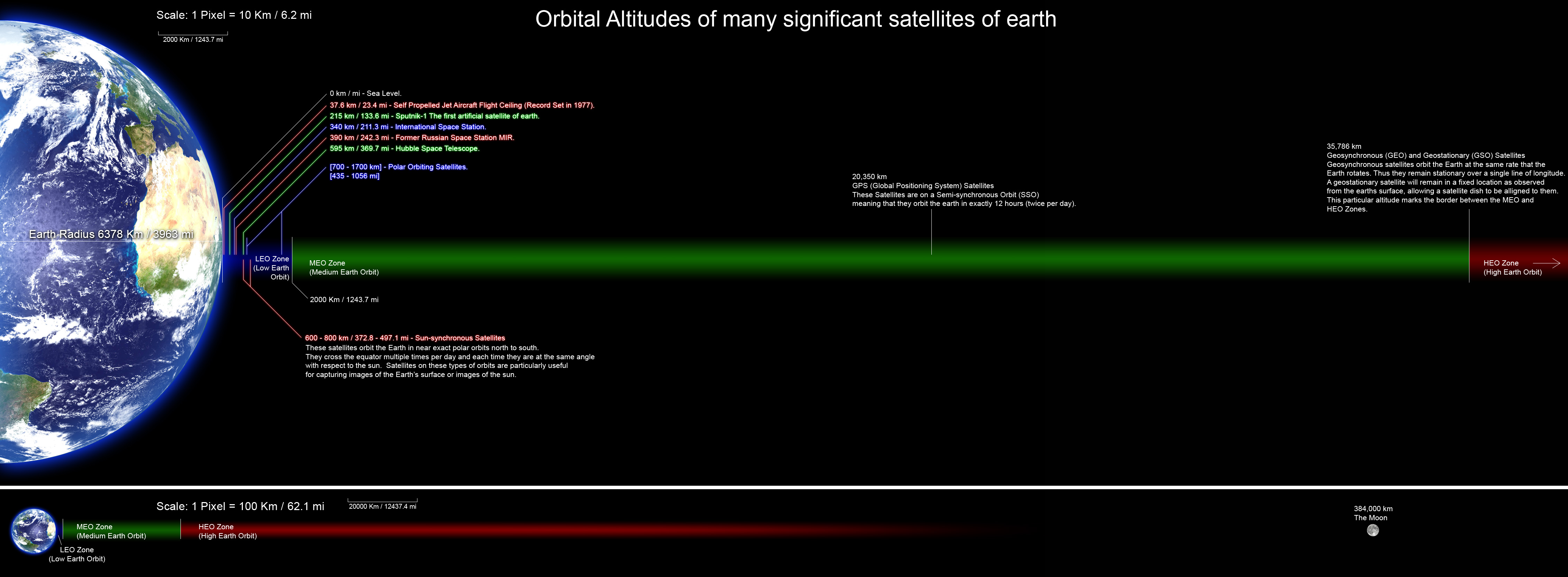
(Click that image to make it big.)
Now: I would need to re-read the beginning to figure out exactly where the ISS is in the novel, but presumably it's in its present-day orbit, about 200 miles above the Earth. This is the same orbit into which all of the Arks are launched. This does make sense since, for the last several decades, all of our manned missions have been confined to launches in this orbit, so we wouldn't have the capacity to send up manned missions to much higher altitudes in the very short timespan allotted in the book.
In contrast, the moon is [checks Google] 240,000 miles away from Earth. Wow! That means that the ISS is .08% (not 8%) of the way from Earth to the Moon. That's really astonishing; both in terms of the task that the characters in this book need to accomplish and, in the real world, it makes me retroactively even more impressed at the success of the Apollo missions. And retroactively sad that our species' capacity for spaceflight has apparently declined so swiftly over the past four decades.
Neal continues to demonstrate his fantastic skill at coming up with wonderful character names. My favorite name in this book is definitely Sonar Taxlaw. Sonar also continues a grand Stephenson tradition of characters who are introduced very late in the book but end up becoming surprisingly compelling, along the lines of Olivia Halifax-Lin or Jules Verne Durand. We don’t get to spent a whole lot of time with her, but she’s pretty fascinating, both in her own right and as a window into Digger society, particularly its quasi-religious approach to societal roles while also recognizing the characteristics of someone “on the spectrum”. There's a great line like "Sonar happily recited some facts, which was her favored technique for interacting with other people," which is something that I can certainly relate to.
One persistent criticism of Stephenson’s books is their abrupt or lackluster endings. I actually think that his last few books have all had nicely satisfying endings: The Baroque Cycle, Anathem, and REAMDE all wound down their main plots gracefully and gave a good amount of closure to their characters, while leaving their worlds open for future exploration. seveneves isn’t quite as tidy; you could easily imagine another five hundred pages being spent to wrap up the Red-Blue conflict. Of course, this isn’t the worst criticism one can imagine: coming to the end of a nearly thousand-page-long book and wanting it to keep on going says a lot for the quality of that book.
END SPOILERS
Okay! So, uh, I really liked this book. I was going to throw together a snap-in-time list of my favorite Stephenson books, but I’m finding it impossible to compare them (how does one judge the relative merits of Anathem and REAMDE?), so I’ll just say that seveneves is another great book. It isn’t as difficult to read as Anathem and The Baroque Cycle could be, but also has more engaging ideas at play than REAMDE or Zodiac, and is a good all-around example of Stephenson’s capabilities.
Also! I wanted to point out this fantastic interview between two of my favorite authors, Neal Stephenson and David Mitchell. They do get into some plot points of seveneves, so you might want to hold off on the interview if you're avoiding spoilers for the book. It's a lot of fun to see them interact, connecting in some ways and not connecting in others. I hadn't really thought of it before, but Neal and David are in some ways mirror images of one another, in that they both combine elements of genre fiction with literary qualities. But, David Mitchell is more firmly on the "literature" side of the spectrum, while Neal is more on the "popular" side. This interview also gets at another interesting distinction. One of the things I most admire about Mitchell is his keen moral compass; he's unusually willing to delve into questions of morality in his books. Stephenson, as the interview makes clear, takes a more detached view: he doesn't deny the existence of good or evil, but also views it as a kind of fundamental and permanent aspect of the human condition, to be recognized rather than struggled against. I get the sense that David writes, to some extent, because he hopes to help increase empathy and altruism in the world. Neal writes, to some extent, because he's interested in studying how humans work.
Okay! These scattered thoughts are now done. Good book.
Wednesday, May 27, 2015
Fellows
As I briefly noted earlier, I've started casually playing through The Lord of the Rings Online and found it a surprisingly relaxing, fun experience. Not too much to report, but I figured I'd share a couple of observations.

Things I like:

Things I'm a bit indifferent to:

Things I dislike:
As you will not be shocked to learn, I've been taking some screenshots of my experiences and assembled them into an album. It's pretty interesting to look through... a mixture of gorgeous settings and badly dated graphics.
We'll see where things go from here. I'm up to level 19, pretty significantly overleveled for the content I'm currently doing in Bree; as with currency, it feels like Turbine has shifted the XP curve to hurry people along to later content, but that does mean that if you try to actually do everything in the game, you end up getting no meaningful rewards from the quests. Anyways, I'll wrap up the stuff in the Old Forest and Barrow Downs, along with any other Ranger business, then head on into the Lone Lands. I'm on a trajectory for reaching level 30 before terribly much longer, at which point I'll make the call whether to start spending money on the game or not. So far, the pleasures of adventuring in Middle-earth have outweighed the pains of playing a somewhat dated free-to-play game, so I won't be shocked if I stick a quarter into the machine to keep playing a while longer.

Things I like:
- Fantastic sense of place. It feels like you're "really" in Middle-earth.
- Rather good writing. There's only so much you can do when your game design requires you to have thousands of quests, leading to endless variations on "Kill 10 Crebain!" and "Collect 20 wild mushrooms!", but they're presented in a way that contributes to the overall narrative ("The enemy has sent birds to spy on the path taken by Frodo!") and setting ("With the threat of war in the south, we need to make sure Bree has enough food stockpiled to survive the disruption of trade and farming!"), and the writing itself is solid... not too goofy, not too dark, nicely congruent with the feel of Tolkien's voice.
- Terrific customization options. It probably says a lot that, thus far, the time I've most been tempted to spend money on the game was to buy a particularly pretty cloak (sky-blue with Telperion woven in silver threads on the back). And I love how you can present yourself with one outfit while gaining the gameplay benefits of another.
- Wonderful music. It's thematically rich and varied, catching my interest and never outstaying its welcome. Best of all, it seems to be tied to your current region, so I expect I'll continue to hear new music throughout the course of the game.
- Well-sized content. I imagine this will change as I progress, but at this point, I feel like I can make good use of whatever time I feel like spending in the game: just a few local quests if I'm hopping on for a quick half-hour before bed, or an entire chain of events and instances if I have a couple of hours to play on the weekend.
- The community seems good. I dropped off the global chat channel so I don't hear a whole lot, but people seem well-behaved and generally friendly. Since arriving in Bree I've also seen a lot of fun-looking roleplaying events around the Prancing Pony: dance parties, plays, in-character bantering, and other fun activities. (I'm playing on the Landroval server, I imagine this can vary a lot from one server to another.)
- The integration with the canonical story is surprisingly well-done. I was kind of dreading meeting Aragorn and Gandalf and other major characters, but so far it has blended in quite well, both in terms of the books' timeline and the representation of the characters.

Things I'm a bit indifferent to:
- The economy seems out of whack. I think it's a by-product of them trying to hurry new players through areas where they used to spend a lot of time, but it feels really weird that I earn, say, 80 copper pieces for finishing a quest, and 400 silver pieces for opening a Hobbit gift. Thanks to the rapid progression in RPGs, though, it's not that big of a factor... I'll quickly outlevel any new equipment anyways, so the only thing I'm expecting to spend any money on soon is housing and cosmetic outfits.
- Combat is... fine. I dunno. I hit three keys and every enemy dies before it reaches me. Again, this is probably due to rebalancing, and I'm sure it gets tougher at higher levels; hopefully it also gets more interesting, because at the moment, there's no reason for me to use 80% of my skills.
- Crafting. Right now, the main issue is just that you outlevel your gear so quickly that there's really no reason to spend time and effort making new items. I imagine it becomes more useful once your progress curve slows. They made an interesting design choice that requires cooperation across multiple professions in order to craft most items (e.g., if you're a weaponsmith, you'll need materials from a metalworker); if I get into this, I imagine that I'll need to hit up the auction house semi-regularly in order to make the stuff I want.
- Voice acting is really minimal. It reminds me a lot of the Baldur's Gate era: you'll get a short voiced phrase that accompanies two paragraphs of written text. It isn't bad, as such, but that sort of in-between state feels weird these days; I'm much more used to games either going full-text and letting your imagination color them in, or fully voicing them for maximum impact.

Things I dislike:
- The sheer proliferation of currencies is absurd. Three types of specie (copper, silver, gold), mithril coins, turbine points, various types of marks, medallions, tokens, barter items, badges, and more. I hate it. Each merchant only accepts a particular type of currency, and I have no idea how I'm supposed to earn most of them, or what I can do with some of the ones I have.
- It's to be expected in a free-to-play game, but it's aggravating to see the developers intentionally cripple aspects of the game to make it painful for people who haven't spent money. The most obvious is the limit on currency (2 gold coins), which leads to a UI nag every time you loot any money or sell an item. I vastly prefer Failbetter's F2P philosophy, which is essentially "Provide a great and complete experience to all players, and offer to sell more and newer experiences to players who want more."
- And, given that there is a store, it's bafflingly hard to use. I spent an inordinate amount of time trying to figure out how to get into the store from the lotro.com website, only to finally realize that it's impossible. You can only browse and purchase from the in-game browser, which has an awful, janky, ugly interface. All I want to do is browse through it on my desktop browser, where I can actually read about stuff and compare items and complete purchases.
- Overall model and texture quality is rather low. It's mostly a factor of how old the game is, and I'm amazed that the environment itself holds up so well.
- This is a rather unfair complaint, but I'm a bit bored by the lack of choice in quests. I've been trying to instead focus on the choices available to you as a character: which quests to accept or decline, where to go, how to spend your time. Still, my time with Star Wars: The Old Republic spoiled me for having interesting, engaging, branching storylines in my massively multiplayer roleplaying game, and it's increasingly hard for RPGs to keep my interest without offering a similar degree of agency over how the plot develops.
As you will not be shocked to learn, I've been taking some screenshots of my experiences and assembled them into an album. It's pretty interesting to look through... a mixture of gorgeous settings and badly dated graphics.
We'll see where things go from here. I'm up to level 19, pretty significantly overleveled for the content I'm currently doing in Bree; as with currency, it feels like Turbine has shifted the XP curve to hurry people along to later content, but that does mean that if you try to actually do everything in the game, you end up getting no meaningful rewards from the quests. Anyways, I'll wrap up the stuff in the Old Forest and Barrow Downs, along with any other Ranger business, then head on into the Lone Lands. I'm on a trajectory for reaching level 30 before terribly much longer, at which point I'll make the call whether to start spending money on the game or not. So far, the pleasures of adventuring in Middle-earth have outweighed the pains of playing a somewhat dated free-to-play game, so I won't be shocked if I stick a quarter into the machine to keep playing a while longer.
Jaws Clamped Shut
Dragon Age: Inquisition is holding up as one of my favorite games, of ever. Its first expansion, Jaws of Hakkon, provided a great excuse to dive back into the world. There is still plenty that I haven’t done in the main game yet - the Hissing Wastes remain largely unexplored, along with most of the Emerald Graves and some other locations - but the prospect of additional storylines prompted me to pony up for the DLC.
BioWare has gotten really great at putting together DLC recently; in particular, the expansions for Dragon Age 2 and Mass Effect 3 did a fantastic job at responding to specific criticisms that players had about the main games, and in many respects surpassed them. I believe this is mostly due to BioWare’s surprising humility in listening to and responding to their fans, as they seem to be very in tune with the cultural pulse around what aspects people enjoy, dislike, and want more of.

JoH doesn’t provide as dramatic a sense of improvement, but I think that’s mostly because Inquisition is such a great game to begin with. It’s more about giving us stuff that we already like than fixing anything fundamentally broken in the game. (Though the latter is arguably accomplished thanks to the Black Emporium, a free update distributed separately from the DLC, which finally lets players fix visual blemishes in their characters.) We get to banter more with Scout Harding and learn about her history, elevating this fan-favorite character from a minor source of exposition to a supporting sidekick. There’s also a lot of new banter between companions: not even tied in to the new story, just further developments in their funny, fraught relationships. And, on the flip side, BioWare has omitted some of the aspects of the game that people didn’t particularly enjoy; most noticeably, there are no new requisition orders from your camps.
 For better and worse, JoH feels like a big new area in Inquisition rather than a sequel to Inquisition. You have the same freedom of exploration, gorgeous new vistas to see, cultures to learn about, side-quests that range from the rote to the fascinating. I’ve been impressed by the work BioWare went to in making this content available at various points during the game: much like the Dragon Age 2 DLC, you can play it at nearly any point, including after the end of the game, and the dialogue within it will be updated to reflect your current status. I happily played it in my post-end-game Aztar Cadash save, and was satisfied with the occasional recognition of the massive feats I had already accomplished. At the same time, the plot in JoH feels sufficiently weighty to be worth my Inquisitor’s time.

MEGA SPOILERS for Jaws of Hakkon
There’s a bunch of great lore in the game. A lot has to do with the Avvar, who have been present since Origins but, thanks in part to the discarded Human Commoner origin story, haven’t really been explored to the same extent as many other ethnic groups. As is so often the case in Dragon Age, we see that they aren’t a single monolithic entity, but a dispersed and varied culture with conflicting leaders, perspectives, and agendas. On the whole, they have a strong Nordic feel about them, reminiscent of the Wildlings in Game of Thrones / A Song of Ice and Fire, as well as the Nords of Skyrim.
It doesn’t directly play into the plot much, but one thematic plot thread that I particularly enjoyed had to do with the Avvar’s reaction to the “modern” world. You spend some time in Stone-Bear Hold, a mostly-peaceful settlement. Their leader, Sun-Hair, is really quite progressive: she wishes to trade more with the “lowlanders”, and has little use for the more violent tendencies of the Jaws of Hakkon. One of my favorite parts was when you find some notes where she was practicing a letter to the Orlesians inviting them to trade: there’s a wonderful mix of pride in her culture, frustration at the limits of her literacy, embarrassment at how she will be perceived, hopefulness for the ways this exchange could improve the lives of her people. I was strongly reminded of the perennial dilemma faced by indigenous people confronted with an outside culture, as they try to strike a balance between holding on to the traditions which have sustained them for generations and the advantages offered by joining the global monoculture.
The deep lore in the game, though, has to do with the history of the Inquisition. We’ve learned a lot about this over the course of the main game: how it was originally a separate faction, devoted to stamping out the threat of mage abominations, and relatively late in joining the Chantry to present a unified force against the Blight. We get some impressive lore bombs here, of which the biggest might be that the old Inquisition was led by an elf, who was also a personal friend of Emperor Drakon. We already know that, around the time of the Exalted March on the Dales, the Chantry hierarchy purged most references to elves from the canon, removing persons such as Andraste’s disciple Shar’tan. That same effort was successful in wiping the record of elven involvement from the founding narrative of the Orlesian Chantry.
Anyways. As usual, Dragon Age does a fantastic job at evoking real-world scenarios; it’s hard to hear this story and not think of events like the establishment of the biblical canon. There isn’t a one-to-one correlation, and the game isn’t meant to be an allegory or anything, but it certainly adds to the game’s great strengths at feeling complex, messy, and real.
END SPOILERS
As has become rote, I took a whole bunch of screenshots of my time in the expansion and uploaded them into an album. Some of them are very pretty! Others are silly. Many contain spoilers.
On the whole, I'm really digging BioWare's approach to DLC. In contrast to the long run-up to Inquisition, with frequent tantalizing glimpses at the upcoming game, they've been very tight-lipped about further releases for Inquisition, not announcing JoH until right before it went on sale. Of course, this also means that the next expansion could drop at any time, and after this experience, I'm even more eager to pick up what comes next.
BioWare has gotten really great at putting together DLC recently; in particular, the expansions for Dragon Age 2 and Mass Effect 3 did a fantastic job at responding to specific criticisms that players had about the main games, and in many respects surpassed them. I believe this is mostly due to BioWare’s surprising humility in listening to and responding to their fans, as they seem to be very in tune with the cultural pulse around what aspects people enjoy, dislike, and want more of.

JoH doesn’t provide as dramatic a sense of improvement, but I think that’s mostly because Inquisition is such a great game to begin with. It’s more about giving us stuff that we already like than fixing anything fundamentally broken in the game. (Though the latter is arguably accomplished thanks to the Black Emporium, a free update distributed separately from the DLC, which finally lets players fix visual blemishes in their characters.) We get to banter more with Scout Harding and learn about her history, elevating this fan-favorite character from a minor source of exposition to a supporting sidekick. There’s also a lot of new banter between companions: not even tied in to the new story, just further developments in their funny, fraught relationships. And, on the flip side, BioWare has omitted some of the aspects of the game that people didn’t particularly enjoy; most noticeably, there are no new requisition orders from your camps.


MEGA SPOILERS for Jaws of Hakkon
There’s a bunch of great lore in the game. A lot has to do with the Avvar, who have been present since Origins but, thanks in part to the discarded Human Commoner origin story, haven’t really been explored to the same extent as many other ethnic groups. As is so often the case in Dragon Age, we see that they aren’t a single monolithic entity, but a dispersed and varied culture with conflicting leaders, perspectives, and agendas. On the whole, they have a strong Nordic feel about them, reminiscent of the Wildlings in Game of Thrones / A Song of Ice and Fire, as well as the Nords of Skyrim.
It doesn’t directly play into the plot much, but one thematic plot thread that I particularly enjoyed had to do with the Avvar’s reaction to the “modern” world. You spend some time in Stone-Bear Hold, a mostly-peaceful settlement. Their leader, Sun-Hair, is really quite progressive: she wishes to trade more with the “lowlanders”, and has little use for the more violent tendencies of the Jaws of Hakkon. One of my favorite parts was when you find some notes where she was practicing a letter to the Orlesians inviting them to trade: there’s a wonderful mix of pride in her culture, frustration at the limits of her literacy, embarrassment at how she will be perceived, hopefulness for the ways this exchange could improve the lives of her people. I was strongly reminded of the perennial dilemma faced by indigenous people confronted with an outside culture, as they try to strike a balance between holding on to the traditions which have sustained them for generations and the advantages offered by joining the global monoculture.
The deep lore in the game, though, has to do with the history of the Inquisition. We’ve learned a lot about this over the course of the main game: how it was originally a separate faction, devoted to stamping out the threat of mage abominations, and relatively late in joining the Chantry to present a unified force against the Blight. We get some impressive lore bombs here, of which the biggest might be that the old Inquisition was led by an elf, who was also a personal friend of Emperor Drakon. We already know that, around the time of the Exalted March on the Dales, the Chantry hierarchy purged most references to elves from the canon, removing persons such as Andraste’s disciple Shar’tan. That same effort was successful in wiping the record of elven involvement from the founding narrative of the Orlesian Chantry.
Anyways. As usual, Dragon Age does a fantastic job at evoking real-world scenarios; it’s hard to hear this story and not think of events like the establishment of the biblical canon. There isn’t a one-to-one correlation, and the game isn’t meant to be an allegory or anything, but it certainly adds to the game’s great strengths at feeling complex, messy, and real.
END SPOILERS
As has become rote, I took a whole bunch of screenshots of my time in the expansion and uploaded them into an album. Some of them are very pretty! Others are silly. Many contain spoilers.
On the whole, I'm really digging BioWare's approach to DLC. In contrast to the long run-up to Inquisition, with frequent tantalizing glimpses at the upcoming game, they've been very tight-lipped about further releases for Inquisition, not announcing JoH until right before it went on sale. Of course, this also means that the next expansion could drop at any time, and after this experience, I'm even more eager to pick up what comes next.
Subscribe to:
Posts (Atom)