Hey, I’ve been playing more Lord of the Rings Online! I’ll break with tradition and present a link to my screenshot album at the top of the post instead of the bottom.
This period covers my time in Enedwaith, followed by a backtrack to Eriador to complete the Level 50-51 climax of Volume I of the epic storyline. Along the way are some adventures with Bingo Boffin, a trip to the Yule Festival, and a few other random quests. As usual, there are tons of spoilers and ramblings in the album notes. A few things that felt worthy of more detailed exposition are in this post.
One thing I’ve felt mildly but consistently disappointed in has been the lack of choice in the game. As noted in earlier posts, I’ve been spoiled by BioWare, even their own MMO of Star Wars: The Old Republic, in being able to chart my character’s course. I get why this is the case: to their great credit, Turbine is creating a game steeped in Tolkien’s values, so there’s no option to join the “dark side” or aid Sauron’s forces or any nonsense like that.
MINI SPOILERS
Recently, though, I’ve been pleasantly surprised by the introduction of a few choices. They’re minor, but significant to me, and presented in a thoughtful way. One came during the early part of the Grey Company’s epic storyline, where you travel throughout Eriador to summon the various Rangers to travel to Rohan. Most of this is completely rote: travel to a spot, talk to a ranger, do a short quest for them, and then move on to the next. The interesting one, though, came with a ranger who was stationed in the Shire. He’s fallen in love with the people there, and wonders aloud whether he should leave. In either case, he wants you to bring the news to a hobbit who has been asking after his plans: one Lotho Sackville-Baggins.
Lotho? That rang a bell… wasn’t he a bad hobbit? I did a quick wiki search, and was confirmed in my suspicion: during the Scouring of the Shire, Lotho (aka Pimple) seizes control of the Shire, and his thugs enforce “Sharkey’s” (aka Saruman’s) malevolent designs.
Now, I don’t expect that my choice here will affect the ultimate outcome of the story - it isn’t like they’ll decide whether to scour the Shire or not based on one decision way back at Level 50. But it’s exactly this type of choice that’s perfect for the game and the story. There isn’t a “good” or a “bad” choice here. In one direction, you urge the Ranger to fulfill his duty, travel to the aid of his liege and kin, and trust that the hobbits can look after themselves. In the other direction, you urge the Ranger to follow the direction of his heart, and lend his sword to the people who need him most. While there may not be a major gameplay consequence, it’s a decision that will resonate as the story continues. Whenever the Grey Company faces obstacles, I’ll wonder if they would fare better with one more talented warrior by their side. Whenever I travel back through Brockenborings, I’ll feel a little happier knowing that at least one Dunedain remains to look after the little folks.
The second choice was even more interesting. The Yule Festival is pretty different from any of the other ones I’ve been to before. The Spring, Summer, and Harvest festivals have all taken place at the standard fairgrounds for the four races. Yule, however, is a bit more like the Treasure Hunt in that it takes place in an entirely new area. This new areas is considerably more developed, though, with a mayor and economy and traditions.
You tour the village on your arrival, and get a sense for its purpose. This is, to put it bluntly, a tourist town. They host festivals to attract out-of-towners like yourself. As you speak with more of the inhabitants and explore off the beaten path, though, you realize that it isn’t nearly as idyllic as it initially appears. The Mayor, in his quest to make a picture-perfect town, has quietly swept the undesirable beggars out to the far reaches of town. He squeezes the workers to work harder for less pay, so he can put on a bigger show for the visiting patrons.
Many of the yule quests have the same structure as the other seasonal festivals. There are quests to collect things (parts to build a snowman!), quests to defeat things (collect branches from ambulatory trees!), and entertaining bits of busy-work (bake bread! clean up dirty trash!). My favorite is a new innovation: the GLOBE theater (Green Lily Orators, Bards, and Entertainers), run by an enterprising troupe of hobbits. Impressively, the game recruits actual players to play roles within the play, while other players watch and show their approval or disdain by tossing rose-petals and rotten fruit respectively. (I gave an exemplary performance in my role as Partygoer!)
Now: I tend to say that you don’t have a choice in quests in LOTRO, but there really is one choice in every quest: whether to take it or not. For the most part, that isn’t really a choice at all; or, if the answer is “no”, it’s for mechanical rather than story reasons (it would take you too far out of your way, or take too much time, for too small of rewards). In the Yule festival, though, there are some quests that you’ll think twice before accepting. One quest, offered by the striking workers, asks you to give your hard-earned tokens to the unemployed. There aren’t any rewards to speak of for this; it effectively undos the rewards you would get from one of the other “real” quests. The only benefit is you feeling good about yourself. Conversely, there’s also a quest to shoo the undesirables off of the street. This is an easy job, with good rewards, and no negative consequences, other than possibly thinking less of yourself.
After the first day, I returned to the town, to find that the game had now progressed to presenting an actual mutually-exclusive choice. The Mayor asks you to infiltrate the workers and find information that would embarrass them into ending their strike. The workers, in turn, ask you to help uncover malfeasance in the Mayor’s administration and ultimately convince him to re-hire the proletariat at their original wages.
This was FASCINATING. For starters, it’s an asymmetric choice. The rewards you get from siding with the Mayor are MUCH better than siding with the workers; the poor only offer you shabby clothing and a unique title. This dynamic reminded me much more of the choices that Failbetter Games offers, where you feel compelled to take the “good” choice despite knowing that it offers fewer rewards; and the fact that it offers fewer rewards, curiously, makes you feel even better about taking it, as if it’s saying something positive about you as a human being rather than as a character in a game.
It was also surprising for its on-the-nose portrayal of inequality. I’m curious to see what year this was added to the game, but it must have been sometime after the 2008 financial crisis. LOTRO is a fantasy game, but in this one scene it feels a little like a small metaphor for the very real problems that people in the real world are facing.
It’s a delicate thing to present, and I’m a bit surprised that they attempted it at all. Tolkien isn’t particularly interested in poverty in his books, and in real life he was fairly anti-socialist (particularly later in life). But he was even more irritated at the factory-owners and industry titans, and you can sense that deep-rooted antipathy in (e.g.) his descriptions of Saruman overseeing the “factories” of Isengard or the Shire. Tolkien would have preferred that the factories be shut down entirely rather than turned over to the workers, but it isn’t necessarily out of character to offer this kind of story in Middle-earth.
Okay! So, yeah. That’s a grand total of two interesting choices in, uh, about ten months of gameplay. I’m curious to see if this pace continues in the future.
MEGA SPOILERS
As I noted before, one of the difficult things about playing this game as an MMORPG is how fragmented the storytelling can be. I think the epic storyline is probably good, but since I only experience it in short chunks separated by long periods of time spent doing other things, it’s hard to keep it all straight.
I’m a bit happier with how the conclusion of Volume I went. Part of this might be that it was just more memorable: you spend a lot of time with a handful of characters, rather than the constantly-changing cast that was featured earlier. But I think a big part is also because I was overleveled enough to just blow through it all. By this point I was level 67, far above the level 50-51 it was originally created for, so I didn’t have to waste any time discovering new fast travel points or while moving from point A to point B, and wasn’t distracted by on-level quests along the way. I could just do story after story and see how it all ended.
And there is a LOT of story! I was a little surprised by that. Because there’s so much STUFF in an MMO, I’ve tended to assume that it was filling out and covering up an anemic central plot. It’s complex enough to be the central thread of a single-player RPG, though.
I’ll probably go into this in more detail in the album, so I’ll refrain from the blow-by-blow recap here. But here are some musings on how well it worked for me big-picture:
The final conclusion to Volume I was very affecting. I was a little gun-shy at first after the Lorniel episode; I worried that Amarthiel was getting more development just to get shot down. That was… kind of true, I guess, but I ended up sort of loving how it was handled.
The whole arc with Laerdan and Amarthiel/Narmeleth is such a wonderfully Tolkienesque story. Its tragedy feels very much like something out of The Silmarillion: most of the tales in that book are stories of things getting worse and worse, of hopes being betrayed, of pride destroying chances of happiness. And yet, its conclusion rests on some of the values that Tolkien held most dear. It’s a story of confession, of redemption, of mercy, of sacrifice. Amariel can’t undo the deeds that she’s done, but her soul is saved, thanks to the hard work of others and her humility in accepting her own limits. (I hadn’t thought of it in these terms while playing, but it’s a very Catholic story as well.) Part of me wishes that Amariel had lived and could do more cool things, but as it stands she’s the most memorable original character in this game, and I’m happy with the emphatic conclusion to her story.
That kind of devotion to Tolkien’s themes is even more important to me than their admirable respect towards Tolkien’s lore. They bend over backwards, for example, to explain that Narchuil is NOT one of the Nine, or even one of the Seven (which I personally would have been tempted to do), but still manage to connect it to Sauron via the oblique passages describing the various other rings he crafted. And his appearance as the Gift-Lord is chilling and subtle, all the more ominous for how innocuous it appears.
END SPOILERS
As usual, the thing I love most about LOTRO is the feeling of physically inhabiting the space of Middle-earth. I’m glad that I’m now able to engage even more with the feeling of actually living there, making choices and inhabiting the emotional universe Tolkien created.
That sense of identification is strong, so much so that every once in a while I’m pulled up short by some quest I’m doing. I’m currently traveling through Enedwaith preparing the way through the Grey Company. Much of this is agreeable work - gathering allies, scouting roads, gathering supplies - but every once in a while there’s a quest like “Collect 8 Dunlending Cloaks”. Which must be done by killing Dunlendings. Which then plunges me into a miniature crisis - Dunlendings are people, too. These PARTICULAR Dunlendings are part of an army that seeks to overthrow the Free Peoples and plunge Arda into darkness, but does that mean that they can’t be reasoned with?
While the details sometimes make me question the game I’m playing, the larger picture stays clear. This is a game that presents the nuance and complexity in tribal societies, the mixture of good and bad people everywhere, or even in the same person. I was briefly annoyed recently by the revelation that a particular character wasn’t just a dwarf, but a Dourhand Dwarf. In the shorthand of this game, Longbeards = Good Dwarfs, Dourhands = Bad Dwarves. Every time you see a Dourhand, you kill it.
Except, this time, you don’t. Dourhands are rational, thinking, social creatures, just like you or me. This particular person was unhappy with the actions of several of his comrades, and works with you to undo the damage done. That really touched me - it’s just a single character out of the thousands of faceless foes, granted, but one is all it takes to show that genetics aren’t destiny, that you can’t dismiss a tribe or a race as being evil because of their ancestry.
And then I remembered that, of course, this isn’t some amazing new insight that Turbine has injected into the game. One of my favorite moments in the theatrical version of Lord of the Rings is probably when Faramir comments on the Easterling slain by his forces. Up until this point, we’ve known the Easterlings as members of a faceless evil “other”, the “evil men” who are supporting Sauron and so much be stopped. But in the midst of very real suffering, he ponders this man. He had a family, and people who loved him. He didn’t think of what he was doing as evil. He had accepted the call to raise arms, just as the brave Gondorians on the western side had done.
I can’t watch this scene without thinking of Tolkien’s time as a soldier at the Battle of the Somme, when he witnessed first-hand the awful waste of war. He saw bravery and sacrifice, and made those virtues in his books; but he avoids glorifying killing and battle. After the victory of the Battle of Morannon and the destruction of the Ring, Aragorn focuses on rebuilding, and creates a stable peace that endures beyond the end of his reign.
That’s the endgame. Not total victory and raising your side to supremacy, but removing the essential threat facing you, and then using the gifts of wisdom and diplomacy to raise everyone around you. That’s the moral universe that Tolkien created, and it’s one that I love inhabiting.
Showing posts sorted by date for query faramir. Sort by relevance Show all posts
Wednesday, December 23, 2015
Tuesday, October 28, 2014
Sub-creation
My recent, lengthy, kinda-ranty post got me thinking about Middle-earth and her video games. I have to confess that I totally am one of the people who is tempted to buy any product with “Tolkien,” “Middle-earth,” “Lord of the Rings” or “Hobbit” in the title, and so over the years I’ve encountered quite a few products. None of them have been exactly amazing, but each has its own charm.
The earliest one I encountered was “War in Middle-earth”, which I played on my ancient IBM 8088 PC with a CGA monitor (colors!). The game basically follows the events of Lord of the Rings, and does so fairly faithfully. You start off in the Shire with Frodo, Sam, and Pippin; you then walk down to Brandywine and pick up Merry, then it’s off to Bree to join Aragorn and so on. Along the way you occasionally bump into friendly people for a chat, who will sometimes share rumors with you; other times you’ll run into a group of hostile enemies, who you must fight or flee to proceed.
It was a surprisingly idyllic game, and my strongest memories of it are just watching those cute, chubby little hobbits gradually walking through screen after screen of background scenery. There didn’t seem to be much in the way of choice, and things would sometimes go horribly if, for instance, I ran into one or more Ringwraiths.
It wasn’t until much later that I realized there was an entirely different mode to the game: you could switch from the side view to a top-down strategic map, which displayed all of Middle-earth including the major fortresses and armies. At this point, it started to feel much more like a game to me. By default, the game will have your characters follow the path laid out by Tolkien in the books: however, you can issue your own orders, which can drastically change how events play out. For example, rather than traveling south to meet Merry, you can have your hobbits start out directly east to beeline towards Bree; this is risky, since there are ringwraiths on the road, but you can spot them and move off the path when necessary.
As I played the game over and over again, I gradually came to discover more of its mechanics. As the game continues, more and more units will activate: either due to you reaching a certain location, or performing a certain act, or after a certain time is reached, or after other events have transpired. Again, by default, events will play out fairly similarly to those of the books. The armies of Rohan will begin to stir after Saruman reveals his hostility. Gondor will react after Sauron’s host begins to march. Sending Merry and/or Pippin into Fangorn may awaken the Ents and Huorns; they aren’t under your control, but will fight on your side, crushing Saruman’s forces at Isengard.
I gradually came to discover, though, that the game was filled with things that weren’t part of the original series. Many of those cryptic statements you heard from people like Radagast and Galadriel were hints about where to find certain items of power. Some obvious ones are useful weapons or armor for your characters, like coats of mithril mail or elven blades. More interesting, though, were artifacts like the Sceptre of Arnor, abandoned in Annuminas, or one of the Dwarven Rings of Power, hidden south of Dol Guldur. If you find one of these items, and return them to their associated faction, then they will activate and join your side, regardless of what’s happening in the timeline. In this way, it’s possible to actually take the initiative: instead of waiting for the forces of darkness to strike, and then scrambling a defense of the free lands, you can organize a more comprehensive strategy.
The goal of “War in Middle-earth” is to destroy the One Ring, which you must do by taking it to Mount Doom; however, you can’t ignore the higher-level strategic picture either, as the game will immediately end if you lose ownership of two of the five major strategic points (which I want to say are Helm’s Deep, Edoras, Minas Tirith, Rivendell, and… maybe Erebor?). So, in the conventional strategy, you will send a small but well-prepared group of individuals into Mordor, while marshaling as many forces as possible and deploying them effectively to hold off destruction until your ring-bearers complete their quest.
Once you get the mechanics down, this isn’t terribly difficult. So, I decided to set a more ambitious task for myself. Would it be possible to actually defeat Sauron militarily? On the surface, this seemed like an absurd goal, as the forces of the enemy vastly outnumber your own. But still, it was something I had to try.
In addition to the hobbits, you also start out the game in control of Faramir and Eomer. There’s a gap of several months after the Council of Elrond during which you can’t issue new orders, but any existing orders will continue to be carried out during this time. So, after a lot of planning and scheming, I worked out an optimal process for recruiting all the Free Folks as soon as possible. I forget all the details, but I think it started by splitting my party and sending Pippin off to Annuminas; Eomer’s swift cavalry raced to Mirkwood, while Faramir went searching for some other artifact (perhaps a palantir?). I made sure they all had the items in their hands and were on their way to their final destinations by the time Frodo arrived in Rivendell. And so, I could immediately start raising the Elves and Dwarves in the North, as well as the Men in the South.
The enemy always follows the same sequence of moves, regardless of what you do, and so I could confidently dispatch my forces. Rivendell is a safe city, and needed only a token guard to stand against the few orc skirmishers sent against it. Erebor needed a slightly stronger defense against the group of Easterlings sent against it, but it could spare a large portion of its levies. And so, I was delighted to create a true Last Alliance, not just of Elves and Men but also of Dwarves, which hasn’t been seen on a large scale since the War of Power.
The Ents and Huorns will single-mindedly crush Saruman’s defenses at Isengard, but even after this he will still send out his new armies of Uruk-hai. So, I assembled a ridiculously huge force and had it camp in Helm’s Deep. You get a significant combat bonus when defending a fortress like this, and so wave after wave of uruk-hai dashed themselves against our wall while inflicting virtually no casualties. We stood against successive waves until Saruman was spent, then sent them racing along the Great West Road to Minas Tirith.
This is, by far, the biggest flash-point in the game. The armies of Mordor are HUGE, and that isn’t even counting all the corsairs, easterlings, and Haradim joining in the fight. That fight was more challenging, even with Minas Tirith’s defenses, but after a seemingly endless series of assaults we emerged, blinking, into the daylight. That was it. We were diminished, but had defeated all of Sauron’s armies!
I was delighted, and stunned. What to do next? The game was still going, but for the first time I wasn’t reacting to anything. The enemy is entirely scripted, and Sauron wasn’t breeding any more orcs for me to fight. I came up with the idea of wiping all the forces of evil off the map: while the mobile armies had been defeated, there were still groups of goblins in Goblin Town, orcs in Moria, and a few other strongholds. So, I took my super-ultra-mega-force on a tour, walking around the entire map and wiping out all the foes. Now I had to fave enemies on their own turf, and so they managed to inflict a good amount of damage, but my own numbers were so overwhelming that I was able to prevail. And then, all that remained was Mordor!
I crashed through Minas Ithil, then marched up to Barad-dur! This is an incredibly difficult fight: not only are a ton of enemies there, but so is Sauron himself; he’s a single unit, but incredibly powerful. Even after all of the other enemies were killed, he still managed to slay thousands of my soldiers before succumbing. And succumb he did, and then… I lost!

Staring at the screen, stunned, I wondered what had gone wrong. Did I break the game by daring to take actions that the creators hadn’t intended? Was it making some meta-commentary about the futility of opposing evil?
Eventually, I realized that I had inadvertently triggered part of the game’s logic. When an enemy kills the Ringbearer, if you win the fight, one of the survivors will pick up the Ring and continue the quest. If you are wiped out or flee, then the enemy will take the Ring, but the game doesn’t instantly end. Instead, they will immediately head out towards Barad-dur. If you have swift units to pursue them, or have forces in the way that can intercept them, then you can defeat them, retake the Ring and continue your quest. If you fail, then the game ends when the Ring reaches Barad-dur.
And so, I realized, since I had added Frodo and Aragorn and all the rest to my Stack of Doom, I was accidentally returning the Ring to the one place it wasn’t supposed to do. I didn’t want to do that, and also didn’t want to attack Mount Doom, since presumably that would end the game in the way I didn’t want. So, instead, I sent Frodo and an honor guard back to Gondor, then had my megaforce wipe out Mount Doom before finally assaulting Barad-dur for a second time. We were once again victorious. I wasn’t exactly sure what to expect; maybe nothing. But I was delighted to actually win the game through my military victory! While highly improbable, our tale-twisting exploits had accomplished what had seemed utterly impossible within the books: we had stood united against Sauron, and managed to defeat his mighty host, tear down the Dark Tower and free Middle-earth of his evil influence. All without doing something so trite as tossing a ring into a volcano.
So, yeah. I have very fond memories of the game, although in all honesty I can’t strongly recommend playing it, especially not now. There’s really no AI to speak of, and the combat system is rather frustrating, particularly at the micro level of individual characters: you can’t order your entire party to flee a hopeless fight, and so must always sacrifice a character when you bump into, say, a Ringwraith or a Balrog. That said, I really like what the game manages to pull off in terms of authentically portraying the background of the novels while allowing you to change the story in some very creative and original ways.
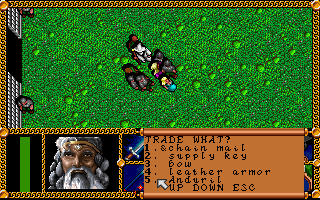
The next big Middle-earth game I remember playing is “Lord of the Rings”, an old Interplay RPG. This played much more like, well, an RPG than the more strategic “War in Middle-earth”. As with WiMe, it covers the same timeline as the books, although it has a bit more in the way of invention. The overall plot arc is the same: you must escape the Shire, evade the Riders, meet with Aragorn in Bree, reach Rivendell, and by the end of the game make your way through Moria. Along the way, though, there some new quests to do, as well as a few new characters.

As with WiMe, things get more interesting the more you deviant from the canonical plot. In one sequence, you are set upon by Ringwraiths; a ranger (not Aragorn) shouts at you to flee, and then sacrifices himself to buy you time to escape. But! As I discovered on a later play-through, you can actually charge back in and save him. Using one of your “Elbereth!” words of power will dispose of the ringwraith; at this point, the ranger will join your party, giving you a crucial human ally who helps you with other obstacles as you make your way towards Bree, and afterwards, you can end up with two Rangers in your party. I seem to vaguely remember there also being some sort of, hm, witch or wise-woman or something who could also join you.

Magic was kind of strange in the game. Middle-earth is a very low-magic world, and they did a good job at representing this: only a few characters like Gandalf are capable of casting spells. Mechanically, though, it was a bit strange, since casting spells will decrease a character’s health rather than a separate “mana” pool. Since healing is pretty rare in this game, you were incentivized to avoid casting spells except in dire circumstances, even when your party members had it available to them.
As a side note, while the game invented a lot of stuff, I was generally happy at its humble attitude towards the source material. I even remember the well-written manual, in which the creators admitted that, if Tolkien were still alive, he probably wouldn’t have approved of the game. Tolkien was notoriously skeptical of technology, and the combination of an adaptation of his beloved work and a diabolical instrument like the computer would have likely dismayed him. Nonetheless, even knowing this, they did what they could to honor his story and his setting.
Sometimes I feel like the major driving force in my life has been a desire to explore Middle-earth. It was such a powerful, formative draw for me in my youth, and a big part of the reason why I started programming computers was a desire to do a similar sort of world-building. Any time I play a new fantasy game, I’m indulging in that ancient compulsion to thoroughly explore, to get to know a place, to immerse myself in the imagined land. Usually the new land (Thedas or the Sword Coast or Nirn or Britannia or whatever) is just a proxy for my first love, but on a few rare and precious occasions I’ve felt like I’m actually in the primary world, getting to know more of Middle-earth.
That’s the sensation that, at its best, the 1990 Lord of the Rings game evoked. You have to go into Moria, because of COURSE you have to go into Moria, because that’s a crucial part of the game. You can stick close to the script, and move through it and get out of that dangerous place as quickly as possible. But, if you’re driven to learn more, you can get off the script. You can, as the dwarves infamously did, dig too deeply. You can haul a pickaxe down into the depths of the mine, and actually mine your own mithril. Foolhardy? Undoubtedly. Non-canonical? Unquestionably! Exhilarating? Certainly. Ever wanted to find Durin’s axe? Well, it’s a video game. It doesn’t have to follow the plot of the game. You can find that axe, and give it to Gimli, and it made me feel so very happy to do so.
And, more recently, I’ve gushed here about Sil, an absolutely fantastic roguelike that evokes the Lay of Beren and Luthien. Tasked with cutting a Silmaril from Morgoth’s iron crown, you venture deep into the fortress of Angband, encountering and outwitting or outmatching a huge host of First Age foes. Again, this isn’t canonical - only Beren was able to reclaim a single Silmaril - but it’s so steeped in the lore, and, more importantly, so respectful to the spirit of Tolkien that it stands out to me as the best video game ever created based on Tolkien’s works.

So, to close the loop back to Shadow of Mordor, I think that’s the aspect of it which distresses me the most. Not creating new creatures, or changing the timelines, or even necessarily messing with the Halls of Mandos. It’s just that, for all the nifty snippets of accurate lore about Numenor and the Blue Wizards and Feanor, it seems set in a moral universe that’s completely alien to every primary work Tolkien wrote. There’s no hint of The Song, no idea that Eru Iluvatar is watching over events. It’s the same crappy world of The Dark Knight and 24 and Hitman and God of War and Mafia and Max Payne. There’s no shortage of franchises out there that want to tell the story about A Badly Damaged Man Must Do Dark Things In Order To Exact Revenge Upon Those Who Have Wronged Him. There’s an alarming lack of franchises built around concepts of grace, of enduring rather than returning oppression, of melancholic nostalgia rather than gloomy angst. I wish they had taken advantage of Tolkien’s unique style and perspective rather than painting it with the same ugly brush of sadism that covers so many game franchises.
The earliest one I encountered was “War in Middle-earth”, which I played on my ancient IBM 8088 PC with a CGA monitor (colors!). The game basically follows the events of Lord of the Rings, and does so fairly faithfully. You start off in the Shire with Frodo, Sam, and Pippin; you then walk down to Brandywine and pick up Merry, then it’s off to Bree to join Aragorn and so on. Along the way you occasionally bump into friendly people for a chat, who will sometimes share rumors with you; other times you’ll run into a group of hostile enemies, who you must fight or flee to proceed.
It was a surprisingly idyllic game, and my strongest memories of it are just watching those cute, chubby little hobbits gradually walking through screen after screen of background scenery. There didn’t seem to be much in the way of choice, and things would sometimes go horribly if, for instance, I ran into one or more Ringwraiths.
It wasn’t until much later that I realized there was an entirely different mode to the game: you could switch from the side view to a top-down strategic map, which displayed all of Middle-earth including the major fortresses and armies. At this point, it started to feel much more like a game to me. By default, the game will have your characters follow the path laid out by Tolkien in the books: however, you can issue your own orders, which can drastically change how events play out. For example, rather than traveling south to meet Merry, you can have your hobbits start out directly east to beeline towards Bree; this is risky, since there are ringwraiths on the road, but you can spot them and move off the path when necessary.
As I played the game over and over again, I gradually came to discover more of its mechanics. As the game continues, more and more units will activate: either due to you reaching a certain location, or performing a certain act, or after a certain time is reached, or after other events have transpired. Again, by default, events will play out fairly similarly to those of the books. The armies of Rohan will begin to stir after Saruman reveals his hostility. Gondor will react after Sauron’s host begins to march. Sending Merry and/or Pippin into Fangorn may awaken the Ents and Huorns; they aren’t under your control, but will fight on your side, crushing Saruman’s forces at Isengard.
I gradually came to discover, though, that the game was filled with things that weren’t part of the original series. Many of those cryptic statements you heard from people like Radagast and Galadriel were hints about where to find certain items of power. Some obvious ones are useful weapons or armor for your characters, like coats of mithril mail or elven blades. More interesting, though, were artifacts like the Sceptre of Arnor, abandoned in Annuminas, or one of the Dwarven Rings of Power, hidden south of Dol Guldur. If you find one of these items, and return them to their associated faction, then they will activate and join your side, regardless of what’s happening in the timeline. In this way, it’s possible to actually take the initiative: instead of waiting for the forces of darkness to strike, and then scrambling a defense of the free lands, you can organize a more comprehensive strategy.
The goal of “War in Middle-earth” is to destroy the One Ring, which you must do by taking it to Mount Doom; however, you can’t ignore the higher-level strategic picture either, as the game will immediately end if you lose ownership of two of the five major strategic points (which I want to say are Helm’s Deep, Edoras, Minas Tirith, Rivendell, and… maybe Erebor?). So, in the conventional strategy, you will send a small but well-prepared group of individuals into Mordor, while marshaling as many forces as possible and deploying them effectively to hold off destruction until your ring-bearers complete their quest.
Once you get the mechanics down, this isn’t terribly difficult. So, I decided to set a more ambitious task for myself. Would it be possible to actually defeat Sauron militarily? On the surface, this seemed like an absurd goal, as the forces of the enemy vastly outnumber your own. But still, it was something I had to try.
In addition to the hobbits, you also start out the game in control of Faramir and Eomer. There’s a gap of several months after the Council of Elrond during which you can’t issue new orders, but any existing orders will continue to be carried out during this time. So, after a lot of planning and scheming, I worked out an optimal process for recruiting all the Free Folks as soon as possible. I forget all the details, but I think it started by splitting my party and sending Pippin off to Annuminas; Eomer’s swift cavalry raced to Mirkwood, while Faramir went searching for some other artifact (perhaps a palantir?). I made sure they all had the items in their hands and were on their way to their final destinations by the time Frodo arrived in Rivendell. And so, I could immediately start raising the Elves and Dwarves in the North, as well as the Men in the South.
The enemy always follows the same sequence of moves, regardless of what you do, and so I could confidently dispatch my forces. Rivendell is a safe city, and needed only a token guard to stand against the few orc skirmishers sent against it. Erebor needed a slightly stronger defense against the group of Easterlings sent against it, but it could spare a large portion of its levies. And so, I was delighted to create a true Last Alliance, not just of Elves and Men but also of Dwarves, which hasn’t been seen on a large scale since the War of Power.
The Ents and Huorns will single-mindedly crush Saruman’s defenses at Isengard, but even after this he will still send out his new armies of Uruk-hai. So, I assembled a ridiculously huge force and had it camp in Helm’s Deep. You get a significant combat bonus when defending a fortress like this, and so wave after wave of uruk-hai dashed themselves against our wall while inflicting virtually no casualties. We stood against successive waves until Saruman was spent, then sent them racing along the Great West Road to Minas Tirith.
This is, by far, the biggest flash-point in the game. The armies of Mordor are HUGE, and that isn’t even counting all the corsairs, easterlings, and Haradim joining in the fight. That fight was more challenging, even with Minas Tirith’s defenses, but after a seemingly endless series of assaults we emerged, blinking, into the daylight. That was it. We were diminished, but had defeated all of Sauron’s armies!
I was delighted, and stunned. What to do next? The game was still going, but for the first time I wasn’t reacting to anything. The enemy is entirely scripted, and Sauron wasn’t breeding any more orcs for me to fight. I came up with the idea of wiping all the forces of evil off the map: while the mobile armies had been defeated, there were still groups of goblins in Goblin Town, orcs in Moria, and a few other strongholds. So, I took my super-ultra-mega-force on a tour, walking around the entire map and wiping out all the foes. Now I had to fave enemies on their own turf, and so they managed to inflict a good amount of damage, but my own numbers were so overwhelming that I was able to prevail. And then, all that remained was Mordor!
I crashed through Minas Ithil, then marched up to Barad-dur! This is an incredibly difficult fight: not only are a ton of enemies there, but so is Sauron himself; he’s a single unit, but incredibly powerful. Even after all of the other enemies were killed, he still managed to slay thousands of my soldiers before succumbing. And succumb he did, and then… I lost!

Staring at the screen, stunned, I wondered what had gone wrong. Did I break the game by daring to take actions that the creators hadn’t intended? Was it making some meta-commentary about the futility of opposing evil?
Eventually, I realized that I had inadvertently triggered part of the game’s logic. When an enemy kills the Ringbearer, if you win the fight, one of the survivors will pick up the Ring and continue the quest. If you are wiped out or flee, then the enemy will take the Ring, but the game doesn’t instantly end. Instead, they will immediately head out towards Barad-dur. If you have swift units to pursue them, or have forces in the way that can intercept them, then you can defeat them, retake the Ring and continue your quest. If you fail, then the game ends when the Ring reaches Barad-dur.
And so, I realized, since I had added Frodo and Aragorn and all the rest to my Stack of Doom, I was accidentally returning the Ring to the one place it wasn’t supposed to do. I didn’t want to do that, and also didn’t want to attack Mount Doom, since presumably that would end the game in the way I didn’t want. So, instead, I sent Frodo and an honor guard back to Gondor, then had my megaforce wipe out Mount Doom before finally assaulting Barad-dur for a second time. We were once again victorious. I wasn’t exactly sure what to expect; maybe nothing. But I was delighted to actually win the game through my military victory! While highly improbable, our tale-twisting exploits had accomplished what had seemed utterly impossible within the books: we had stood united against Sauron, and managed to defeat his mighty host, tear down the Dark Tower and free Middle-earth of his evil influence. All without doing something so trite as tossing a ring into a volcano.
So, yeah. I have very fond memories of the game, although in all honesty I can’t strongly recommend playing it, especially not now. There’s really no AI to speak of, and the combat system is rather frustrating, particularly at the micro level of individual characters: you can’t order your entire party to flee a hopeless fight, and so must always sacrifice a character when you bump into, say, a Ringwraith or a Balrog. That said, I really like what the game manages to pull off in terms of authentically portraying the background of the novels while allowing you to change the story in some very creative and original ways.
The next big Middle-earth game I remember playing is “Lord of the Rings”, an old Interplay RPG. This played much more like, well, an RPG than the more strategic “War in Middle-earth”. As with WiMe, it covers the same timeline as the books, although it has a bit more in the way of invention. The overall plot arc is the same: you must escape the Shire, evade the Riders, meet with Aragorn in Bree, reach Rivendell, and by the end of the game make your way through Moria. Along the way, though, there some new quests to do, as well as a few new characters.
As with WiMe, things get more interesting the more you deviant from the canonical plot. In one sequence, you are set upon by Ringwraiths; a ranger (not Aragorn) shouts at you to flee, and then sacrifices himself to buy you time to escape. But! As I discovered on a later play-through, you can actually charge back in and save him. Using one of your “Elbereth!” words of power will dispose of the ringwraith; at this point, the ranger will join your party, giving you a crucial human ally who helps you with other obstacles as you make your way towards Bree, and afterwards, you can end up with two Rangers in your party. I seem to vaguely remember there also being some sort of, hm, witch or wise-woman or something who could also join you.
Magic was kind of strange in the game. Middle-earth is a very low-magic world, and they did a good job at representing this: only a few characters like Gandalf are capable of casting spells. Mechanically, though, it was a bit strange, since casting spells will decrease a character’s health rather than a separate “mana” pool. Since healing is pretty rare in this game, you were incentivized to avoid casting spells except in dire circumstances, even when your party members had it available to them.
As a side note, while the game invented a lot of stuff, I was generally happy at its humble attitude towards the source material. I even remember the well-written manual, in which the creators admitted that, if Tolkien were still alive, he probably wouldn’t have approved of the game. Tolkien was notoriously skeptical of technology, and the combination of an adaptation of his beloved work and a diabolical instrument like the computer would have likely dismayed him. Nonetheless, even knowing this, they did what they could to honor his story and his setting.
Sometimes I feel like the major driving force in my life has been a desire to explore Middle-earth. It was such a powerful, formative draw for me in my youth, and a big part of the reason why I started programming computers was a desire to do a similar sort of world-building. Any time I play a new fantasy game, I’m indulging in that ancient compulsion to thoroughly explore, to get to know a place, to immerse myself in the imagined land. Usually the new land (Thedas or the Sword Coast or Nirn or Britannia or whatever) is just a proxy for my first love, but on a few rare and precious occasions I’ve felt like I’m actually in the primary world, getting to know more of Middle-earth.
That’s the sensation that, at its best, the 1990 Lord of the Rings game evoked. You have to go into Moria, because of COURSE you have to go into Moria, because that’s a crucial part of the game. You can stick close to the script, and move through it and get out of that dangerous place as quickly as possible. But, if you’re driven to learn more, you can get off the script. You can, as the dwarves infamously did, dig too deeply. You can haul a pickaxe down into the depths of the mine, and actually mine your own mithril. Foolhardy? Undoubtedly. Non-canonical? Unquestionably! Exhilarating? Certainly. Ever wanted to find Durin’s axe? Well, it’s a video game. It doesn’t have to follow the plot of the game. You can find that axe, and give it to Gimli, and it made me feel so very happy to do so.
And, more recently, I’ve gushed here about Sil, an absolutely fantastic roguelike that evokes the Lay of Beren and Luthien. Tasked with cutting a Silmaril from Morgoth’s iron crown, you venture deep into the fortress of Angband, encountering and outwitting or outmatching a huge host of First Age foes. Again, this isn’t canonical - only Beren was able to reclaim a single Silmaril - but it’s so steeped in the lore, and, more importantly, so respectful to the spirit of Tolkien that it stands out to me as the best video game ever created based on Tolkien’s works.

So, to close the loop back to Shadow of Mordor, I think that’s the aspect of it which distresses me the most. Not creating new creatures, or changing the timelines, or even necessarily messing with the Halls of Mandos. It’s just that, for all the nifty snippets of accurate lore about Numenor and the Blue Wizards and Feanor, it seems set in a moral universe that’s completely alien to every primary work Tolkien wrote. There’s no hint of The Song, no idea that Eru Iluvatar is watching over events. It’s the same crappy world of The Dark Knight and 24 and Hitman and God of War and Mafia and Max Payne. There’s no shortage of franchises out there that want to tell the story about A Badly Damaged Man Must Do Dark Things In Order To Exact Revenge Upon Those Who Have Wronged Him. There’s an alarming lack of franchises built around concepts of grace, of enduring rather than returning oppression, of melancholic nostalgia rather than gloomy angst. I wish they had taken advantage of Tolkien’s unique style and perspective rather than painting it with the same ugly brush of sadism that covers so many game franchises.
Labels:
fantasy,
games,
j r r tolkien,
middle earth,
retro gaming,
rpg,
strategy game
Monday, December 30, 2013
Desolation
I realize that I am squarely in the center of the target audience for "The Hobbit: The Desolation of Smaug." I grew up on Tolkien, and credit the book The Hobbit with sparking a lifelong love of reading. I love fantasy, love adventure, love Tolkien, love magic and elves and gorgeous vistas and battle scenes and lore. I'm the kind of person who grows baffled when people complain about how long the Hobbit movies are - who would not want to spend more time in Middle-earth? In the words of Ice T, I don't understand why Peter Jackson made these movies three hours long when they could easily have been nine hours each.
I missed out on the midnight screening of The Hobbit this year, but compensated with a pretty nice back-to-back marathon instead: the extended edition of An Unexpected Journey (thanks to an awesome Christmas present from my brother), followed by a trip to the theater to see The Desolation of Smaug (once again in 3D HFR).
MINI SPOILERS for The Hobbit: An Unexpected Journey (Extended Edition)
The extended scenes in AUJ feel less significant than those in the LotR trilogy, but were still really nice additions. For the most part they add more humor and song back into the story; in particular, the stay in Rivendell lasts quite a bit longer, with more sight-seeing, more dialogue, and some fun singing and comedy. It also restores another song that the Goblin King sings in Goblin Town.
The other additions are more minor, and seem to primarily flesh out the lore a bit more: some of these add connections to or foreshadowings of the main plot in LotR, others given some more background, particularly on the feud between dwarves and elves.
END SPOILERS
I'd deliberately avoided all reviews and articles about The Desolation of Smaug, so I went into the movie with no expectations other than those set by the book and the previous movie. And, unsurprisingly, I loved it. The story turns even more serious than the already-somewhat-dark first section, seeming to lose all of the singing and much of the comedy. But it's also more focused, with the quest in full swing, despite a division in the plot (reminiscent of the trifurcation of plot threads after the breaking of the Fellowship in LotR). The story itself is exciting, and at the same time it's sowing some seeds that will pay off explosively in the third movie.
I don't think I can do justice to the beauty of these films. They're absolutely stunning. Even when re-watching AUJ at home, my breath was taken away by the gorgeous sunset lighting that fills the frames at Rivendell and at the climax. Similar beauty surrounds the action in TDoS as the party travels through Mirkwood en route to Erebor. Individual locations are deliberately ugly - Mirkwood has a sinister sheen, and Laketown feels desperately insular - but even these are intricately designed, and help establish the contrast with the heart-wrenchingly exquisite landscapes we see adjacent to them.
While I'm not a musical person, I've steeped myself in these movies enough to have an autonomic response to the major themes written by Howard Shore. I love how he can incredibly subtly drop in a sly reference to the Ring Theme in the scenes where Bilbo is using his ring - it isn't as fully developed here as it will be in the future after its power is revealed, but the insinuations send shivers up my spine. Other old friends return as well, like the sweet Hobbit theme that crops up whenever Gandalf marvels at the courage and resilience of these tiny Englishmen. And, of course, tons of new music has been composed for the new films as well. The Lonely Mountain theme remains my favorite of the new crop, but there are also some cool new pieces set around Dol Goldur and Thranduil's Court.
MINI SPOILERS for The Desolation of Smaug
In no particular order, here are some opinions!
Tauriel is a terrific character. I'm not a huge fan of Evangeline Lilly, but I loved her portrayal of this character, and was really impressed in general by the addition. I should probably note that I have a fairly catholic approach towards Tolkien fandom: the books are my first love, and I'm generally happiest when they're adhered to, but I really enjoy other artists' interpretations of the stories; I tend to tolerate differences from the source material so long as they don't make things actively worse than the original (as in the re-interpretation of Faramir's character). I think that Tauriel is a case study in the right way to adapt a work: she serves a particular purpose, and while she isn't present in the initial lore, she doesn't contradict the rest of the lore.
First, the purpose: clearly the reason Tauriel exists is to add a female protagonist to The Hobbit. That is, frankly, something that's rather sorely needed: if AUJ hadn't had a scene with the White Council including Galadriel (which was also an addition from the book), it would have had absolutely no speaking female roles at all, which is a particular kind of Bechdel hell. Why doesn't The Hobbit have any female characters? Well, one very likely reason is that Tolkien had his three sons in mind when he was writing it: he would tell them stories, and if you're telling a story to a young boy, you'll probably have a young boy as a protagonist. His daughter Priscilla was only three years old when he finished work on The Hobbit. Years later, when working on The Lord of the Rings, Priscilla was a teenager and complained about how the boys had all the fun in the book; so Tolkien, the good father and good writer, created the character of Eowyn, an intelligent and brave young woman who rules wisely and slays the Witch-King of Angmar, greatest of the nine Nazgul. If The Hobbit had been written a decade later, would we have gotten more female characters? I like to think that we would have. (And maybe finally gotten a straight answer as to the identity of dwarven women.)
Anyways: all that to say, I think there are great reasons to add female characters to the movie. It makes the story more interesting, provides a more-relatable role model, and hopefully will make the movie more attractive to potential female fans. Importantly, the idea of a strong female warrior is consonant with other writings in Tolkien's legendarium. Besides Eowyn, Haleth was a famous amazonian warrior chieftess who led one of the tribes of men back in the First Age. In other writings specifically about elves, Tolkien noted that:
In all such things, not concerned with the bringing forth of children, the neri and nissi (that is, the men and women) of the Eldar are equal... There are, however, no matters which among the Eldar only a ner can think or do, or others with which only a nis is concerned.
This isn't to say that it would be wrong to create an awesome female warrior elf if Tolkien didn't have a precedent, but I think it smooths the way considerably.
As you can probably tell just by the number of words I'm writing, this is the sort of thing that creates big controversy among Tolkien fans. Many devotees cringe at any deviation from the canonical text, and tampering with Tolkien's work is often seen as disrespect for the man's great work. So, I think it was not only good, but smart, of the writers to pay so much attention to the lore in crafting the dialogue of her scenes. There are just a couple of sentences exchanged between her and Thranduil, briefly referencing the distinction between the sindarin and the silvan elves; it isn't particularly important for the story, and will certainly fly right over the heads of people who aren't steeped in the lore, but for those of us who have devoured the Silmarillion and pored over pages of charts of geneologies, it's an immediate, soothing reminder that the creators of this movie are also fans, and also know the lore, and are crafting a component that will slip into place, not carelessly ripping apart the story for their own whims.
While book fans appear divided on the issue, it looks like Tauriel is striking a chord among movie and fantasy fans, judging from the excellent fan art and cosplay I've seen. She might end up becoming one of the best legacies of these movies.
Similarly, I was fine with the addition of Legolas. It's well-established that Legolas is the son of Thranduil, and he would almost certainly have been in Mirkwood at the time of The Hobbit. He isn't named in the book, but almost no elves apart from Thranduil are, so it's totally reasonable to imagine that he was present. (The best counter-argument is probably that he would have mentioned in TLotR if he was; but I can certainly imagine why a proud sindar lord would not want to notify his noldor hosts that he failed to prevent the escape of a company of dwarves.)
Legolas's action scenes were as ridiculous as always. It no longer irritates me. By now I'm just willing to accept that that's what he does.
Speaking of which, though, the choreography for the fights in TDoU were incredible. That escape from Thranduil's Court was particularly exciting: almost entirely invented, of course (the barrels leave uneventfully in the books), but it was a really fresh twist on the chase scene trope, and also included some of the most comical sequences in the movie.
Not everything was reinvented, though. For example, the Beorn section played out pretty much exactly like it did in the book. They also did a really good job at developing certain themes, such as the tension between elves and dwarves; while not using the exact same techniques as the books, I feel like they landed in the exact right emotional spot in conveying the mutual bad blood between the two groups, the dwarves driven by greed, the elves by pride, and both by stubbornness. Scenes like the confrontation between Thorin and Thranduil were really well done: you can see how each of them, believes that they are right and just, and neither has sufficient empathy to consider the others' desires. (I hate to keep riding this hobby horse, but it's stuff like this that makes me baffled whenever people describe Tolkien's universe as morally black-and-white. Granted, Eru is perfectly good, and Morgoth is perfectly evil, but everyone else is drawn in varying shades of gray, from the greatest of elves to the lowliest of men.)
The casting for the movie seemed really solid. Martin Freeman continues to impress me, and further solidifies his position as the best hobbit, ever. Beorn looks a bit different from how I imagined, but his character's affect was perfect, all suppressed menace. Evangeline Lilly disappeared inside her role and let the fantastic character shine through. Thranduil's role from the first part was greatly fleshed out, and is arguably even a deeper portrayal than the character shown in the book: he isn't just a capricious meany, but a dedicated isolationist (and one we can sympathize with, too, as he's one of the few creatures alive to know first-hand the terrible tolls of war).
Things get really fun in Laketown, which is the first part in the movie where we've had a large cast of Men (as opposed to males). I haven't seen the guy who plays Bard in anything else, and at first I thought it was Kit Harrington (Jon Snow in Game of Thrones). I had heard about Stephen Fry playing the Master of Laketown, and loved him in that role. He's an interesting character, kind of an affably, menially corrupt charlatan. Even the minor characters in Laketown were a lot of fun; the gatekeeper reminded me a lot of Tony Robinson, and the Master's stooge recalled Blackadder in a particularly sniveling role. (Also a nice bit about Laketown: we finally see some people of color! Yet another thing that's been pretty lacking in the films, and that also meshes nicely with the lore. Laketown has active river trade with the Rhun area, and therefore more traffic with the Easterlings, in contrast with the more isolated northerners west of the Misty Mountains.)
Oh, but Smaug... wow! Everyone's been waiting to see him, and it's about five hours into the series before we get our first look at him. He's fantastic. Great and terrible, indeed. I'd been particularly excited to see him ever since I heard that Guillermo del Toro did the creature design for him, since del Toro is almost certainly the best monster-maker of the last two decades. I'd been curious if he would come up with a particularly crazy concept, but it turned out to be an extremely well-conceived take on the traditional idea of a dragon. You've got your serpentine neck, your wings, your talons, your fire, your scales. But... the look of it is awe-inspiring, and grows impossibly more overwhelming as you see more of him in action. They did an incredible job at conveying the scale of the beast, which is incredibly hard: how can you make a mind grasp how much bigger this beast is than the hobbit?
Of course, the voice is responsible for much of the effect, and the terrific Benedict Cumberbatch brings his A-Game; the voice is digitally manipulated to be even deeper than usual, but his precise diction and haughtiness still radiate out from every syllable. I haven't re-read The Hobbit lately, but I'm pretty sure that much of Smaug's dialogue with Bilbo is lifted wholesale from the book, and their exchange really captures all the fraught contradictions of the scene: Smaug is so much more powerful than Bilbo that it isn't even funny, but his vanity and pride urge him to put on a show for his victim. Bilbo's in constant danger, frantically drawing on all his reserves of courage, flattery, guile, and magic in order to survive.
Also on the topic of Benedict Comberbatch: he also did the voice for the Necromancer / Sauron. The scene that showed Gandalf's confrontation with Sauron was fascinating. Sauron has no physical form at this point in history, and is merely a disembodied evil spirit. How does one portray that? Well, the way the movie does is darn impressive, offering a pretty convincing idea of what "darkness incarnate" might look like. Likewise, kudos for being able to portray a struggle against evil, when there is nothing physical to struggle against.
END SPOILERS
My biggest complaint with the movie is that - get ready! - it isn't long enough. Or, more specifically, I'm a bit curious why they cut it at the point they did. Assuming that the movies continue to follow the main plot of the book, an excellent climax would have come up in the next couple of scenes. As it is, I'm wondering how the pacing of the third movie is going to feel. I can already imagine how all the critics who complained that the first movie took too long to get going will soon be complaining about how the third movie has too much action.
Be that is it may, middle entries in trilogies are notoriously difficult to manage, and I did enjoy the set piece that the film ends on, even if it ends in a shockingly bald cliffhanger. I'm just not entirely sure why they felt the need to have one. Do they seriously think that we won't be back next year for the third?
Labels:
fantasy,
j r r tolkien,
movies,
peter jackson,
reviews
Wednesday, December 19, 2012
The Blobbit: Blere and Black Again
So much to write! Let's start off with The Hobbit. I have a happy history of midnight openings for Lord of the Rings - the first two movies came out while I was still in college, and the third right after I graduated, so I was at my peak in terms of staying up late to enjoy something cool. I just love the ad-hoc communities that pop up around events like this. Any genre franchise movie opening attracts friendly-yet-hard-core fans eager to out-geek one another and show the level of their devotion.
The Hobbit isn't just famous as Peter Jackson's return to Middle-earth settings; it's also been getting a lot of press for its technological advances. Peter Jackson has used this opportunity to champion a switch to a new format for film, dubbed 48 fps. For almost a century, film has been projected at a speed of 24 frames per second; this is a little slower than the human eye can detect, so there is a sort of falseness built into the movie-watching experience; it's what makes something look like a movie and not like reality. Video is shot at a higher frame rate of 30 frames-per-second, which results in a smoother picture. Amusingly enough, people often react to video by claiming that it looks more "fake" than film. Actually, the opposite is true, but in a revealing sort of way: it looks more like reality, and the reality is that those are actors, using props, on a stage, and not characters using items in the world.
(As a tangent: a lot of different concepts get conflated together. High-definition is independent from film speed; the amount of detail you see in a 24 fps version of The Hobbit will be the same as the detail visible in a 48 fps version. Also, the film speed Peter Jackson shot in is different from technologies like "motion smoothing" and "de-jittering" that are built into many new HDTVs. Those technologies actually are awful: they essentially invent fake composite images that get inserted between the actual images, which can, for example, convert from 30 fps to 60 fps. That leads to something that's truly fake.)
The 48 fps Jackson shot in is even higher than the 30 fps of video, and closer to the maximum that our eye can perceive. I decided that I wanted to try watching the movie in its full-on, no-holds-barred form: 48 fps, in 3D, on a huge screen. I initially considered the Metreon IMAX in San Francisco, but since BART shuts down a bit after midnight and I wouldn't be getting out until around 3AM, I opted for the Century Tanforan closer to home. It has a "Cinemark XD", which isn't as large as an IMAX but it still a very big screen, and an awesome theater with large, comfy leather seats.
I pre-ordered my ticket a few days before, but that turned out to not be too necessary. I'm not sure what other theaters were like, but I was fifth in line even though I just showed up a bit more than two hours before midnight. There was a pretty good turnout, but the theater was probably less than a quarter full. (That said, they were doing the midnight showing on three screens, which must have brought down the density. Not that I'm complaining!)
Now, in the past, when I've occasionally gone to sneak-peeks (like for Serenity) or other special events, the pre-movie experience has been great: typically just one or two trailers attached to the movie, and nothing else. Sadly, that wasn't the case here… there was the standard assortment of ads for video games, television shows, beverages, and so on, followed by a long series of trailers. (The reboot of the Lone Ranger looks WEIRD. Most of the sci-fi movies looked grim but interesting.) My theater didn't get the nine-minute Star Trek opening that IMAX got, but we did get to see the new trailer. I'd seen it on Apple's trailers site the week before, and… yeah, definitely looks even better on the big screen.
While the movie trailers were 2D, the DVD trailers before then were in 3D, and the 3D picture looked great. I've enjoyed a couple of 3D movies in the past, particularly Coraline, but I sometimes get the impression that I don't detect 3D as strongly as other people do… I do perceive depth in the image, but I don't get a very strong sense of dimensionality. This time, though, the 3D really "popped" in a way that it hasn't before. I have no idea if that's due to the higher frame rate, or the enormous screen, or what, but it was very impressive.
Ah, but then the movie started. The opening logos for all the film studios (Warner Brothers, New Line, and MGM) were all animated in 3D, and looked amazing. The still images that were shown looked great, with lots of depth and detail. Any time that the camera panned, though, or a lot of action was on the screen, it looked bizarrely awful. There was a kind of streaking effect, so motion was kind of smeared across the screen.
I saw a couple of other people lifting their glasses off and back on, and one or two people left the theater. The rest of us sat quietly and hoped that the movie got better. It really felt like a case of The Emperor's New Clothes - each of us saw that something was wrong, but nobody wanted to be the first to speak up. I think this was partly because of all the controversy around the new format - we all had heard criticism of how 48 fps looked "bad," and were wondering, "Well, is this what they were talking about?"
Of course, it turned out that it was actually a problem with the projector. They softly brought up the lights after about five or ten minutes, and the theater manager (a VERY young guy!) came in and apologized to everyone. He said that they had tested the movie earlier in the day, and everything had looked fine then, but something was going wrong now. His specific words were: "It isn't supposed to look that bad." I just love the use of "that" in that sentence, which seems to imply, "Yeah, sure, it's supposed to look bad.... just not THAT bad!"
They said that they would try to fix the projector and restart the movie. They apologized profusely and offered everyone vouchers for another free movie. Fortunately, we geeks are an amiable lot, and a little punchy when this low on sleep, so folks mostly reacted by laughing and napping. Come on... we had already stayed up until nearly 1AM, there was no way we would call it quits now!
After about ten minutes the movie restarted, and, thank Eru, everything was fixed. The movie began from the very beginning, so I got to re-see all those scenes that had been so painful to watch. Everything was now incredibly lifelike, epic, grand, eminently watchable.
So, whenever people ask me what I think of the new 48 fps format, I have to say that I think it looks great, but I also need to warn them that I'd been perfectly primed to think it was great - after the incredibly awful first showing, and then re-watching in glorious 48 fps, it looked particularly wonderful in comparison!
To be honest, I'm not a huge film buff. I used to go to the movies somewhat often, but for the past few years I see maybe four a year in the theater, and not a whole lot more at home. It seems to be the most enthusiastic theater-goers who are most upset about the format shift, and I cheerfully concede that they probably are picking up on things that I'm not. I will say, though, that I thought The Hobbit was the best-looking movie I've ever seen. It's hard to say how much of that is the 3D, how much the frame rate, and how much seeing it on a huge screen, but it was simply incredible. The epic landscape scenes were jaw-droppingly detailed and gorgeous. You could see an entire forest that seemed to stretch for dozens of miles, and if you wanted to, you could focus on one particular tree and see individual branches, even though it seemed very far away. The actors all looked great as well. I remember being disconcerted when watching movies like Gladiator, that had enormous close-ups that made peoples' faces look freaky. Either I'm used to it now, or Jackson is doing it better than Scott, or there's some improvement from the new technology, since this time around the big screen seemed to enhance and not detract from the close-ups.
The one thing I had trouble with was the battle scenes. They felt exhilarating, but I had a really hard time tracking the action. Unlike, say, the Battle of Helm's Deep in The Two Towers, where I felt like I always had a clear idea of where the various forces were and what each major character was doing, the fights here felt overwhelming and I couldn't always tell what was going on. Again, though, I'm not sure how much of that feeling was due to the technology, and how much is due to how it was shot or edited.
The music in the movie is really, really good. There is a LOT of music that's reprised from Lord of the Rings, generally to good effect - familiar themes for Hobbiton, and the Ring theme, and Rivendell and so on. The new music is excellent, though, and particularly the main "Lonely Mountain" theme. We get to hear that song in a few variations throughout the movie - it is introduced in an acapella vocal arrangement, and returns in more instrumental versions as the movie goes on. It's absolutely haunting, and mesmerizing.
With technical considerations out of the way, let us move on to discussing some
MINI SPOILERS (book and movie)
First things first: Martin Freeman is incredible as Bilbo Baggins. He's the best Hobbit from any of the four movies so far. I did really enjoy Elijah Wood, Sean Astin, Dominic Monaghan and Billy Boyd from the Lord of the Rings movies, but Freeman blows them all away. He just perfectly embodies Bilbo's character, and the subtle yet crucial qualities that make someone a Hobbit. Bilbo is ultimately someone who is very put-upon, but who bears up under the stress and follows through. He's upset by changes to his routine, and never actually comes around to enjoying his new life, but accepts his lot and does the best he can. Well... that's a perfect description of the roles Freeman has played, as Tim in The Office and as Watson in Sherlock. Freeman perfectly nails that delicate balance of aggrievement and stoicism that the character requires. Even if the rest of the movie was awful, it would be worth watching for his performance alone.
Fortunately, the rest of the movie is quite good as well! Several characters reprise their roles from the earlier movies, in canon-friendly ways. Gandalf is obviously a major character, and it's interesting to see McKellan back in the Grey mode instead of the White. We also see the other members of the White Council: Elrond, Galadriel, Saruman. Along with the 48 fps issue, this is probably the other major controversy around the movie: how Peter Jackson has filled out what's a relatively slight children's novel to a sprawling three-movie epic (and, at just under 3 hours long, each entry in that trilogy is quite substantial already). Some of this extension comes from simple decisions, like some extended takes and a general decision to let the story breathe instead of rushing from plot point to plot point (much like he did in the Extended versions of Lord of the Rings). The bulk of it, though, and the source of the controversy, is his decision to include other events that Tolkien described as having occurred during the time of The Hobbit, but that weren't actually included within the book.
The most obvious is the plot of the Necromancer, which is briefly mentioned within The Hobbit, and later expanded upon within The Lord of the Rings (particularly in the Appendices to Return of the King). Within the context of The Hobbit, the Necromancer is an evil wizard who lives in Dol Guldur, at the southern edges of Mirkwood. Ultimately, he is revealed to be a disguised but re-emerging Sauron. In the books, Gandalf just disappears to deal with him, and reappears at plot-opportune times. In the movie, we actually see what this entails: the meetings of the White Council, their deliberations over the scope of the threat and how to respond.
For the most part, what has impressed me most about Jackson's adaptations is how faithful he has been to Tolkien's work. Yes, there are exceptions, most egregiously his reshaping of the character of Faramir. However, I've been regularly impressed by just how much of the original texts carries forward into the films: whole lines of dialog, visits to particular sites, and so on help to ground the movies within Tolkien's mythos. In contrast, while the stuff Jackson is doing with "The Hobbit" does have a textual basis derived from Tolkien, he's completely on his own when it comes to deriving dialog and fleshing out the details of events.
On the whole, I think he does a good job. Characters sound fairly similar in those "new" scenes to how they sound in the other movies, so it isn't terribly jarring. As an avowed Tolkien nerd, I didn't find fault with most of the expanded stuff he included; it's either taken from the appendices (such as the meeting of the White Council) or fits within a compatible framework (such as Radagast discovering a Morgul blade; I'm pretty sure that Tolkien didn't state that that happened, but it helps make the threat more concrete in a way that works nicely for a movie). The one major invention is actually tied in to the main story with Thorin and Bilbo: Jackson created a new character, a "white Orc," to serve as a grand villain for the first movie. Which is fine, but also kind of funny, since that's EXACTLY what he did for the first movie in "Lord of the Rings" as well. It might have been nice to do something else this time around, but whatever, it's fine.
I've heard a bunch of complaints about Radagast. Personally, I enjoyed him... he's definitely a comic character, and very silly, but I feel like Jackson has more license to play around with him than he does with the other major characters. It is pretty fascinating to consider him alongside Gandalf and Saruman. He doesn't attend the White Council, and I can't remember whether he does in the books, but it seems in keeping with his nature-loving ways to shun even Rivendell.
On the topic of the White Council... I was VERY glad to see Galadriel appear again, because, man, if she wasn't here, there would be NO women at all in the entire movie. I hadn't thought much about gender before, but The Hobbit is very much a boy's book. Anyways, she's wonderful, as always. The thing that had disturbed me most about the first trailer for The Hobbit was a shot that made it look like she and Gandalf might have some sort of pseudo-romantic relationship. That same shot is in the movie, but in the context of the entire scene it's much clearer that their bond is one of affection, not of love. Which, lore-wise, is a relief. I mean, this isn't Melian we're talking about here! I can't get behind a Maiar/Eldar pairing!
I had somehow missed the news that Christopher Lee would be returning for this movie, so it was a pleasant surprise to see him, and it took me a little while to realize that it actually was him and not a replacement. The man is ninety years old, it's great to see him still in action and with such gravitas! It's also interesting to see his character - this is the old Saruman the White, before he was corrupted; but, as shown in this movie, he's still a little overbearing and not as wise as he might think. I thought that was an interesting decision to make - again, since there's little direct textural reference to Saruman, Jackson could have made him very noble and admirable; I feel like, instead, he's showing the seeds of his personality that will lead to his downfall. (Which, in turn, makes me wonder what it will be like when we watch all six movies in sequence after they're all done. The arcs in LotR were already impressive, and for some characters they'll be growing even longer.)
One of the smaller things that had bugged me about Lord of the Rings is how the dwarves in general, and Gimli in particular, were played for laughs; Gimli was generally the comic relief character, and there were jokes about dwarf-tossing and such scattered throughout. Which was a bit of a shame, since in the books I'd always pictured Gimli as an incredibly brave, stoic figure. So, going into this movie I'd been a little concerned that, with thirteen dwarves, it would play as a non-stop laff riot. Fortunately, that's not the case! While some of the dwarves do have a good sense of humor, as a group they're much closer to how I'd imagined them in Tolkien's world. They're serious, and solid, and determined, and honorable, and brave, and tenacious. They're shown to be strong in battle (where Gimli was often portrayed as being lucky), and I rooted for them throughout.
END SPOILERS
Between the trailers for the movie and the pre-release publicity I'd heard, I had prepared myself for a stylistic adjustment: based on what I'd seen, I would be seeing "The Lord of the Rings Prequels," not "The Movie Version of The Hobbit." The book The Hobbit is a light-hearted, often funny, occasionally charming children's book; the books of The Lord of the Rings are epic, dramatic, occasionally bleak fantasy novels for adults. It turns out that the movie of The Hobbit is actually about midway between the tone of the book "The Hobbit" and of the movies for "The Lord of the Rings". It keeps a lot of the humor of The Hobbit and, a surprisingly large number of the songs and poems. However, the battles and the portrayal of evil feel much closer to that of the earlier movies. Looking back over the movie, it seems a bit jarring just how much the tone can shift from one end to another, but I think it's handled well within the movie itself, since it didn't strike me as odd while I was watching.
Back to the question of length: I do get why people who don't like these movies would be upset at seeing even more of them. Looking back over the almost three hours of the movie, I can picture ample opportunities to cut them down without wrecking the plot: they could pass over the prologue, which establishes the framing device of telling the story, and cut out some of the journeying, and excise some of the side-stories. But, for someone like me who loves Middle-earth, all of those things are wonderful. As long as the material is high-quality, I'll gladly take as much of it that's offered. Since I enjoy this world and these characters, every extended scene gives me more time to spend with them, and every side-plot lets me see another corner of the world. So: people who didn't like The Lord of the Rings should probably stay away, since this is largely more of the same; but people like me who did enjoy it are in for a treat, because this trip to Middle-earth is in some ways even better than the last one.
Labels:
j r r tolkien,
middle earth,
movies,
peter jackson,
reviews
Monday, November 05, 2012
Partly Cloudy
I finally made it out to see Cloud Atlas! Sadly, the movie doesn't seem to be doing well at the box office, so I figured I should catch it while it's still available. I'm glad I did - I found it very satisfying, both as an adaptation and in its own right.
MINI SPOILERS
Many reviews have focused on how the film casts the same actors in multiple roles. Some reviewers dislike this, saying that it's distracting and pulls you out from the movie; personally, I enjoyed it. It adds yet another dimension to what's already a nicely complex movie with a whole lot going on. The actors wax and wane in their various roles, starring in one time period and playing a minor part or just appearing as a walk-on in another period. The exception is Hugo Weaving, who gives an insanely villainous tour-de-force, appearing as a primary villain in every single storyline.
One rare weakness in the movie: Doona Bae, the Korean actress who portrays Sonmi-451, doesn't speak English terribly well. This isn't a problem at all in the Neo-Seoul portions, where it sounds right to hear English dialog in a strong Korean accent. However, it does make things a bit awkward when she plays a Westerner in some other time periods. I think her make-up is actually really impressive (particularly when she portrays a freckled red-haired lady), but the dialog does make me cringe a little.
The music is wonderful! It's much more orchestral than anything I've heard from the Wachowskis or Tywker previously; a few scenes of the Neo-Seoul period have more action-movie-sounding music, but the rest is majestically instrumental. I rarely bring the music in a film home with me, but I thought the Cloud Atlas theme was haunting, and it's still playing in my head now. I may actually buy the soundtrack, which would be the first time I've done that since the nineties. It totally makes sense that music would be a strength of the movie, given that Robert Frobisher is a composer, and Luisa Rey finds his music.
The movie plays a lot with the idea of repetition, in many different forms, as ideas and acts echo throughout time. Casting is one of the most obvious aspects of this, when we see the same actors appear in different roles. Music is another: we hear the Cloud Atlas theme early on, and catch traces of it appearing in different variations later. The movie directly borrows some elements from David Mitchell's book, such as the birthmark shaped like a comet. We're treated multiple times to some of the best dialog in the movie, as various powerful ideas are restated, often by the same actor but different characters. Some of these are depressingly cold sentiments: "The weak are meat and the strong do eat." "There is a natural order in the world, and those who try to upend it do not fare well." Others are more hopeful, uplifting ideas: "Our lives are not our own, we are bound to others, past and present. And by each crime and every kindness, we birth our future." These lines resonate, growing stronger each time we hear them.
It's a funny movie, too. Most of the humor is in the Timothy Cavendish setting, but due to how the movie is cut, its comic relief gets spread around. Cavendish is as funny in the movie as he is in the book; he's a little less acerbic, more of a victim and less of a rascal (though we do get some good glimpses of that when he's trying to raise money), but they wrote some good new lines for him for the film. The theater I was in was more than happy to laugh with him. Jim Broadbent is just a great actor, taking some sayings that could be cheesy and making them wonderful.
I tend to really enjoy self-aware movies, even more so than self-aware books and much more than other forms of self-aware art. There are some fun, winking parts where the movie acknowledges its quirks. The film opens with rapid cutting between all of the six plotlines, including the end of Sixsmith, the start of Ewing, Sonmi's confession, and so on; this seems purposely designed to disorient viewers, but comes to an end when Timothy Cavendish, seated at an old-fashioned typewriter, grouses about how he "dislikes flashbacks, foreshadowing, and all sorts of tricky devices." From then on, the movie grows much better behaved, with title cards for each time period and a more sensible chronological progression within each story. There's also a fun bit where we (through Sonmi's eyes) get to see the theatrical adaptation of The Ghastly Ordeal of Timothy Cavendish. The role of Cavendish, which is played by Jim Broadbent in Cloud Atlas, is played by Tom Hanks in the film-within-a-film. It seems like... well, like you would expect a Hollywood adaptation of the movie to look like. Cavendish is strong, confident, heroic, the antithesis of the bewildered, cranky old man we know.
There's an interesting idea in the movie that... well, I suppose it might have been in the book, but it felt fresh when I saw it in this context. That Cavendish film is pretty corny, but it includes a dramatic line reading from Hanks, something like "I will not stand for this gross injustice." It seemed overly dramatic when Jim Broadbent said it originally, and comical when Hanks said it. However, that short movie clip fascinates Yoona-939, and seems to serve as a sort of inspiration in her rebellion: she quotes it after taking her independent action that moves her towards freedom. I love it. It plays into one of the major themes of Cloud Atlas, where an idea or act that one person takes ripples forward in time to have a great impact. It's also cool because it's a case of showing how art can influence life. We think of fiction (whether books or movies) as "fake," divorced from reality; but the ideas within them can have profound impacts on entire civilizations. I honestly believe that we would be living in a much darker world if George Orwell hadn't written 1984; the vivid warning of that book has helped westerners fight back against encroaching authoritarianism in democracies. (Conversely, while I was watching the previews before Cloud Atlas, including Gangster Squad and Zero Dark Thirty, I found myself wondering whether the way we depict violence in our movies impacts American attitudes towards... well, everything.)
MEGA SPOILERS
What I REALLY want to talk about are the differences between the book and the movie. Consider this section to be filled with spoilers for both.
Like I wrote at the very top of this post, I was really impressed with the adaptation. The movie is quite long, coming in at a little under three hours (and, once you account for trailers and such, you'll be in that theater for a bit over three hours), but even with all that time, they still needed to trim the book's plot to make everything fit. I think they did a great job at accomplishing this. Some characters are dropped, some scenes excised, a few chronologies reworked, but none of the changes seemed to harm the core themes of the book and movie. It must have been a gargantuan undertaking, and they passed with flying colors.
Hm... I guess I'll tackle my major observations going in book order. Let's start with Adam Ewing!
The meeting with the pastor happens at the very beginning of the movie, unlike the book, where the captain didn't meet him until a later island. A ton of dialog was removed, but the movie kept the most important beats. I think that, with just a handful of scenes, they did a great job at capturing Adam's moral evolution. When he dines at the beginning, he demurs on the question of slavery (and, for that matter, women's liberation): he doesn't agree with the institution, but his desire to be agreeable keeps him from speaking out against it. By the end of the film, his convictions have grown strong enough for him to (politely but firmly) stand up to his father-in-law. This is probably a good place to note that I found all of the characters very believable and faithfully adapted from the book; there was nothing comparable to, say, seeing Faramir transformed into a power-hungry antagonist.
The Adam Ewing section is notable because it's a case where the movie actually adds something: we get to see Ewing return to San Francisco and be reunited with his family. I loved this part! First, it's incredibly cool to see a Barbary Coast-era San Francisco - there's just a brief shot of the city, with sparse houses on very green hills, and it made me oddly emotional. It also gives a definitive happy ending to what I had thought of as an ambiguously sinister one. As I mentioned in my review of the book, my personal crazy theory is that, after Ewing shared his journals with the captain, he was murdered before he could expose his misdeeds. It makes me much happier to think that Ewing was actually reunited with his loved ones.
Robert Frobisher's section was one of my favorites from the book, and I enjoyed the movie quite as well. While his personality was very much in keeping with the book's Frobisher - smart, arrogant, sensitive, ambitious - it did feel like they modified his sexuality. In the books, I thought of Frobisher as being about a 2 on the Kinsey scale; in the movies, it's more like a 4. He's obviously very fond of Sixsmith in both, but the movie seems to hold that relationship as being a one-true-love type of thing; in the book, his appetites were strong and varied. The movie keeps his trysts with Jocasta, but completely eliminates the Eva character. His sexuality becomes much more important in the movie, since he makes an advance on Vyvyan, and that act is what leads to their separation and his eventual suicide; I'm pretty sure that in the book, it's purely their ambitions and pride that drive them apart. I'll be honest: I thought about Lana Wachowski during these scenes, and wondered how much her own experiences might have informed this. Still, while these are changes from the book, they don't at all make this section any weaker or dull its themes. I suppose the ultimate effect is to make Frobisher even more sympathetic, and Vyvyan less so.
One very curious change from the book was to set the Frobisher section in Scotland rather than in Belgium. This seems designed so they can use Chateu Zedelghem as the retirement home in The Ghastly Ordeal of Timothy, which does give them a nifty repeated visual. It also seems to further disprove my crazy theory about Ewing's murder, since there's even less reason for why a Dutch captain's library would end up in a Scottish manor than a Belgian one. And I suppose it makes more sense for Frobisher to flee to Scotland than to Belgium. And explain why everyone is speaking English. So, I guess maybe I'm not so curious about the change after all. However, I do find it much harder to imagine one of Europe's most brilliant composers of the 1930s living in Scotland and meeting with German visitors there. Eh.
Halle Berry was fantastic as Luisa Rey in her section. This was one of the parts that made me think I may have mis-understood the novel, though I should re-read it and make sure. When I was reading her (many!) chapters in the book, I thought that the big plot was just that Swannekke wanted to cut costs, and then to cover up their tracks; the movie makes it very clear that the villains actually WANT the power plant to fail, and the ultimate plot is to discredit alternative energy and ensure Big Oil's continued domination. That's a cool and even more sinister plot than I had expected.
The film kept most of the brutality of the book's Luisa Rey section, with shocking murders sprinkled liberally around. One small consolation: Joe Napier gets to live. I was happy to see that Isaac Sachs dies in the movie; when I saw the trailer, I'd been briefly worried that they'd keep him as a love interest.
There's another minor shift in geography for this part of the movie: in the book, the action mainly takes place in Yerba Buena, a fictional California city that seems to be somewhere along the Central Coast. The name "Yerba Buena" does have strong associations with San Francisco, though, and in the movie they set it in The City. Man... I could say this about every part of the movie, but I LOVE how the San Francisco scenes look. The geography is cool, of course, but it's a real pleasure to see the 1970's depicted today: funky fashions, hilarious dialogue ("If all reporter chicks are like you, I might need to re-think this whole Women's Lib thing!"), gigantic cars chasing each other, an atmosphere mixed with optimism and paranoia.
The Cavendish section is streamlined, getting rid of some business like his long journey to Aurora House, but is probably the most faithful adaptation of any of the stories to film. The one significant shift here happens at the very end, where Cavendish is reunited with Ursula in a very happy ending. Cavendish is also significant because I think it's the one part in the movie that uses a voiceover. (Though, now that I think of it, most of them do retain the framing device of the book: Frobisher writes letters to Sixsmith, Luisa Rey's tales are being heard by a young Javier Gomez, Sonmi-451 is being interrogated by the Archivist, Zachry is telling stories around a campfire.)
By contrast, the Neo-Seoul part was probably the most heavily adapted. One of my few disappointments while watching the trailer was a brief scene that seemed to depict Sonmi getting rescued from Unanimity; I was worried that they would get rid of Sonmi's death and turn it into a cliche Hollywood happy ending. As it turns out, I didn't need to worry. The restructured plot just moves differently than in the book: Sonmi is captured by Unanimity fairly early on, but escapes and joins the resistance before being recaptured near the very end. Anyways... her story's beginning in Papa Song's and her end in the interrogation room were like the book's versions of those scenes, but almost everything in the middle was slightly altered. No time spent in the University, no surgical alterations, no flight to the countryside. The most significant change is probably Sonmi's lover (Hae-Joo Im in the book, though I think they might have renamed the character in the movie); in the book he's actually a very-deep-cover agent for Unanimity, facilitating a conspiracy to strengthen the government by manufacturing a crisis among fabricants. In the movie, though, I think his love and dedication are entirely genuine, and the Union's resistance is real.
Again, though: despite all these tweaks in the plot, the overall arc of the story and its moral themes remarkably remain intact. Sonmi's story is still one of freedom, and courage, of creating an identity from nothing, of discovering painful horrors and feeling compelled to risk everything in order to oppose them. I do get why they changed what they did: there just isn't enough time in a movie to include the lengthy portions of her journey, and an already-large cast would have been more overwhelming if they had included more characters. They managed to hold onto the core even while trimming what they could.
Last, but not least, Zachry. First, I want to address a common criticism I hear, that Tom Hanks is too old for the role of Zachry. It's true that, in the book, Zachry is a young man. However, one of the major points that the book makes is that, other than the Prescients, everyone left on Earth is much sicker and aging much faster than before. Only one person Zachry knows has reached the age of 40, and most members of the community believe that he only succeeded in doing so by selling his soul to the devil. So, the haggish crones we encounter are all people in their 30's. With all that in mind, I think the way Hanks looks in the movie is quite appropriate for someone Zachry's age.
The plot itself is simplified, of course, but I was impressed by how many story beats it was able to retain: the Prescients arriving (a notable occasion, but not so exciting as to make Zachry leave his goats), Meronym's imposition, the threat of the Kona, Meronym's secretive life-saving, the journey up the mountain, the Kona attack, Zachry's escape. A lot is excised or dropped as well: in the movie, the Kona attack as Zachry and Meronym are descending the mountain, and they completely get rid of the trade festival, the Senator, and Zachry's imprisonment. Those are all powerful things, and would have been great if we had a two-hour movie of Sloosha's Crossin' 'n Ev'rythin' After, but I think the movie holds up fine without them.
This section also has one other thing that's either something I totally missed from the book (very possible, especially given Zachry's language), or that was changed for the movie. I was under the impression that Meronym's visit to the island was primarily one of science: she was trying to document the environmental damage, and visited the observatory to try and retrieve information from the Old'uns. In the movie, though, she's clearly on a rescue mission. They mention off-world colonies (both here and, very briefly, in Neo-Seoul), and it sounds like Meronym is sending a distress signal so those colonists can come rescue the survivors of the Fall. They do so, and so the movie has a far more upbeat ending than the book. Sloosha's Crossin' ends with Zachry dying (at a happy old age, granted) on a new island (which I'd taken to be another Pacific island free of the Kona, but I suppose could also have been an analogue to the island Earth); in the movie, he's an old man, married to old Meronym, with grandchildren, on a far planet.
I had mixed feelings about this. On the one hand, it's a very emotionally satisfying conclusion. It doesn't detract from the awfulness of the apocalypse that struck Earth, and still lets the people we like live happily ever after. I also really enjoyed the image of Zachry pointing into a dark sky filled with sparkling lights and showing which one is Earth; it reminded me in a good way of the excellent very end to the Mass Effect trilogy. On the other hand, I found it intellectually troubling. This definitely isn't meant to be a hard science-fiction movie, but I couldn't come up with any good explanations for how they got there. Are the colonies in the Solar System? If so, where? Are they on terraformed moons? Or are they in another star system? If so, it doesn't seem even remotely feasible that a colony could have heard their distress signal, sent a ship, and returned within a hundred years, let alone the few years it seems to have taken them. It also bugged me a bit because I'm wary of a philosophy (which, to be clear, I don't think the movie espouses) that seems to say, "It doesn't matter if we ruin the Earth's environment, because we can always head to another planet to start over." The book ends on a challenging note with a note of hope: Zachry's tribes will need to deal with sins of their ancestors for generations to come, but thanks to his bravery and decency they can do so in a safe environment. The movie ends on a much more optimistic note, where Zachry and Meronym have escaped all the problems of Earth and can start building a new society from scratch, making a fresh start based on solid morals.
So, that piece of it maybe skewed a bit brighter than the book, but it hardly ruined the movie. If anything, it further emphasizes the value of behaving morally towards one another. And I was very happy that the movie didn't shy away from the painful-yet-powerful ends to its stories. The first and last time we see Frobisher, he's committing suicide. Sonmi-451 goes to her death with grace and dignity. Isaac dies a senseless death. I'm not going to complain about Adam and Zachry finding happiness at the ends of their lives.
END SPOILERS
Good movie! It may be cliche, but the best way I can describe it is "a big-budget indie movie." It's got A-list talent, gorgeous costumes, fantastic sets, wonderful music, and futuristic special effects. It also has an incredibly complex plot, gimmicky casting, an intricate set of references, meta-awareness, and very stylish visual flair. It's a shame that it doesn't seem to be finding an audience, but it seems destined to become one of the future's cult movies. (Oh, and if you are lucky enough to catch it in the theater - you don't need to stick around ALL the way through the credits, but do at least stay until the cast is credited. It's a lot of fun to see all the roles each actor played, many of which caught me by surprise.)
Labels:
david mitchell,
movies,
reviews,
science fiction
Subscribe to:
Posts (Atom)